

Conduction

Presentation
•
Science
•
6th - 8th Grade
•
Practice Problem
•
Medium
+5
Standards-aligned

Barbara White
Used 3+ times
FREE Resource
10 Slides • 13 Questions
1

Conduction
Middle School

2
Learning Objectives
Define the three methods of heat transfer: conduction, convection, and radiation.
Explain how insulation reduces energy transfer to improve energy efficiency.
Describe the steps of the engineering design process for developing solutions.
Compare the insulating mechanisms of a thermos and a double-paned window.


3
Key Vocabulary

Insulation
Materials that are used to reduce the rate of energy transfer.
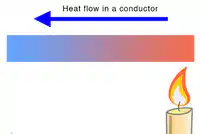
Conduction
The process of energy transfer between materials that are in direct contact with each other.
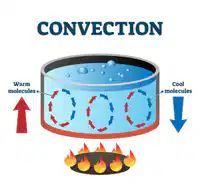
Convection
The movement of thermal energy through a fluid, such as air or water.
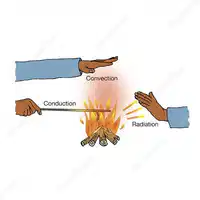
Radiation
The transfer of thermal energy through space by electromagnetic waves.
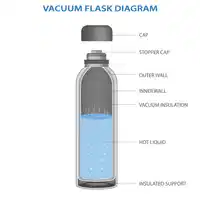
Vacuum
A space that is completely empty of matter, which is an excellent insulator.

Energy Efficiency
The use of less energy to perform the same task or produce the same result.
4
Key Vocabulary

Engineering Design
The process of devising a system, component, or process to meet desired needs.

Criteria
The requirements that a design must meet to be considered successful.

Constraints
The limitations on a design, such as cost, materials, or time.

Renewable Energy
Energy that comes from sources that are naturally replenished, such as solar or wind power.
Nonrenewable Energy
Energy that comes from sources that will eventually run out, such as coal and oil.

5
How Heat Moves: Conduction, Convection, and Radiation
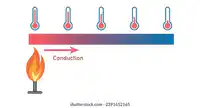
Conduction
Heat transfers through direct physical contact between particles.
Air particles touching the heater get warmed up directly.
Energy is passed from one particle to the next.
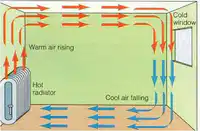
Convection
Warm air near the heater becomes less dense and rises.
The movement of heated air creates a circulating current.
This process helps to distribute warmth throughout a room.

Radiation
Heat is transferred as energy waves traveling through space.
This process can warm objects without any direct contact.
A heater warms you from across the room this way.
6
Multiple Choice
Which method of heat transfer occurs when particles are in direct physical contact with each other?
Conduction
Convection
Radiation
Circulation
7
Multiple Choice
How does the process of convection work to distribute warmth throughout a room?
It creates a circulating current as warm, less dense air rises and cooler air sinks.
It transfers heat through energy waves that travel directly to every corner.
It passes energy directly from one air particle to the next until it reaches the walls.
It causes the air in the room to expand and push heat outwards.
8
Multiple Choice
If you are standing on the other side of a room from a heater, what is the best explanation for how you can feel its warmth?
The air particles that touched the heater travel in a current to warm you.
Heat is transferred through space as energy waves, which warm you without direct contact.
The floor gets hot from the heater and passes the heat directly to your body.
The heater causes all the air particles in the room to vibrate at the same time.
9
Engineering Insulation
Insulation reduces unwanted energy transfer in walls, windows, floors, and ceilings.
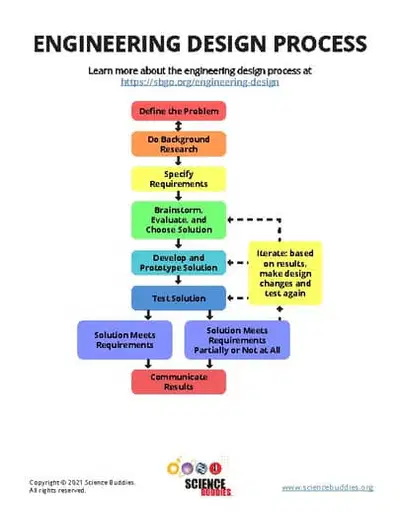
Engineers follow a design process to identify problems and brainstorm solutions.
They then design, build, test, and evaluate the results to improve it.
Design considers criteria (success factors) and constraints (limitations like cost).

10
Multiple Choice
What is the main purpose of insulation?
To reduce unwanted energy transfer.
To make the walls of a building stronger.
To create a new source of energy.
To help engineers brainstorm new ideas.
11
Multiple Choice
How do criteria and constraints guide the engineering design process?
Criteria are the goals for success, while constraints are the limitations.
Constraints are the goals for success, while criteria are the limitations.
Criteria describe the problems, and constraints describe the solutions.
Constraints are the first step in the process, and criteria are the last.
12
Multiple Choice
An engineer is designing insulation for a home in a very cold climate and has a limited budget. How would these factors be classified in the design process?
The need for the insulation to work in a very cold climate is a criterion, and the limited budget is a constraint.
The limited budget is a criterion, and the need for it to work in a cold climate is a constraint.
The cold climate and the limited budget are both considered criteria for the design.
The cold climate and the limited budget are both considered constraints on the design.
13
Insulation in Buildings and Materials
Well-insulated buildings are more energy-efficient, saving on heating and cooling.
This reduces the need for nonrenewable energy sources like coal and oil.
Insulating materials include fiberglass batting, sugarcane fiber, and even recycled denim.
14
Multiple Choice
What is the primary advantage of a well-insulated building?
It is more energy-efficient.
It is less expensive to build.
It can be built more quickly.
It supports more weight.
15
Multiple Choice
What is the relationship between insulating buildings and the use of resources like coal and oil?
It lessens the demand for nonrenewable energy sources.
It creates renewable energy from materials like denim.
It makes heating and cooling systems unnecessary.
It cleans pollution from the air.
16
Multiple Choice
Which statement best explains why improving building insulation is an effective way to conserve the Earth's resources?
Because saving energy reduces the amount of nonrenewable fuels that need to be burned.
Because insulating materials are made from recycled resources.
Because energy-efficient buildings are cheaper to construct.
Because fiberglass and denim are nonrenewable resources.
17
Smart Designs: The Thermos and Double-Paned Windows
Thermos Design
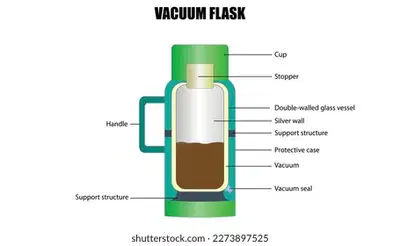
A thermos has two walls to keep liquids at a consistent temperature.
The space between the walls is a vacuum, which contains almost no particles.
This vacuum acts as an excellent insulator, stopping heat transfer through conduction.
Double-Paned Windows
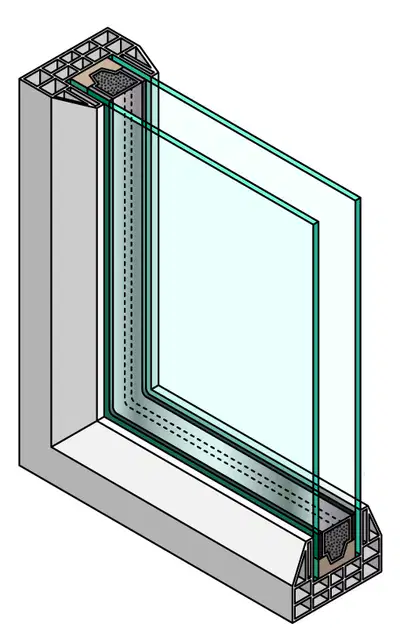
These windows have two layers of glass, much like the walls of a thermos.
The space is filled with a stable gas like argon (Ar) or krypton (Kr).
This gas layer has few particles, reducing heat transfer by conduction.
18
Multiple Choice
What is the main reason both a thermos and double-paned windows have a space between their layers?
To reduce heat transfer through conduction.
To make the objects heavier and more stable.
To store a reserve of gas or air.
To increase the strength of the glass or walls.
19
Multiple Choice
How is the insulating design of a thermos similar to that of a double-paned window?
Both designs use a perfect vacuum to stop heat transfer.
Both designs are filled with a stable gas like argon.
Both designs use a space containing very few particles to act as an insulator.
Both designs rely on having three or more layers of glass.
20
Multiple Choice
If you had two identical double-walled cups, but one was filled with argon gas and the other was filled with regular air, which would be less effective at keeping a drink hot, and why?
The cup with argon gas, because argon is a gas and can't stop heat.
The cup with air between the walls, because air has more particles than argon, allowing for more heat conduction.
Both cups would be equally effective at keeping the drink hot.
Neither cup would be effective without a true vacuum.
21
Common Misconceptions
Misconception | Correction |
|---|---|
Insulation completely stops the flow of heat. | Insulation only slows down heat transfer; it does not stop it. |
A single pane of glass insulates better than a double-paned window. | The trapped gas in a double-paned window is a better insulator. |
Blankets and coats create their own heat to keep you warm. | They trap your body's heat, slowing its transfer to the colder air. |
22
Summary
Heat is transferred through conduction, convection, and radiation.
Insulation slows heat transfer, improving energy efficiency.
The engineering design process is a cycle of testing and improving solutions.
Engineers balance project criteria with constraints.
A vacuum and trapped gases are excellent insulators.
Improving insulation helps conserve nonrenewable energy resources.
23
Poll
On a scale of 1-4, how confident are you about explaining how insulation works?
1
2
3
4
Conduction
Middle School
Show answer
Auto Play
Slide 1 / 23
SLIDE
Similar Resources on Wayground

19 questions
Endo & Exo Reactions Mini-Lesson
Presentation
•
6th - 8th Grade
19 questions
Cell Organelles and Functions Review
Presentation
•
6th - 8th Grade
16 questions
Energy Transformation
Presentation
•
6th - 8th Grade
16 questions
Topographic Maps
Presentation
•
6th - 8th Grade
18 questions
Scientific Method Lesson
Presentation
•
6th - 8th Grade
18 questions
Moon Phases
Presentation
•
6th - 8th Grade
18 questions
Spring and Neap Tides
Presentation
•
6th - 8th Grade
17 questions
Metric Measurements
Presentation
•
6th - 8th Grade
Popular Resources on Wayground
19 questions
Naming Polygons

Quiz
•
3rd Grade
10 questions
Prime Factorization
Quiz
•
6th Grade
20 questions
Math Review
Quiz
•
3rd Grade
15 questions
Fast food
Quiz
•
7th Grade
20 questions
Main Idea and Details
Quiz
•
5th Grade
20 questions
Context Clues
Quiz
•
6th Grade
20 questions
Inferences
Quiz
•
4th Grade
19 questions
Classifying Quadrilaterals
Quiz
•
3rd Grade
Discover more resources for Science
16 questions
Interactions within Ecosystems
Presentation
•
6th - 8th Grade
12 questions
PS.8.1.2, PS.8.1.3, PS.8.1.5 Review
Quiz
•
8th Grade
20 questions
Rocks and The Rock Cycle
Quiz
•
6th Grade
20 questions
Moon Phases and Eclipses
Quiz
•
6th - 8th Grade
16 questions
Photosynthesis and Cellular Respiration Review
Quiz
•
7th Grade
20 questions
Human Body Systems
Quiz
•
6th Grade
22 questions
6th & 8th Grade Science Material SOL Review
Quiz
•
6th - 8th Grade
15 questions
Punnett Squares
Quiz
•
6th Grade