

Deposition

Presentation
•
Science
•
6th - 8th Grade
•
Practice Problem
•
Medium
+4
Standards-aligned

Barbara White
Used 13+ times
FREE Resource
13 Slides • 22 Questions
1

Middle School

2
Explain how weathering, erosion, and deposition are processes that change Earth’s surface.
Describe how deposition helps cycle Earth's materials using energy from the sun.
Identify the properties of calcium carbonate (CaCO3) and its role in limestone formation.
Use uniformitarianism to explain how geologists can study Earth and other planets.


3
Key Vocabulary

Deposition
This is the geological process of dropping sediment by natural forces like wind, water, or ice.

Weathering
Weathering is the natural process that is responsible for the breakdown of rocks into smaller pieces.

Erosion
Erosion is the natural process of moving weathered rock and sediment from one location to another.

Sedimentation
Sedimentation is the natural process of settling or depositing sediment that has been moved by erosion.

Geoscience Process
A geoscience process is any natural process that works to shape the surface of the Earth.

Limestone
Limestone is a type of sedimentary rock that is primarily made from calcium carbonate materials.
4
Key Vocabulary

Calcium Carbonate
A chemical compound with the formula CaCO3, commonly found in natural forms like limestone and shells.

Uniformitarianism
The scientific idea that the same natural laws and processes that operate now have always operated.

Stalactite
An icicle-shaped rock formation that hangs down from the ceiling of a cave, growing over time.

Stalagmite
A type of rock formation that rises from the floor of a cave due to dripping water.
5
Geoscience Processes: Shaping Earth

Weathering
The process that breaks down rocks on the Earth’s surface.
The smaller rock pieces that are created are called sediment.
This can be a physical or a chemical process.

Erosion
The movement of sediment from one place to another location.
The main agents of erosion are water, wind, and ice.
It carries away the weathered rock from its original spot.

Deposition
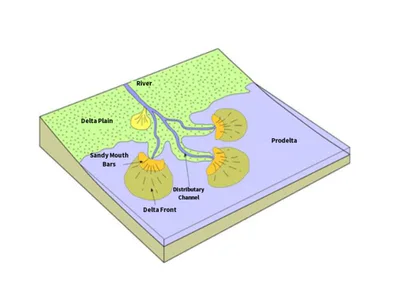
The final step where sediment is dropped in a new place.
This process builds up land over a long period of time.
It is responsible for creating landforms like deltas and beaches.
6
Multiple Choice
Which process is responsible for breaking down rocks on the Earth's surface into smaller pieces called sediment?
Weathering
Erosion
Deposition
Landforms
7
Multiple Choice
How do weathering, erosion, and deposition work together to shape the land?
Weathering breaks down rock, erosion moves the sediment, and deposition drops the sediment in a new location.
Erosion breaks down rock, deposition moves the sediment, and weathering drops the sediment in a new location.
Deposition breaks down rock, weathering moves the sediment, and erosion drops the sediment in a new location.
Erosion creates landforms, weathering moves sediment, and deposition breaks down rock.
8
Multiple Choice
A fast-moving river carrying a large amount of sediment flows into the ocean and slows down. Based on the geological processes described, what is the most likely result?
The river will begin to cause more weathering of the rocks on the plain.
The sediment being carried by the river will be dropped, building up a delta.
The river will start to move faster and pick up more sediment.
The water will turn to ice and carry the sediment away.
9
What is Calcium Carbonate?
Calcium Carbonate, CaCO3, is the chemical name for the common mineral calcite.
It is the primary component of limestone and many marine organism shells.
The mineral fizzes and releases carbon dioxide when it touches a weak acid.
A transparent form called Iceland spar makes objects appear doubled.


10
Multiple Choice
What is calcium carbonate?
The chemical name for the mineral calcite
A type of transparent, doubling crystal
A common ingredient found only in shells
A chemical that is only created when acid is present
11
Multiple Choice
What happens when calcium carbonate reacts with a weak acid?
It fizzes and releases carbon dioxide.
It becomes transparent and doubles images.
It transforms into a marine organism's shell.
It rapidly absorbs the acid.
12
Multiple Choice
A scientist believes a common rock sample is limestone. Which test would best confirm the rock is limestone?
Placing a drop of a weak acid on it to see if it fizzes.
Holding it up to text to see if the words appear doubled.
Checking to see if it is part of a marine animal's shell.
Breaking it open to see if it is the mineral calcite.
13
Limestone: Formation and Varieties
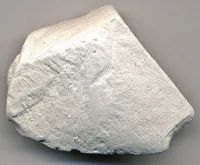
Chalk
It is a powdery and fine-grained type of rock.
This limestone is composed of almost pure calcite.
It is formed from the remains of microscopic algae.

Coquina
This is a unique type of limestone rock.
It is made of cemented fossil bits and shell fragments.
These fragments are deposited by water over a long time.
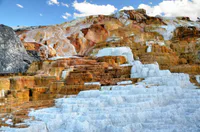
Travertine
It is a hard and very dense calcium carbonate rock.
It is deposited around hot springs from mineral-rich water.
The rock forms when this mineral-rich water evaporates.
14
Multiple Choice
Which type of limestone is composed of cemented fossil bits and shell fragments?
Coquina
Chalk
Travertine
Calcite
15
Multiple Choice
What do the formation processes of chalk and coquina have in common?
They both form from the remains of living organisms.
They both are created by the evaporation of mineral-rich water.
They both are deposited around hot springs.
They both are described as hard and dense rocks.
16
Multiple Choice
A geologist finds a very hard, dense rock layer near the site of an ancient hot spring. Based on this evidence, what is the most likely conclusion about how the rock formed?
It formed from the evaporation of mineral-rich water.
It is composed of the remains of microscopic algae.
It was created by the cementing of shell fragments.
It is a powdery and fine-grained type of rock.
17
Caves and Their Formations
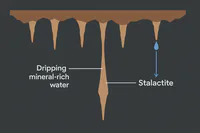
Stalactites
Icicle-shaped spikes of rock that hang down from the ceilings of caves.
They are formed by mineral-rich water that drips and hardens over time.
Remember: Stalactites with a "c" hang from the "ceiling" of the cave.

Stalagmites
Pillar-like structures of rock that build up from the floor of caves.
These are formed by the same water that drips down from the ceiling.
Remember: Stalagmites with a "g" build up from the "ground."

Columns
A column forms when a stalactite and a stalagmite meet and join.
This creates a single, continuous pillar of rock from floor to ceiling.
This entire formation process can take many thousands of years to complete.
18
Multiple Choice
What fundamental process leads to the creation of cave formations like stalactites and stalagmites?
The dripping and hardening of mineral-rich water over time.
The movement of wind and air currents inside the cave.
The slow carving of rock by underground rivers.
The pressure from rocks building up deep underground.
19
Multiple Choice
What is the primary distinction between stalactites and stalagmites?
Stalactites are sharp and pointed, while stalagmites are smooth and rounded.
Stalactites are made of different minerals than stalagmites.
Stalactites hang down from the ceiling, while stalagmites build up from the ground.
Stalactites are formed by water, while stalagmites are formed by ice.
20
Multiple Choice
If a stalactite growing downwards and a stalagmite growing upwards are directly aligned, what is the predicted outcome after thousands of years?
The stalactite will break off and fall to the ground.
They will both stop growing when they get close to each other.
They will eventually meet and fuse together to form a column.
The stalagmite will begin to shrink as the stalactite grows.
21
The Role of Deposition in the Rock Cycle
Deposition is a key step in the rock cycle, recycling Earth’s materials.
Energy from the sun is the main driver of this cycle on the surface.
This energy powers the wind and water cycles, causing erosion and deposition.
Deposited sediment can form sedimentary rock, continuing the cycle over millions of years.


22
Multiple Choice
What is the main role of deposition in the rock cycle?
To recycle Earth’s materials by moving sediment
To create energy that powers the sun
To break down large rocks into smaller pieces
To form new volcanoes on the Earth's surface
23
Multiple Choice
What is the relationship between energy from the sun and the process of deposition?
The sun's energy powers the wind and water cycles that cause deposition.
The sun's energy directly melts rock, which is then deposited.
Deposition of sediment creates the energy that powers the sun.
Deposition only happens in places that do not receive the sun's energy.
24
Multiple Choice
What would be the most likely long-term effect on the rock cycle if the sun's energy no longer powered wind and water?
The formation of new sedimentary rock would greatly decrease.
The rock cycle would begin to speed up.
Earth's materials would be recycled much more quickly.
The sun would find a new source of energy.
25
Using Earth to Understand Mars
Uniformitarianism states that the same geologic processes have always shaped the Earth.
This means we can use the present to understand the planet's past.
Scientists apply this same principle to other planets like Mars.
Martian landforms suggest that water may have once flowed on its surface.

26
Multiple Choice
What is the principle of uniformitarianism?
The idea that the same geologic processes shaping Earth today also shaped it in the past.
The idea that Earth's landforms were created by a single, large event.
The idea that Mars and Earth have identical geologic histories.
The idea that only processes from the past can be used to understand the present.
27
Multiple Choice
How does the principle of uniformitarianism help scientists study a planet's past?
It allows them to use present-day observations to understand the planet's history.
It helps them predict how the planet will look in the distant future.
It proves that all planets in the solar system were formed in the same way.
It explains why Earth has a different atmosphere than Mars.
28
Multiple Choice
Scientists observe landforms on Mars that look like landforms formed by flowing water on Earth. According to the principle of uniformitarianism, what can scientists reasonably conclude?
Processes that create certain landforms on Earth likely created similar landforms on Mars.
The landforms on Mars must have formed by processes unknown on Earth.
Mars must once have hosted life exactly like Earth's.
Earth's geologic processes are now transferring to Mars.
29
The Search for Water on Mars
Early Mariner 9 images suggested that water once flowed on the surface of Mars.
The Pathfinder lander found evidence of ancient floods and rusted rocks on Mars.
In 2008, a lander confirmed water’s presence by digging up frozen ice.
Flowing salty water suggests Mars may have once been able to support life.


30
Multiple Choice
What is the main conclusion from the scientific search for water on Mars?
Evidence that water has been present on the planet.
That Mars has a breathable atmosphere.
That Mars is covered in active volcanoes.
Signs of current, complex life forms.
31
Multiple Choice
How did missions like Mariner 9 and the Pathfinder lander provide evidence for water in Mars's past?
By identifying features that suggested ancient floods and flowing water.
By directly sampling and tasting the liquid water.
By discovering living plants near the planet's poles.
By finding skeletons of ancient Martian animals.
32
Multiple Choice
What is the most significant scientific conclusion drawn from the combined evidence of past floods, rusted rocks, and frozen ice on Mars?
That Mars may have once had the conditions necessary to support life.
That humans can drink the water found on Mars today.
That Mars was once completely covered by a single, large ocean.
That the rocks on Mars are not actually rusted.
33
Misconception | Correction |
|---|---|
Weathering and erosion are the same thing. | Weathering breaks down rock, while erosion moves the resulting pieces. |
All limestone is the same. | Limestone has many varieties, like chalk and coquina, formed by different processes. |
All caves are formed by earthquakes. | Most large caves form slowly from chemical weathering by acidic groundwater. |
Finding water on Mars means liquid oceans. | Mars' water is mostly frozen, with evidence of past or seasonal liquid flows. |
34
Weathering, erosion, and deposition are processes that shape the surface of the Earth.
Deposition of minerals like Calcium Carbonate (CaCO3) forms rocks like limestone.
Caves form from weathering, while features like stalactites form from deposition.
We use uniformitarianism to understand Earth's past and geological evidence on Mars.
35
Poll
On a scale of 1–4, how confident are you about the concepts covered in today's review?
1
2
3
4
Middle School
Show answer
Auto Play
Slide 1 / 35
SLIDE
Similar Resources on Wayground

32 questions
Earth's Spheres
Presentation
•
6th - 8th Grade
30 questions
Earth Spheres and Interactions
Presentation
•
6th - 8th Grade
30 questions
Light and Sound Waves
Presentation
•
6th - 8th Grade
30 questions
Atomic Structure & Theory
Presentation
•
6th - 8th Grade
29 questions
The Layers of the Earth's Atmosphere.
Presentation
•
6th - 8th Grade
26 questions
PHYSICAL AND CHEMICAL CHANGES
Presentation
•
6th - 8th Grade
26 questions
Lab Safety
Presentation
•
6th - 8th Grade
27 questions
The Seasons
Presentation
•
6th - 8th Grade
Popular Resources on Wayground
10 questions
How much do you know about our Portrait of an Eagle?

Quiz
•
10th Grade
10 questions
Fast Food Slogans
Quiz
•
6th - 8th Grade
21 questions
Continents and Oceans
Quiz
•
6th Grade
20 questions
Parts of Speech
Quiz
•
5th Grade
16 questions
Subject & Predicate
Quiz
•
5th Grade
25 questions
Multiplication Facts
Quiz
•
5th Grade
12 questions
Map Skills
Quiz
•
3rd Grade
22 questions
Continents and Oceans
Quiz
•
5th Grade
Discover more resources for Science
17 questions
7.6D Aqueous Solutions
Quiz
•
7th Grade
20 questions
Scientific Method and Variables
Quiz
•
8th Grade
20 questions
Scientific method and variables
Quiz
•
8th Grade
27 questions
Counting Atoms - Subscripts
Quiz
•
8th Grade
10 questions
6.6D - Relative Density Review
Quiz
•
6th Grade
20 questions
Claim, Evidence and Reasoning (CER)
Quiz
•
6th - 8th Grade
18 questions
Counting Atoms
Quiz
•
7th - 8th Grade
20 questions
Density
Quiz
•
6th Grade