

Domains

Presentation
•
Science
•
6th - 8th Grade
•
Practice Problem
•
Medium
+9
Standards-aligned

Barbara White
Used 11+ times
FREE Resource
14 Slides • 25 Questions
1

Domains
Middle School

2
Learning Objectives
Classify organisms into the three domains: Bacteria, Archaea, and Eukarya.
Differentiate between prokaryotic and eukaryotic cells based on having a nucleus.
Describe the characteristics and reproduction methods of the Domain Bacteria.
Identify key characteristics that define the Archaea and Eukarya domains.
Explain the difference between the helpful and harmful roles of bacteria.


3
Key Vocabulary

Domain
Domain is the highest and most general rank in the biological classification system of life.

Prokaryote
A prokaryote is a single-celled organism that does not have a true, membrane-bound nucleus.

Eukaryote
A eukaryote is an organism whose cells contain a true nucleus enclosed within a nuclear membrane.

Nucleus
The nucleus is a large organelle that contains the cell's essential genetic and hereditary information.

Bacteria
Bacteria are a major domain of prokaryotic microorganisms, found almost everywhere on the entire Earth.

Archaea
Archaea are a domain of single-celled prokaryotic organisms that are known to be extremophiles.
4
Key Vocabulary

Eukarya
Domain of complex organisms whose cells contain a membrane-bound nucleus and other organelles.
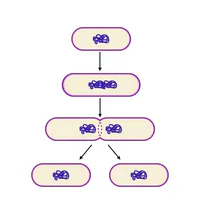
Binary Fission
Simple asexual process where one bacterial cell splits into two identical daughter cells.

Plasmid
Small circular DNA molecule in bacteria that often carries helpful but nonessential genes.

Extremophile
Organism adapted to survive in very hot, acidic, salty, or otherwise extreme environments.

Microbiome
Entire community of microorganisms living on and inside another organism, influencing health and environment.

Antibiotic Resistance
Ability of some bacteria to keep growing even after exposure to antibiotic medicines.
5
Prokaryotes vs. Eukaryotes
Prokaryotes
Prokaryotic cells are simple and do not have a nucleus to hold their genetic material.
These cells are found in the domains Bacteria and Archaea, which are the oldest life forms.
Organisms with these cells are typically single-celled, such as bacteria, and are microscopic in size.

Eukaryotes

Eukaryotic cells are more complex and have a true nucleus that contains the genetic material.
All organisms in the Eukarya domain are composed of one or more eukaryotic cells.
This group includes all plants, animals, fungi, and protists, which can be multicellular or single-celled.
6
Multiple Choice
What is the primary structural difference between prokaryotic and eukaryotic cells?
Eukaryotic cells have a nucleus, while prokaryotic cells do not.
Prokaryotic cells are always multicellular, while eukaryotic cells are not.
Eukaryotic cells are found in bacteria, while prokaryotic cells are in animals.
Prokaryotic cells are more complex than eukaryotic cells.
7
Multiple Choice
Based on their cell structure, why are organisms in the domains Bacteria and Archaea grouped separately from those in the domain Eukarya?
Organisms in Bacteria and Archaea are made of cells that lack a nucleus.
Organisms in the Eukarya domain are always single-celled.
Organisms in Bacteria and Archaea are the most recent life forms to evolve.
Organisms in the Eukarya domain do not have genetic material.
8
Multiple Choice
A scientist discovers a new, single-celled organism. Under a microscope, she sees that its genetic material is enclosed in a nucleus. In which domain does this organism most likely belong?
Eukarya, because it has a nucleus.
Archaea, because it is a single-celled organism.
Bacteria, because it is microscopic in size.
It could be in either Archaea or Bacteria.
9
What are Bacteria?
Bacteria are abundant, single-celled prokaryotes that have existed for 3.5 billion years.
Their cells have no nucleus or other membrane-bound organelles.
A typical cell has a cell wall, membrane, cytoplasm, and genetic material.
Many have flagella for movement and are grouped by their shape.


10
Multiple Choice
Which statement best describes a bacterium?
It is a single-celled organism that lacks a nucleus.
It is a multicellular organism that has a nucleus.
It is an organism that always has flagella for movement.
It is a simple organism that contains many organelles.
11
Multiple Choice
How does the lack of a nucleus affect the internal structure of a bacterial cell?
The genetic material is stored within the cell wall for protection.
The genetic material is contained inside a small, membrane-bound organelle.
The genetic material floats in the cytoplasm because there is no nucleus to contain it.
The genetic material is attached to the flagella to help with movement.
12
Multiple Choice
A scientist discovers a new single-celled organism. It has a cell wall, genetic material, and flagella, but it does not have a nucleus. What is the most logical conclusion about this organism?
The organism is likely a bacterium because it is a single cell with no nucleus.
The organism cannot be a bacterium because it has a cell wall.
The organism is a complex prokaryote because it has flagella.
The organism is an early form of an animal cell because it can move.
13
Domain Bacteria: Reproduction and Habitat
Bacteria primarily reproduce asexually using a process called binary fission.
A bacterium makes a copy of its DNA, then splits into two cells.
Bacteria can exchange bits of DNA called plasmids to gain new traits.
They are found everywhere, even in extreme places like boiling hot springs.


14
Multiple Choice
What is the primary way that bacteria reproduce?
Through a process called binary fission.
By exchanging parts with other cells.
By finding a mate to reproduce with.
By splitting into three or more new cells.
15
Multiple Choice
What is the main function of exchanging plasmids between bacteria?
It allows bacteria to gain new traits.
It is the main way bacteria create offspring.
It causes the bacteria to split into two cells.
It makes all the bacteria genetically identical.
16
Multiple Choice
If a single bacterium lands in a hot spring with plenty of nutrients, what is the most likely outcome?
It would create a large population of bacteria through binary fission.
It would not be able to survive in the extreme temperature.
It would immediately start exchanging plasmids with other bacteria.
It would wait to find another bacterium to reproduce with.
17
Domain Archaea: The Extremophiles
Archaea are single-celled prokaryotic organisms that do not have a nucleus.
They are extremophiles, thriving in harsh environments like hot springs and salt lakes.
Their cell walls and genetic code are very different from those of bacteria.


18
Multiple Choice
What is a defining characteristic of an organism described as an extremophile?
They thrive in harsh environments.
They have a nucleus in their cells.
They have the same genetic code as bacteria.
They are multi-celled organisms.
19
Multiple Choice
How are archaea distinguished from bacteria?
Archaea have very different cell walls and genetic code.
Archaea are multi-celled, while bacteria are single-celled.
Archaea have a nucleus, while bacteria do not.
Archaea live in mild environments, while bacteria live in harsh ones.
20
Multiple Choice
A scientist finds a new single-celled organism that has no nucleus and a genetic code that is very different from bacteria. In which environment was this organism most likely discovered?
A boiling hot spring.
A freshwater pond.
A mild garden soil.
The surface of a human hand.
21
Domain Eukarya: Complex Life
Eukarya includes all organisms whose cells have a nucleus and organelles.
These advanced cells are called eukaryotic cells, and they protect the DNA.
This domain contains all multicellular life like plants, animals, and fungi.
It also includes a diverse group of single-celled organisms called protists.


22
Multiple Choice
What is the main characteristic of organisms in the Domain Eukarya?
Their cells have a nucleus and organelles
They are all multicellular organisms
They are all single-celled organisms
Their cells do not have a nucleus
23
Multiple Choice
What is the primary function of the advanced structures found in eukaryotic cells?
To protect the cell's DNA
To help the cell move around
To allow the cell to get bigger
To absorb sunlight for energy
24
Multiple Choice
Which statement best explains why both a large animal and a microscopic, single-celled protist are classified in the Domain Eukarya?
Both are made of complex cells that have a nucleus.
Both are multicellular and live in the same habitat.
Both get their energy by eating other organisms.
Both are considered to be types of fungi.
25
The Human Microbiome: Helpful vs. Harmful
Helpful Roles
Bacteria in our digestive tract are necessary for the digestion of our food.
They help our bodies make some of the essential vitamins that we need.
Helpful bacteria also protect us by warding off other, more dangerous bacteria.

Harmful Roles

Bacteria can be harmful when they enter the body and cause an infection.
They can cause damage by destroying large numbers of healthy human cells.
Some harmful bacteria release toxins that interfere with normal cell functions.
26
Multiple Choice
What is a primary helpful role of bacteria in the human digestive tract?
They help digest food and make essential vitamins.
They release toxins that stop normal cell functions.
They destroy large numbers of healthy human cells.
They cause infections when they enter the body.
27
Multiple Choice
How can some bacteria be harmful to the human body?
By helping to create essential vitamins.
By protecting the body from dangerous bacteria.
By destroying healthy cells or releasing toxins.
By aiding in the digestion of food.
28
Multiple Choice
If a person's helpful bacteria were destroyed, what is a likely consequence based on the roles described?
The body would produce more of its own vitamins.
The person would be more vulnerable to infections from harmful bacteria.
The body would digest food more efficiently.
Harmful bacteria would also be destroyed.
29
Harmful Bacteria and Disease
Food-Borne Illness
A harmful strain of E. coli, O157:H7, can be deadly if undercooked meat from infected cows is eaten.
Bacteria like Salmonella can be found in raw eggs, causing illness if the eggs are not cooked properly.
Listeria is another type of harmful bacteria that can contaminate foods such as deli meats and soft cheeses.

Other Diseases

Lyme disease is transmitted to humans through the bite of infected black-legged ticks that carry the bacteria.
Tuberculosis is a bacterial infection that attacks the lungs and spreads from person to person through the air.
The plague is a serious bacterial infection that is transmitted by fleas that have fed on infected rodents.

30
Multiple Choice
What is the primary health risk associated with bacteria like E. coli, Tuberculosis, and the plague?
They are only found in undercooked foods.
They can cause a variety of serious diseases.
They are mainly transmitted by insects.
They only affect the human digestive system.
31
Multiple Choice
How does the way people get sick from E. coli and Salmonella differ from the way they get sick from Tuberculosis and Lyme disease?
One group is deadly, while the other only causes minor illness.
One group is found in meat, while the other is found in dairy.
One group is transmitted through food, while the other is transmitted by insects or through the air.
One group affects the lungs, while the other affects the stomach.
32
Multiple Choice
A person goes on a camping trip and is very careful to cook all their food thoroughly. Based on the information provided, which bacterial illness are they still at risk of contracting?
Lyme disease from a tick bite.
E. coli infection from undercooked meat.
Salmonella from raw eggs.
Listeria from soft cheeses.
33
Responding to and Using Bacteria
Antibiotics are medicines that kill harmful bacteria, but some can become resistant.
Resistant bacteria survive antibiotics and reproduce, creating a more resistant population.
Beneficial bacteria decompose dead matter and recycle important nutrients like nitrogen.
Humans use bacteria to make foods, medicines like insulin, and clean oil spills.


34
Multiple Choice
Which statement best summarizes the two main roles of bacteria described?
They are either harmful and killed by antibiotics, or beneficial and used by people and nature.
They are only used to make food and medicine for humans.
They only cause diseases and are always resistant to medicine.
They are only helpful for cleaning up the environment, like oil spills.
35
Multiple Choice
How does the use of antibiotics contribute to the rise of resistant bacteria?
Antibiotics cause mutations that make bacteria stronger.
Antibiotics kill weaker bacteria, leaving resistant ones to survive and reproduce.
Bacteria learn to consume antibiotics as a source of food.
Antibiotics only work against beneficial bacteria, not harmful ones.
36
Multiple Choice
A scientist discovers a new type of bacteria that is very effective at breaking down and consuming oil. What would be a logical and beneficial application for this discovery?
Creating a new type of antibiotic to kill harmful bacteria.
Using the bacteria to help clean up ocean oil spills.
Developing a new kind of food made from bacteria.
Using the bacteria to increase nitrogen in farm soil.
37
Common Misconceptions
Misconception | Correction |
|---|---|
All bacteria are harmful germs. | Most bacteria are harmless or helpful, aiding in digestion and decomposition. |
Archaea are just another type of bacteria. | Archaea are a distinct domain of life with unique genetic properties. |
Antibiotics can cure the common cold. | Antibiotics only treat bacterial infections, not viruses like the common cold. |
Stop taking antibiotics when you feel better. | Complete the full course to prevent creating antibiotic-resistant bacteria. |
38
Summary
Life is classified into three domains: Bacteria, Archaea, and Eukarya.
Prokaryotes like Bacteria and Archaea lack a nucleus, while eukaryotes have one.
Some bacteria are vital for health, but others can cause disease.
Misusing antibiotics leads to the rise of dangerous, antibiotic-resistant bacteria.
39
Poll
On a scale of 1-4, how confident are you about the concepts covered in today's review?
1
2
3
4
Domains
Middle School
Show answer
Auto Play
Slide 1 / 39
SLIDE
Similar Resources on Wayground

33 questions
Lab Equipment
Presentation
•
6th - 8th Grade
31 questions
Classification and Taxonomy
Presentation
•
6th - 9th Grade
34 questions
Evidence for Evolution
Presentation
•
6th - 8th Grade
36 questions
Safety & Lab Equipment
Presentation
•
6th - 8th Grade
37 questions
Thermal Energy
Presentation
•
6th - 8th Grade
37 questions
Physics STAAR Review - Graphing & Calculations
Presentation
•
6th - 8th Grade
33 questions
G6-Plant Classification
Presentation
•
6th - 8th Grade
35 questions
Convection
Presentation
•
6th - 8th Grade
Popular Resources on Wayground
6 questions
PRIDE Always and Everywhere
Presentation
•
12th Grade
20 questions
Lab Safety Quiz

Quiz
•
6th Grade
26 questions
KOR Review Kahoot Questions
Quiz
•
8th Grade
21 questions
Continents and Oceans
Quiz
•
6th Grade
12 questions
Unit Zero lesson 2 cafeteria
Presentation
•
9th - 12th Grade
20 questions
Parts of Speech
Quiz
•
5th Grade
10 questions
Riddles Riddles fun Riddles
Quiz
•
6th - 12th Grade
16 questions
Subject & Predicate
Quiz
•
5th Grade
Discover more resources for Science
20 questions
Lab Safety Quiz
Quiz
•
6th Grade
20 questions
Lab Safety
Quiz
•
5th - 8th Grade
20 questions
Scientific Method and Variables
Quiz
•
8th Grade
20 questions
Scientific method and variables
Quiz
•
8th Grade
27 questions
Counting Atoms - Subscripts
Quiz
•
8th Grade
10 questions
6.6D - Relative Density Review
Quiz
•
6th Grade
10 questions
Scientific Method and Variables
Quiz
•
6th Grade
14 questions
Science Variables
Quiz
•
7th Grade