

Population Size

Presentation
•
Science
•
6th - 8th Grade
•
Practice Problem
•
Medium
+2
Standards-aligned

Barbara White
Used 17+ times
FREE Resource
13 Slides • 22 Questions
1

Population Size
Middle School

2
Learning Objectives
Define limiting factors and explain how they constrain population growth.
Describe how resource availability affects organisms and population size.
Explain the concept of carrying capacity and its relationship with resources.
Analyze data to identify cause and effect relationships between resources and populations.


3
Key Vocabulary
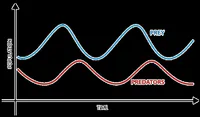
Limiting Factor
A limiting factor is any factor that restricts the size of a population in an ecosystem.
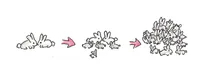
Reproductive Potential
Reproductive potential is the maximum rate at which a population can grow under ideal conditions.
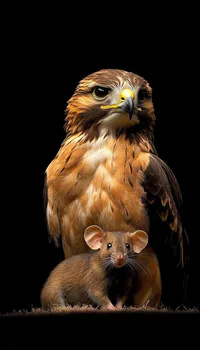
Biotic Factor
A biotic factor is a living component of an ecosystem that can limit a population's growth.
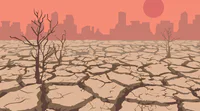
Abiotic Factor
An abiotic factor is a non-living part of an ecosystem that influences population size and growth.
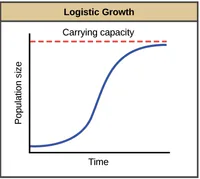
Carrying Capacity
Carrying capacity is the maximum population size that an ecosystem can sustainably support over time.

Competition
Competition is the struggle between organisms for the same limited resources like food, water, or territory.
4
Key Vocabulary

Predation
Predation is a biological interaction where one organism, the predator, hunts and kills another organism for food.
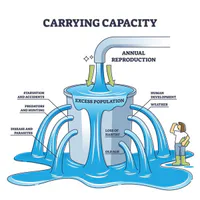
Resource Availability
Resource availability refers to the accessible supply of necessary materials like food, water, and shelter in an ecosystem.
Population
A population is a group of organisms from the same species that live in the same area.
5
Introduction to Limiting Factors
A species’ reproductive potential is the rate the maximum rate at which its population can grow.
However, population growth is controlled by environmental limiting factors.
These factors prevent any single species from taking over an ecosystem.
6
Multiple Choice
What is the primary role of an environmental limiting factor?
To control the growth of a population in an environment
To increase the rate at which a population can grow
To help a single species take over an ecosystem
To measure the reproductive potential of a species
7
Multiple Choice
What is the relationship between a species' reproductive potential and limiting factors?
Limiting factors prevent a species from reaching its full reproductive potential.
Reproductive potential is the cause of environmental limiting factors.
A species with high reproductive potential has no limiting factors.
Limiting factors and reproductive potential work together to increase population size.
8
Multiple Choice
What would be the most likely consequence if all limiting factors for a single species were removed from an ecosystem?
The species' population would grow rapidly, potentially harming the ecosystem's balance.
The species' reproductive potential would permanently decrease.
The population size of all other species would increase.
The ecosystem would remain unchanged.
9
Biotic Limiting Factors
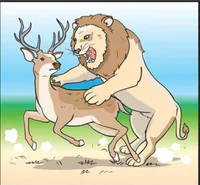
Predation
One organism, the predator, hunts and kills another organism for food.
This interaction helps to control the size of the prey population.
Examples include lions hunting deer and house cats catching birds.

Disease
Microorganisms like bacteria and viruses can cause infectious diseases in populations.
These diseases can reduce the number of individuals in a population.
Disease spreads quickly in dense populations where organisms live close together.
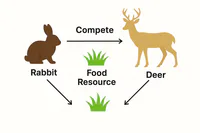
Competition
Organisms compete when they need the same limited resources to survive.
This can be for things like food, water, or a place to live.
This limits population growth and the ability of organisms to reproduce.
10
Multiple Choice
What is the primary role of biotic limiting factors like predation, disease, and competition?
They help organisms find more food.
They limit the size of a population.
They cause organisms to grow larger.
They increase the number of resources available.
11
Multiple Choice
Why does disease spread more quickly in a dense population?
Organisms in dense populations are usually weaker.
Dense populations attract more predators.
There is less food available in dense populations.
Organisms living close together allow diseases to pass easily between them.
12
Multiple Choice
If a new predator is introduced into an environment where it must hunt the same prey as a native predator, what is the most likely outcome?
The prey population will increase because of the new predator.
The populations of both predators will be limited because they hunt the same prey.
Only one of the predator populations will be affected by the other.
The two predator species will learn to share the prey without any negative effects.
13
Abiotic Limiting Factors
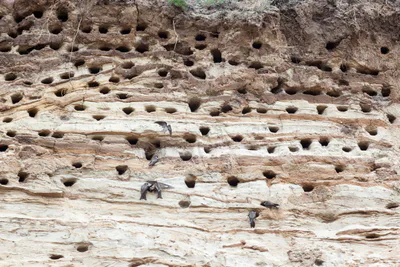
Many organisms require specific physical environments, like sandy cliffs or gravel beds, to reproduce.
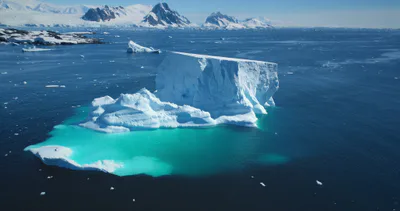
In some regions, winter is a limiting factor due to harsh weather.
To survive, some animals will migrate to warmer regions or become dormant.
Climate change reduces habitats and disrupts the timing of animal migration and mating.
14
Multiple Choice
Which statement best describes an abiotic limiting factor?
It is a physical condition that can restrict an organism's ability to survive or reproduce.
It is the way that different animals in an area interact with each other.
It is a behavior that helps an animal find a mate during any season.
It is the process by which animals change their environment to suit their needs.
15
Multiple Choice
Based on the information, what is the primary reason some animals migrate or become dormant?
To find new types of food.
To avoid predators more easily.
To survive harsh winter weather.
To locate more spacious habitats.
16
Multiple Choice
How could climate change create a problem for an animal that needs a specific physical environment to reproduce?
It can disrupt the timing of migration, which may not align with the availability of a specific habitat needed for mating.
It causes animals to become dormant for longer periods, which helps them survive.
It creates new, sandy cliffs and gravel beds, which increases the rate of reproduction.
It makes the weather less harsh, which removes the need for animals to migrate at all.
17
Resource Availability and Its Effect on Populations
Abundant Resources
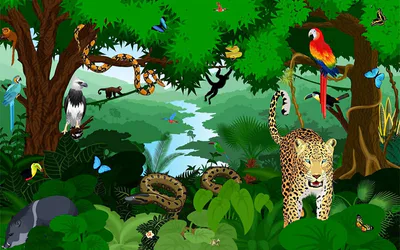
When resources are plentiful, organisms can grow larger and faster, leading to healthier individuals in the population.
Plentiful resources also lead to higher rates of reproduction, meaning more offspring are born and survive.
As a result of these positive effects, the overall size of the population generally increases over time.
Scarce Resources
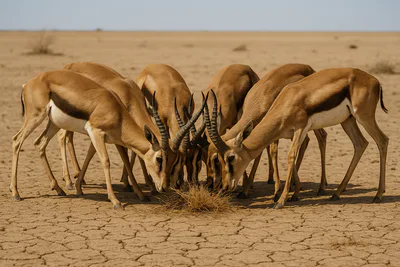
When resources are limited, it leads to increased competition among individuals for food, water, and space.
Individual growth is often stunted, and organisms have lower rates of successful reproduction due to stress.
The overall population size may decline as a result of starvation, stress, and lower birth rates.
18
Multiple Choice
What is the primary factor discussed that directly influences whether a population's size increases or decreases?
The availability of resources in their environment
The number of predators hunting them
The average age of the organisms
The genetic diversity of the population
19
Multiple Choice
What is the relationship between abundant resources and population size?
They cause more competition for food and water.
They allow individuals to be healthier and have more offspring.
They force the population to move to a new area.
They cause the population size to decline over time.
20
Multiple Choice
A population of fish lives in a lake that begins to dry up during a severe drought, reducing the amount of water and food available. What is the most likely outcome for this fish population?
The population will likely decline due to increased competition and lower birth rates.
The individuals will grow larger and stronger to cope with the stress.
The population will experience a higher rate of successful reproduction.
The population size will remain stable and unaffected by the drought.
21
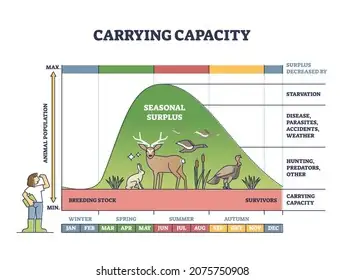
Analyzing Population Data
Scientists analyze data to find how resource availability affects organisms.
They look for cause and effect relationships within the collected data.
Tables and graphs help to organize data and visualize these relationships.
This data analysis allows scientists to predict future population changes.
22
Multiple Choice
What is the main reason scientists analyze population data?
To find cause-and-effect relationships between resources and organisms.
To count every single organism in a habitat.
To create new resources for different organisms.
To change the environment to better suit a population.
23
Multiple Choice
How does organizing population data into tables and graphs help scientists?
They make the relationships between different factors easier to see.
They automatically correct any errors in the collected data.
They increase the number of organisms for scientists to study.
They provide a complete history of every organism in the population.
24
Multiple Choice
By analyzing the relationship between resource availability and population size, what are scientists able to do?
Predict how a population might change if its resources change.
Know the exact size of the population in the distant future.
Create a new ecosystem for the population to live in.
Decide which organisms are the most important in an environment.
25
Carrying Capacity & Primary Production
Carrying Capacity
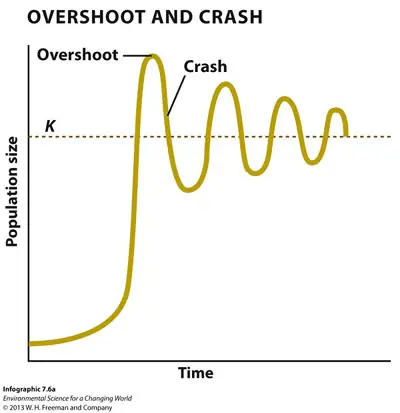
The carrying capacity is the total number of individuals that an ecosystem can sustain indefinitely.
This limit is determined by the amount of energy available, which starts with photosynthetic producers.
If a population exceeds this capacity, it can damage the ecosystem and cause the population to crash.
Primary Production

Carrying capacity depends on primary production—the amount of food made by plants and algae.
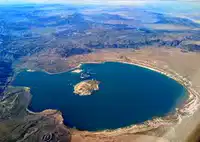
Mono Lake has high primary production from algae, supporting a large and complex food web.
The Great Plains has slower production from grasses, resulting in a different carrying capacity.
26
Multiple Choice
What is the definition of an ecosystem's carrying capacity?
The maximum number of individuals that an ecosystem can support over time.
The total number of different species found in an ecosystem.
The amount of space available for animals to roam in an ecosystem.
The number of predators that live in an ecosystem.
27
Multiple Choice
How does primary production affect an ecosystem's carrying capacity?
The amount of food made by producers determines the energy available.
The number of consumers determines how many producers can grow.
The carrying capacity is determined by the size of the ecosystem, not food.
Primary production and carrying capacity are unrelated concepts.
28
Multiple Choice
What is the most likely consequence if a population grows far beyond its ecosystem's carrying capacity?
The ecosystem will produce more food to support the extra individuals.
The population will continue to grow at an even faster rate.
The population is likely to crash because it has used up its resources.
The individuals will evolve to need fewer resources.
29
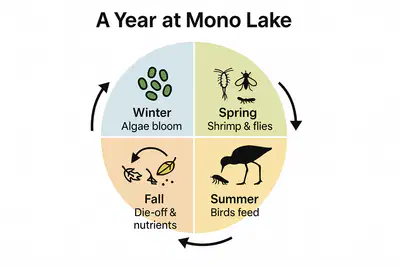
A Year at Mono Lake
Winter conditions are perfect for a massive explosion in the algae population.
In spring, brine shrimp and flies hatch and feast on the algae.
Migrating birds arrive in the summer and prey on the brine shrimp.
In the fall, organisms die off and nutrients are recycled for winter.
30
Multiple Choice
What does the information about the events at Mono Lake primarily describe?
A seasonal cycle of life and nutrients
The migration patterns of birds in California
The specific diet of the brine shrimp
The effects of winter on algae populations
31
Multiple Choice
What is the relationship between algae, brine shrimp, and migrating birds in the Mono Lake ecosystem?
The algae provide food for the shrimp, which are then eaten by the birds.
The birds arrive in the summer to help the algae population grow.
The brine shrimp and the birds compete for the same food source.
The death of organisms in the fall directly feeds the migrating birds.
32
Multiple Choice
Based on the cycle described, what would be the most likely consequence if the decomposition and nutrient recycling in the fall did not happen?
The algae population would be smaller the following winter.
The migrating birds would arrive earlier in the spring.
The brine shrimp population would increase in the fall.
The water in the lake would become much colder.
33
Common Misconceptions
Misconception | Correction |
|---|---|
A population can grow forever. | Populations are limited by factors like resource scarcity and predation. |
Food amount only affects total population size. | Resource availability directly impacts individual organism growth. |
Only living things (biotic factors) limit populations. | Non-living (abiotic) factors like weather also limit populations. |
Competition only happens when animals fight. | Competition is any struggle for limited resources like food or water. |
34
Summary
A population’s size depends on biotic and abiotic factors in its environment.
Resource availability affects organism growth, reproduction, and the entire population.
Carrying capacity is the maximum population an ecosystem's resources can support.
Predation and competition limit population sizes and can be tracked using data.
35
Poll
On a scale of 1-4, how confident are you about the concepts covered in today's review?
1
2
3
4
Population Size
Middle School
Show answer
Auto Play
Slide 1 / 35
SLIDE
Similar Resources on Wayground

33 questions
Electromagnets!
Presentation
•
6th - 8th Grade
32 questions
Properties & Changes of Matter
Presentation
•
6th - 8th Grade
27 questions
Interactions within Ecosystems
Presentation
•
6th - 8th Grade
26 questions
Tides
Presentation
•
6th - 8th Grade
26 questions
States of Matter
Presentation
•
6th - 8th Grade
32 questions
Do you know the difference between the C,E,&R?
Presentation
•
6th - 8th Grade
31 questions
Meteoroids, Meteors, Meteorites
Presentation
•
6th - 8th Grade
25 questions
Animal & Plant Cells
Presentation
•
6th - 8th Grade
Popular Resources on Wayground
15 questions
Grade 3 Simulation Assessment 1

Quiz
•
3rd Grade
22 questions
HCS Grade 4 Simulation Assessment_1 2526sy
Quiz
•
4th Grade
16 questions
Grade 3 Simulation Assessment 2
Quiz
•
3rd Grade
19 questions
HCS Grade 5 Simulation Assessment_1 2526sy
Quiz
•
5th Grade
17 questions
HCS Grade 4 Simulation Assessment_2 2526sy
Quiz
•
4th Grade
20 questions
Equivalent Fractions
Quiz
•
3rd Grade
24 questions
HCS Grade 5 Simulation Assessment_2 2526sy
Quiz
•
5th Grade
20 questions
Math Review
Quiz
•
3rd Grade
Discover more resources for Science
20 questions
8th Grade Science STAAR Review
Quiz
•
8th Grade
16 questions
Interactions within Ecosystems
Presentation
•
6th - 8th Grade
20 questions
Earth Day
Quiz
•
3rd - 12th Grade
20 questions
Rocks and The Rock Cycle
Quiz
•
6th Grade
20 questions
genetics, punnett squares, heredity
Quiz
•
7th Grade
16 questions
Photosynthesis and Cellular Respiration Review
Quiz
•
7th Grade
20 questions
Abiotic & Biotic Factors
Quiz
•
7th Grade
52 questions
iLearn Science Review
Quiz
•
6th Grade