

Ocean Currents

Presentation
•
Science
•
6th Grade
•
Practice Problem
•
Medium
Standards-aligned

Barbara White
Used 100+ times
FREE Resource
9 Slides • 13 Questions
1

Middle School

2
Explain what ocean currents are and how they move energy around the globe.
Describe how latitude and the angle of sunlight affect the temperature of ocean water.
Analyze how the transfer of energy between the ocean and atmosphere influences a location's climate.
Explain how factors like warm and cold currents cause regional differences in climate.


3
Key Vocabulary
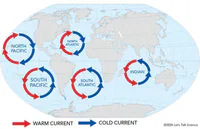
Ocean Current
A continuous, directed movement of ocean water that flows in one of Earth's oceans.

Climate
The long-term pattern of weather in a particular area that is observed over many years.

Energy Transfer
The movement of energy from a warmer object or substance to a much colder one.

Latitude
The measurement of the distance of a specific place north or south of the Earth's equator.

Temperature
A measure of the average kinetic energy of all the particles within a given substance.

Salinity
The specific measure of all the salts that have been dissolved in a body of water.
4
What Are Ocean Currents?
Ocean currents are like huge rivers of water that flow within the oceans.
These currents are always moving, carrying large amounts of water around the globe.
They transport energy, living organisms, and other materials from one place to another.
Continents act as barriers that guide the complex paths these currents take.

5
Multiple Choice
What is the best definition of an ocean current?
A large, moving river of water within the ocean
A temporary wave caused by wind on the surface
The daily rise and fall of sea level along a coast
A storm that forms over tropical waters
6
Multiple Choice
What is a primary function of the continuous movement of ocean currents?
They only move water from the surface to the deep ocean
They help continents move into different positions
They move energy and materials around the world
They cause the tides to rise and fall every day
7
Multiple Choice
Based on the factors that guide ocean currents, what would most likely happen if a current flowing in the open ocean encountered a continent?
The current would stop moving completely
The path of the current would be blocked and redirected
The current would flow over the top of the continent
The continent would have no effect on the current
8
Sunlight, Latitude, and Ocean Temperature
The sun heats the Earth unevenly, causing different temperatures across the planet.
Low latitudes near the equator receive direct sunlight, warming the ocean.
High latitudes near the poles receive sunlight at a shallow angle.
This spreads the sun’s energy out, making the ocean water colder.

9
Multiple Choice
What causes ocean water near the equator to be warm?
The sunlight is more direct and concentrated there.
The ocean is deeper and holds more heat.
The wind blows more warm air to the area.
The sunlight is more spread out and indirect.
10
Multiple Choice
Why is sunlight less effective at heating the ocean near the poles compared to the equator?
The sun's energy is spread out over a much larger area.
The ice at the poles reflects all the sunlight away.
The sun is physically farther away from the poles.
The ocean water at the poles is already frozen solid.
11
Multiple Choice
If a planet had an atmosphere that caused sunlight to strike all parts of its surface at the same steep, direct angle, what would likely be true about its ocean temperatures?
Ocean temperatures would be uniformly warm all over the planet.
The oceans at the poles would still be colder than at the equator.
The oceans would be warmest in the middle latitudes.
The oceans would be frozen solid everywhere.
12
Ocean Currents: Earth's Heating System
Ocean currents carry warm water from the equator toward the poles.
Cold currents move chilly water from the poles back to the equator.
This global circulation is driven by differences in water density.
Colder, saltier water is denser and sinks, while warmer water rises.

13
Multiple Choice
What is the main function of ocean currents as described in the text?
To distribute the sun's heat to different parts of the planet.
To make the ocean water saltier near the poles.
To create powerful waves for surfing.
To help marine animals find food more easily.
14
Multiple Choice
Which statement best describes the relationship between warm and cold ocean currents?
Warm currents move from the equator toward the poles, while cold currents move from the poles toward the equator.
Cold currents move from the equator toward the poles, while warm currents move from the poles toward the equator.
Both warm and cold currents begin near the Earth's equator.
Both warm and cold currents begin near the North and South poles.
15
Multiple Choice
What is the best explanation for why cold currents move from the poles toward the equator?
The sun's heat pushes the cold water away from the poles.
Warm water flowing from the equator leaves empty space for cold water to fill.
Cold water is denser than warm water, causing it to sink and flow.
The rotation of the Earth pushes water from the poles to the equator.
16
Warm Ocean Currents
Warm ocean currents are warmer than the air, so they transfer their heat energy to the air.
This process warms the air, which results in a milder climate for any land that is nearby.
The ocean helps keep coastal climates from getting too hot because it can absorb lots of energy.

Cold Ocean Currents

Cold ocean currents are colder than the air, so energy transfers from the air to the ocean.
This process cools the air above, which leads to a cooler climate on any adjacent coastlines.
This helps to keep the nearby land from getting extremely hot, which moderates the coastal climate.
17
Multiple Choice
What determines the direction that heat energy moves between the ocean and the air?
Energy moves from the warmer area to the cooler area.
Energy moves from the cooler area to the warmer area.
Energy is created by the movement of the currents.
The air and ocean do not exchange any energy.
18
Multiple Choice
What is the relationship between ocean current temperature and the air temperature above it?
A warm current warms the air, and a cold current cools the air.
A warm current cools the air, and a cold current warms the air.
Both warm and cold currents make the air warmer.
Both warm and cold currents make the air cooler.
19
Multiple Choice
Imagine two coastal areas at the same latitude. One is near a warm ocean current, and the other is near a cold ocean current. What would be the most likely difference in their climates?
The coast near the cold current would likely have a cooler climate.
The coast near the warm current would likely have a cooler climate.
Both coastal areas would have the exact same climate.
The climates cannot be predicted based on ocean currents.
20
Misconception | Correction |
|---|---|
Oceans only affect weather right at the coastline. | Ocean currents influence global weather patterns that can extend far inland. |
Ocean water is always warm. | Currents from the poles are very cold, sometimes near freezing. |
The sun heats all parts of the Earth equally. | The sun’s energy is more concentrated at the equator than the poles. |
Ocean currents and tides are the same thing. | Currents are water flow; tides are the rise and fall of sea level. |
21
Ocean currents are like massive rivers that move water and energy around Earth.
A location's latitude determines how much direct sunlight it receives, affecting ocean temperature.
Warm currents carry heat away from the equator, and cold currents bring cooler water.
Ocean currents and the atmosphere interact, influencing the climate of different regions.
22
Poll
On a scale of 1-4, how confident are you about explaining how ocean currents affect climate?
1 (Not confident at all)
2 (A little confident)
3 (Mostly confident)
4 (Very confident)
Middle School
Show answer
Auto Play
Slide 1 / 22
SLIDE
Similar Resources on Wayground

15 questions
Energy Resources
Presentation
•
6th Grade
15 questions
Moon Phases
Presentation
•
6th Grade
15 questions
Solution, Colloid and Suspension
Presentation
•
6th Grade
16 questions
Science
Presentation
•
6th Grade
16 questions
18 Week Checkpoint Review: 6th Grade Science
Presentation
•
6th Grade
18 questions
Hurricane Formation and Impact
Presentation
•
6th Grade
18 questions
Ocean Basin
Presentation
•
6th Grade
16 questions
Gravity Lesson
Presentation
•
6th Grade
Popular Resources on Wayground
10 questions
Safety Day 2026 – Student Review

Quiz
•
9th Grade
21 questions
Continents and Oceans
Quiz
•
6th Grade
20 questions
Parts of Speech
Quiz
•
5th Grade
16 questions
Subject & Predicate
Quiz
•
5th Grade
25 questions
Multiplication Facts
Quiz
•
5th Grade
12 questions
Map Skills
Quiz
•
3rd Grade
22 questions
Continents and Oceans
Quiz
•
5th Grade
15 questions
Rounding Decimals
Quiz
•
5th Grade
Discover more resources for Science
20 questions
Elements, compounds, and mixtures
Quiz
•
6th Grade
10 questions
6.6D - Relative Density Review
Quiz
•
6th Grade
10 questions
Exploring Chemical and Physical Changes

Interactive video
•
6th - 10th Grade
20 questions
CONDUCTION,CONVECTION AND RADIATION
Quiz
•
6th Grade
20 questions
Rocks and The Rock Cycle
Quiz
•
6th Grade
19 questions
Describing and Classifying Matter
Presentation
•
6th Grade
21 questions
Waves and Wave Properties
Quiz
•
6th - 8th Grade
20 questions
Phases of the Moon
Quiz
•
6th Grade