Search Header Logo
FTCE 01, 02, 04 math practice

FTCE 01, 02, 04 math practice

Assessment

Presentation

Mathematics

Professional Development

Easy

CCSS
5.NF.B.4A, 3.NF.A.1, 5.NF.B.4

+52

Standards-aligned

Created by

Ana Rosario

Used 5+ times

FREE Resource

40 Slides • 92 Questions

1

media

2

media

3

media

4

Multiple Select

Which of the following statements demonstrate the property of transitivity?

1

If a > b and b > c, then a > c.

2

If a = b and b = c, then a = c.

3

If a < b and b < c, then a < c.

4

If a + b = c and b + c = d, then a + b + c = d.

5

Multiple Choice

Explain the concept of transitivity and give an example from everyday life where this property is used.

1
Transitivity is the property where if A is related to B and B is related to C, then A is related to C. An example is social relationships: if Alice is friends with Bob, and Bob is friends with Charlie, then Alice is connected to Charlie.
2

Transitivity is the idea that if A is true, then B must be false. An example is social relationships: if Alice is friends with Bob, and Bob is friends with Charlie, then Alice is connected to Charlie.

3

An example of transitivity is a recipe where A and B are ingredients. An example is social relationships: if Alice is friends with Bob, and Bob is friends with Charlie, then Alice is connected to Charlie.

4

Transitivity means A is always equal to B.

An example is social relationships: if Alice is friends with Bob, and Bob is friends with Charlie, then Alice is connected to Charlie.

6

Multiple Choice

Question image

A matches with which property?


Type the NUMBER only of the answer.


Answer choices:

1. Commutative Property

2. Associative Property

3. Identity Property

4. Inverse Property

5. Property of Zero

6. Distributive Property

7. Reflexive Property

8. Symmetric Property

9. Transitive Property

1
5
2

4

3

3

4

2

7

Multiple Choice

Question image

B matches with which property?


Type the NUMBER only of the answer.


Answer choices:

1. Commutative Property

2. Associative Property

3. Identity Property

4. Inverse Property

5. Property of Zero

6. Distributive Property

7. Reflexive Property

8. Symmetric Property

9. Transitive Property

1
2
2

3

3

6

4

7

8

Multiple Choice

Question image

C matches with which property?


Type the NUMBER only of the answer.


Answer choices:

1. Commutative Property

2. Associative Property

3. Identity Property

4. Inverse Property

5. Property of Zero

6. Distributive Property

7. Reflexive Property

8. Symmetric Property

9. Transitive Property

1
7
2

8

3

9

4

6

9

Multiple Choice

Question image

D matches with which property?


Type the NUMBER only of the answer.


Answer choices:

1. Commutative Property

2. Associative Property

3. Identity Property

4. Inverse Property

5. Property of Zero

6. Distributive Property

7. Reflexive Property

8. Symmetric Property

9. Transitive Property

1
6
2

7

3

8

4

9

10

Multiple Choice

Question image

H matches with which property?


Type the NUMBER only of the answer.


Answer choices:

1. Commutative Property

2. Associative Property

3. Identity Property

4. Inverse Property

5. Property of Zero

6. Distributive Property

7. Reflexive Property

8. Symmetric Property

9. Transitive Property

1
9
2

8

3

7

4

6

11

media

12

Multiple Choice

If a tower is 20 m, a tree is 15 m, and a pole is 10 m, then the tallest object is ___.

1
tower
2

tree

3

pole

13

media

14

media

15

media

16

Multiple Choice

Which of the following best describes tiling in geometry?

1

Covering a plane with shapes without gaps or overlaps

2

Arranging shapes randomly on a plane

3

Stacking shapes on top of each other

4

Filling a plane with only circles

17

Multiple Choice

If a student is having problems conceptualizing how to find the area of a shape, why would a teacher assign a titling question for finding the area?

1
A teacher assigns a titling question to help students conceptualize the process of finding the area by focusing their thinking.
2
A teacher assigns a titling question to distract students from the main topic of area.
3
A titling question is used to test students' memorization of formulas for area.
4
A teacher assigns a titling question to confuse students about area calculations.

18

Multiple Choice

If numbers are equal to the same number, then they are equal to each other. If a=b and b=c, then a=c is?

1

Reflexive Property of Equality

2

Transitive Property of Equality

3

Symmetric Property of Equality

4

Addition property of Equality

19

Multiple Choice

Question image
Given the following tile pattern, how many tiles would be in the 5th shape?
1
b = 8
2
b = 11
3
b = 7
4
b = 9

20

Multiple Choice

Question image

Is the pattern below a growing pattern or a repeating pattern?

1

Repeating because it is an A B C pattern.

2

Repeating because it uses the same shapes over and over.

3

Growing because there is a change and it does not repeat.

4

Shrinking because it gets smaller.

21

Multiple Choice

Question image

Are these patterns the same?

1

Yes, they are both repeating. The core of the pattern is AB.

2

Yes, both patterns are decreasing. The rule is subtracting by 1.

3

The patterns are different. Top one is Repeating Core is AB. The bottom one is adding by 1.

4

The patterns are different because one is shapes and the other is fruit.

22

Multiple Choice

Question image

What is the area of the following figure? (just type the number

1
23
2
23 square units
3
23 su

23

media

24

media

25

Multiple Choice

What does the term 'iteration' mean in the context of algorithms?

1

Repeating a process or operation

2

Sorting a list

3

Adding numbers

4

Drawing shapes

26

Multiple Choice

Question image
Find the rule for the table.
1
Add 4
2
Multiply by 2
3
Multiply by 4
4
Divide by 6

27

Multiple Choice

Question image

Hilda is making a repeating pattern with shapes shown in the image. The rule is "Heart, Square, Triangle." If Hilda continues the pattern, what will be the 11th shape?

1

square

2

heart

3

triangle

28

Multiple Choice

Question image

The house numbers on a street follow the rule "Subtract 5". What are the next three house numbers if the first house is 25? Choose the correct house numbers and an accurate feature of the pattern.

1

20, 15, 10- they're all multiples of 5

2

21, 18, 15- they're all multiples of 3

3

30, 35, 40- they're all multiples of 5

4

20, 15, 10- they're all multiples of 10

29

Multiple Choice

Question image

Football players come out of the tunnel and their jerseys have the number pattern shown above:


What rule does the pattern follow

1

Add 3

2

Add 4

3

Add 5

4

Add 6

30

Multiple Choice

In the sequence 3, 7, 11, 15, ___, the next term is _______.

1
19
2

20

3

23

4

27

31

Multiple Choice

Explain how iteration can be used to generate a sequence in an algorithm. Give an example.

1
Creating a sequence by multiplying the previous number by 2.
2
Generating a sequence by randomly selecting numbers from a list.
3
An example of using iteration to generate a sequence is creating the Fibonacci sequence: start with 0 and 1, then repeatedly add the last two numbers to generate the next number.
4
Using recursion to generate a sequence of prime numbers.

32

media

33

Multiple Choice

In the sequence 20, 17, 14, 11, ___, the next term is _______.

1
8
2

9

3

7

34

media

35

Multiple Choice

What is the rule used in the sequence 2, 6, 18, 54, ...?

1

Add 4

2

Multiply by 3

3

Subtract 2

4

Divide by 2

36

Multiple Choice

Which type of assessment is used to identify students' strengths and weaknesses before instruction begins?

1

Summative Assessment

2

Formative Assessment

3

Diagnostic Assessment

4

Performance-Based Assessment

37

media

38

media

39

Multiple Choice

What does 'subitizing' refer to?

1

Counting objects one by one

2

Instantly recognizing the number of objects in a small group without counting

3

Estimating large quantities

4

Adding numbers quickly

40

Multiple Choice

Max is 183 cm tall. Ruby is 169 cm tall. How much taller is Max than Ruby?
1
12 cm
2
16cm
3
14 cm
4
18cm

41

Multiple Choice

The bakery has 381 chocolate cupcakes and 346 vanilla cupcakes. How many total cupcakes does the bakery have?
1
727 cupcakes
2
725 cupcakes
3
720 cupcakes
4
729 cupcakes

42

Multiple Choice

The bakery has 381 chocolate cupcakes and 346 vanilla cupcakes. How many more chocolate cupcakes are at the bakery?
1
25 cupcakes
2
45 cupcakes
3
35 cupcakes
4
36 cupcakes

43

media

44

Multiple Choice

Name the type of assessment utilized by an exit ticket.
1
Formative
2
Summative
3
Traditional 
4
Authentic

45

Multiple Choice

What type of assessment is a 3D model?
1
formative
2
summative
3
traditional
4
authentic

46

Multiple Choice

Name the type of assessment utilized by a unit test.
1
Formative
2
Summative

47

Multiple Choice

Which of the following best describes iteration in mathematics?

1

Repeating a process or operation

2

Covering a plane with shapes

3

Instantly recognizing the number of objects

4

Evaluating at the end of a unit

48

Multiple Choice

Name the type of assessment utilized by a performance rehearsal.
1
Formative
2
Summative

49

Multiple Choice

Name the type of assessment utilized by a final project
1
formative
2
summative

50

media

51

Multiple Select

Which of the following are included in the operations focused on in Competency 01?

1

Fractions

2

Decimals

3

Integers

4

Percentages

52

media

53

media

54

Multiple Choice

Which of the following is NOT a rational number?

1

3/4

2

0.25

3

π

4

2

55

Multiple Choice

Numbers such as 1, 2, and 3 are called ___ numbers.

1
natural
2

rational

3

integers

4

non-Integers

56

Multiple Choice

what would we call these numbers, -2, -1, 0, 1, 2

1
Rational numbers
2
Natural numbers
3
Whole numbers
4
Integers

57

Multiple Choice

What would we call these group of numbers, 0.5, 1/2, Pi?

1

integers

2

Non-Integers

3

Natural Numbers

4

Rational numbers

58

Multiple Choice

What would we call these group of positive whole numbers- 1, 2, 3, 4...

1

Non-Integers

2
Rational numbers
3
Natural numbers
4
Integers

59

media

60

Multiple Choice

Which model represents fractions as parts of a divided area, such as 3/4 as 3 of 4 equal rectangle parts?

1

Linear Model

2

Set Model

3

Area Model

4

Decimal Model

61

Multiple Choice

Explain how you could use compensation to solve a subtraction problem more easily. Give an example.

1
23
2
10
3
30
4
15

62

Multiple Choice

Question image

Which problem does the model represent?

1

15×26\frac{1}{5}\times\frac{2}{6}

2

13×25\frac{1}{3}\times\frac{2}{5}

3

25×15\frac{2}{5}\times\frac{1}{5}

4

25×25\frac{2}{5}\times\frac{2}{5}

63

Multiple Choice

Question image

Linear Model: What is the value of the shaded region?

1

55

2

52\frac{5}{2}

3

5 125\ \frac{1}{2}

4

1111

5

6

64

Multiple Choice

Question image

What is the fraction of cups shaded in?

1

1/3

2

2/6

3

4/5

4

3/6

65

Multiple Choice

Fraction of Stickers
In a pack of 4 stickers, 3/4 are glittery. How many stickers are glittery?

1
3
2
2
3
4
4
1

66

Multiple Choice

Fraction of Cookies
A plate has 8 cookies, and 1/2 are chocolate chip. How many cookies are chocolate chip?

1
6
2
4
3
8
4
2

67

Multiple Choice

Question image

Linear Model: Use the model to answer the division problem:

3 34÷34=?3\ \frac{3}{4}\div\frac{3}{4}=?

1

55

2

33

3

34\frac{3}{4}

4

44

68

Multiple Choice

Question image

Linear Model: Choose the equation that matches this tape model.

1

23÷5=\frac{2}{3}\div5=

2

5÷23=5\div\frac{2}{3}=

3

5 14÷23=5\ \frac{1}{4}\div\frac{2}{3}=

4

8÷23=8\div\frac{2}{3}=

69

Multiple Choice

Question image

Area Model: What decimal is represented by the shaded part model?

1
0.07
2
0.7
3
7.5
4
0.75

70

Multiple Choice

Nahom has $0.07. What fraction of a dollar is this?

1

7/100

2

7/10

3

70/100

4

100/7

71

Multiple Choice

Which fraction is the same as 0.05

1

1/5

2

1/50

3

5/100

4

5/10

72

Multiple Choice

Question image

Area Model: How much of the grid is shaded

1

0.40

2

0.38

3

3.8

4

4.0

73

Multiple Choice

Which model represents the answer 615\frac{6}{15}  ?

1
2
3
4

74

Multiple Choice

Question image

Set Model: What multiplication problem is represented by the model above?

1

5 x 5

2

1/5 x 5

3

4/5 x 1/5

75

Operations with fractions

76

Multiple Choice

Which model correctly shows the problem 26×15\frac{2}{6}\times\frac{1}{5}  ?

1
2
3
4

77

Multiple Choice

Question image

Which problem does the model represent?

1

45×36\frac{4}{5}\times\frac{3}{6}

2

36×45\frac{3}{6}\times\frac{4}{5}

3

45×56\frac{4}{5}\times\frac{5}{6}

4

34×46\frac{3}{4}\times\frac{4}{6}

78

Multiple Choice

Which model represents the answer 12\frac{1}{2}  ?

1
2
3
4

79

Multiple Select

Select TWO models that represent the problem 35×14\frac{3}{5}\times\frac{1}{4}  

1
2
3
4

80

Multiple Choice

Select a model that represents the answer 412\frac{4}{12}  

1
2
3
4

81

Multiple Choice

Question image

Which problem does this model represent?

1

12×13\frac{1}{2}\times\frac{1}{3}

2

68×12\frac{6}{8}\times\frac{1}{2}

3

68×13\frac{6}{8}\times\frac{1}{3}

4

48×12\frac{4}{8}\times\frac{1}{2}

82

Multiple Choice

Question image

Which problem does the model represent?

1

35×13\frac{3}{5}\times\frac{1}{3}

2

35×15\frac{3}{5}\times\frac{1}{5}

3

15×12\frac{1}{5}\times\frac{1}{2}

4

13×15\frac{1}{3}\times\frac{1}{5}

83

Multiple Choice

Question image

What multiplication problem is represented by the model above?

1

2 x 3

2

1/3 x 2

3

1/2 x 3

84

Multiple Choice

Question image

What multiplication problem is represented by the model above?

1

4/3 x 3

2

2/4 x 3

3

1/3 x 4

85

Multiple Choice

Question image

What multiplication problem is represented by the model above?

1

2/5 x 3

2

3/5 x 2

3

3 x 1/5

86

Multiple Choice

Question image

What multiplication problem is represented by the model above?

1

1/9 x 6

2

2/6 x 9

3

2/9 x 6

87

Multiple Choice

Question image

What multiplication problem is represented by the model above?

1

1/3 x 2

2

2/3 x 3

3

2/3 x 1

88

Multiple Choice

Question image

What multiplication problem is represented by the model above?

1

3/10 x 4

2

1/10 x 3

3

12/10 x 4

89

Multiple Choice

Question image

What multiplication problem is represented by the model above?

1

4/7 x 7

2

3/7 x 3

3

4/7 x 6

90

Multiple Choice

Question image

What multiplication problem is represented by the model above?

1

1/6 x 6

2

5/6 x 2

3

5/6 x 5

91

Multiple Choice

Question image

What multiplication problem is represented by the model above?

1

7/12 x 3

2

5/12 x 7

3

3/12 x 5

92

media

93

Multiple Choice

The sum of 7/8 and 1/4 is approximately what in fraction and decimal?

1
5/8 and 0.625
2
1 and 1.0
3
9/8 and 1.125
4
3/4 and 0.75

94

Multiple Choice

Which mental math strategy can be used to solve 48 ÷ 6?

1

Use related multiplication

2

Estimate using benchmarks

3

Round to the nearest ten

4

Use a number line

95

media

96

Multiple Choice

What mental math strategies could i used to solve a word problem involving both fractions and decimals?

1
Use only multiplication for all calculations
2
Convert fractions to decimals or vice versa, use estimation, and apply basic operations.
3
Ignore the fractions and decimals entirely
4
Rely solely on a calculator without any mental math

97

media

98

Multiple Choice

A bank account has -25 dollars. After a $40 deposit and $15 withdrawal, what is the balance?

1

$0

2

$30

3

-$10

4

$15

99

media

100

Multiple Choice

Lynn is simplifying the expression  

58+9÷325\cdot8+9\div3^2   . Which steps below best represent how she should simplify this expression? 

1
2
3
4

101

Multiple Choice

(10) (18) ÷3\left(-10\right)\ -\left(-18\right)\ \div3  Solve.


1
-4
2

-3

3

-5

4

-4

102

Multiple Choice

68÷2+376-8\div2+3\cdot7  

When simplifying the following, using order of operations, which operation should be performed first?

1

646-4  

2

8÷28\div2  

3

2+32+3  

4

373\cdot7  

103

Multiple Choice

-8 + (15 - 3) ÷ 4 is equivalent to:

1

-5

2

1

3

-11

4

11

104

Multiple Choice

What are the steps to solve the following expression?

50 − 16 ÷ 2 (12 + 4)

1

parentheses

multiplication

subtraction

division

2

parentheses

multiplication

division

subtraction

3

parentheses

division

multiplication

subtraction

4

parentheses

subtraction

multiplication

division

105

Multiple Choice

62+(14)÷ 2 – (8)6^2+\left(-14\right)÷\ 2\ –\ (-8)  

1

7

2

19

3

13

4

37

106

Multiple Choice

7(5+3)4(92)\frac{7\left(5+3\right)}{4\left(9-2\right)}  

1

0.5

2

98

3

32

4

2

107

media

108

media

109

Multiple Select

Which of the following are equivalent values?

1

-3/2 and -1.5

2

5/4 and 1.25

3

2/3 and 0.75

4

3/4 and 0.5

110

media

111

Multiple Choice

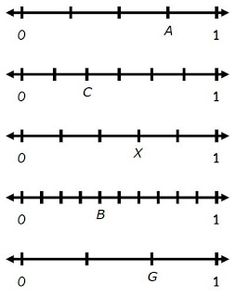
Question image
What is the fraction at point A on the number line?
1
3/3
2
2/3
3
3/4
4
4/3

112

Multiple Choice

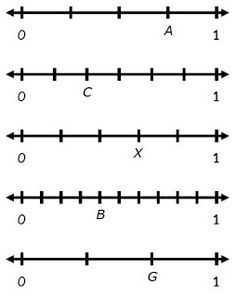
Question image
What is the fraction at point C on the number line?
1
2/6
2
2/5
3
2/4
4
6/2

113

Multiple Choice

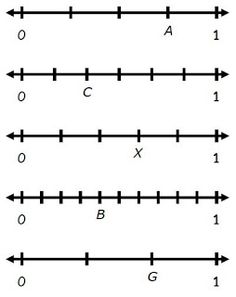
Question image
What is the fraction at point B on the number line?
1
4/6
2
4/10
3
4/9
4
3/10

114

media

115

Multiple Choice

Write an Equation.
Joella makes $12.75 per hour. This is $2.50 more than her younger sister makes per hour. How much does Joella's sister make per hour?
1
x + 2.50 = 12.75
2
2.50x = 12.75
3
x - 2.50 = 12.75
4
x/2.50 = 12.75

116

Multiple Choice

Write an Equation.
Gold costs $1,654 per ounce. How many ounces are needed to be worth $16,540?
1
1,654x = 16,540
2
x/1,654 = 16,540
3
x - 1,654 = 16,540
4
x + 1,654 = 16,540

117

Multiple Choice

Jacob collects hats. He has 6 hats already and collects 2 more hats each week. How many week would it take Jacob to collect 32 hats?

1

13 weeks

2

12 weeks

3

14 weeks

4

11 week

118

media

119

media

120

media

121

media

122

media

123

media

124

media

125

media

126

media

127

media

128

media

129

media

130

Open Ended

Reflecting on the content overview, which competency do you feel most confident about, and which one would you like to learn more about?

131

Multiple Choice

Which of the following topics is NOT covered in the FTCE Mathematics Subtest according to the content overview?

1

Operations with fractions, decimals, and integers

2

Solving linear equations and identifying patterns

3

Properties of 2D/3D shapes and coordinate geometry

4

Advanced calculus and trigonometry

132

media
media

Show answer

Auto Play

Slide 1 / 132

SLIDE