

Health Skills Grade 12 Term 2 Chapter 7

Presentation
•
Other
•
12th Grade
•
Practice Problem
•
Easy

Kylie Masur
Used 29+ times
FREE Resource
90 Slides • 33 Questions
1
Health Skills Grade 12 Term 2 Chapter 7
Healthy and Responsible Adolescent Relationships

2
Lesson 7.1
Building Healthy Adolescent Realtionships
3
Relationships
What do you think of the following statements?
It is important to have friendships in our lives
Healthy relationships make us feel like there is always someone to talk to
4
Poll
Do you think that having many relationships is important, or a few very strong relationships is important?
Many relationships with many people
A few quality relationships
5
Open Ended
Why do you feel the way that you do? Either that having many relationships is very important or a few quality relationships?
6

7
What is self-worth?
Having a sense of self-worth means that you value yourself, and having a sense of self-value means that you are worthy.
Self-worth is defined by Merriam-Webster as: “a feeling that you are a good person who deserves to be treated with respect
8
Poll
Do you think you have self-worth
Yes
No
9

10

11
Open Ended
Why do you think being a member of a group of friends is important for well-being and health?
12
Differences Among Relationships
Adolescence can be a challenging time in a young person’s life. You are developing physically, intellectually and emotionally. Your social world is expanding, your friends are becoming increasingly important and many of you will enter a wide range of new relationships outside the family through school, peers and through membership of groups linked to your interests, sport or hobbies.
13
Differences Among Relationships
Relationships are different. Some relationships are formal, and others are closer and more familiar. Relationships meet different adolescent’s needs. For example, family and friends relationships, meet adolescent emotional needs. Whilst, their relationships with teachers are based on their need to learn.
14
Differences Among Relationships
Another factor that makes different relationships unique is the role adolescent plays. A role is a part you play when you interact with others in any relationship. Within one day, you may play different roles with different people. You might be a son or a daughter at home, a friend when you are hanging out with your friends, a student at school, an employee in your future job, or a husband or a wife in future marriage.
The responsibilities that come with a role may change over time. New roles and responsibilities might be taken by adolescents as they get older.
15
Multiple Choice
Ali and his father have very different economical views. However, they accept their differences and do not try to change each other’s opinions.
Which quality of healthy relationships does this action shows?
Acceptance
Mutual Respect
Supportive
Trust
16
Open Ended
Pretend your friend was absent from this class and she/he asks you to explain the lesson. What would you tell her about what you learned in this lesson?
17
Lesson 7.2
Effective Communication Skills
18

19

20
Poll
Do you feel like you treat others the way you would like to be treated?
No
Yes
Sometimes I feel I treat them better than I am treated
Sometimes I feel I treat them worse than I am treated
21

22

23

24
Poll
Do you think that giving and receiving equally is an important aspect of friendships and relationships?
Yes
No
25

26
Open Ended
Has there ever been a time in a relationship when you did not feel safe? Why did this make feel this way? Are you still friends with the person who made you feel unsafe? Have they changed their behaviour?
27

28

29

30

31
Poll
Do you think you are passive (don't express your views), aggressive (overly forceful or pushy about your views), or assertive (strong minded but respectful about expressing your views)?
Passive
Aggressive
Assertive
32
Open Ended
Case Study
Mariam’s friend Hala is the kind of person who always wants to have her own way. When they go out together, Hala decides where they’ll go and what they’ll do. If Mariam offers a suggestion, Hala refuses it. Mariam wants to stay friends with Hala, but she is tired of being pushed around. She wishes she knew how to stand up for herself without being rude.
1. Identify the style of communication each person reflects
Typer your answer like this:
Hala:
Mariam:
33
Ways to communicate
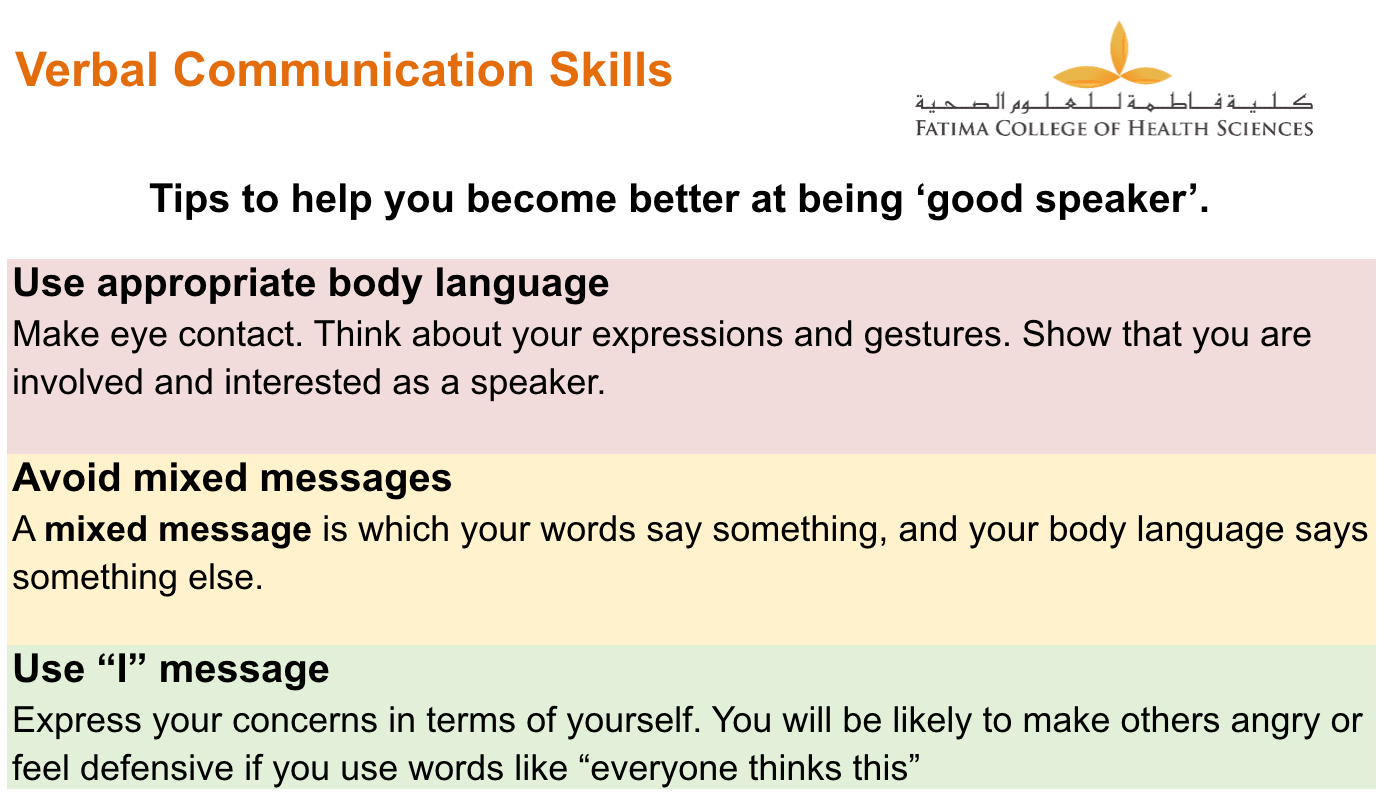
You communicate with others either verbally or nonverbally.
When you talk on the phone or write a message you only use your own words. This is called verbal communication. When communicating in person people can see you, so your body language. people can receive your messages through your expressions and gestures. This known as nonverbal communication.
34

35

36
37

38
Multiple Choice
Select the most appropriate answer demonstrating "I" message
You're always making me upset
You always say mean things that hurt me
I feel very sad when hurtful things are said to me
It makes me so mad when you say rude things and you always do!
39
Open Ended
Your friend borrows your favorite book and returns it torn and scribbled on, without saying anything about it. When you flip through the book and find some pages missing, you are angry.
How will you handle this using "I" messaging?
40

41

42

43
Poll
Based on your knowledge of good listening skills, do you believe you are a good listener?
Yes
No
44

45
Open Ended
Write an e-mail to a teacher explaining why you didn't do your homework.
46

47

48
Multiple Choice
You ask a classmate if they can help you with a project. They cross their arms, roll their eyes, but don't say anything. Have they communicated with you?
No, at this stage it is one way communication
No, but they are rude
Sort of, you won't really know until she answers though
Yes, she has demonstrated non-verbal communication
49

50

51

52
Open Ended
Which strategy do you think is most important to maintaining healthy relationships and why?
- Separating emotions from reality.
- Continue to appreciate and respect each other.
- Say what you feel is true.
- Do not give up your principles.
- Stay friends even when things become difficult.
- Act independently to improve any relationship.
53
Lesson 7.3
Developing Healthy Adolescent-Family Relationships
54
Open Ended
What is a family?
55

56

57
Open Ended
How does your family look? When I think of family, I think mine looked like this when I was younger; my mom, dad, brother and sister, but my family has grown over the years and now includes my brother-in-law, my brothers girlfriend, and my fiancé. So how does yours look in your opinion?
58

59
Open Ended
What does your nuclear family look like now?
60

61

62

63

64
Poll
What family do you most relate to?
Nuclear (mom, dad, siblings in your house)
Extended (grandparents, aunts, uncles, live in your house)
Blended (through divorce you have new siblings and live with that family)
Single Parent (one parent/divorce/widow)
Foster (not your birth parents)
65

66

67

68

69
ACTIVITY BREAK
Go to TEAMS and complete the assignment "Young Adult-Family Relationships Health Chart"
You have 10 minutes
70

71

72

73

74
Open Ended
What qualities do you think build a strong family?
75

76

77
Open Ended
How does quality time affect family relationships?
78
Open Ended
In your opinion, what are some issues that can cause problems in families?
79

80

81

82

83

84
Lesson 7.4
Friendship during Adolescence
85
Open Ended
What are three qualities you think a good friend should have?
86

87

88

89

90

91
Open Ended
Which of the aforementioned qualities do you think are the most important and why?
92

93

94

95

96

97

98

99

100

101

102
Poll
Have you ever felt positive peer pressure?
Yes
No
103

104

105

106

107
Poll
Have you ever felt negative peer pressure?
Yes
No
108
Open Ended
‘Peer pressure is defined as the social pressure from members of your group to accept certain beliefs or act in certain ways in order to be accepted’.
Please give an example of peer pressure.
109
Open Ended
Write a statement that summarizes your view on positive and negative peer pressure.
110
Open Ended
‘Refusal skills can help deal with negative peer pressure’.
a) Have you ever had to say no to a friend if he pressured you to participate in an unsafe activity?
b. How would you say no?
c. What happened to the relationship?
111

112

113

114

115

116

117
Open Ended
Your friend is telling you to skip your university lecture to go to lunch. She is saying it's no big deal and that you understand everything anways. How do you tell your friend no?
118

119

120

121
Open Ended
Why do you think that sometimes it might be better to end a friendship, for both people involved?
122

123

Health Skills Grade 12 Term 2 Chapter 7
Healthy and Responsible Adolescent Relationships
Show answer
Auto Play
Slide 1 / 123
SLIDE
Similar Resources on Wayground

118 questions
Unit 3 HSCCC Presentation
Presentation
•
12th Grade
120 questions
Q4W1-Pagbása at Pagsusuri
Presentation
•
11th Grade
116 questions
F6 E4 Unit 4.2 Manufacturing Industry ZDR
Presentation
•
12th Grade
121 questions
Why Big Data Matters?
Presentation
•
University
112 questions
unit 6 level 2 2024
Presentation
•
University
122 questions
Repaso Final Español
Presentation
•
University
123 questions
Writing Foundation 1
Presentation
•
University
113 questions
110-2-2 高頻單字複習 Unit(06)-Unit(10) 01
Presentation
•
10th - 12th Grade
Popular Resources on Wayground
10 questions
Safety Day 2026 – Student Review

Quiz
•
9th Grade
21 questions
Continents and Oceans
Quiz
•
6th Grade
20 questions
Parts of Speech
Quiz
•
5th Grade
16 questions
Subject & Predicate
Quiz
•
5th Grade
25 questions
Multiplication Facts
Quiz
•
5th Grade
12 questions
Map Skills
Quiz
•
3rd Grade
22 questions
Continents and Oceans
Quiz
•
5th Grade
15 questions
Rounding Decimals
Quiz
•
5th Grade
Discover more resources for Other
26 questions
SLIME!!!!!
Quiz
•
KG - 12th Grade
21 questions
Los paises hispanohablantes y sus capitales
Quiz
•
12th Grade
20 questions
Cell Transport
Quiz
•
9th - 12th Grade
20 questions
Budgeting
Quiz
•
9th - 12th Grade
20 questions
Investing
Quiz
•
9th - 12th Grade
8 questions
DNA vs. RNA
Presentation
•
9th - 12th Grade
12 questions
Identify Rigid Transformations
Quiz
•
8th - 12th Grade
10 questions
Complementary, Supplementary, Vertical, and Linear Pairs
Quiz
•
9th - 12th Grade