

Chapter 1 The First Americans Whole Chapter

Presentation
•
History
•
7th Grade
•
Practice Problem
•
Medium

Anna Rogers
Used 8+ times
FREE Resource
37 Slides • 24 Questions
1

2

3

4
Multiple Choice
What was Beringia, and why was it important in the migration of early Americans?
A land bridge between Asia and North America that allowed migration
A large mountain range in Asia
A river that separated North and South America
An ancient city in Alaska
5

6

7
Multiple Select
Which of the following animals did early Native Americans hunt when they first arrived from Asia?
Saber-toothed tigers
Woolly mammoths
Mastodons
Horses
8

9
Fill in the Blanks
A single
Type answer...
10

11

12
Fill in the Blanks
Scientists use
Type answer...
13

14
Multiple Choice
Which of the following was NOT a result of farming allowing people to settle and spend time on activities other than finding food?
Built permanent shelters of clay, brick, stone, or wood
Made pottery and cloth decorated with dyes
Developed more complex forms of governments
Invented the wheel for transportation
15

16

17
Multiple Select
Which of the following civilizations were among the largest and most advanced early American civilizations?
Olmec
Maya
Aztec
Inuit
18

19
Fill in the Blanks
The Maya built their civilization in the steamy rain forests of present-day
Type answer...
20

21

22
Fill in the Blanks
The Mayans used their knowledge of astronomy to develop a
Type answer...
23

24
Multiple Choice
Which of the following goods did Mayan traders NOT transport by water?
Jade statues
Turquoise jewelry
Cacao beans
Pottery
25

26

27
Multiple Choice
After the fall of the Maya, what sign did the Aztec see that led them to choose their new home?
A rainbow over a mountain
An eagle sitting on a cactus with a snake in its beak
A jaguar crossing a river
A temple on a hill
28

29
Multiple Select
Which of the following statements about Tenochtitlan is/are correct?
It was built on an island in Lake Texcoco.
It was the largest city in the Americas at its height.
It was known for its outdoor marketplaces.
It was abandoned before the arrival of the Spanish.
30

31
Fill in the Blanks
The Aztec believed that human sacrifices were necessary to keep the gods
Type answer...
32

33

34
Multiple Choice
Which of the following statements best describes the extent of the Inca Empire under Pachacuti and his son Topa Inca?
It stretched more than 3,000 miles from present-day Colombia to northern Argentina and Chile.
It was limited to the city of Cuzco and its surroundings.
It covered only the highlands of Peru.
It included only the coastal regions of South America.
35

36
Open Ended
Explain how the Inca were able to communicate across their vast empire and maintain control over distant regions.
37

38
Fill in the Blanks
All Incan land belonged to the
Type answer...
39
Multiple Select
Which of the following were important features of life in the Incan Empire?
Use of quipus for record keeping
Official language was Quechua
All land belonged to the emperor
Practice of democracy
40

41

42
Open Ended
How did the Hohokam adapt to their environment in the dry, hot desert of present-day Arizona?
43
Multiple Choice
Which of the following best describes the Anasazi civilization?
They lived in the forests of the Pacific Northwest and relied on salmon fishing for survival.
They were nomadic hunters who built teepees across the Great Plains.
They lived in the Four Corners region and built large stone dwellings like Pueblo Bonito, connected by complex road systems.
They formed the Iroquois League to prevent wars between their five nations.
44
45
Multiple Choice
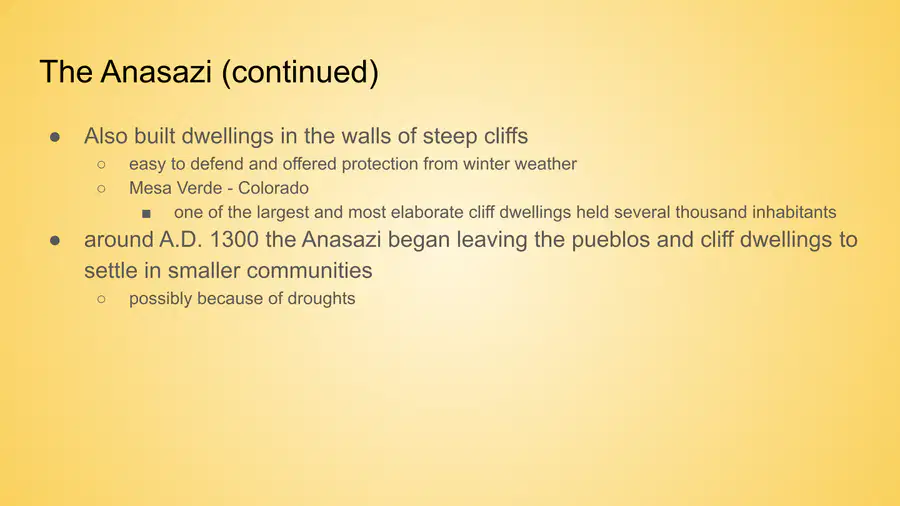
What is one reason the Anasazi began leaving their pueblos and cliff dwellings around A.D. 1300?
Droughts
Invasion by the Spanish
Earthquakes
Flooding
46

47

48

49
Multiple Choice
Which of the following statements best describes Cahokia?
It was a small village built by the Ancestral Puebloans in the southwestern United States.
It was a large Mississippian settlement in Illinois known for its pyramid-shaped Monks Mound topped with a temple.
It was a desert trading center built by the Aztecs near present-day Mexico City.
It was a ceremonial site created by the Iroquois in the northeastern United States.
50

51

52
Multiple Choice
Which of the following accurately describes the lifestyles of the Native American Peoples of the West?
The Tlingit and Haida were nomadic desert dwellers who relied on buffalo for survival.
The Nez Perce and Yakima built large stone cities and farmed the Great Plains.
The Pomo of California’s central valley gathered acorns to make flour, while the Ute and Shoshone of the Great Basin lived in temporary shelters made from branches and reeds.
All Native peoples of the West lived in permanent wooden houses and survived mainly by farming corn and beans.
53

54

55

56

57
Multiple Choice
What was a key feature of the Iroquois and other Eastern Woodland peoples?
They lived in desert regions and built cliff dwellings for protection.
They formed complex political systems, such as the Iroquois League, to govern and reduce conflict among their nations.
They relied solely on fishing and lived in small, isolated communities.
They were nomadic hunters with no formal laws or alliances.
58

59
Open Ended
What questions do you still have about the journey of the first Americans or the history of Native Americans?
60

61
Multiple Choice
What is one theory about how the first Americans arrived in North and South America?
They sailed from Europe
They crossed a land bridge called Beringia
They were always there
They came from Atlantis
Show answer
Auto Play
Slide 1 / 61
SLIDE
Similar Resources on Wayground

55 questions
XSEL 2.0 Mathematics Subject Orientation
Presentation
•
7th Grade
54 questions
Texas History
Presentation
•
7th Grade
53 questions
Intro to Probability
Presentation
•
7th Grade
57 questions
PRESENT SIMPLE AFFIRMATIVE
Presentation
•
7th Grade
57 questions
7.Science.U02.L3-5.Heat Transfer
Presentation
•
7th Grade
55 questions
Speed
Presentation
•
7th Grade
58 questions
Rome
Presentation
•
6th - 8th Grade
56 questions
Characteristics of the Election Process
Presentation
•
7th Grade
Popular Resources on Wayground
10 questions
Safety Day 2026 – Student Review

Quiz
•
9th Grade
21 questions
Continents and Oceans
Quiz
•
6th Grade
20 questions
Parts of Speech
Quiz
•
5th Grade
16 questions
Subject & Predicate
Quiz
•
5th Grade
25 questions
Multiplication Facts
Quiz
•
5th Grade
12 questions
Map Skills
Quiz
•
3rd Grade
22 questions
Continents and Oceans
Quiz
•
5th Grade
15 questions
Rounding Decimals
Quiz
•
5th Grade
Discover more resources for History
25 questions
The American Revolution
Quiz
•
7th - 10th Grade
30 questions
Foundations of Gov. Test Review
Quiz
•
7th Grade
15 questions
Ancient Rome
Quiz
•
7th - 10th Grade
16 questions
Students of Civics Unit 2: The Constitution
Quiz
•
7th - 11th Grade
14 questions
Lawmaking (CE.2b)
Quiz
•
7th Grade
10 questions
Exploring the 7 Principles of the Constitution

Interactive video
•
6th - 10th Grade
10 questions
Significance of the Declaration of Independence
Interactive video
•
6th - 10th Grade
20 questions
Quiz on Spanish and Mexican Colonization
Quiz
•
7th Grade