

MS-LS1-4: Animal and Plant Reproduction

Presentation
•
Science
•
6th Grade
•
Practice Problem
•
Medium
+2
Standards-aligned

Barbara White
Used 62+ times
FREE Resource
10 Slides • 16 Questions
1

Animal and Plant Reproduction
Middle School

2
Explain how special plant parts increase the chances of successful plant reproduction.
Describe how certain animal actions increase the chances of successful animal reproduction.
Analyze how animal behaviors like pollination directly help plants to reproduce.
Use evidence to support that these are adaptations for reproduction.


3
Key Vocabulary
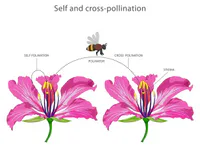
Pollination
The delivery of pollen to a flower's stigma, which is a crucial first step in reproduction.
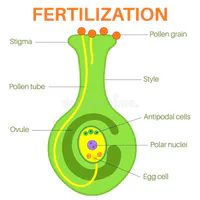
Fertilization
The process where male and female reproductive cells join to form a zygote, initiating new life.
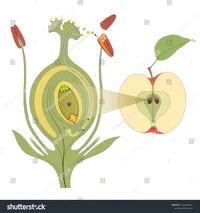
Ovary
The part of a flower that contains the ovules and develops into the fruit after fertilization.

Seed Dispersal
The natural process of transporting seeds away from the parent plant to find new areas to grow.
Adaptation
A special trait or feature that helps an organism survive and successfully reproduce in its environment.
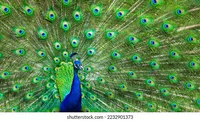
Courtship Behavior
Special actions or displays animals perform in order to attract a suitable mate for breeding successfully.
4
How Flowering Plants Reproduce
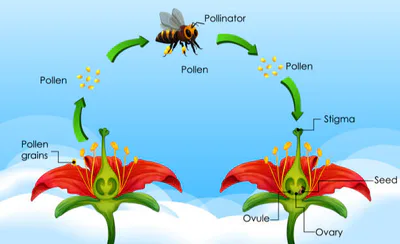
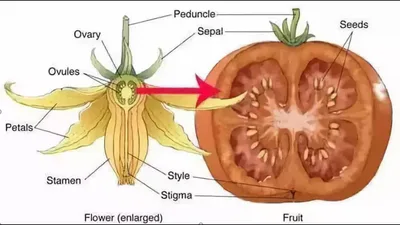
Flowering plants reproduce sexually through a process called pollination.
Pollen travels from the anther to the stigma, then to the ovary.
Inside the ovary, a sperm cell from pollen fertilizes an egg cell.
The fertilized ovule becomes a seed, and the ovary grows into a fruit.
5
Multiple Choice
What is the function of pollination in a flowering plant?
To allow the plant to reproduce sexually
To help the plant absorb water from the soil
To enable the plant to convert sunlight into energy
To provide structural support for the plant's stem
6
Multiple Choice
Which statement best describes what occurs during fertilization in a flowering plant?
Pollen is captured by the stigma and travels to the ovary.
A sperm cell fertilizes an egg cell, leading to a seed.
The ovary grows larger and develops into a fruit.
The plant produces nectar to attract pollinators.
7
Multiple Choice
If pollen successfully travels from the anther to the stigma but cannot reach the ovary, what is the most likely outcome?
A seed and fruit would not be produced.
The flower would produce more pollen.
The plant's leaves would wilt.
The flower's petals would change color.
8
Specialized Plant Structures for Reproduction
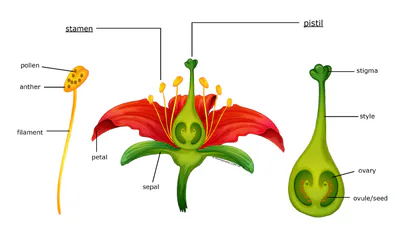
Plants have special structures that help them successfully reproduce.
Brightly colored flowers are visual signals that attract animal pollinators.
Flower nectar and odors act as rewards and attractants for pollinators.
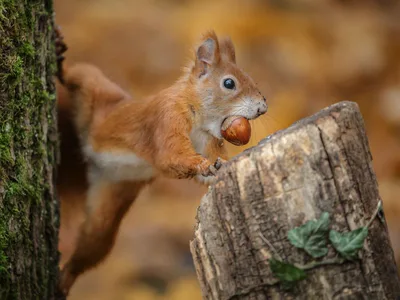
Hard shells on nuts protect the seed and encourage animal dispersal.
9
Multiple Choice
What is the primary purpose of specialized plant structures like brightly colored flowers and hard-shelled nuts?
To help them successfully reproduce
To provide food for all animals
To protect the plant from harsh weather
To help the plant absorb sunlight
10
Multiple Choice
How do features like brightly colored flowers, nectar, and odors help a plant to reproduce?
By scaring away animals that might eat the plant
By attracting animal pollinators
By creating food for the plant to consume
By protecting the plant from disease
11
Multiple Choice
If a plant produces a nut with a very hard shell, what is the most likely way this structure helps the plant reproduce?
Insects will be attracted to the hard shell for pollination.
The hard shell will absorb water to help the seed sprout quickly.
An animal will carry the nut to a new place, allowing the seed inside to grow.
The flower's bright colors will help the nut get noticed and eaten.
12
Seed Dispersal Strategies

Wind and Water
Seeds with wing-like structures, like dandelions, are carried away by the wind.
Light seeds like these can travel very long distances on the wind.
Buoyant seeds, like coconuts, float on water to find new places.
Animal Dispersal: Food
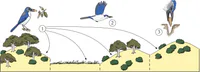
Animals eat fruits and the hard seeds inside pass through their bodies.
The seeds are then deposited in a new location in their droppings.
Squirrels bury nuts, often forgetting where they hid them, allowing them to grow.

Animal Dispersal: Hitching
Some seeds have tiny hooks or barbs that attach to animal fur.
These seeds get a free ride, or "hitchhike," on a passing animal.
They fall off later in a completely new place to start growing.
13
Multiple Choice
What is the primary goal of seed dispersal?
To move seeds away from the parent plant to a new place to grow.
To make sure the seeds get enough sunlight to start growing.
To provide a source of food for the plant that produced them.
To protect the seeds from being eaten by animals.
14
Multiple Choice
How do physical structures like wings, buoyancy, and hooks help with seed dispersal?
They allow seeds to be carried by natural forces like wind and water or to attach to animals.
They provide all the nutrients the new plant will need to grow.
They change color to attract different types of animals to the seed.
They help the seed to burrow deep into the soil once it lands.
15
Multiple Choice
Imagine a remote island with frequent strong winds and many types of birds, but no land mammals like squirrels. Which seed would be most likely to successfully colonize the entire island?
A lightweight seed with wing-like structures.
A large, heavy nut that is buried for later.
A seed with sharp barbs designed to hook onto fur.
A seed contained within a fruit that is eaten by animals.
16
Animal Behaviors for Reproduction

Courtship Displays
Animals use vocal calls or visual signals to attract a potential mate.
For example, a peacock will show off its very colorful plumage.
These special displays show good health and fitness for successful breeding.

Nest Building
Many birds build nests to create a safe place for their eggs.
Nests help to keep the eggs and young birds warm and insulated.
They also protect the young from predators, helping them to survive.

Herding and Grouping
Some animals live together in large groups or herds for safety.
They work together to defend their young from dangerous predators.
This increases the chances that young will survive to become adults.
17
Multiple Choice
What is the primary purpose of animal behaviors such as courtship displays, nest building, and herding?
To ensure their young can survive and have offspring.
To find new territories with more food and water.
To establish a social hierarchy within a group.
To protect themselves from changes in the weather.
18
Multiple Choice
How do behaviors like building a nest or living in a group help young animals?
They provide safety from predators and insulation from the cold.
They help animals locate the best sources of food.
They allow animals to attract mates with colorful displays.
They teach young animals how to perform vocal calls.
19
Multiple Choice
If a male animal wants to attract a mate to produce healthy young, which strategy would be the most effective way to show his fitness?
A bright courtship display, because it signals good health for breeding.
A large herd, because it helps defend against predators.
A well-insulated nest, because it keeps eggs warm.
A loud vocal call, because it can be heard from far away.
20
Mimicry
Some plants trick insects by looking like something desirable, such as another insect or a source of food.
For instance, certain orchid species have evolved to resemble and smell like female wasps to attract male wasps.
A male wasp attempts to mate with the flower, gets covered in pollen, and carries it to another orchid.

Entrapment

Some plants temporarily trap insects to ensure they are thoroughly coated with pollen before they can depart.
The carrion flower emits an odor like rotting meat to attract flies, which are its primary pollinators.
When a fly enters the flower, it is briefly held inside, ensuring it is coated with pollen before escaping.
21
Multiple Choice
What is the main goal of advanced pollination strategies like mimicry and entrapment?
To ensure pollen is transferred between plants for reproduction
To provide a reliable source of food for insects
To defend the plant against harmful pests
To change the color of the flower to attract birds
22
Multiple Choice
How can the pollination strategy of mimicry be distinguished from the strategy of entrapment?
Mimicry involves tricking an insect's senses, while entrapment involves physically holding an insect.
Mimicry always uses smells, while entrapment always uses visual traps.
Mimicry is for attracting mates, while entrapment is for finding food.
Mimicry only works on wasps, while entrapment only works on flies.
23
Multiple Choice
A carrion flower attracts flies using an odor of rotting meat. What would be the most likely outcome if the flower produced a sweet, sugary scent instead?
The flower would be less likely to be pollinated.
The flower would attract a greater number of flies.
The flower would need to develop a different color.
The flower would successfully trap a new type of insect.
24
Misconception | Correction |
|---|---|
Foods like tomatoes and cucumbers are vegetables. | They are fruits because they develop from the flower’s ovary and contain seeds. |
Flowers are pretty and smell nice for humans. | Their traits are adaptations to attract specific animal pollinators for reproduction. |
An adaptation guarantees success for a plant. | Adaptations only increase the probability of success, which is never certain. |
25
Successful reproduction is not guaranteed; it is a matter of probability.
Plants and animals have special structures and behaviors to increase reproductive success.
Many plants depend on animal behaviors for pollination and seed dispersal.
These specialized traits are adaptations that improve the chance of reproduction.
26
Poll
On a scale of 1-4, how confident are you that you can explain how a plant's structure or an animal's behavior can affect its chances of reproducing?
1
2
3
4
Animal and Plant Reproduction
Middle School
Show answer
Auto Play
Slide 1 / 26
SLIDE
Similar Resources on Wayground

20 questions
Integumentary System
Presentation
•
6th Grade
21 questions
Respiratory System
Presentation
•
6th Grade
19 questions
Photosynthesis
Presentation
•
6th Grade
19 questions
Food Web and Energy Pyramids
Presentation
•
6th Grade
20 questions
8.1 Rocks, MInerals, and Soil
Presentation
•
6th Grade
18 questions
Cell Theory Lesson
Presentation
•
6th Grade
19 questions
Newton's Laws of Motion
Presentation
•
6th Grade
17 questions
The Solar System!
Presentation
•
6th Grade
Popular Resources on Wayground
10 questions
How much do you know about our Portrait of an Eagle?

Quiz
•
10th Grade
10 questions
Fast Food Slogans
Quiz
•
6th - 8th Grade
21 questions
Continents and Oceans
Quiz
•
6th Grade
20 questions
Parts of Speech
Quiz
•
5th Grade
16 questions
Subject & Predicate
Quiz
•
5th Grade
25 questions
Multiplication Facts
Quiz
•
5th Grade
12 questions
Map Skills
Quiz
•
3rd Grade
22 questions
Continents and Oceans
Quiz
•
5th Grade
Discover more resources for Science
10 questions
6.6D - Relative Density Review
Quiz
•
6th Grade
20 questions
Claim, Evidence and Reasoning (CER)
Quiz
•
6th - 8th Grade
20 questions
Density
Quiz
•
6th Grade
10 questions
Exploring Chemical and Physical Changes

Interactive video
•
6th - 10th Grade
20 questions
Food Chains & Food Webs
Quiz
•
5th - 7th Grade
18 questions
Interpreting Distance/Time Graphs
Quiz
•
6th Grade
10 questions
Decoding the Periodic Table of Elements
Interactive video
•
6th - 10th Grade
15 questions
Potential and Kinetic Energy
Quiz
•
6th Grade