Search Header Logo
Community Ecology Review

Community Ecology Review

Assessment

Presentation

Science

9th Grade

Medium

NGSS
MS-LS2-4, MS-LS2-1, HS-LS2-6

+5

Standards-aligned

Created by

Heather Glazebrook

Used 1+ times

FREE Resource

6 Slides • 40 Questions

1

​Community Ecology Review

By Heather Glazebrook

2

media

3

Match

Match the levels of Ecology to their description

An individual living thing.

A group of individuals of the same species living in the same area at the same time.

All the different populations that live together in one area.

All living (biotic) and non-living (abiotic) components of an area and their interactions.

Large regions with similar climates, plants, and animals.

Organism

Population

Community

Ecosystem

Biome

4

media

5

media

6

Multiple Choice

Which of the following is a biotic factor that would affect the carrying capacity of a population?

1

Soil

2

Predator

3

Rainfall

4

Sunlight

7

Multiple Choice

Question image

Which statement best describes the predator-prey relationship displayed on this graph?

1

There is no relationship between the predator and prey.

2

When the prey population increases, the predator population decreases.

3

When the prey population increases, the predator population increases.

4

when the predator population increases, the prey population increases.

8

Multiple Choice

What is carrying capacity?

1

A condition that occurs when two or more organisms compete for the same resources within an ecological community

2

A relationship in which two organisms are mutually dependent on each other for survivial

3

All the biotic and abiotic factors and the interactions among them in a given area

4

The maximum number of organisms an ecosystem can support

9

Multiple Choice

A condition that occurs when two or more organisms compete for the same resources within an ecological community

1

Interdependent Relationship

2

Carrying Capacity

3

Competition

4

Ecosystem

10

Multiple Choice

Which statement best describes the term limiting factors?

1

All the biotic and abiotic factors and the interactions among them in a given area

2

A finite resource organisms in an ecosystem require

3

The biotic and abiotic factors in an ecosystem

4

The maximum number of organisms an ecosystem can support

11

Multiple Select

Question image

The graph pictured here shows:

1

Rapid Growth

2

Exponential Growth

3

Linear Growth

4

Logistic Growth

12

Multiple Choice

Competition begins when a population reaches its carrying capacity.

1

True

2

False

13

Multiple Choice

Carrying capacity is the amount of individuals in a population that an ecosystem can hold __________ competition.

1

with

2

without

14

Multiple Choice

Question image

What is the carrying capacity of the population approximately?

1

150

2

200

3

250

4

300

15

Multiple Choice

Question image

During which year did the population reach its carrying capacity?

1

1

2

2

3

3

4

4

16

Multiple Choice

Question image

What is the carrying capacity of the population?

1

20

2

40

3

60

4

80

17

Multiple Choice

Which is NOT an example of a limiting factor.
1
Climate
2
Available Food & Water
3
Available Space & Shelter
4
Species color

18

Multiple Choice

Food, water, shelter, and space are resources that are __________.

1

limiting factors

2

wet

3

messy

4

found in rocks

19

Multiple Choice

If the population of a certain predator increases, there is often _______ its prey
1
a decrease the population of
2
an increase of the population of 
3
great news for its prey of
4
no  impact found on

20

Multiple Choice

If there is more food than usual in an ecosystem, then...
1
Populations will stay the same
2
Populations will decrease
3
Populations will increase

21

Multiple Choice

Any thing or organism that regulates the size of a population of another organism is known as __________.
1
a limiting measure
2
a limiting factor
3
factorization
4
materialization of precipitation

22

media

23

Multiple Choice

A species form that supports an entire ecosystem.

1

Keystone Species

2

Herbivores

3

Umbrella Species

4

Predators

24

Multiple Choice

Why are bees considered a keystone species?

1

The honey they make supports the bear population

2

They pollinate flowers that produce fruit which supports the ecosystem

3

They sting when threatened

4

They live in hives

25

Multiple Choice

Why are some sharks considered a keystone species?

1

Because they are a top predator

2

They scare off smaller fish that may overgraze an area of sea grass

3

They are tertiary consumers

4

They are cartilaginous

26

Multiple Choice

Question image

A species that plays a critical role in the health, maintenance, growth, or definition of an ecosystem.

1

keystone

2

invasive

3

engineer

4

predator

27

Multiple Choice

Question image
Based on the graph shown, how can you tell sea otters are a keystone species?
1
as the sea otter population decreases, biodiversity increases
2
as sea otter population increases, biodiversity increases
3
changes in the sea otter population have little effect on biodiversity 
4
the sea otter population dereases due to the presence of urchins

28

media

29

Multiple Choice

Question image

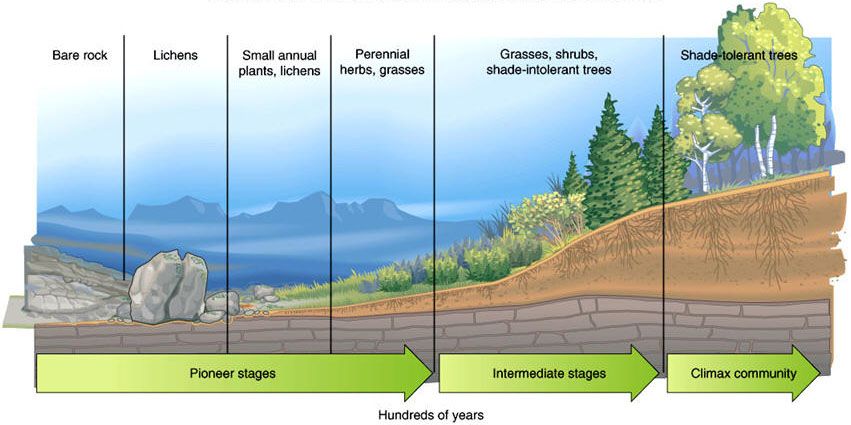
The picture display which type of succession?

1

primary

2

secondary

3

tertiary

4

all of the above

30

Multiple Choice

Question image

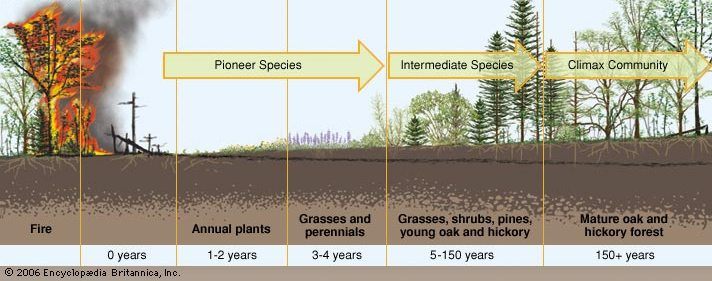
The picture displays which type of succession?

1

primary

2

secondary

3

tertiary

4

all of the above

31

Multiple Choice

Question image

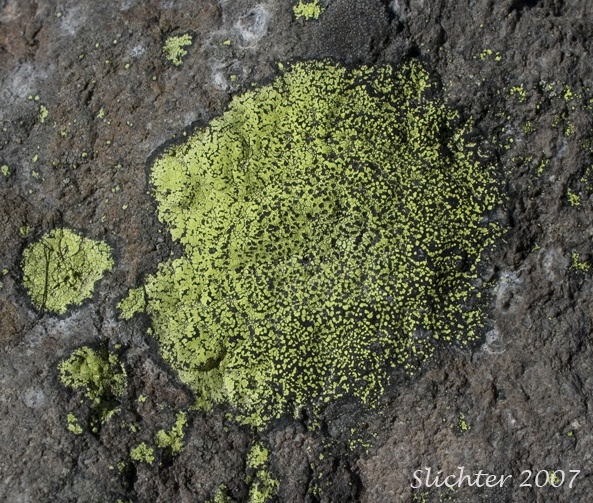
What is the name given to lichen/algae during primary succession?

1

pioneer species

2

volunteer species

3

founder species

4

conqueror species

32

Multiple Choice

After a volcanic eruption, volcanic rock is present (but no soil). Which of the following states the most likely order of succession that would be seen?

1

Lichens → Shrubs → Grasses → Trees

2

Lichens → tree → shrubs→Grasses

3

Grasses → Lichens → Shrubs → Trees

4

Lichens → Grasses → Shrubs → Trees

33

Multiple Choice

Natural disasters such as flooding,forest fires, and tornadoes are associated with which type of succession?

1

primary

2

secondary

3

Gordito

4

ecosystem

34

Multiple Choice

Question image

Why does primary succession typically occur over a longer period of time (as compared to secondary succession)?

1

Because trees do not perform respiration

2

Because the climax community is usually a forest.

3

Because primary succession already has soil

4

Because primary succession does not begin with soil being present

35

Multiple Choice

What is an example of an area that is likely to undergo primary succession?

1

Glaciers melt and leave exposed rock

2

Plants die from drought and decompose

3

Land is bulldozed and soil remains

4

A forest fire occurs

36

Multiple Choice

An increase in biodiversity or a progression over time -after a natural or man made disturbance - is called what?

1

ecological recession

2

climax recession

3

ecological succession

4

climax succession

37

Multiple Choice

The final stage of ecological succession can typically be observed when evidence of a _____________________ is present.

1

Mature Tree Growth

2

Climax Community

3

Pioneer Community

4

housing community

38

Multiple Choice

What are the pioneer species for secondary succession?

1

Trees and shrubs

2

Mosses and lichens

3

Grasses and weeds

4

Fruits and Vegtables

39

Multiple Choice

What type of succession occurs in an area that once had plants and animals, then there was a disturbance (like a forest fire) and now only has soil?

1

Primary

2

Secondary

3

Tertiary

4

Quaternary

40

Multiple Choice

What type of succession occurs in an area that has no soil, for example a lava flow.

1

Primary

2

Secondary

3

Tertiary

4

Quaternary

41

Multiple Choice

What is the definition of resilience?

1

The ability to avoid challenges

2

The ability to recover quickly from difficulties

3

The ability to predict the future

4

The ability to control others

42

Multiple Choice

Explain the concept of ecological resilience.

1

The ability of an ecosystem to easily succumb to disturbances and lose its essential functions and structure.

2

The ability of an ecosystem to resist disturbances but not recover from them, leading to a permanent loss of essential functions and structure.

3

The ability of an ecosystem to resist and recover from disturbances while maintaining its essential functions and structure.

4

The ability of an ecosystem to adapt to disturbances by completely changing its functions and structure.

43

Multiple Choice

How can ecological resilience be enhanced in ecosystems?

1

By ignoring habitat degradation and implementing unsustainable management practices

2

By increasing human impact and exploiting natural resources

3

By reducing human impact, promoting biodiversity, restoring degraded habitats, and implementing sustainable management practices.

4

By introducing non-native species and reducing biodiversity

44

Multiple Choice

Biodiversity, aka biological diversity, usually refers to

1

the same species in a general location

2

the number of different species in a given area

3

the number of animal species in a given area

4

the number of plant species in a given area

45

Multiple Choice

Great Biodiversity = Great Sustainability

1

True

2

False

46

Multiple Choice

Question image

Why is "A" less biodiverse than "B"?

1

Image "A" is more biodiverse.

2

Image "A" has many corn plants and this makes it have high "rich" biodiversity.

3

Image "A" has a lot more plants than image "B"

4

Even though "A" has a lot of corn plants they are all the same species and makes this a low "poor" biodiverse area.

​Community Ecology Review

By Heather Glazebrook

Show answer

Auto Play

Slide 1 / 46

SLIDE