
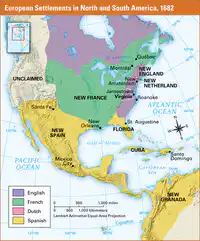
EUROPEAN COLONIZATION IN AMERICA (DL)

Presentation
•
Social Studies
•
6th - 8th Grade
•
Medium

Alexis Alcaraz
Used 10+ times
FREE Resource
29 Slides • 18 Questions
1
EUROPEAN COLONIZATION / COLONIZACION EUROPEA
By Alexis Alcaraz
2

1. Born in Venice, Italy
2. Travel to Asia in search for goods
3. Return to Italy : people were interested in his stories of "the Indies," as India and East Asia were known then.
4. Christopher Colombus sailed west looking for a new shortest route to "the Indies" crossing the Atlantic Ocean
MARCO POLO
3
Multiple Choice
where did Marco Polo head in the 1200s to search for goods?
¿A dónde se dirigió Marco Polo en la década de 1200 para buscar mercancías?
East Asia ("the Indies").
al este de Asia (las Indias)
to Spain
a Espana
to America
hacia America
to Africa
hacia Africa
4
Multiple Choice
Inspired by Marco Polo, Christopher Columbus decided to explore a new shortest route to reach the Indies by heading towards:____
inspirado por Marco Polo, cristobal colon decidio explorar una nueva ruta mas corta para llegar a Las Indias dirigiendose hacia:____
To the East Europe
el este de Europa
to the West Europe across the Atlantic Ocean
el oeste de Europa cruzando el oceano Atlantico
5

1. In August 1492, Columbus sailed west with three small ships.
2. October 12, 1492, Columbus stepped on an island inhabited by the Taino people, claimed it for Spain, and named it San Salvador.(Bahamas- present day)
3. Mistakenly believing that he had reached the Indies, Columbus called these people Indians.
4. The islanders were native people who spoke a language called Taino.
1. En agosto de 1492, Colón navegó hacia el oeste con tres pequeños barcos.
2. El 12 de octubre de 1492, Colón puso pie en una isla habitada por el pueblo taíno, la reclamó para España y la nombró San Salvador. (Bahamas - en la actualidad)
3. Creyendo erróneamente que había llegado a las Indias, Colón llamó a estas personas indios.
4. Los isleños eran pueblos nativos que hablaban un idioma llamado taíno.
6

7

8

9
Multiple Choice
Why did Columbus call the natives "Indians"?
Porque Colon llamo a los nativos "indios"
he believed he had arrived to INDIANA
creyo que habia llegado a INDIANA
for his/her clothing
por su vestimenta
he believed he had arrived in "the Indies"
creyo que habia llegado a "las Indias"
for being unknown
por ser desconocidos
10
The voyages of Columbus triggered a great transfer of people, plants, animals, and diseases back and forth across the Atlantic Ocean. This transfer is called the Columbian Exchange, which brought valuable new crops such as corn, potatoes, and squash to Europe.
COLUMBIAN EXCHANGE

11
1, When the Spanish and other Europeans arrived in the Americas, they enslaved Indigenous people.
2. the death rate among Indigenous people was high due to disease, violence, and harsh work conditions introduced by the Europeans.
3. To ensure that they could continue exploiting the resources of the Americas, Europeans began enslaving Africans to replace the Indigenous people they had enslaved.
Europeans Bring Slavery to the Americas
1. Cuando los españoles y otros europeos llegaron a América, esclavizaron a los indígenas.
2. La tasa de mortalidad entre los indígenas era alta debido a las enfermedades, la violencia y las crueles condiciones laborales que introdujeron los europeos.
3. Con el fin de asegurarse de que podrían seguir explotando los recursos de América, los europeos comenzaron a esclavizar a los africanos para reemplazar a los indígenas esclavizados.
Los europeos introducen la esclavitud en América
12
Multiple Choice
The Columbian Exchange brought deadly diseases to America from Europe.
el intercambio colombino trajo enfermedades mortales a America desde Europa
TRUE
CIERTO
FALSE
FALSO
13
Multiple Choice
To ensure that they could continue exploiting the resources of the Americas, Europeans began enslaving Africans to replace the Indigenous people they had enslaved.
Con el fin de asegurarse de que podrían seguir explotando los recursos de América, los europeos comenzaron a esclavizar a los africanos para reemplazar a los indígenas esclavizados.
TRUE
CIERTO
FALSE
FALSO
14
SPAIN STARTS AN EMPIRE
15

CONQUISTADORS-spanish soldiers who conquer new land for Spain
CONQUISTADORES-soldados espanoles que conquistaron nuevas tierras para Espana
16
Multiple Choice
Which of these was a goal of the Spanish conquistadors who came to the Americas?
¿Cuál era un objetivo de los conquistadores españoles que vinieron a las Américas?
to trade with the native peoples
comerciar con los pueblos nativos
to conquer a large empire for Spain
conquistar un gran imperio para Espana
to establish agricultural communities
establecer comunidades agrícolas
to learn about the culture of the Aztec people
aprender sobre la cultura Azteca
17

1. In 1519, Hernán Cortés arrived in Mexico from Cuba with horses and 500 soldiers.
2. Natives = powerful Aztecs who ruled much of Mexico.
3. The Aztecs were unsure what to make of the strangers. They had never seen men dressed in metal armor and riding horses. Some mistook Cortés for the great Aztec god Quetzalcoatl and welcomed him as a hero. They would soon realize their mistake.
4 Defeated the Aztecs, captured Cuauhtémoc (last emperor), and destroyed the city.
5 On its ruins, the Spanish founded Mexico City, capital of the Viceroyalty of New Spain.

1. En 1519, Hernán Cortés llegó a México desde Cuba con caballos y 500 soldados.
2. Nativos = poderosos aztecas que gobernaban gran parte de México.
3. Los aztecas no estaban seguros de qué pensar de los extraños. Nunca habían visto a hombres vestidos con armaduras de metal y montando caballos. Algunos confundieron a Cortés con el gran dios azteca Quetzalcóatl y lo recibieron como a un héroe. Pronto se darían cuenta de su error.
4. Derrotaron a los aztecas, capturaron a Cuauhtémoc (último emperador) y destruyeron la ciudad
5. Sobre sus ruinas, los españoles fundaron la Ciudad de México, capital del Virreinato de la Nueva España.
18
1) Pizarro realizó sus primeros viajes explorando la costa pacífica de América del Sur con un pequeño ejército desde Panamá hasta Perú.
2) Pizarro se encontró con el poderoso Imperio Inca. Los incas también estaban envueltos en una guerra civil, que dejó al imperio gravemente dividido.
3) Pizarro asesinó al gobernante inca, Atahualpa, y conquistó el Imperio Inca.
4) Desde allí, los españoles conquistaron a la mayoría de los pueblos indígenas y sus tierras en toda América del Sur.
1) Pizarro made his first voyages exploring the Pacific coast of South America with a small army from Panama to Peru.
2) Pizarro encountered the powerful Inca Empire. The Incas were also embroiled in a civil war, which left the empire badly divided.
3) Pizarro murdered the Inca ruler, Atahualpa, and conquered the Inca Empire.
4) From there, the Spanish conquered most of the Indigenous people and their lands throughout South America.
FRANCISCO PIZARRO - PERU
19
1) Había navegado con Colón al Caribe y había hecho su fortuna desenterrando oro en la isla de Puerto Rico, que los españoles habían conquistado.
2) Ponce de León desembarcó en una península soleada de América del Norte en abril de 1513. Como había avistado esta exuberante nueva tierra alrededor de la Semana Santa, conocida como Pascua Florida en español, la llamó La Florida, que significa "florido."
3) A menudo se le relaciona con la leyenda de la Fuente de la Juventud, aunque los historiadores debaten si realmente ese era su objetivo.
4) Ocho años después, regresó a Florida con 200 hombres para establecer un asentamiento español, o colonia.
5) Los pueblos indígenas, incluidos los Muscogees (Creeks), trataron de defenderse de los invasores españoles disparándoles flechas envenenadas. En lugar de encontrar una fuente de juventud, Ponce de León murió por una flecha envenenada.
1) He had sailed with Columbus to the Caribbean and made his fortune by unearthing gold on the island of Puerto Rico, which the Spanish had conquered.
2) Ponce de León landed on a sunny peninsula of North America in April 1513. Because he had sighted this lush new land around Easter, known as Pascua Florida in Spanish, he called it La Florida, meaning "flowery."
3) He is often linked with the legend of the Fountain of Youth, though historians debate if this was truly his goal.
4) Eight years later, he returned to Florida with 200 men to establish a Spanish settlement, or colony.
5) Indigenous people, including Muscogees (Creeks), sought to defend themselves against Spanish invaders by shooting them with poisoned arrows. Instead of finding a fountain of youth, Ponce de León died from a poisoned arrow.
JUAN PONCE DE LEON - FLORIDA
20
Multiple Choice
WHO CONQUER MEXICO
QUIEN CONQUISTO MEXICO
CHRISTOPHER COLUMBUS
CRISTOBAL COLON
HERNAN CORTES
FRANCISCO PIZARRO
JUAN PONCE DE LEON
21
Multiple Choice
WHO CONQUER PERU
QUIEN CONQUISTO PERU
CHRISTOPHER COLUMBUS
CRISTOBAL COLON
HERNAN CORTES
FRANCISCO PIZARRO
JUAN PONCE DE LEON
22
Multiple Choice
WHO CONQUER FLORIDA
QUIEN CONQUISTO FLORIDA
CHRISTOPHER COLUMBUS
CRISTOBAL COLON
HERNAN CORTES
FRANCISCO PIZARRO
JUAN PONCE DE LEON
23
Other nations wanted wealth from the Americas, but none was strong enough to challenge Spain's American empire. Instead, they sought their fortunes in areas under Indigenous control and not yet colonized by Spain.
CLAIMING A NEW FRANCE

24
1) Le dio a Francia sus primeras reclamaciones en América del Norte (en lo que hoy es Canadá).
2) Exploró y mapeó gran parte del río San Lorenzo, abriendo el camino para la posterior colonización francesa.
3) En esta tierra, que más tarde se llamaría Nueva Francia, Cartier descubrió algo casi tan valioso como el oro español: piel de castor. Los sombreros de castor eran un artículo de moda en Europa, y los fabricantes de sombreros franceses pagaban altos precios por las pieles de castor.
1) Gave France its first claims in North America (in present-day Canada).
2) Explored and mapped much of the St. Lawrence River, opening the way for later French colonization
3) On this land, which would later be named New France, Cartier discovered something almost as valuable as Spanish gold—beaver fur. Beaver hats were a fashionable item in Europe, and French hat makers paid high prices for beaver pelts.
JACQUES CARTIER
25
1) 1608: Fundó la Ciudad de Quebec, el primer asentamiento francés permanente en Canadá. Dejó un legado como el fundador de Canadá francés.
2) Exploró y mapeó el Río San Lorenzo, la región de los Grandes Lagos y partes de Nueva Inglaterra.
3) Desarrolló el comercio de pieles, que se convirtió en la base de la economía de Nueva Francia. Se llamaban a sí mismos coureurs de bois, que significa "corredores de madera" en francés.
1) 1608: Founded Quebec City, the first permanent French settlement in Canada.
Left a legacy as the founder of French Canada.
2) Explored and mapped the St. Lawrence River, Great Lakes region, and parts of New England.
3) Developed the fur trade, which became the foundation of New France’s economy. They called themselves coureurs de bois, which means "wood runners" in French.
SAMUEL DE CHAMPLAIN
26

27
1) Exploró la región de los Grandes Lagos y partes del valle del río Ohio.
2) 1682: Viajó río abajo por el río Mississippi hasta el golfo de México.
3) 1) Exploró la región de los Grandes Lagos y partes del valle del río Ohio.2) 1682: Viajó río abajo por el río Mississippi hasta el golfo de México.3) Reclamó toda la cuenca del río Mississippi para Francia y la nombró Luisiana (en honor al rey Luis XIV).4) Intentó establecer una colonia francesa cerca de la desembocadura del Mississippi, pero debido a errores de navegación, aterrizó en Texas.Su colonia en Texas fracasó y fue asesinado por sus propios hombres en 1687.
4) Intentó establecer una colonia francesa cerca de la desembocadura del Mississippi, pero debido a errores de navegación, aterrizó en Texas.
5) Su colonia en Texas fracasó y fue asesinado por sus propios hombres en 1687.
1) Explored the Great Lakes region and parts of the Ohio River Valley.
2) 1682: Traveled down the Mississippi River to the Gulf of Mexico.
3) Claimed the entire Mississippi River basin for France and named it Louisiana (in honor of King Louis XIV).
4) Tried to establish a French colony near the Mississippi’s mouth, but due to navigational errors, landed in Texas.
5) His Texas colony failed, and he was killed by his own men in 1687.
ROBERT CAVELIER DE LA SALLE
28

29
Multiple Choice
WHO WAS THE FIRST FRENCH TO ARRIVE TO NORTH AMERICA AND DISCOVER THE BEAVER FUR?
QUIEN FUE EL PRIMER FRANCES EN LLEGAR A NORTEAMERICA Y DESCUBRIO LA PIEL DE CASTOR?
JACQUES CARTIER
SAMUEL DE CHAMPLAIN
ROBERT CAVELIER DE LA SALLE
JUAN PONCE DE LEON
30
Multiple Choice
FUNDO EL PRIMER ASENTAMIENTO FRANCES EN AMERICA Y DESARROLLO EL COMERCIO DE PIELES
FOUNDED THE FIRST FRENCH SETTLEMENT IN AMERICA AND DEVELOPED THE FUR TRADE
JACQUES CARTIER
SAMUEL DE CHAMPLAIN
ROBERT CAVELIER DE LA SALLE
NAPOLEON BONAPARTE
31
Multiple Choice
Reclamó toda la cuenca del río Mississippi para Francia y la nombró Luisiana
Claimed the entire Mississippi River basin for France and named it Louisiana
JACQUES CARTIER
SAMUEL DE CHAMPLAIN
ROBERT CAVELIER DE LA SALLE
NAPOLEON BONAPARTE
32
ENGLAND COLONIZATION
33
1) Un explorador italiano (nacido como Giovanni Caboto) que navegó para Inglaterra bajo el reinado del rey Enrique VII.
2) 1497: Navegó hacia el oeste a través del Atlántico desde Inglaterra en busca de una ruta hacia Asia como Colón.
3) Desembarcó en la costa de Terranova (o posiblemente Nueva Escocia), convirtiéndose en uno de los primeros europeos desde los vikingos en llegar a América del Norte
.4) Reclamó la tierra para Inglaterra, dándole una base para la posterior colonización.
1) An Italian explorer (born Giovanni Caboto) who sailed for England under King Henry VII.
2) 1497: Sailed west across the Atlantic from England seeking a route to Asia like Columbus.
3) Landed on the coast of Newfoundland (or possibly Nova Scotia), becoming one of the first Europeans since the Vikings to reach North America.
4) Claimed the land for England, giving it a basis for later colonization.
JOHN CABOT
34

35
1) Intento establecer una colonia en la isla de Roanoke, frente a la costa de lo que hoy es Carolina del Norte.
2) 1585: El primer grupo de colonos aterrizó en la isla de Roanoke, pero luchó con escasez de alimentos y conflictos con los pueblos indígenas.
3) 1587: Un segundo grupo de colonos llegó. Cuando un barco de suministros regresó en 1590, la colonia había desaparecido; solo la palabra “CROATOAN” estaba tallada en un poste. El destino de los colonos sigue siendo un misterio.
1) Tried to start a colony on Roanoke Island off the coast of present-day North Carolina.
2) 1585: First group of colonists landed on Roanoke Island but struggled with food shortages and conflict with Indigenous peoples.
3) 1587: A second group of colonists arrived. When a supply ship returned in 1590, the colony had disappeared—only the word “CROATOAN” was carved on a post. The fate of the colonists remains a mystery.
WALTER RALEIGH
36
1606: El rey Jacobo I otorga una carta de concesión a la Compañía de Virginia de Londres para establecer una colonia en América que llamaron Virginia.
1607: Los colonos llegan y establecen Jamestown en el río James.
1608: John Smith, un miembro de la expedición de Jamestown, tomó el control de Jamestown. Fue uno de los asentadores originales.
1606: King James I grants a charter to the Virginia Company of London to establish a colony in America they called Virginia.
1607: Settlers arrive and establish Jamestown on the James River.
1608: John Smith, a member of the Jamestown expedition,took control of Jamestown. He was one of the original settlers.
Jamestown: The First English Colony / La Primera Colonia Inglesa (JOHN SMITH)
37
Multiple Choice
LANDED ON THE COAST OF NEWFOUNDLAND AND CLAIM THE LAND FOR ENGLAND
DESEMBARCO EN LA COSTA DE TERRANOVA Y RECLAMO LA TIERRA PARA INGLATERRA
JOHN CABOT
WALTER RALEIGH
JOHN SMITH
HENRY HUDSON
38
Multiple Choice
Tried to start a colony on Roanoke Island off the coast of present-day North Carolina.
Intento establecer una colonia en la isla de Roanoke, frente a la costa de lo que hoy es Carolina del Norte.
JOHN CABOT
WALTER RALEIGH
JOHN SMITH
HENRY HUDSON
39
Multiple Choice
In 1608, _______, a member of the Jamestown expedition, took control of Jamestown. He was one of the original settlers.
En 1608, ______, un miembro de la expedición de Jamestown, tomó el control de Jamestown. Fue uno de los asentadores originales.
JOHN CABOT
WALTER RALEIGH
JOHN SMITH
HENRY HUDSON
40

NETHERLANDS COLONIZATION
41
1) Marinero inglés que exploró la costa más al norte por los Países Bajos.
2) Su viaje fue patrocinado por comerciantes holandeses que esperaban encontrar el Paso del Noroeste hacia Asia para el comercio.
3) Exploró el río que más tarde recibiría el nombre de río Hudson en lo que hoy es Nueva York.
4) Reclamó el área para los holandeses, lo que llevó a la futura colonia de Nueva Holanda.
5) En 1621, los comerciantes holandeses formaron la Compañía Neerlandesa de las Indias Occidentales para colonizar aún más América del Norte.
6) Los primeros colonos holandeses se establecieron a lo largo del alto Hudson cerca de la actual Albany, Nueva York.
1) English sailor who explored the coastline farther north for the Netherlands.
2) His voyage was sponsored by Dutch merchants who hoped to find the Northwest Passage to Asia for trade.
3) Explored the river that would later be named the Hudson River in present-day New York.
4) Claimed the area for the Dutch, which led to the future colony of New Netherland.
5) In 1621, Dutch merchants formed the Dutch West India Company to further colonize North America.
6) The first Dutch colonizers settled along the upper Hudson near present-day Albany, New York.
HENRY HUDSON
42
Fundada: 1625 (por la Compañía Holandesa de las Indias Occidentales)
Ubicación: Punta sur de la isla de Manhattan, la actual ciudad de Nueva York
Propósito: Sirvió como la capital de la colonia Holandesa Nueva Holanda; centro clave para el comercio y los negocios.
Economía: Basada en el comercio de pieles con los nativos americanos. Además, como un centro para el transporte marítimo y el comercio.
Founded: 1625 (by the Dutch West India Company)
Location: Southern tip of Manhattan Island, present-day New York City
Purpose: Served as the capital of the Dutch colony New Netherland; key center for trade and business.
Economy: Based on the fur trade with Native Americans. Also, as a hub for shipping and commerce
NEW AMSTERDAM
43
1664:
Inglaterra envía barcos de guerra para apoderarse de Nueva Países Bajos.
Los holandeses se rinden sin una gran lucha.
La colonia es renombrada Nueva York, en honor al Duque de York (el hermano del Rey Carlos II).
1664:
England sends warships to seize New Netherland.
The Dutch surrender without a major fight.
The colony is renamed New York, in honor of the Duke of York (the brother of King Charles II).
NEW NETHERLANDS BECAME NEW YORK
44
Multiple Choice
NEW NETHERLANDS BECAME NEW YORK WHEN ENGLAND SENDS WARSHIPS TO SEIZE THE NETHERLANDS
NUEVA HOLANDA SE CONVIERTE EN NUEVA YORK CUANDO INGLATERRA ENVIA BARCOS PARA APODERARSE DE NUEVA HOLANDA
TRUE
FALSE
45
Multiple Choice
NEW AMSTERDAM WAS THE CAPITAL OF NEW NETHERLANDS
NUEVA AMSTERDAM ERA LA CAPITAL DE NEW NETHERLANDS
TRUE
FALSE
46
Multiple Choice
3) Explored the river that would later be named the Hudson River in present-day New York.
Exploró el río que más tarde recibiría el nombre de río Hudson en lo que hoy es Nueva York.
WALTER RALEIGH
JOHN CABOT
JOHN SMITH
HENRY HUDSON
47

SPAIN (NEW SPAIN AND NEW GRANADA) = FLORIDA, MEXICO, CENTRAL AMERICA, PERU AND THE CARRIBEAN
FRANCE (NEW FRANCE) = FROM QUEBEC TO LOUISIANA
ENGLAND (NEW ENGLAND) = FIRST SETTLEMENT IN JAMESTOWN VIRGINIA.
THE NETHERLANDS (NEW NETHERLANDS) = NEW AMSTERDAM AS THE COLONY CAPITAL, LATER BECAME NEW YORK WHEN ENGLAND REGAIN CONTROL OF THE LAND
EUROPEAN COLONIZATION / COLONIZACION EUROPEA
By Alexis Alcaraz
Show answer
Auto Play
Slide 1 / 47
SLIDE
Similar Resources on Wayground

42 questions
13th and 14th Amendments
Presentation
•
6th - 8th Grade
39 questions
2.1 Notes
Presentation
•
6th - 8th Grade
40 questions
Writing a multiple-paragraph argumentative essay
Presentation
•
6th - 8th Grade
42 questions
The Election of 1800
Presentation
•
6th - 8th Grade
41 questions
Working Condition Notes
Presentation
•
6th - 8th Grade
40 questions
The Begginings of Islam
Presentation
•
7th Grade
47 questions
The Rise of Democracy
Presentation
•
6th - 7th Grade
45 questions
Election 2020 Review Lesson
Presentation
•
6th - 8th Grade
Popular Resources on Wayground
6 questions
PRIDE Always and Everywhere
Presentation
•
12th Grade
20 questions
Lab Safety Quiz

Quiz
•
6th Grade
26 questions
KOR Review Kahoot Questions
Quiz
•
8th Grade
21 questions
Continents and Oceans
Quiz
•
6th Grade
12 questions
Unit Zero lesson 2 cafeteria
Presentation
•
9th - 12th Grade
20 questions
Parts of Speech
Quiz
•
5th Grade
10 questions
Riddles Riddles fun Riddles
Quiz
•
6th - 12th Grade
16 questions
Subject & Predicate
Quiz
•
5th Grade
Discover more resources for Social Studies
17 questions
SS8H1 Quiz
Quiz
•
8th Grade
15 questions
6th Grade Europe's Environmental Issues/Impact of Geography
Quiz
•
6th Grade
10 questions
Exploring the Age of Exploration: Key Events and Figures

Interactive video
•
6th - 10th Grade
10 questions
The 5 Themes of Geography
Quiz
•
6th Grade
20 questions
Primary and Secondary Sources
Quiz
•
7th Grade
13 questions
Primary and Secondary Sources
Quiz
•
6th Grade
21 questions
ss.7.cg.1.1- Ancient Influences
Quiz
•
7th Grade
12 questions
Latitude & Longitude
Interactive video
•
6th Grade