

Influences of Weather and Climate

Presentation
•
Science
•
6th - 8th Grade
•
Practice Problem
•
Hard
Standards-aligned

Barbara White
Used 94+ times
FREE Resource
9 Slides • 13 Questions
1
Middle School

2
Explain how the Sun's energy drives weather patterns through radiation and convection.
Describe different types of air masses and fronts, and the weather they produce.
Relate high and low air pressure systems to specific weather conditions.
Interpret basic symbols on a weather map to identify weather patterns.


3
Key Vocabulary
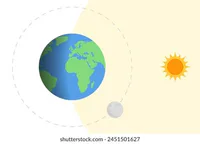
Radiation
Energy that travels from a source as electromagnetic waves, including light, ultraviolet, and infrared heat.

Convection
The transfer of heat through a gas or liquid, like air, in a circular flow pattern.
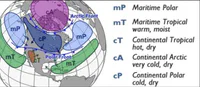
Air Mass
A huge body of air that has a characteristic temperature, pressure, and moisture throughout its volume.

Front
The boundary where two different air masses meet, which often results in a distinct change in weather.

Air Pressure
The weight of a column of air that is pressing down on a particular location on Earth.
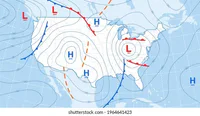
Weather Map
A chart showing data about current weather conditions to forecast upcoming weather for a specific area.
4
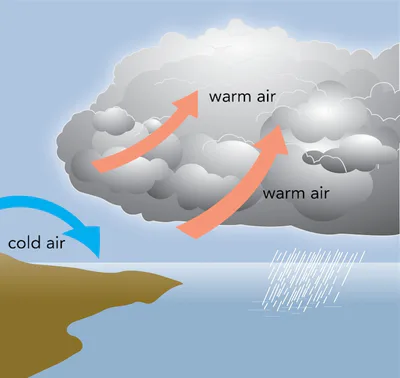
The Sun's Energy and Convection
The Sun's radiation is the primary source of energy that heats the Earth.
Convection occurs as warm air rises and cooler, denser air sinks to replace it.
This circular movement, a convection current, is responsible for creating winds.
This process also drives the water cycle through evaporation and condensation.

5
Multiple Choice
What is the definition of a convection current?
The circular movement of warm air rising and cool air sinking.
The energy that comes directly from the Sun's radiation.
The process that creates clouds through condensation.
The force that is responsible for creating the water cycle.
6
Multiple Choice
How does the Sun's energy cause winds on Earth?
The Sun heats the Earth, which causes warm air to rise and cool air to sink, creating air movement.
The Earth's rotation directly spins the air into currents that we feel as wind.
The Sun's radiation pushes the air sideways, causing it to move across the land.
The water cycle releases energy that creates wind as a byproduct of evaporation.
7
Multiple Choice
If the Sun's energy no longer heated the Earth unevenly, what would be the most likely impact on both wind and the water cycle?
The process of convection would slow down or stop, which would reduce both wind and evaporation.
Winds would become much stronger because the air would be denser.
The water cycle would speed up because cooler air holds more moisture.
Only the creation of winds would be affected, but the water cycle would not.
8
Types of Weather Fronts
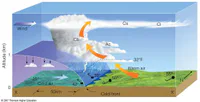
Cold Front
A cold air mass pushes against and replaces a warm air mass.
Denser cold air forces warm air up, often producing strong storms.
It is shown on a weather map with blue triangles.
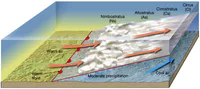
Warm Front
A warm air mass pushes against and replaces a cold air mass.
The less dense warm air slowly flows over the cold air.
This brings overcast skies and is shown by red semicircles.
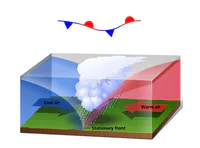
Stationary Front
Two air masses meet, but neither is strong enough to move.
The front stalls and can bring long periods of rainy weather.
It is shown by alternating blue triangles and red semicircles.
9
Multiple Choice
What is the fundamental difference that defines whether a weather front is a cold front or a warm front?
Which type of air mass is replacing the other.
The symbols used on a weather map.
The speed at which the front is moving.
The season in which the front occurs.
10
Multiple Choice
How does the interaction between air masses lead to different weather in cold fronts versus warm fronts?
In a cold front, dense cold air forces warm air up rapidly, causing storms, while in a warm front, less dense warm air slowly flows over cold air.
In a cold front, warm air gently slides over cold air, causing overcast skies, while in a warm front, cold air pushes warm air up, causing storms.
Both fronts involve cold air forcing warm air up, but warm fronts move much faster than cold fronts.
Both fronts involve two air masses meeting and stalling, leading to long periods of similar weather.
11
Multiple Choice
A weather map for your area shows a line with alternating blue triangles and red semicircles. What conclusion can you draw about the upcoming weather?
A cold air mass is pushing out a warm air mass, which will likely bring strong storms.
A warm air mass is flowing over a cold air mass, which will likely bring overcast skies.
Two air masses have met and stalled, which will likely cause long periods of rainy weather.
The front has passed, and the weather is expected to become clear and calm.
12
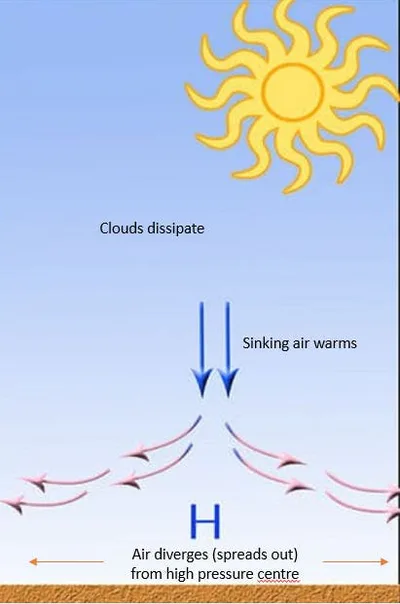
High Pressure (H)
Sinking, cool, and dense air creates what is known as a high-pressure system.
These systems are typically associated with very calm and clear weather conditions.
Winds flow away from high-pressure centers in a clockwise direction in the Northern Hemisphere.
Low Pressure (L)

Rising, warm, and less-dense air creates what is known as a low-pressure system.
These systems usually bring cloudy skies, precipitation, and stormy weather conditions.
Winds flow toward low-pressure centers in a counter-clockwise direction in the Northern Hemisphere.
13
Multiple Choice
What type of weather is typically associated with a high-pressure system?
Calm and clear skies
Cloudy and rainy conditions
Stormy and windy weather
Humid and foggy conditions
14
Multiple Choice
What is the primary difference between the air in high-pressure and low-pressure systems?
High-pressure systems have sinking, cool air, while low-pressure systems have rising, warm air.
High-pressure systems have rising, warm air, while low-pressure systems have sinking, cool air.
High-pressure systems have fast-moving air, while low-pressure systems have slow-moving air.
High-pressure systems have wet air, while low-pressure systems have dry air.
15
Multiple Choice
A weather balloon in the Northern Hemisphere detects winds moving away from a central point in a clockwise pattern. What conclusion can be drawn about the weather in that area?
Clear skies and calm conditions, because the winds indicate a high-pressure system.
Cloudy skies and precipitation, because the winds indicate a low-pressure system.
Stormy weather, because winds are flowing in a clockwise direction.
Clear skies and calm conditions, because the winds indicate a low-pressure system.
16
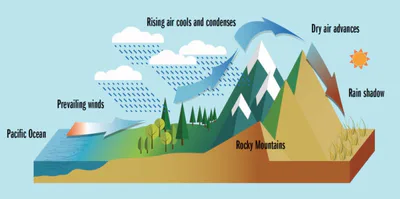
Landforms & Weather
Mountains can significantly influence local weather patterns by affecting the movement and temperature of air masses.
As moist air is forced to rise over a mountain, it cools and releases its moisture as rain or snow.
This process leaves the air dry as it descends, creating a much drier area known as a rain shadow.
Weather Maps

A weather map provides a snapshot of atmospheric conditions using various symbols to represent different weather elements.
Key symbols include H for high pressure, L for low pressure, a blue line for a cold front.
A red line with semicircles represents a warm front, with symbols pointing in the direction of movement.
17
Multiple Choice
What is the main function of symbols like 'H', 'L', and colored lines on a weather map?
To show the locations of cities and roads
To represent different atmospheric conditions
To indicate the best places for planting crops
To mark the boundaries between countries
18
Multiple Choice
How do mountains contribute to the formation of a rain shadow?
They block the sun, causing the land to become cool and dry.
They force moist air to rise, cool, and release its moisture, leaving dry air to descend.
They absorb all the moisture from the ground, preventing clouds from forming.
They increase the speed of the wind, which blows the clouds away from the area.
19
Multiple Choice
A weather map shows a red line with semicircles pointing north, indicating a warm front is moving north over a mountain range. What is the most likely forecast for the region north of the mountains?
The area will be much drier because of the rain shadow effect.
The area will experience heavy snowfall due to the warm front.
The area will have high pressure and clear skies.
The area will have the same weather as the region south of the mountains.
20
Misconception | Correction |
|---|---|
Air pressure is the same everywhere. | Air pressure changes with temperature and altitude. |
All weather fronts cause severe storms. | Different fronts create different types of weather. |
High-pressure systems always bring bad weather. | High-pressure systems usually bring calm and clear skies. |
Cold moves from a colder place to a warmer one. | Heat energy moves from warmer places to colder places. |
21
The Sun’s energy heats Earth’s surface, driving all weather patterns.
Wind is created by convection currents moving through the atmosphere.
Weather changes happen at fronts, where different air masses meet.
High-pressure systems bring clear skies, while low-pressure systems bring cloudy weather.
Landforms like mountains can significantly alter local weather patterns.
Weather maps use standard symbols to help us forecast the weather.
22
Poll
On a scale of 1-4, how confident are you about interpreting a basic weather map after this review?
1
2
3
4
Middle School
Show answer
Auto Play
Slide 1 / 22
SLIDE
Similar Resources on Wayground

19 questions
The Metric System & Metric Conversions
Presentation
•
6th - 8th Grade
15 questions
Physical and Chemical Properties
Presentation
•
6th - 8th Grade
17 questions
Natural Selection Review
Presentation
•
7th - 8th Grade
17 questions
Distance Time Graph Lesson
Presentation
•
6th - 8th Grade
18 questions
Prefixes and Suffixes
Presentation
•
6th - 8th Grade
18 questions
Newton's Third Law
Presentation
•
6th - 8th Grade
15 questions
HR Diagram
Presentation
•
6th - 8th Grade
19 questions
Abiotic and Biotic Factors/ Components of an Ecosystem
Presentation
•
6th - 8th Grade
Popular Resources on Wayground
10 questions
How much do you know about our Portrait of an Eagle?

Quiz
•
10th Grade
10 questions
Fast Food Slogans
Quiz
•
6th - 8th Grade
21 questions
Continents and Oceans
Quiz
•
6th Grade
20 questions
Parts of Speech
Quiz
•
5th Grade
16 questions
Subject & Predicate
Quiz
•
5th Grade
25 questions
Multiplication Facts
Quiz
•
5th Grade
12 questions
Map Skills
Quiz
•
3rd Grade
22 questions
Continents and Oceans
Quiz
•
5th Grade
Discover more resources for Science
17 questions
7.6D Aqueous Solutions
Quiz
•
7th Grade
20 questions
Scientific Method and Variables
Quiz
•
8th Grade
20 questions
Scientific method and variables
Quiz
•
8th Grade
27 questions
Counting Atoms - Subscripts
Quiz
•
8th Grade
10 questions
6.6D - Relative Density Review
Quiz
•
6th Grade
20 questions
Claim, Evidence and Reasoning (CER)
Quiz
•
6th - 8th Grade
18 questions
Counting Atoms
Quiz
•
7th - 8th Grade
20 questions
Density
Quiz
•
6th Grade