

Matter - Chemical /Physical Properties of Matter

Presentation
•
Science
•
6th - 8th Grade
•
Practice Problem
•
Hard
+4
Standards-aligned

Eugene Jones
FREE Resource
15 Slides • 16 Questions
1

2
Open Ended
Why is it important to distinguish between elements, compounds, and mixtures in the study of matter?
3
4
Multiple Choice
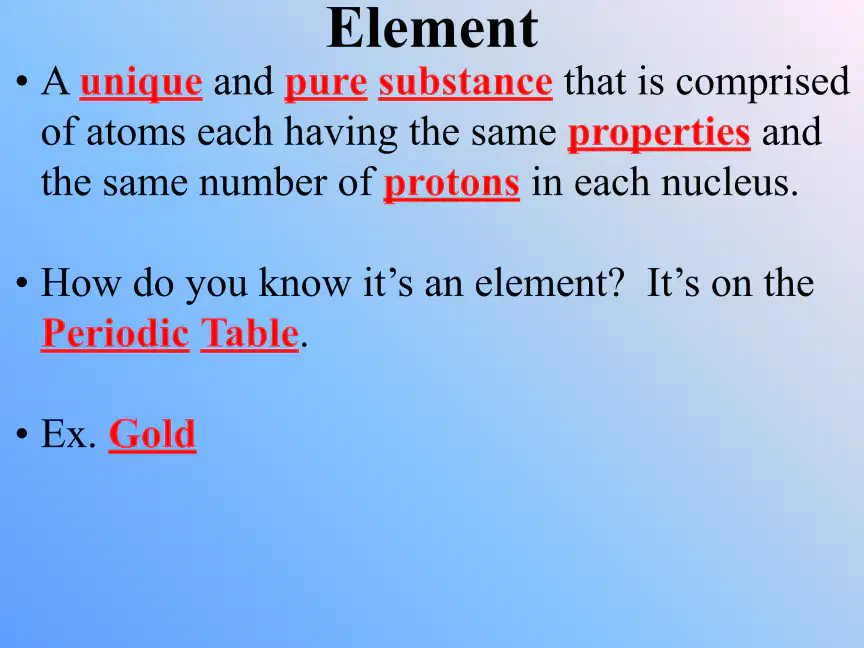
Which of the following statements best describes an element?
A substance made up of different types of atoms.
A unique and pure substance with atoms having the same number of protons.
A mixture of two or more substances.
A substance that can be separated into simpler substances by chemical means.
5
6
Multiple Choice
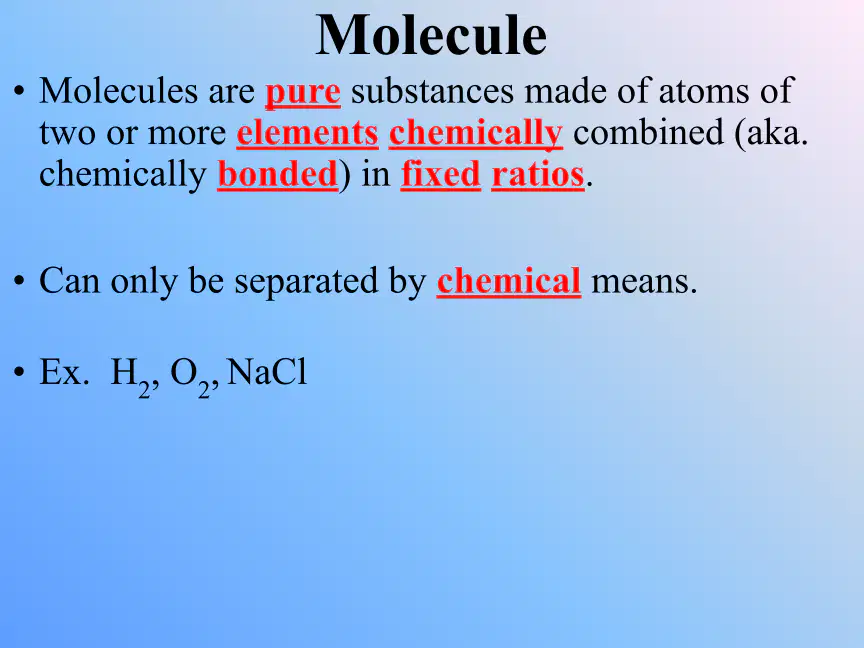
Which of the following best describes a molecule?
A pure substance made of atoms of two or more elements chemically combined in fixed ratios.
A physical combination of two or more substances in any proportion.
A substance that can be separated by physical means.
A mixture with a uniform composition.
7
8
Multiple Select
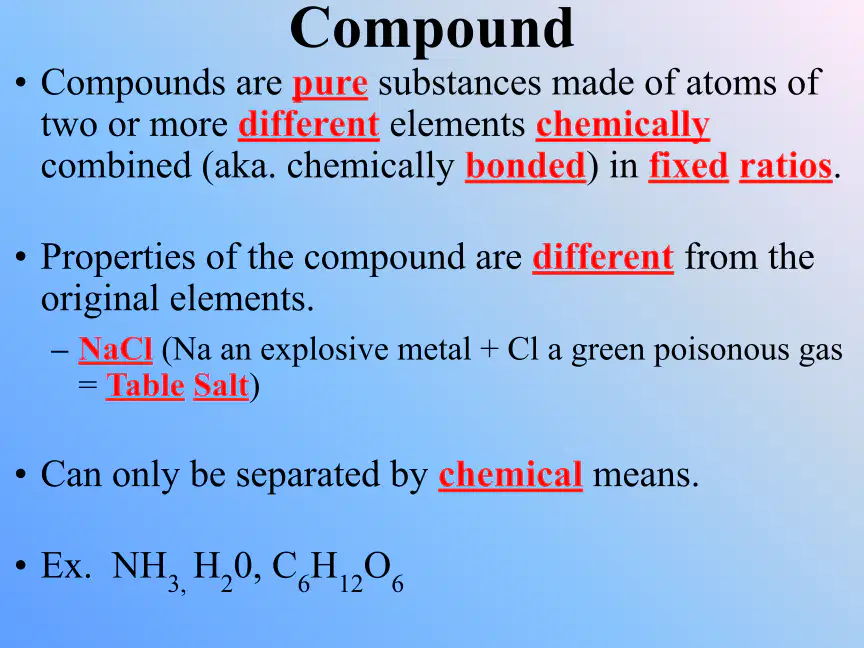
Which of the following statements are true about compounds?
Compounds are made of different elements chemically bonded.
The properties of a compound are the same as the original elements.
Compounds can only be separated by chemical means.
Compounds may be present in any proportion.
9
10
Open Ended
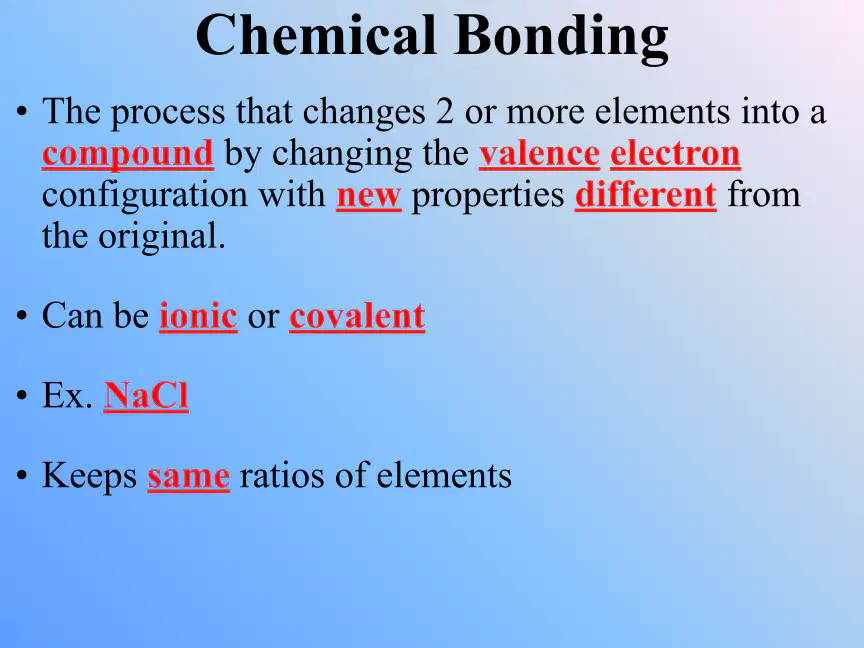
Explain how chemical bonding changes the properties of the elements involved.
11
12
Multiple Choice
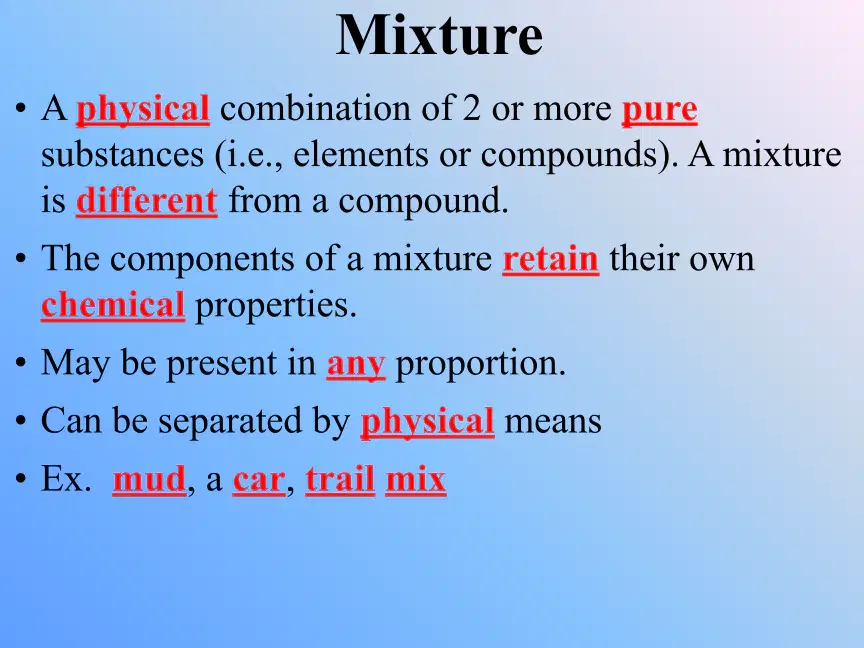
Which of the following is a key difference between a mixture and a compound?
Mixtures can be separated by physical means, while compounds require chemical means.
Compounds can be present in any proportion, while mixtures have fixed ratios.
Mixtures are always uniform in composition, while compounds are not.
Compounds retain the properties of their components, while mixtures do not.
13
14
Fill in the Blanks
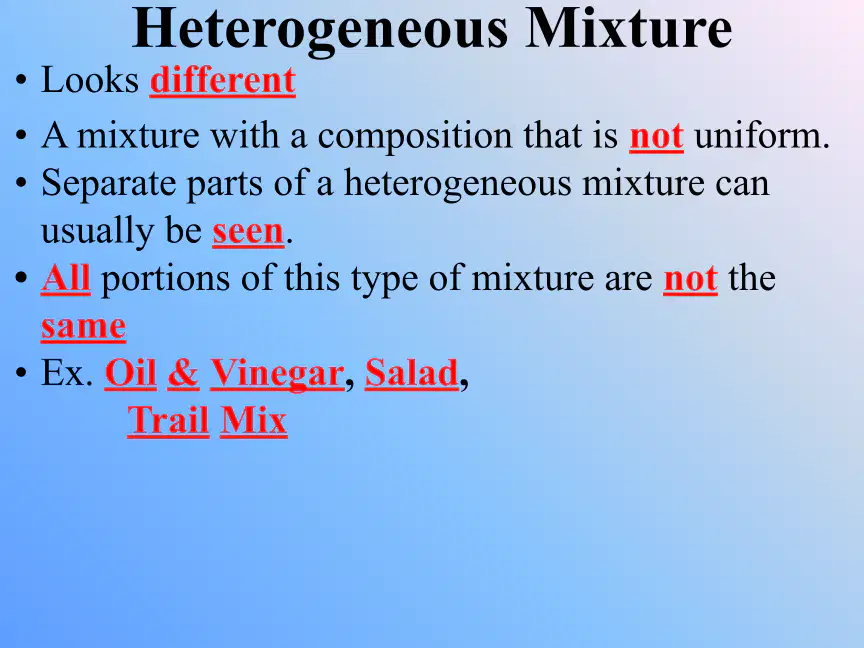
A heterogeneous mixture looks
15
16
Multiple Choice
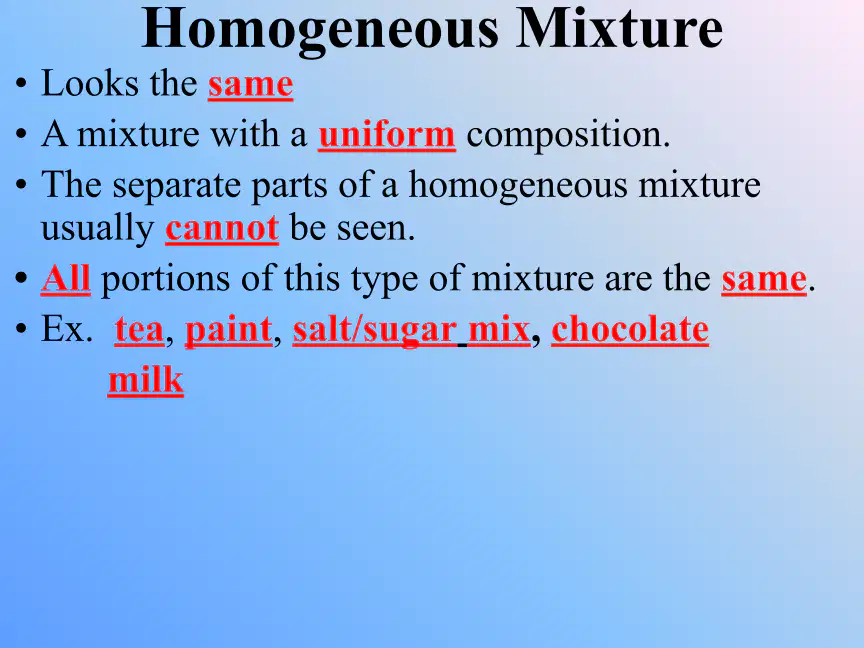
Which example is a homogeneous mixture?
Trail mix
Salad
Tea
Oil & Vinegar
17
18
Multiple Choice
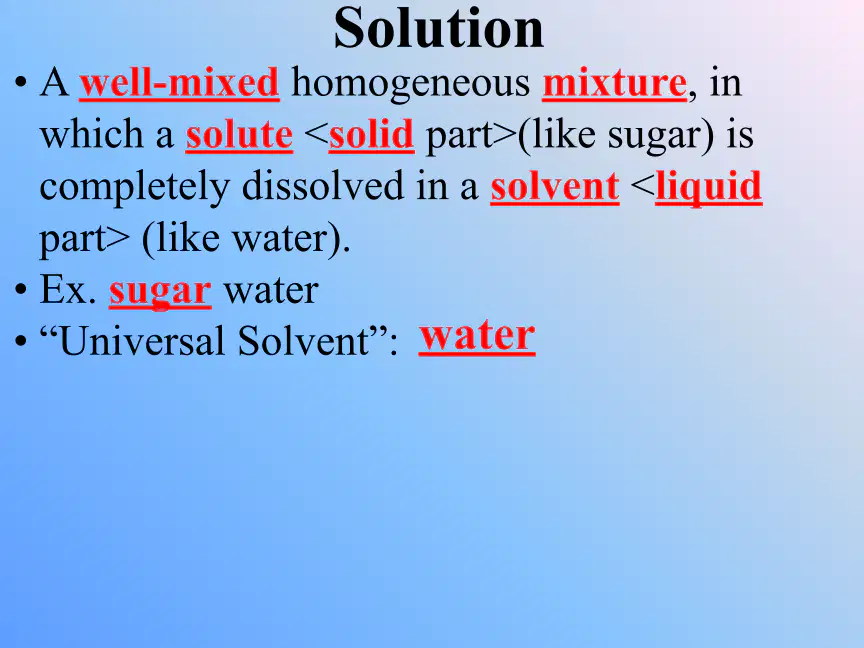
Which of the following best describes a solution?
A well-mixed homogeneous mixture where a solute is dissolved in a solvent
A heterogeneous mixture where substances are not evenly distributed
A mixture of two solids that do not dissolve in each other
A chemical reaction between two liquids
19
20
Multiple Select
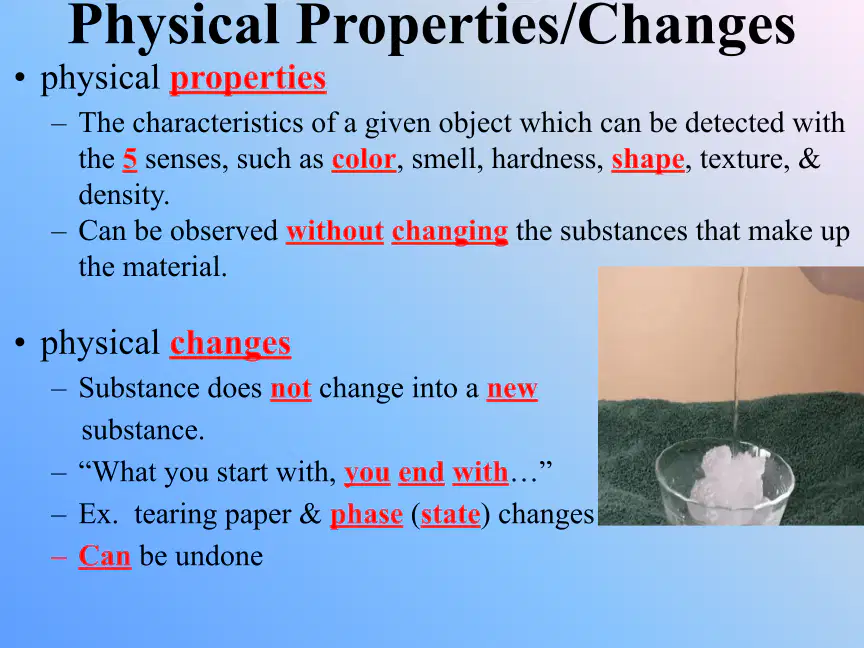
Which of the following are examples of physical properties?
Color
Shape
Combustibility
Density
21
22
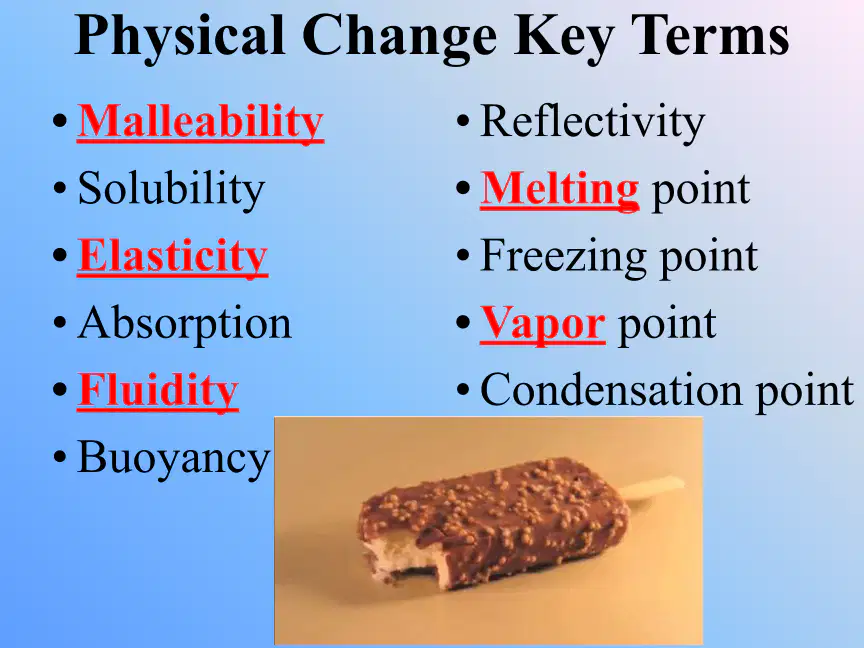
Fill in the Blanks
The process in which a solid turns into a liquid is called
23
24
25
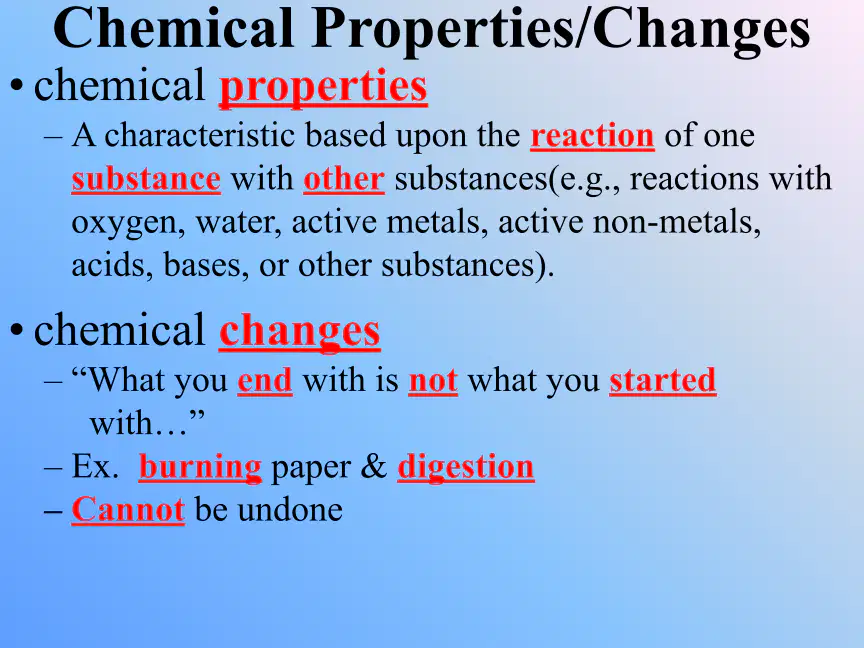
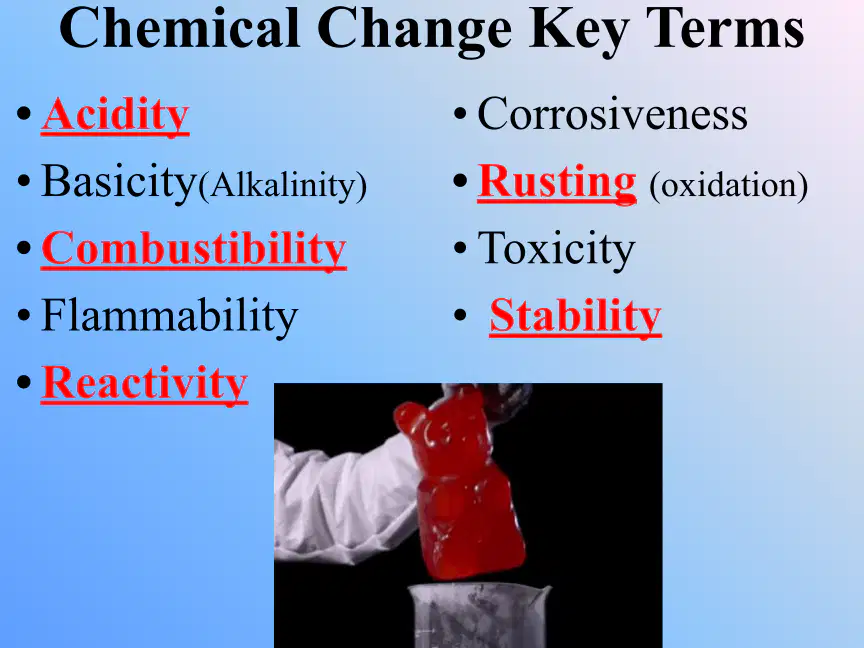
Multiple Choice
Which of the following is NOT a key term associated with chemical changes?
Elasticity
Acidity
Rusting
Combustibility
26
27
Fill in the Blanks
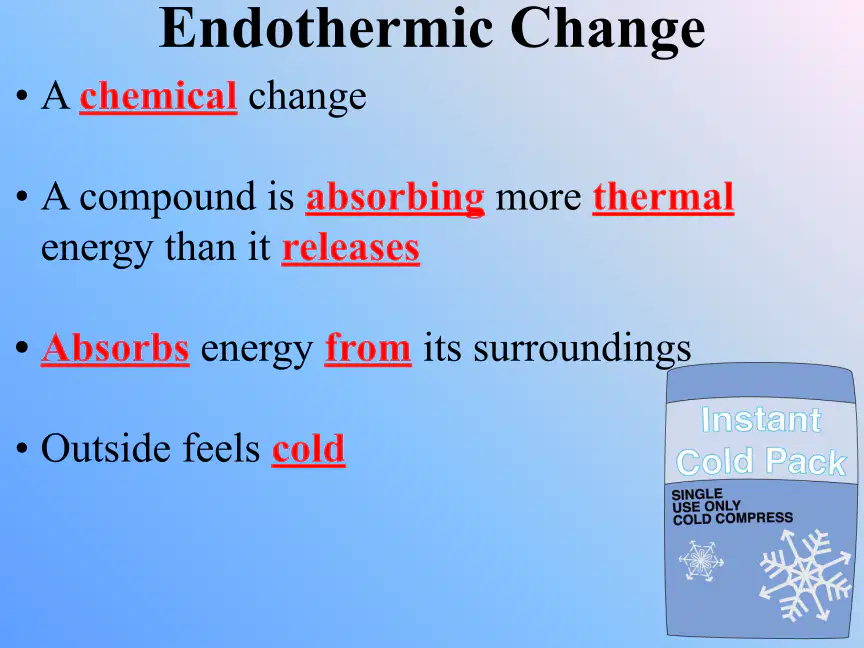
During an endothermic change, energy is
28
29
Open Ended
After learning about elements, compounds, mixtures, and physical vs. chemical changes, what is one question you still have or something you would like to learn more about?
30
Multiple Choice
What is one way to determine if a substance is an element?
Check if it is on the Periodic Table
See if it can be broken down into simpler substances
Test if it reacts with water
Measure its melting point
31
Multiple Choice
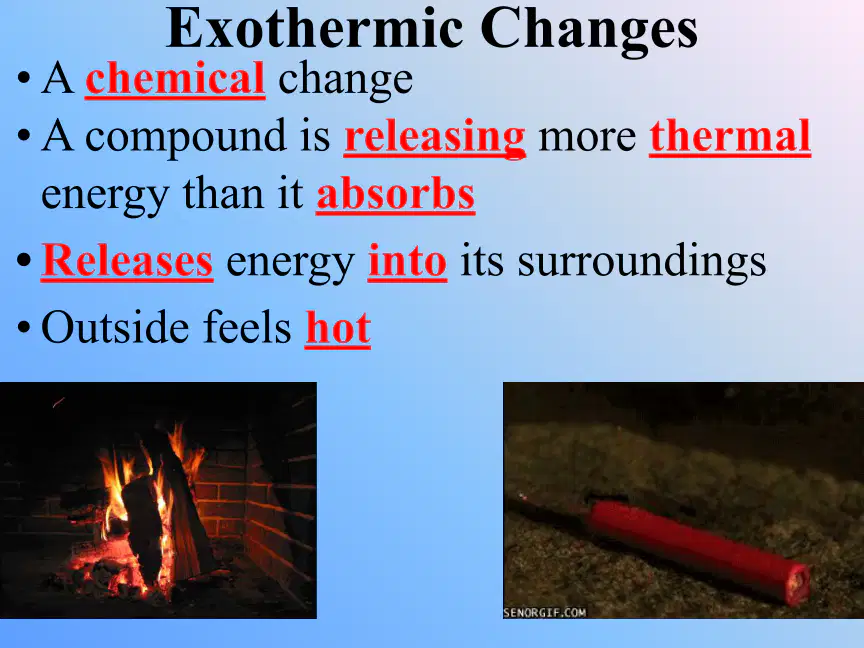
Which of the following best describes an exothermic change?
A chemical change that releases more thermal energy than it absorbs, making the surroundings feel hot.
A chemical change that absorbs more thermal energy than it releases, making the surroundings feel cold.
A physical change that releases energy into its surroundings, making the surroundings feel cold.
A physical change that absorbs energy from its surroundings, making the surroundings feel hot.
Show answer
Auto Play
Slide 1 / 31
SLIDE
Similar Resources on Wayground

25 questions
Modeling Conservation of Mass
Presentation
•
6th - 8th Grade
27 questions
Kinetic Energy
Presentation
•
6th - 8th Grade
21 questions
Rock Cycle Lesson
Presentation
•
6th - 8th Grade
28 questions
Soil Formation and Layers
Presentation
•
6th - 8th Grade
27 questions
Dynamic Nature of Ecosystems
Presentation
•
6th - 8th Grade
20 questions
Properties of Matter- Introduction
Presentation
•
6th - 8th Grade
21 questions
Chemical Reactions
Presentation
•
7th - 8th Grade
22 questions
Rock Cycle
Presentation
•
6th - 8th Grade
Popular Resources on Wayground
10 questions
How much do you know about our Portrait of an Eagle?

Quiz
•
10th Grade
10 questions
Fast Food Slogans
Quiz
•
6th - 8th Grade
21 questions
Continents and Oceans
Quiz
•
6th Grade
20 questions
Parts of Speech
Quiz
•
5th Grade
16 questions
Subject & Predicate
Quiz
•
5th Grade
25 questions
Multiplication Facts
Quiz
•
5th Grade
12 questions
Map Skills
Quiz
•
3rd Grade
22 questions
Continents and Oceans
Quiz
•
5th Grade
Discover more resources for Science
17 questions
7.6D Aqueous Solutions
Quiz
•
7th Grade
20 questions
Scientific Method and Variables
Quiz
•
8th Grade
20 questions
Scientific method and variables
Quiz
•
8th Grade
27 questions
Counting Atoms - Subscripts
Quiz
•
8th Grade
10 questions
6.6D - Relative Density Review
Quiz
•
6th Grade
20 questions
Claim, Evidence and Reasoning (CER)
Quiz
•
6th - 8th Grade
18 questions
Counting Atoms
Quiz
•
7th - 8th Grade
20 questions
Density
Quiz
•
6th Grade