Search Header Logo
Computational Thinking Fundamentals Review

Computational Thinking Fundamentals Review

Assessment

Presentation

Computers

11th Grade

Easy

Created by

Arturo Sánchez Vermont

Used 3+ times

FREE Resource

2 Slides • 41 Questions

1

​Review of Fundamentals

By Arturo Sánchez Vermont

2

Multiple Choice

It's the pillar that consists in breaking down a large problem into smaller tasks

1

Algorithms

2

Decomposition

3

Patterns

4

Abstraction

3

Multiple Choice

A sequence of instructions that can be followed to solve many problems of similar type.

1

Algorithms

2

Decomposition

3

Patterns

4

Abstraction

4

Multiple Choice

Method of problem solving that aims for analysis and efficiency.

1

Electronical Thinking

2

Computational Thinking

3

Intelligent Thinking

5

Multiple Choice

It's the coding language we'll learn in this class, it's one of the easiest ones to learn

1

Java

2

HTML

3

Python

4

C++

6

Multiple Choice

Algorithms are a series of steps that help solve a task, but they don't solve the task by themselves.

1

True

2

False

7

Multiple Choice

It's the information an algorithm requires in order to be able to function

1

Finite

2

Input

3

Output

4

Effective

8

Multiple Choice

Which one is NOT a property of Algorithms?

1

Short

2

Effective

3

Finite

4

Input

9

Multiple Choice

Property of Algorithms that dictates that they must always have an end.

1

Output

2

Effective

3

Finite

4

Precise and General

10

Multiple Choice

It's the name of ANY information that comes out of the device.

1

Output

2

Input

3

Process

11

Multiple Choice

This happens inside the device without any control from us.

1

Output

2

Input

3

Process

12

Multiple Choice

In a physical context, a computer's Keyboard is considered...

1

Input

2

Output

3

Both

13

Multiple Choice

Pillar that finds similar information that repeats on a problem.

1

Algorithms

2

Decomposition

3

Patterns

4

Abstraction

14

Multiple Choice

In a calculator, the numbers and operators serve as the Inputs

1

True

2

False

15

Multiple Choice

Pillar that hides the information we don't need so we focus on what matters at the moment.

1

Algorithms

2

Decomposition

3

Patterns

4

Abstraction

16

Multiple Choice

It's the correct way to express an exponent in coding

1

x

2

*

3

**

4

^

17

Multiple Choice

The camera on a phone is an Output

1

True

2

False

18

Multiple Choice

It's the operator that returns the REMAINDER of a division

1

/

2

//

3

&

4

%

19

Multiple Choice

A touchscreen can be considered...

1

Input

2

Output

3

Both

20

Multiple Choice

In an Integer Division, the result is always rounded DOWN

1

True

2

False

21

Multiple Choice

Symbol that means "Lesser than or equal to"

1

>

2

<

3

>=

4

<=

22

Multiple Choice

Operator that is a normal division, but will always be rounded down

1

/

2

%

3

//

4

&

23

Multiple Choice

In PEMDAS, which of these operators has the highest priority?

1

/

2

%

3

+

4

**

24

Multiple Choice

Evaluate this expression: 6 >= 6

1

True

2

False

25

Multiple Choice

In PEMDAS, which of these operators has the highest priority?

1

( )

2

*

3

//

4

-

26

Multiple Choice

Operator that checks if two values are the SAME

1

=

2

==

3

!=

27

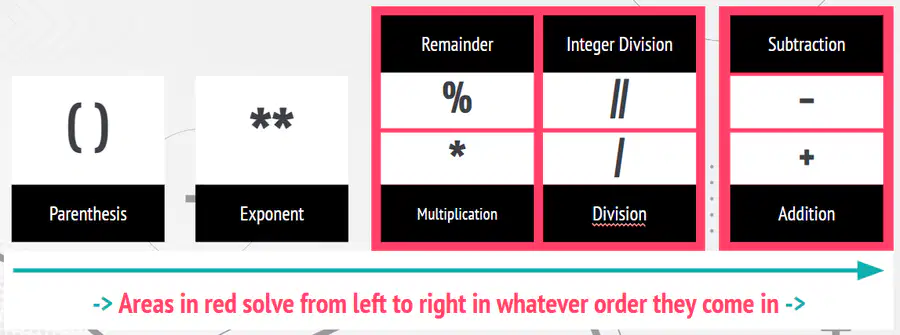
% // / and * all have the SAME PRIORITY, they'll be solved left to right in whatever order they come. Same goes of + and -

Remember!

media

28

Multiple Choice

Evaluate this: (5+2)*2 == 5+2*2

1

True

2

False

29

Multiple Choice

Evaluate this: 13%6 <= 3

1

True

2

False

30

Multiple Choice

VERY HARD QUESTION: Evaluate (8-2*3 < 13) == (50/2 > 14%3)

1

True

2

False

31

Multiple Choice

Operator that checks if two values are DIFFERENT

1

=

2

==

3

!=

32

Multiple Choice

Evaluate this: (4+26)/2 != 4**2

1

True

2

False

33

Multiple Choice

It's a visual representation of an Algorithm

1

Mindmap

2

Flowchart

3

Visual Map

4

Instruction Chart

34

Multiple Choice

Shape used to represent a Decision in Flowcharts

1

Oval

2

Rhomboid

3

Rectancle

4

Diamond

35

Multiple Choice

Flowcharts can have multiple ending points

1

True

2

False

36

Multiple Choice

Shape used to represent the Start and Endings of a Flowchart

1

Oval

2

Rhomboid

3

Rectangle

4

Diamond

37

Multiple Choice

HARD QUESTION: Use PEMDAS and evaluate: (6%4+2)*2

1

0

2

6

3

8

4

2

38

Multiple Choice

An INPUT or OUTPUT is represented by a straight rectangle in a Flowchart

1

True

2

False

39

Multiple Choice

Flowcharts can have multiple starting points.

1

True

2

False

40

Multiple Choice

Shape used to represent the INPUT and OUTPUT on Flowcharts

1

Oval

2

Rhomboid

3

Rectangle

4

Diamond

41

Multiple Choice

FINAL QUESTION: Which one is NOT a pillar of Computational Thinking

1

Analysis

2

Decomposition

3

Abstraction

4

Patterns

42

Poll

Which cat are you rn?

Defeated

Happy

Scared

Frustrated

Vibing

43

Poll

What topic(s) do you feel you need reviewing the most?

Remember you can also ask for tutoring :)

(If it's pillars tell me because I could only have 5 options)

All good :)

Algorithms

Input Process Output

Operators

Flowcharts

​Review of Fundamentals

By Arturo Sánchez Vermont

Show answer

Auto Play

Slide 1 / 43

SLIDE