

2.1.3.

Presentation
•
English
•
5th Grade
•
Practice Problem
•
Easy
+14
Standards-aligned

Mitzi Herron
Used 3+ times
FREE Resource
30 Slides • 9 Questions
1
2

3

4
Word Study

5
Learners can:
read, spell, and write words with long vowels
identify and spell multisyllabic words through syllable mapping (encoding), including open syllables
identify, read, and spell words with Latin root mot
demonstrate comprehension of the text through oral or written response
Word Study: Latin Root mot (Day 3)

6

Long Vowels
You have learned that long vowels say their name. They are found in open syllables.
Long vowels can also be found in words with the VCe pattern. These words have a long vowel followed by a consonant and a silent e at the end.
For example:
the word “place” has a long a followed by the consonant c and a silent e.
Long Vowels
7
Open Ended
Press play on the audio clip to hear the word. Write the word you hear below.
8
Open Ended
Press play on the audio clip to hear the word. Write the word you hear below.
9
Open Ended
Press play on the audio clip to hear the word. Write the word you hear below.
10


Check Your Work
11

A root is a word part that gives a word the most important part of its meaning.
Roots cannot stand on their own. They can be combined with different prefixes or suffixes to give words a new meaning.
Latin Root Mot
12
The Latin word mot means to move.


13
Match
Match each word to its correct definition.
motel
remote
promote
motion
emotion
a roadside place to sleep
to be far away
to move up or forward
to move
feelings or reactions
a roadside place to sleep
to be far away
to move up or forward
to move
feelings or reactions
14
Multiple Select
Choose two words that have at least one open syllable with a long vowel sound.
Work together as a whole group to divide words into syllables before determining which TWO words contain open syllables!
15

Now, you will read the short story, “Finding Chance.”
While you read today, look for these words:
“emotional”
“automatic“
“mischief”
Use the highlighter tool to highlight these words.
Think about what the word means using clues in the sentence.
Practice Reader
16
17

18
19
Reading

20
Reading: Using Text Evidence
Pennsylvania is a state rich in history.
You have been reading all about the history of the
Declaration of Independence and the Constitution.
All of this took place in a building called Independence Hall.

21
22
Words to Know

23
Words to Know

24

25

As you read, look for the following nonfiction text features:
(1) headings
(2) bold text
(3) captions
(4) pictures
Read pages 14-19
Read Aloud
26
27
Sometimes, the evidence is not always stated in the text. You might need to make an inference.
Good readers use clues from the text to make inferences. An inference is when you use what you already know and clues from the text to better understand a story.
Making an Inference

28
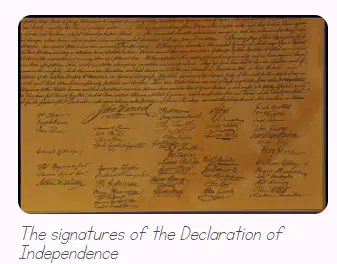
Use the clues you find in the caption and picture to make an inference:
What inference can you make about John Hancock's signature on the Declaration of Independence?
You can start your answer with:
I can infer that John Hancock signed the Declaration of Independence this way because . . .
Let's make an inference!
29
30
Draw
Let's get creative! Use your tools to finish the doodle!
There will be a 3-minute timer on the screen!
31
Writing

32

Please turn to page 13 in your Writing Activity Book.
or
page 1 in Classkick (Unit 2: Writing)
Complete #1 & #2
33

A topic sentence expresses the main topic for that paragraph. The topic sentence identifies the main point the author is writing about.
Topic Sentence
34
Draw
Use your highlighter tool to highlight the topic sentence in this paragraph.
35

36

Let's learn more about each of the four types of writing enhancers.
37
Multiple Choice

Which is true of writing enhancers?
Writing enhancers help writers add supporting details about the main topic and main idea.
Writing enhancers help writers introduce the main topic.
Writing enhancers help writers only to introduce vocabulary.
Writing enhancers can be used to add facts or opinions.
38
Draw
Exit Ticket: Circle the picture that best demonstrates how you feel about today's lesson.
39

Don't forget to submit your lesson for review!

Show answer
Auto Play
Slide 1 / 39
SLIDE
Similar Resources on Wayground

34 questions
2nd Nine Weeks Benchmark Review
Presentation
•
5th Grade
36 questions
U3W3 - Rosa
Presentation
•
5th Grade
34 questions
Physical Properties of Matter Review
Presentation
•
5th Grade
33 questions
READING - A Restaurant Menu
Presentation
•
5th Grade
34 questions
LA 2nd Period Review
Presentation
•
5th Grade
35 questions
ILE 3 Unit 14 Test
Presentation
•
5th Grade
35 questions
English Quarter 2 Week 8
Presentation
•
5th Grade
35 questions
Fiction STAAR Vocabulary 6th grade
Presentation
•
6th Grade
Popular Resources on Wayground
6 questions
Secondary Safety Quiz
Presentation
•
9th - 12th Grade
10 questions
MyPath Diagnostic Overview
Presentation
•
6th - 8th Grade
20 questions
Lab Safety Quiz

Quiz
•
6th Grade
21 questions
Continents and Oceans
Quiz
•
6th Grade
20 questions
Adding and Subtracting Decimals
Quiz
•
5th Grade
20 questions
Parts of Speech
Quiz
•
5th Grade
16 questions
Subject & Predicate
Quiz
•
5th Grade
21 questions
Lab Safety
Quiz
•
10th Grade
Discover more resources for English
20 questions
Parts of Speech
Quiz
•
5th Grade
16 questions
Subject & Predicate
Quiz
•
5th Grade
20 questions
Four Types of Sentences
Quiz
•
3rd - 5th Grade
20 questions
4 Types of Sentences
Quiz
•
4th - 5th Grade
18 questions
ADJECTIVES and ADVERBS
Presentation
•
5th - 7th Grade
20 questions
Main Idea and Details
Quiz
•
5th Grade
10 questions
Plot - Elements of Plot Practice

Interactive video
•
5th Grade
20 questions
Complete Sentence or Fragment
Quiz
•
4th - 6th Grade