

PowerPoint - Analyzing Legal, Ethical and Insurance Considerations in Sports Medicine

Presentation
•
Health Sciences
•
9th - 12th Grade
•
Practice Problem
•
Easy

Alex Shaheen
Used 1+ times
FREE Resource
13 Slides • 8 Questions
1

2
3
4
5
Match
Match the following
The state of being legally responsible for the harm one causes another person
The failure to use ordinary or reasonable care—the care that persons would normally exercise to avoid injury to themselves or others under similar circumstances
Legal wrongs committed against the person or property of another
When an athlete knows of and understands the dangers of an activity and voluntarily chooses to be exposed to those dangers
Liability
Negligence
Torts
Assumption of Risk
Liability
Negligence
Torts
Assumption of Risk
6
7
8
Open Ended
What measures can be taken to minimize the chances of litigation should an athlete be injured?
9
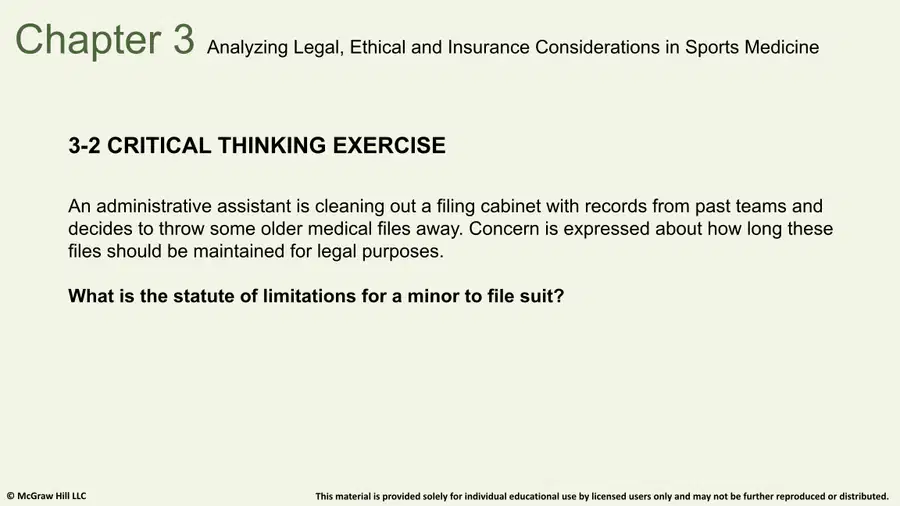
10
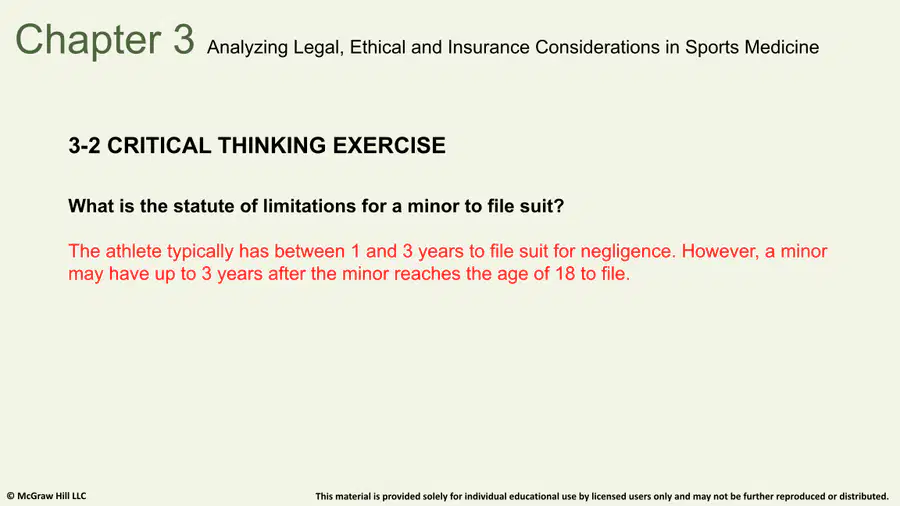
11
Open Ended
What measures can be taken to minimize the chances of litigation should an athlete be injured?
12
Fill in the Blanks
13
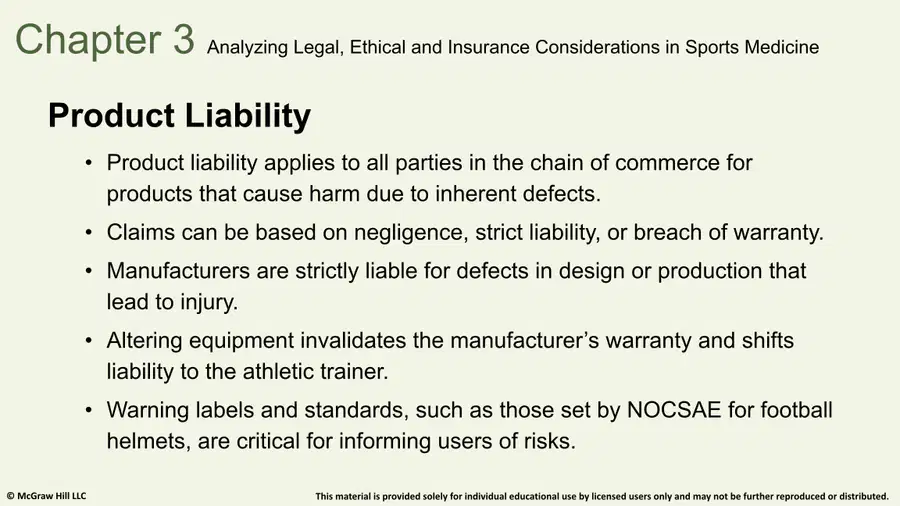
14
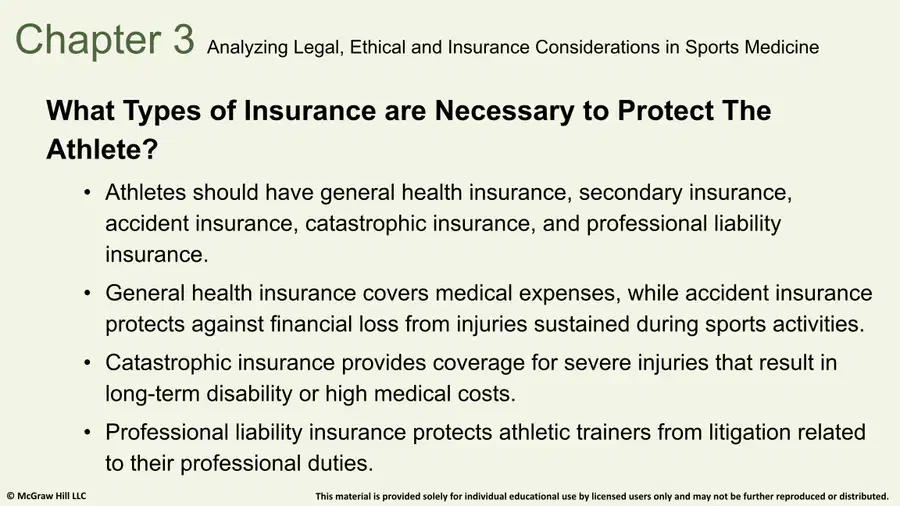
15
Open Ended
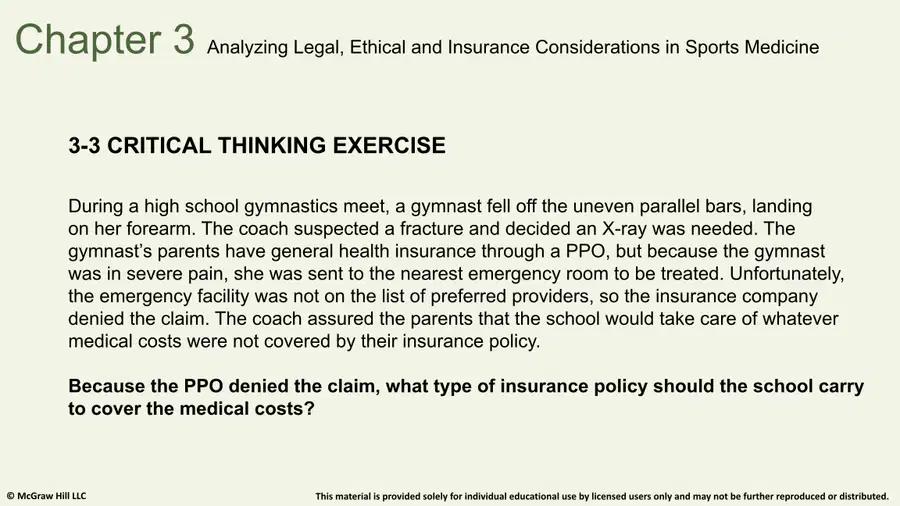
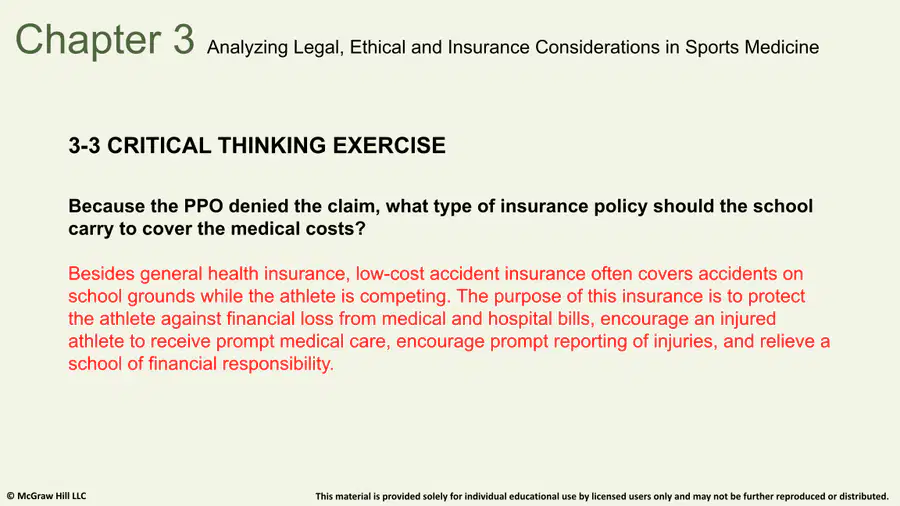
Why is it necessary for an athlete to have both general health insurance and accident insurance?
16
17
18
Match
Briefly discuss the various methods of third-party reimbursement.
A form of managed care that emphasizes preventive measures and limits where an individual can receive care, generally covering 100% of medical costs if services are rendered at an in-network facility and often utilizing a fixed monthly payment system to providers
A group of health care providers who agree to offer services to policyholders at discounted rates, where policyholders are not required to pay for care if they go to a preferred facility, and payment is typically on a fee-for-service basis
A form of reimbursement used by managed care providers where members make a standard monthly payment regardless of the amount of service they receive from the provider
A traditional billing method where a provider charges the patient or a third-party payer a fee for services based on a set schedule, and it is not considered a type of managed care
A health insurance program for individuals with low incomes and limited resources, funded by federal and state governments
Health Maintenance Organization (HMO)
Preferred Provider Organization (PPO)
Capitation
Indemnity Plan
Medicaid
Health Maintenance Organization (HMO)
Preferred Provider Organization (PPO)
Capitation
Indemnity Plan
Medicaid
19
20
Open Ended
Why should an individual carry individual liability insurance?
21
Match
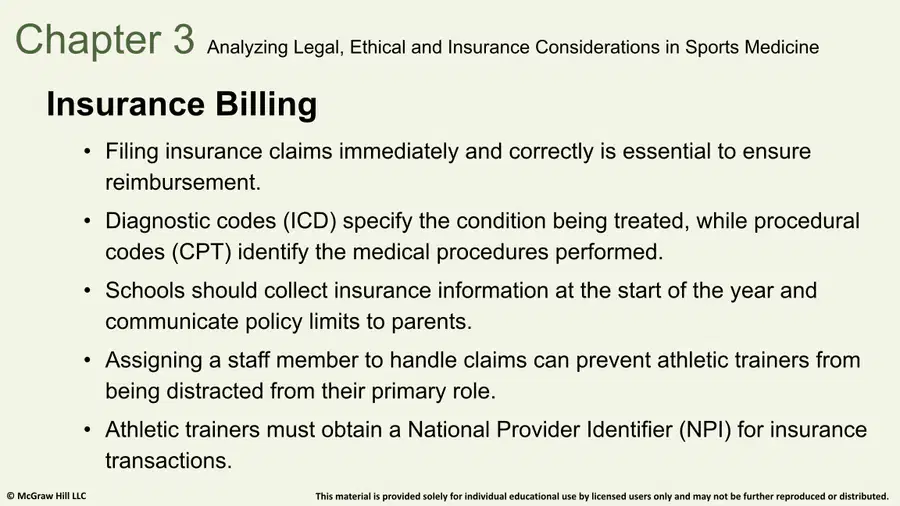
Match the the critical considerations for filing insurance claims
Specify the condition or injury that the healthcare provider is treating
Identify specific medical procedures used in treating a patient
Healthcare providers must obtain and use or administrative and insurance transactions
Diagnostic Codes (ICD)
Procedural Code (CPT)
National Provider Identifier (NPI
Diagnostic Codes (ICD)
Procedural Code (CPT)
National Provider Identifier (NPI
Show answer
Auto Play
Slide 1 / 21
SLIDE
Similar Resources on Wayground

16 questions
Lesson: Solving One-Step Equations
Presentation
•
9th - 12th Grade
16 questions
Computer Science Principles Unit 2 Review
Presentation
•
9th - 12th Grade
16 questions
Definite and Indefinite Spanish Articles
Presentation
•
9th - 12th Grade
16 questions
Observations and Inferences
Presentation
•
9th - 12th Grade
16 questions
Parts of Speech- Part 2
Presentation
•
9th - 12th Grade
15 questions
ES.4 Minerals
Presentation
•
9th - 12th Grade
16 questions
Stem Changing Verbs
Presentation
•
9th - 12th Grade
16 questions
Affirmative & Negative Words
Presentation
•
9th - 12th Grade
Popular Resources on Wayground
5 questions
A Home on the Shore

Quiz
•
3rd Grade
28 questions
US History Regents Review
Quiz
•
11th Grade
6 questions
A Horse Tale
Quiz
•
3rd Grade
20 questions
Math Review
Quiz
•
3rd Grade
10 questions
Juneteenth History and Significance

Interactive video
•
5th - 8th Grade
20 questions
Dividing Fractions
Quiz
•
5th Grade
55 questions
A Long Walk to Water Final Review
Quiz
•
6th - 8th Grade
10 questions
Equation Word Problems
Quiz
•
7th Grade
Discover more resources for Health Sciences
28 questions
US History Regents Review
Quiz
•
11th Grade
20 questions
Insurance
Quiz
•
9th - 12th Grade
10 questions
Juneteenth: History and Significance
Interactive video
•
7th - 12th Grade
10 questions
7.3-7.4 Quiz
Quiz
•
11th Grade
20 questions
Summer Geometry QUIZ (Week 2)
Quiz
•
9th Grade
6 questions
Mayan Mathematics part 1
Presentation
•
9th - 12th Grade
25 questions
Biology Regents Review
Quiz
•
9th Grade
40 questions
Flags of the World
Quiz
•
KG - Professional Dev...