

Grade 6th UNIT 5 Lesson 3-7/ 4/13-17/2026

Presentation
•
Education
•
6th Grade
•
Practice Problem
•
Medium

Deyvi Rocha
Used 45+ times
FREE Resource
160 Slides • 29 Questions
1
Monday Tuesday Wednesday Thursday Friday
reading Conference

Arlenyz Jazlyn Jayden Erick Fabier
Albriery Dario Jayleen Rosa Said
2
Word Cloud
How is your mood for today ? Cual es tu estado de animo de hoy ?
3
Unit 4
Coming to America: The Circuit
realistic nonfiction
Essential Question;
How do people’s hopes and motivations help them pursue the American Dream, even when faced with great challenges?
¿Cómo ayudan las esperanzas y motivaciones de las personas a perseguir el sueño americano, incluso cuando enfrentan grandes desafíos?
People’s hopes and dreams make them keep trying, even when things are hard. Believing they can reach their goals helps them work hard and never give up.

4


5
Unit 5
NJSLA TEST PREP
Essential Question;
How can we use reading, writing, and language skills to understand texts deeply, communicate clearly, and think critically?
¿Cómo podemos utilizar las habilidades de lectura, escritura y lenguaje para comprender los textos en profundidad, comunicarnos con claridad y pensar de manera crítica?

6

7

8
“Have you ever worked really hard for something important to you? How did it feel to earn it—or to face challenges trying to get it?”
¿Alguna vez has trabajado muy duro por algo importante para ti? ¿Qué se sintió ganarlo o enfrentar desafíos al intentar conseguirlo?
9
Vocabulary

10
1. What is Plot?
Plot is the sequence of events that make up a story. It shows what happens and why.
The Five Elements of Plot:
Exposition: This is the beginning of the story where characters, setting, and the main problem are introduced.
Rising Action: Events that build up the conflict or problem, creating suspense and interest.
Climax: The most exciting or important moment—when the main conflict reaches its peak.
Falling Action: Events that happen after the climax as the story begins to wrap up. Resolution: The end of the story where the conflict is resolved and loose ends are tied up

11
Understanding plot helps you follow the story and see how characters change or grow.
“The Scholarship Jacket”
Background: The Scholarship Jacket is a short story by Marta Salinas that explores themes of fairness, hard work, and integrity. It is often used in middle school classrooms to discuss character development and ethical choices.

Introduction: The story follows Martha, a hardworking student who hopes to earn the scholarship jacket awarded to the top student in her school. As the story unfolds, Martha faces unexpected challenges that test her determination and sense of justice. This story invites us to think about what it really means to be rewarded and how standing up for what’s right matters
Annotate the text
12
Complete the plot diagram of, “The Scholarship Jacket”

13
ELA - ESL


14
"Have you ever been somewhere that changed how you acted or what you did?
¿Alguna vez has estado en algún lugar que haya cambiado tu forma de actuar o lo que hiciste?
15

16
Vocabulary

accompanied,
thoroughly,
wearily,
termites,
jotted
https://www.youtube.com/watch?v=30CPmgVQNks&t=3s
17
Close Read
Chapter 9 in The Circuit using the following questions to guide discussion.
Pair- Share:
Why do you think this chapter is called The Circuit?
Quick Write: Analyze the following paragraph. “That day I could hardly wait for Papa and Mama to hear the great news. As I got off the bus, my little brother and sister ran up to meet me… when I opened the door to our shack,I saw everything we owned was neatly packed in cardboard boxes.” (pg. 83)
18
MINI LESSON
Direct Instruction on Setting (Cornell Notes):
Define setting as the time and/or place in which the action occurs Introduce three types of setting:
physical setting: the place where the action occurs in the novel.
social setting: an aspect of setting that tells about the human environment among which events occur and among which characters live or interact
historical setting: when the events occur and when characters live or interact
19

20
AGENDA 3/16-20/2026
-Independent Reading 15 min
-Objectives/ Assessment
-Anticipatory Set: Think-Write-Pair-Share (3min) (Everybody Writes)
Lesson 11 Analyzing how Setting Influences Characters chapter 9
Small Groups
-Independent/Partner Writing DIT (8 min)
-Share & Reflect (3 min)
- DIT - 15 min

21
AGENDA 3/16-20/2026
-Independent Reading 15 min
-Objectives/ Assessment
-Anticipatory Set: Think-Write-Pair-Share (3min) (Everybody Writes)
Lesson 10 theme chapter 8
Small Groups
-Independent/Partner Writing DIT (8 min)
-Share & Reflect (3 min)
- DIT - 15 min
22


23
AGENDA 3/16-20/2026
-Independent Reading 15 min
-Objectives/ Assessment
-Anticipatory Set: Think-Write-Pair-Share (3min) (Everybody Writes)
Lesson 8 Drawing Conclusions
Small Groups
-Independent/Partner Writing DIT (8 min)
-Share & Reflect (3 min)
- DIT - 15 min
24
“What is one theme that we have identified in the text so far? Why?”
¿Cuál es un tema que hemos identificado en el texto hasta ahora? ¿Por qué?
25

26
Multiple Choice
Wat is a theme in a story ?
27
Multiple Choice
What is a the in the chapter 8 " The Circuit"
28

29


30
Replace this text with your body text.
Duplicate this text as many times as you would like.
Espanol
obligated, apologetically, interrupted,
accompanied,
settlement


31
Multiple Choice
What does obligated mean?
Required or expected to do something
32
Multiple Choice
If someone speaks apologetically, they are:
Saying sorry in a polite way
33
Multiple Choice
What does interrupted mean?
to stop someone while they are speaking or doing something
34
Multiple Choice
To be accompanied means:
35
Multiple Choice
A settlement is:
A place where people establish a community
36
Open Ended
Give an example of a time you were obligated to do something.
37
Open Ended
Describe a place that could be called a settlement.
38
Everybody Writes
Think about a mystery or surprise you’ve experienced. What clues helped you figure out what was really happening? Write 2-3 sentences explaining how you used clues to draw a conclusion.

Piensa en un misterio o una sorpresa que hayas vivido. ¿Qué pistas te ayudaron a descubrir qué estaba sucediendo realmente? Escribe de 2 a 3 oraciones explicando cómo utilizaste esas pistas para llegar a una conclusión.
39
How do good readers draw conclusions?
A conclusion is a decision or opinion based on details in a literary work. To identify the details that will help you draw conclusions, ask questions, such as:
Why is this detail included in the story?
Does this information help me understand the story better?
Use what the text says + What do you already know = Your conclusion
Some sentence stems you can use:
This makes me think…
The character feels…
This is important because…
The author probably thinks…
The character learned…
This makes me feel ___, because …
It means using clues or evidence to figure out something that isn’t directly stated.
40
Evidence: You see smoke coming from a house.
Conclusion: Someone is probably cooking or there is a fire inside.
2.
Evidence: The sidewalk is wet, and people are wearing raincoats.
Conclusion: It probably rained recently.
3.
Evidence: A student has a trophy and a certificate.
Conclusion :
Evidence: You see footprints in the snow leading to the door.
41
Close Read of
Chapter 6 “The Christmas Gift”
Using following questions to guide discussion.
What made Papá feel obligated to stay at the rancher’s farm until all cotton was picked?
Francisco wrote he didn’t mind moving again for the third time that year. Why do you think he felt that way?
Why was Francisco becoming more anxious and excited as Christmas drew closer? What made Mamá cry as she wrapped the kids’ Christmas gifts?
Talk and Turn: Describe the children’s reaction as they opened their Christmas gifts. Quick Write: How did Papá make Mamá cry? How would you describe her feelings?

42

43
44
AGENDA 3/9-13/2026
-Independent Reading 15 min
-Objectives/ Assessment
-Anticipatory Set: Think-Write-Pair-Share (3min) (Everybody Writes)
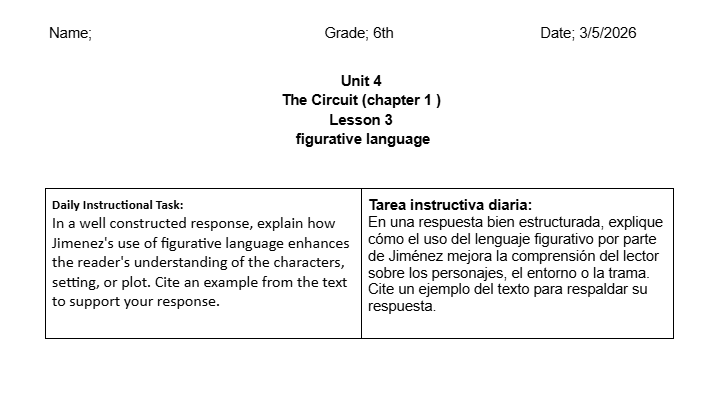
Lesson 3 Figurative Language
Small Groups
-Independent/Partner Writing DIT (8 min)
-Share & Reflect (3 min)
- DIT - 15 min
45


46
Everybody Writes
migrant
hope
puddles
soggy
Piensa en alguna ocasión en la que enfrentaste un problema o desafío. ¿Cómo te sentiste y cómo lo manejaste?
47

Plot
Plot is the organized sequence of events and actions that drive a story
It structure generally includes exposition, conflict, rising action, climax, falling action, and resolution.
48
Multiple Choice
What is a plot in a story ?
49
Multiple Choice
What is a migrant?
50
Multiple Choice
What happens during the harvest?
51
Multiple Choice
Where does Francisco’s family usually work?
52
Multiple Choice
Why is school difficult for Panchito?
53
Multiple Choice
What does hope mean?
54
AGENDA 3/9-23/2026
-Independent Reading 15 min
-Objectives/ Assessment
-Anticipatory Set: Think-Write-Pair-Share (3min) (Everybody Writes)
Lesson 3 Figurative Language
Small Groups
-Independent/Partner Writing DIT (8 min)
-Share & Reflect (3 min)
- DIT - 15 min
55


56
AGENDA 3/2-6/2026
-Independent Reading 15 min
-Objectives/ Assessment
-Anticipatory Set: Think-Write-Pair-Share (3min) (Everybody Writes)
Lesson 5 symbolism
Small Groups
-Independent/Partner Writing DIT (8 min)
-Share & Reflect (3 min)
- DIT - 15 min
57
Everybody Writes
Think about a time you faced a problem or challenge. How did it make you feel, and how did you handle it?
Piensa en alguna ocasión en la que enfrentaste un problema o desafío. ¿Cómo te sentiste y cómo lo manejaste?
58


59
Everybody Writes
Have you ever heard someone say, “It’s raining cats and dogs”? What do you think they really means? Why do you think people use sayings like this instead of just saying it’s raining a lot’?
¿Alguna vez has oído a alguien decir «llueve a cántaros»? ¿Qué crees que significa realmente? ¿Por qué crees que la gente usa dichos como este en lugar de decir simplemente «llueve a cántaros»?
60
Warm up
HEART

61
What is a symbol?
A symbol is something in a story that represents a bigger idea. Examples students know:
Object What it Represents
Heart ❤️ Love
Light 💡 Hope
Storm ⛈ Problems
Authors use symbolism to help readers understand feelings and ideas in a deeper way.
62

63
In Chapter 3 of The Circuit, the family moves from place to place to find work in the fields.
What is the Important object in the chapter 3?
The car / truck the family travels in.

What do you think the car could symbolize?
64
The car is not just transportation. It symbolizes the family's difficult journey and their hope for a better future.
Think-Pair-Share (3 minutes)
How does the car show the family's struggles in the story?
In Chapter 3 of The Circuit, the car symbolizes the family's journey and struggles as migrant workers

65
Multiple Choice
What is symbolism ?
66

67
Figurative Language
A Morning Walk
This morning the sun smiled at the world as I walked to school. The wind whispered through the trees, and the leaves danced like tiny butterflies. My backpack felt as heavy as a mountain, but my excitement was a rocket ready to launch.
Which sentence gives human actions to something that is not human? Can you find a simile (uses like or as)?
Which part is an exaggeration? Figurative language in the text Personification:
The sun smiled / The wind whispered Simile: Leaves danced like tiny butterflies Hyperbole: My backpack felt as heavy as a mountain
Metaphor: My excitement was a rocket
68

69
Multiple Choice
what is figurative language ?
70
71
Figurative Language is when we use words in a creative way to make ideas more interesting, colorful, and vivid, instead of using literal meaning.
Figurative language helps us paint pictures with words.
72
AGENDA 3/2-6/2026
-Independent Reading 15 min
-Objectives/ Assessment
-Anticipatory Set: Think-Write-Pair-Share (3min) (Everybody Writes)
Lesson 1 Launching to the unit
Small Groups
-Independent/Partner Writing DIT (8 min)
-Share & Reflect (3 min)
- DIT - 15 min
73
Unit 3
Do you see me ?
Book "Ghost Boys"
End of unit Assessment

Essential Question;
How do you find courage in the face of fear?
¿Cómo se encuentra el coraje ante el miedo?
74


75
Figurative Language
Chapter 1
76
Everybody Writes
How do people’s hopes and motivations help them pursue the American Dream, even when faced with great challenges?
¿Cómo ayudan las esperanzas y motivaciones de las personas a perseguir el sueño americano, incluso cuando enfrentan grandes desafíos?
People’s hopes and dreams make them keep trying, even when things are hard. Believing they can reach their goals helps them work hard and never give up.
77
Culminating Task : Choose a moment from The Circuit and rewrite it from the perspective of a different character, such as Papa, Mama, Roberto, or a field boss. How does this character experience the event differently from Panchito? What are their thoughts, emotions, and motivations? Use details from the text to make your retelling feel authentic.

Tarea final: Elige un momento de El Circuito y reescríbelo desde la perspectiva de un personaje diferente, como Papá, Mamá, Roberto o un capataz. ¿En qué se diferencia este personaje de Panchito en la experiencia del evento? ¿Cuáles son sus pensamientos, emociones y motivaciones? Usa detalles del texto para que tu relato parezca auténtico.
78

Daily Instructional Task
Write a short response based on the prompts below.
79
80
AGENDA 2/2-6/2026
-Independent Reading 15 min
-Objectives/ Assessment
-Anticipatory Set: Think-Write-Pair-Share (3min) (Everybody Writes)
Lesson 12 Theme
Small Groups Informational Essay ( Body Paragraphs)
-Independent/Partner Writing DIT (8 min)
-Share & Reflect (3 min)
- DIT - 15 min
81


82
Everybody Writes
What are theme in Ghost Boys ? Pages 1-123
Cuales son los temas en el libro "Ghost Boys'
Unfair Treatment Because of Skin Color – Jerome is shot by a police officer just for being Black. This shows how unfair racism can be.
83
What is theme?

84
What is theme?
85
Multiple Choice
What is theme in literature
86


87
AGENDA 1/28-30/2026
-Independent Reading 15 min
-Objectives/ Assessment
-Anticipatory Set: Think-Write-Pair-Share (3min) (Everybody Writes)
Lesson 8-10 Informational Essay ( Body Paragraphs)
-Independent/Partner Writing DIT (8 min)
-Share & Reflect (3 min)
- DIT - 15 min
88
systemic racism,
police brutality, and
the necessity of bearing witness to racial injustice.
Systemic Racism and Injustice: The story highlights how racism persists across time, connecting the 2018 shooting of 12-year-old Jerome with the 1955 murder of Emmett Till.
Bearing Witness and Storytelling: The narrative emphasizes that sharing stories of victims is crucial to fighting against prejudice and ensuring that "every goodbye ain't gone". Empathy and Understanding:
The book encourages us to foster empathy by viewing the world through the eyes of both the victim and the family members affected by violence.
89
D.I.T.

90
Everybody Writes
How does fear affect the characters in Ghost Boys, and how is this like or different from what happens in 'Fears and Phobias'?"
¿Cómo afecta el miedo a los personajes de Ghost Boys, y en qué se parece o se diferencia esto de lo que ocurre en "Miedos y fobias"?
In Ghost Boys, fear makes Jerome feel unsafe and worried, which affects how he acts and thinks. In 'Fears and Phobias', fear also changes how people behave, making them avoid situations or feel anxious. Both show that fear can control thoughts, feelings, and actions.
91
Body Paragraph
1. Topic Sentence
The first sentence of your paragraph.
It introduces the main idea of the paragraph.
Example:
“Fear affects Jerome in Ghost Boys by making him feel unsafe and anxious in his neighborhood.”
92
Body Paragraph
2. Explanation / Context
Explain the topic sentence in your own words.
Give some background if needed.
Example:
“Jerome’s fear is connected to his experiences with racism and the dangers he sees around him every day.”
93
Body Paragraph
3. Evidence / Example
Add facts, quotes, or examples from your sources (book, article, or research).
Use direct quotes or paraphrasing.
Example:
“In the novel, Jerome notices, ‘[Insert quote here],’ which shows that he feels unsafe even in familiar places.”
94
Body Paragraph
4. Explanation / Analysis
Explain how your evidence supports your main idea.
Connect it back to the topic sentence.
Example:
“This quote shows that fear is not just a feeling but also affects Jerome’s actions and decisions.”
95
Body Paragraph
5. Concluding / Transition Sentence
Wrap up the paragraph.
Sometimes, connect to the next paragraph.
Example:
“Because fear influences his behavior, Jerome must learn to cope with these feelings as the story continues.”
Tip: Each paragraph should focus on one main idea. That keeps your essay organized and easy to follow.
96
Multiple Choice
What is a Body Paragraph?
97
Complete Paragraph
Fear affects Jerome in Ghost Boys by making him feel unsafe and anxious in his neighborhood. Jerome’s fear is connected to his experiences with racism and the dangers he sees around him every day. In the novel, Jerome notices, “I try not to walk too fast, but I can’t help looking over my shoulder,” which shows that he feels unsafe even in familiar places. This quote shows that fear is not just a feeling but also affects Jerome’s actions and decisions, causing him to be cautious at all times. Because fear influences his behavior, Jerome must learn to cope with these feelings as the story continues.
98
D.I.T.
99
Small Groups


100
Model
In Ghost Boys, Jerome’s conflicts push the plot forward because they show how unfair treatment, fear, and prejudice affect people’s lives. Jerome struggles with being shot by the police for no reason, and this conflict drives the story by introducing him to the ghost of Emmett Till, who teaches him about the history of racism and the consequences of injustice.
Jerome also faces internal conflicts, such as anger, confusion, and sadness, which show how deeply these events affect him. His attempts to communicate with his family and seek justice for his death create tension and suspense that keep the story moving. Through Jerome’s struggles, the book argues that racism and prejudice harm entire communities, not just individuals, and that understanding history is essential to creating change. By showing Jerome’s conflicts, the story teaches readers important lessons about fairness, empathy, and speaking out against injustice.
101
AGENDA 1/19/2026
-Independent Reading 15 min
-Objectives/ Assessment
-Anticipatory Set: Think-Write-Pair-Share (3min) (Everybody Writes)
Lesson 7 Informational Essay ( introduction ) Hook
-Independent/Partner Writing DIT (8 min)
-Share & Reflect (3 min)
- DIT - 15 min
102


103


104
D.I.T.

105
Everybody Writes
Replace this with your body text. Duplicate this text as many times as you would like. All provided templates can be reused multiple times. Wish you a good day.
Happy teaching!
106
AGENDA 1/12-16/2026
-Independent Reading 15 min
-Objectives/ Assessment
-Anticipatory Set: Think-Write-Pair-Share (2 min) (Everybody Writes)
Lesson 2 Characterization/Character Traits
-Independent/Partner Writing DIT (8 min)
-Share & Reflect (3 min)
- DIT - 15 min
107


108
D.I.T.

109
Characterization: The method an author uses to create and present a character's personality, motives, and psychology.
Character Trait: A specific quality or attribute (e.g., honest, humorous, ambitious) that makes up a character's essence, revealed through description and behavior.
110
Types of Characterization
Direct Characterization: The author explicitly tells the audience about a character's traits (e.g., "She was a kind woman").
Indirect Characterization: The author reveals traits through:
Speech (What they say)
Thoughts (What they think)
Effect on others (How others react to them)
Actions (What they do)
Look (Their appearance)
(Mnemonic: S.T.E.A.L.)g!
111
Chapter 1 Summary Jerome Rogers, a 12-year-old Black boy, is shot and killed by a police officer while playing with a toy gun. Jerome does not understand what has happened at first. He feels confused and scared as he watches his own body lying on the ground. He realizes he is dead and has become a ghost. Jerome begins to see how people react to his death, including the police officer and the crowd nearby.
Chapter 2 Summary Jerome, now a ghost, goes to the police station and sees the officer who shot him. The officer feels afraid and tries to explain that he thought the toy gun was real. Jerome notices how the officer’s fear mattered more than Jerome’s life. Jerome starts to understand that he was killed because of his race. He feels anger and sadness as he watches adults argue about what happened.
112
Chapter 3
Summary
Jerome’s ghost goes home and sees his family grieving. His mother is heartbroken and blames herself for not protecting him. Jerome remembers how much his mother worried about keeping him safe in a dangerous world. He realizes that growing up Black is “perilous,” meaning full of danger. Jerome feels pain seeing his family suffer but also love for them as he watches from the shadows.
113
Multiple Choice
What is characterization?
114
Multiple Choice
Types of characterization
115
Model
Jerome’s mother says that getting a child to adulthood is “perilous,” which means it is dangerous and full of risks, especially for Black children. She worries that even when parents do everything right, their children are still not safe from harm. Jerome’s family shapes who he is by teaching him to be respectful, careful, and aware of how others might see him. For example, his mother warns him to be polite, avoid trouble, and follow rules so he can stay safe. This shows that his family loves him and tries to protect him, even though they know danger still exists. Jerome’s family supports him by guiding his behavior and preparing him for a world that can be unfair.
116
Assessment - DIT

117
Small Groups
118
I can identify at least two literary devices in the poem “Could Have” and explain how each one affects the poem’s meaning or tone using evidence from the text.
Daily Instructional Task:
Students will work in groups to analyze the use of literary devices in the poem “Could Have” by Wisława Szymborska.
119
AGENDA 11/24/2025
-Independent Reading 15 min
-Objectives/ Assessment
-Anticipatory Set: Think-Write-Pair-Share (2 min) (Everybody Writes)
Lesson 7 Narrative Writing
-Independent/Partner Writing DIT (8 min)
-Share & Reflect (3 min)
- DIT - 15 min
120
Anticipatory Set:
View The Elements of a Poem Video and Poetic Devices - Figurative Language - How to Analyze Poems Tell students that we will be looking for the author’s use of literary devices to convey the central idea as we read the poem
"Could Have" by Wisława Szymborska.
121
Poetic Devices and Structure (Cornell Notes)
Poems are arranged in lines or groups of words, that help create rhythm
Stanza: a group of lines that word together to express a central idea
Poetic Elements/Devices: the features authors use to point out their central (main) idea or message to the reader. Rhythm, Rhyme, Figurative Language, Imagery,
122
Background of Poem: This poem comes from Wislawa Szymborska’s View With a Grain of Sand (New York: Harcourt, Brace, 1996). Maria Wisława Anna Szymborska was a Polish poet, essayist, translator and recipient of the 1996 Nobel Prize in Literature. She was born in Prowent in 1923 and later resided in Kraków until the end of her life in 2012.
123
In Two Word Strategy, students reflect on everything they know about the poem they have just read.
Encourage students to consider the poem' s ambiguity, subject matter, tone. Then invite each student to generate two words (these do not need to come from the poem) that reflect their understanding of the poem and write these words on a post-it/notebook.
They should ask themselves: What is the poem mostly about?
They should also record these two words in their notebooks and then use them as the starting point for writing.
Encourage students to write for about 5 to 8 minutes. Have students place their post-it on a board or chart so that the class can see the range of responses. Share out students with a whole group discussion. Make sure that students are able to identify the poem’s central idea.
124
Antithesis Give definition and example of antithesis:
It is a literary device that places opposite words, ideas, or qualities parallel to each other. Example: “I have a dream that my four little children will one day live in a nation where they will not be judged by the color of their skin but by the content of their character.” (Martin Luther King, Jr. “I Have a Dream”). Explain that this is an example of an antithesis as it makes the listener make a comparison of two ideas.
125
AGENDA 12/1-5/2025
-Independent Reading 15 min
-Objectives/ Assessment
-Anticipatory Set: Think-Write-Pair-Share (2 min) (Everybody Writes)
Lesson 7 Narrative Writing
-Independent/Partner Writing DIT (8 min)
-Share & Reflect (3 min)
- DIT - 15 min
126
- Name of Author


127
Anticipatory Set: Everybody writes
In ‘A House of My Own,’ the speaker dreams of a personal space where she can be free and independent. What kind of personal space or safe place do you wish you had in your own life, and why is having that space important to you?”
En «Una casa propia», la narradora sueña con un espacio personal donde pueda ser libre e independiente. ¿Qué tipo de espacio personal o lugar seguro desearías tener en tu vida y por qué es importante para ti?
128
Narrative writing (Cornell Notes)
Title: My Secret Garden
Exposition: Last summer, I discovered a small empty lot near my house. It was full of weeds and trash, but something about it felt magical.
Rising Action: I decided to clean it little by little. Every day after school, I pulled weeds, planted flowers, and even set up a small bench. My friends helped sometimes, but mostly it was my own special project. Climax: One day, after weeks of work, I finally saw the garden bloom. The purple flowers I planted were swaying in the wind, and butterflies landed on them. I felt proud and happy, like I had created my own secret world.
Falling Action: People passing by started noticing my garden. Some smiled, some stopped to ask questions. I realized my little project wasn’t just mine anymore—it made others happy too.
Resolution: Now, every time I visit the garden, I feel peace and pride. It taught me that patience, care, and creativity can turn even a small space into something wonderful.
Narrative Writing
Choose a topic or event – Something from your life, imagination, or inspired by a text. Plan your story structure
(Plot) Exposition – Introduce characters, setting, and situation.
Rising Action – Build up events or conflicts. Climax – The most exciting or important part.
Falling Action – Events that follow the climax.
Resolution – How things end. Include details and emotions – Describe sights, sounds, feelings to make it vivid. Use dialogue if needed – Makes characters come alive. Conclude with reflection – Show what you learned or how you changed.
129

Saturday, June 20, 1942
The Diary of Anne Frank - Saturday, June 20, 1942
130
Key Questions;
What is Anne’s tone at the beginning of the entry?
¿Cuál es el tono de Ana al principio de la entrada?
How does it change towards the end?
¿Cómo cambia hacia el final?
Who does she show great appreciation for? Why?
¿A quién le muestra gran aprecio? ¿Por qué?

131
What is Anne’s tone at the beginning of the entry?
Tone: Frustrated, restless, or confined.
Explanation: At the start, Anne often describes the difficulties of hiding in the Secret Annex—being cooped up, missing freedom, and feeling trapped. She expresses impatience with the monotony of her daily life.
2. How does it change towards the end?
Tone: Reflective, appreciative, or hopeful.
Explanation: By the end of the entry, Anne often finds something positive or meaningful—like writing in her diary, noticing small comforts, or thinking about loved ones. Her tone shifts from frustration to a sense of gratitude or inner peace. calm, her mother for caring, or the helpers who bring food and news from the outside world.
132
3. Who does she show great appreciation for? Why?
She shows appreciation for her family members or helpers in the Annex (like her father, mother, or Margot).
Reason: She recognizes their support, sacrifices, and efforts to keep everyone safe during hiding. For example, she might admire her father for staying

133
Multiple Choice
WHO IS ANNE FRANK ?
134
Multiple Choice
WHAT DOES "SECRET ANNEX" MEANS?
135

136
Anticipatory Set: Ask:
“Have you ever seen someone getting bullied or hurt and no one helped? Why do you think that happens?”
“¿Alguna vez has visto a alguien siendo acosado o herido y nadie le ayudó? ¿Por qué crees que sucede eso?”
Think-Pair-Share responses briefly.
Explain: “Today, we’re going to explore a real psychological phenomenon called the Bystander Effect and learn how authors help us understand ideas like this using text structure.”
137
AGENDA 11/13/2025
-Independent Reading 15 min
-Objectives/ Assessment
-Anticipatory Set: Think-Write-Pair-Share (2 min) (Everybody Writes)
Lesson 2/ text structure
-Independent/Partner Writing DIT (8 min)
-Share & Reflect (3 min)
- DIT - 15 min
138
intervene, confederates, brutal, sensationalized, diffusion, ambiguous, tendency, tactic
intervenir, confederados, brutal, sensacionalista, difusión, ambiguo, tendencia, táctica
139
Mini Lesson
Video on the Bystander Effect Text Structure Video The Bystander Effect by Kendra Cherry
140
Lesson 30

Unit 1
Argumentative Writing
Escritura Argumentativa
141
I can make a clear claim about Percy’s role in the story and support it with reasons and text-based evidence from The Lightning Thief.
Puedo afirmar claramente cuál es el papel de Percy en la historia y respaldarlo con razones y evidencia textual de El ladrón del rayo.
Daily Instructional Task: After completing our novel study of The Lightning Thief, reflect on Percy’s journey. Throughout his quest to return Zeus’s master bolt, Percy is tricked and manipulated by several Olympian gods. Yet, he still manages to complete his mission and prevent a war.
Write a well-structured argumentative response addressing the question: Is Percy more of a pawn or a hero by the end of the story? Be sure to: Clearly state your opinion. Support your claim with specific evidence from the novel. Be sure to explain your reasoning and how your evidence proves your claim.
142
AGENDA 11/11/2025
-Independent Reading 15 min
-Objectives/ Assessment
-Anticipatory Set: Think-Write-Pair-Share (2 min) (Everybody Writes)
Lesson 2/ The Bystander Effect
-Independent/Partner Writing DIT (8 min)
-Share & Reflect (3 min)
- DIT - 15 min
143
Write a summary of the central idea in Kendra Cherry’s article The Bystander Effect. Explain how the structure of the article helps the reader better understand her main point. Use evidence from the article to support your response.
144
I can summarize the main idea of an article and explain how the way it is organized helps the reader understand the author’s message.
Students will write a summary of the central idea in Kendra Cherry’s article The Bystander Effect. Explain how the structure of the article helps the reader better understand her main point. Use evidence from the article to support your response.
145
DIT

146
Everybody Writes
“Which is better: books or movies? Explain your opinion in 2–3 sentences.

147
Argumentative Short Response includes:
Claim – your opinion (in response to a question or prompt)
Evidence – proof from the text Reasoning – explain how the evidence supports your claim
Conclusion – restate your opinion
148
Model Prompt: Should Esperanza be proud of where she comes from?
Claim: Yes, Esperanza should be proud of where she comes from because her neighborhood has shaped who she is. Evidence: In The House on Mango Street, Esperanza says, “I am too strong for her to keep me here forever” (p. 88).
Evidence:
In The House on Mango Street, Esperanza says, “I am too strong for her to keep me here forever” (p. 88).
Reasoning:
This shows that Esperanza understands her roots give her strength, even if she wants to move away. Her experiences on Mango Street make her stronger and more determined to build a better future.
Conclusion:
Esperanza should feel proud of where she comes from because it helped her grow into a confident and hopeful person.
149
Model
Claim: By the end of The Lightning Thief, Percy is more of a hero than a pawn. Reason 1: Percy shows bravery and determination even when the gods try to use him. Evidence; For example, Percy fights Ares on the beach even though Ares is a powerful god. He risks his life to protect his friends and finish his quest. Reasoning: This shows Percy makes his own choices and doesn’t let fear or the gods control him.
Reason 2: Percy chooses to do what is right, not just what others tell him to do. Evidence: When he discovers that Hades isn’t the real thief, Percy decides to return the bolt to Zeus himself instead of running away. Reasoning: This proves that he acts with honesty and courage, showing true hero qualities.
Conclusion: Even though the gods try to manipulate him, Percy stays strong, brave, and loyal. By the end of the story, he proves he is not a pawn but a true hero.
150

151
I can outline a new problem and turning point that makes sense for the characters and follow the novel’s plot structure. “The Lighting Thief”
Puedo hacer un esquema de un nuevo problema y un punto de inflexión que tenga sentido para los personajes y seguir la estructura de la trama de la novela. El Ladrón del Rayo”

152
AGENDA 10/27/2025
-Independent Reading 15 min
-Lesson 31 Culminating Task/ Narrative Writing
-Objectives/ Assessment
-Anticipatory Set: Think-Write-Pair-Share (2 min) (Everybody Writes)
-Quick Review: Dialogue & Plot (2 min)
-Independent/Partner Writing (8 min)
-Share & Reflect (3 min)
- DIT - 15 min
153
Lesson 31
Unit 1
Culminating Task
Tarea culminante
154
Daily Instructional Task


155
Anticipatory Set (2 min)
THINK - WRITE - PAIR - SHARE
Prompt:
“Imagine you are Percy. Something unexpected happens after the ending of the book. What new problem or challenge could he face?”
Imagina que eres Percy. Algo inesperado ocurre al final del libro. ¿A qué nuevo problema o desafío podría enfrentarse?

156
Quick Review: Dialogue & Plot (2 min)
Dialogue shows character feelings and moves the story forward.
Example (2–3 sentences with dialogue + conflict):
Percy looked around the dark cave. “I don’t like this place,” he said nervously. Suddenly, a shadow moved behind the rocks, and he realized they were not alone.
Dialogue: “I don’t like this place,” shows Percy’s fear.
Conflict: The shadow moving creates a new problem or tension.
Plot has a beginning (setting & characters), middle (conflict), and end (climax/resolution).

157
Multiple Choice
What is a dialogue and plot in literature?
158
Model;
The Serpent in the Forest
Introduction
It felt like my adventure was finally over. I had returned Zeus’s lightning bolt, and Camp Half-Blood was quiet again. I walked through the forest, thinking I could finally rest. The air smelled like pine, and the sun was beginning to set. Everything seemed peaceful—until I saw something moving in the shadows.
Sets the scene (forest, sunset, camp) Introduces the character’s feeling (Percy thinks it’s over, but cautious) Hints at the new conflict (something moving in the shadows) Leads naturally into the rising action
159
Rising Action: As I walked closer, I saw a giant serpent slithering out of the trees. My heart jumped, and my hands shook. “Not again!” I shouted, gripping my sword tightly. Grover ran up beside me. “Percy, we need to stop it before it reaches the campers!” he yelled. I nodded. I couldn’t let anyone get hurt. The serpent hissed and raised its head. It was much bigger than I expected. I took a deep breath and moved closer, ready to fight.
160
DIT Schoology 15min.
https://docs.google.com/drawings/d/19_dTcnnZAhmR3JY2ZrNc1nw1iZd54PofZSwz9idxqdM/edit?usp=sharing

161

162
Chapter 5 TWR L4 D1 & D2
Content:
- Objectives-Assessment
- Imagery
- Key Teacher Questions Posed During the Lesson:
- Vocabulary:
- Chapter 5 Questions
- Close Reading of Chapter 5
- Introduce Wedge Protocol:
- Daily Instructional Task:
- Small Groups
By Deyvi Rocha

163
lesson 29
Everybody Writes
Do Now: Read the following paragraph.
“Maria practiced every afternoon for the school spelling bee. Even when she got tired or frustrated, she didn’t give up. On the day of the competition, she didn’t win first place, but she felt proud knowing she had tried her best.”
Think, write ,Pair-Share:
What lesson or message do you think the author wants to show in this story? Think-Pair-Share: What clues helped you figure that out?
164
I can explain what Percy’s decisions reveal about his character and connect those decisions to a larger theme in the novel, using evidence from the text.
Puedo explicar lo que las decisiones de Percy revelan sobre su carácter y conectar esas decisiones con un tema más amplio en la novela, utilizando evidencia del texto.
In Chapter 21, Percy makes important decisions when he returns the master bolt to Zeus. What do his choices reveal about his character, and how do they connect to one of the main themes of the story? Use evidence from the chapter to support your answer.
165
CHAPTER 21 THEME SUMMARY
In Chapter 19, Percy, Annabeth, and Grover finally enter the Underworld to find Hades and return Zeus’s master bolt. The place is dark, scary, and filled with lost souls. They have to cross the River Styx and meet Charon, the boatman who takes them to Hades’ palace. When they finally meet Hades, Percy tells him he doesn’t want a war and only came to get his mom back. But then something surprising happens — the master bolt appears inside Percy’s backpack! Percy realizes that someone must have planted it there to make it look like he was the thief. Hades gets angry and thinks Percy also stole his magic helmet of darkness. Percy tries to explain, but Hades doesn’t believe him. Percy decides not to fight Hades. Instead, he uses the pearls from Poseidon to escape with Annabeth and Grover, even though it means leaving his mom behind for now. This chapter shows Percy’s bravery, quick thinking, and how much he loves his mom. It also reveals that someone powerful has been tricking the gods all along.
166
Multiple Choice
WHAT IS THEME?
167
THEME
The theme in Chapter 19 of The Lightning Thief is bravery and making difficult choices. Percy shows courage when he faces Hades, one of the most powerful gods, even though he’s scared. He also makes a hard choice to leave his mom behind so he and his friends can escape and stop the war between the gods. This shows that being a true hero means doing what’s right, not what’s easy. Another theme is trust and betrayal. Percy learns that someone has tricked him by hiding the master bolt in his backpack. This shows that not everyone can be trusted and that heroes must be careful about who they believe.
168
MODEL
In Chapter 21, Percy shows that he is brave and honest when he returns the master bolt to Zeus. Even though Percy could have kept it or used it for power, he decides to do the right thing. This shows that he wants peace, not war. It also shows he takes responsibility for his actions. This connects to one of the main themes of the story, doing what is right, even when it’s hard. Percy learns that being a hero means making good choices, not just fighting monsters. For example, when he gives the bolt back to Zeus, Percy says he only wants to stop the war between the gods. This proves he cares about others more than himself.
169
After using the Wedge Protocol for essay feedback, students are to make revisions to complete their final draft of their compare and contrast essay.
I can use the point by point structure to organize my compare and contrast essay.
I can use the Wedge Protocol to give and receive feedback to enhance my Compare and Contrast essay.
170

171
Imagery
Imagery is when a writer paints a picture with words so you can imagine what it looks, feels, sounds, smells, or tastes like.


Imagery is the author’s use of language that appeals to the five physical senses. Watch the video “What is Imagery?”
172

173
Example: Chapter 5
“The landscape was dotted with buildings that looked like ancient Greek temples but had modern touches, like air conditioning units and satellite dishes.”
In this description, Riordan blends ancient and modern elements, helping readers visualize Camp Half-Blood as a place where mythological traditions meet contemporary conveniences.
“El paisaje estaba salpicado de edificios que parecían templos griegos antiguos, pero con toques modernos, como unidades de aire acondicionado y antenas parabólicas.”
En esta descripción, Riordan mezcla elementos antiguos y modernos, ayudando a los lectores a visualizar el Campamento Mestizo como un lugar donde las tradiciones mitológicas se encuentran con comodidades contemporáneas.
174
TURN AND TALK
What two things are being compared?
What are the points of comparison?
How are they alike?
How are they different?

175
Multiple Choice
What is imagery in writing?
Words that make the reader see, hear, smell, taste, or feel something
A summary of a story
The main idea of a paragraph
176
Chapter 5: The Lightning Thief –
Who is Mr. D? What kind of person/god is he? What makes him unhappy?
Mr. D is Dionysus, the Greek god of wine and parties.
He is strict, grumpy, and doesn’t like kids complaining.
He is unhappy because he has to stay at Camp Half-Blood as punishment.
Percy is at Camp Half-Blood. What can you infer about who he is?
Percy is not an ordinary kid; he is a demigod (half human, half god).
Evidence: He survives dangerous events and is being trained at a camp for kids like him.
Would you want to live forever? Why or why not?
Example: No, because living forever could get boring and you might miss out on the natural cycle of life.
Chiron claims that the influence of Ancient Greeks can be found in all places across America. Do you agree or disagree?
Example answer: Yes, because many buildings, schools, and statues in America are inspired by Greek designs.
177


178
Vocabulary- Chapter 5
Reverently (p. 58) – Showing deep respect for someone or something.
Example: Percy looked at the camp reverently because it was special.
Wistful (p. 61) – Feeling a little sad or longing for something.
Example: He felt wistful thinking about home.
Gingerly (p. 61) – Doing something carefully and gently.
Example: Percy stepped gingerly on the rocks.
Pavilion (p. 62) – A large, open building or tent used for events or gatherings.
Example: The campers gathered in the pavilion for lunch.
Mischievous (p. 63) – Being playfully naughty or causing minor trouble.
Example: Grover gave Percy a mischievous grin.
Stereotypical (p. 63) – Following a common or typical idea about a person or thing.
Example: Percy thought the camp looked stereotypical like in myths. Immortal (p. 68) – Living forever; never dying. Example: The gods are immortal, so they live forever.
179
Chapter 5: “I Play Pinochle with a Horse” – Summary
Percy arrives at Camp Half-Blood, a safe place for kids who are demigods—half human, half god. He meets Chiron, a wise centaur who trains the campers and teaches them about Greek mythology. Percy sees the camp’s magical buildings, cabins, and special areas for each god, and meets other kids like him. He begins to understand that he is different from ordinary kids and starts to learn about his own powers and destiny. The chapter shows the exciting, mysterious, and magical life at the camp.
Capítulo 5: “Juego Pinochle con un Caballo” – Resumen Percy llega al Campamento Mestizo, un lugar seguro para niños que son semidioses, mitad humanos y mitad dioses. Conoce a Quirón, un centauro sabio que entrena a los campistas y les enseña sobre la mitología griega. Percy ve los edificios mágicos del campamento, las cabañas y las áreas especiales para cada dios, y conoce a otros niños como él. Comienza a entender que es diferente de los niños comunes y empieza a aprender sobre sus propios poderes y destino. El capítulo muestra la vida emocionante, misteriosa y mágica del campamento.
180
Close Reading of Chapter 5, “I PLAY PINOCHLE WITH A HORSE” Reciprocal Reading
Identify the author's use of imagery.
Who is Mr. D? What kind of person/god is he? What makes him unhappy? Use textual evidence to support your answer.
Percy is at Camp Half-Blood. What can you infer about who he is? Use evidence to support your answer.
A brief discussion of immorality occurs. Would you want to live forever? Why or why not?
181
Independent Work:
Identify the senses being appealed to then write a 2-3 sentences response that tells what is being revealed about Half-Blood camp.
“The landscape was dotted with buildings that looked like ancient Greek architecture—an open air pavilion, an amphitheater, a circular arena—except that they all looked brand new, their white marble columns sparkling in the sun. In a nearby sandpit, a dozen high-school aged kids and satyrs played volleyball. Canoes glided across a small lake. Kids in bright orange T-shirts like Grover’s were chasing each other around a cluster of cabins nestled in the woods” (Chapter 5, pg. 67)
El paisaje estaba salpicado de edificios que parecían de la arquitectura griega antigua: un pabellón al aire libre, un anfiteatro, una arena circular, solo que todos parecían nuevos, con sus columnas de mármol blanco brillando al sol. En un arenero cercano, una docena de estudiantes de secundaria y sátiros jugaban al voleibol. Las canoas se deslizaban por un pequeño lago. Niños con camisetas naranjas brillantes como las de Grover se perseguían unos a otros alrededor de un grupo de cabañas enclavadas en el bosque (Capítulo 5, pág. 67).
182
WEDGE PROTOCOL
Purpose:
Wedge Protocol is a way to help students talk about a text, understand it better, and share ideas in groups.
Step 1: Introduce “The Roles” Each student has a special job in the group:
Reader – Reads the text out loud to the group. Summarizer – Tells the group the main ideas in their own words.
Questioner – Asks questions about things they didn’t understand or are curious about.
Clarifier – Explains difficult words or confusing parts.
Complimenter – Says something nice or positive about someone’s idea or contribution.
183
Small Groups


184
LESSON 22
Objectives-Assessment
Imagery
Key Teacher Questions Posed During the Lesson: - Vocabulary: -
Chapter 14 Tone and Mood
-Daily Instructional Task.
- Small Groups

185
In a well-constructed paragraph, Students will describe the mood in the scene by the river and explain how the author creates it. Then, describe what the woman in the water communicates to Percy and identify her tone when speaking to him. Be sure to support your ideas with specific evidence from the text that shows the mood and tone in the scene.
I can determine the tone and mood by analyzing the author’s word choices and explaining how they affect the reader’s experience.
186
Tone and Mood

187
Multiple Choice
what is tone?
188
Close Reading of Chapter 14:
Students will read Chapter 14, “I Become a Known Fugitive.” (Teachers may use Reciprocal Reading, Jigsaw, Carousel, Big Paper, and etc. to engage student conversations.) Use the following questions to guide discussion:
How does Percy’s father’s belief in him change his attitude?
How does his tone change? Use textual evidence to explain.
What does the messenger tell Percy to do? What does she warn him about?
What do you think this means? Use textual evidence to support. What special power does being half-blood give Percy? What helps him, give specific details. How does it help him? Use evidence from text to support your thinking.
189
Multiple Choice
what is mood in literature?
Monday Tuesday Wednesday Thursday Friday
reading Conference
Arlenyz Jazlyn Jayden Erick Fabier
Albriery Dario Jayleen Rosa Said
Show answer
Auto Play
Slide 1 / 189
SLIDE
Similar Resources on Wayground

177 questions
SOUTH EAST ASIAN ART
Presentation
•
8th Grade
170 questions
Untitled Lesson
Presentation
•
6th Grade
177 questions
Sight Words Level 1
Presentation
•
1st - 5th Grade
169 questions
Unit 8 - Civil Rights Movement
Presentation
•
8th Grade
173 questions
FINAL TEST_EMPOWER A1
Presentation
•
KG
188 questions
ENGLISH 5 2ND PT REVIEWER
Presentation
•
5th Grade
197 questions
Hand Tools
Presentation
•
7th Grade
174 questions
Southwest Asia’s presentation
Presentation
•
7th Grade
Popular Resources on Wayground
10 questions
Safety Day 2026 – Student Review

Quiz
•
9th Grade
21 questions
Continents and Oceans
Quiz
•
6th Grade
20 questions
Parts of Speech
Quiz
•
5th Grade
16 questions
Subject & Predicate
Quiz
•
5th Grade
25 questions
Multiplication Facts
Quiz
•
5th Grade
12 questions
Map Skills
Quiz
•
3rd Grade
22 questions
Continents and Oceans
Quiz
•
5th Grade
15 questions
Rounding Decimals
Quiz
•
5th Grade
Discover more resources for Education
21 questions
Continents and Oceans
Quiz
•
6th Grade
20 questions
Context Clues
Quiz
•
6th Grade
10 questions
Columbus Day and Indigenous People's Day

Interactive video
•
5th - 8th Grade
20 questions
Elements, compounds, and mixtures
Quiz
•
6th Grade
20 questions
Area of Parallelograms and Triangles
Quiz
•
6th Grade
20 questions
Add and Subtract Integers
Quiz
•
6th - 8th Grade
28 questions
SMS Staff by the Numbers
Quiz
•
6th - 8th Grade
14 questions
Explore Integers and Rational Numbers
Quiz
•
6th Grade