9 weeks test analysis (review)
Presentation
•
Biology
•
9th - 12th Grade
•
Practice Problem
•
Hard
+11
Standards-aligned
Kyndaliln Mooney
FREE Resource
16 Slides • 43 Questions
1
2
Hotspot
Which enzyme will bind with the substrate?
3
Drag and Drop
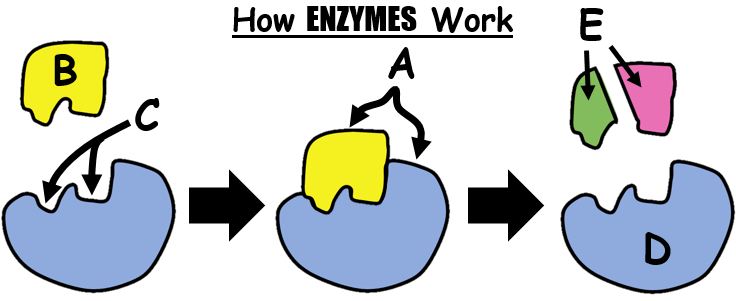
Letter A is the
4
5
Hotspot
Click on the temperature that this enzyme is having optimum activity.
6
7
Multiple Choice
What can be inferred about the pH at which bromelain is most active, based on the graph and the experiment results?
Bromelain is most active at a pH between 3 and 7.
Bromelain is most active at a pH below 2.
Bromelain is most active at a pH above 10.
Bromelain is most active at a pH between 8 and 10.
8
Hotspot
At what pH are both enzymes working?
9
Multiple Choice
What is the primary function of mitochondria?
ATP production
Protein synthesis
Lipid metabolism
DNA replication
10
11
Multiple Choice
Which structure is responsible for controlling substances that enter and leave the cell?
A
B
C
D
12
Hotspot
Identify the part of the membrane that allows small molecules to pass through
13
14
Multiple Choice
Base your answers on the graph and your knowledge of biology.
Both enezymes function from about __ to __.
4-12
0-6
0-12
4-6
15
16
Multiple Choice
After a chemical reaction, enzymes...
17
18
Multiple Choice
What is the purpose of enzymes?
19
20
Multiple Choice
Which statement explains how a change in pH affects the activity of an enzyme?
It alters the shape of the enzyme.
It alters the density of the enzyme.
It alters the solubility of the enzyme.
It alters the concentration of the enzyme.
21
Multiple Choice
structural change in the protein that results in the loss (usually permanent) of its biological shape
denature
-ase
22
Multiple Choice
How do enzymes speed up chemical reactions?
by generating ATP
by lowering activation energy
by raising temperature
by destroying substrates
23
Multiple Choice
What is the activation energy?
24
An enzymes ACTIVE SITE must match the shape of the substrate!
25
Multiple Choice
Letter C...
products
substrate
enzymes
active site
26
Multiple Choice
What type of macromolecules are enzymes?
carbohydrates
lipids
nucleic acids
proteins
27
28
Multiple Choice
At which point during the day was the rate of photosynthesis the highest?
P
Q
R
S
29
Multiple Choice
What is the primary product of photosynthesis?
30
Multiple Choice
Which process describes the energy transformation that takes place during photosynthesis?
conversion of light energy to chemical energy
conversion of chemical energy to heat energy
conversion of chemical energy to light energy
conversion of light energy to heat energy
31
32
33
Multiple Choice
What are the products of the light-dependent and light-independent reactions, labeled Y and Z, respectively?
Y: carbon dioxide; Z: water
Y: cellulose; Z: glycerol
Y: oxygen; Z: glucose
Y: sugars; Z: oxygen
34
35
36
Multiple Choice
During which stage of photosynthesis is oxygen produced?
Calvin cycle
electron chain
light dependent
light independent
37
Match
Match the following
A
B
C
D
Mitochondria
nucleus
chloroplast
bacteria
Mitochondria
nucleus
chloroplast
bacteria
38
Match
Match the following
mitochondria
chloroplast
nucleus
bacteria
site of ATP production
site of photosynthesis
contains DNA in eukaryotes
No membrane bound organelles
site of ATP production
site of photosynthesis
contains DNA in eukaryotes
No membrane bound organelles
39
Multiple Choice
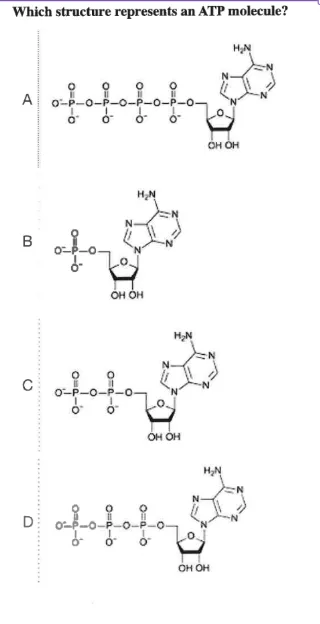
What is the role of ATP?
40
Multiple Choice
What are the three parts of an ATP molecule?
deoxyribose sugar, phosphate groups, and a nitrogen base
ribose sugar, phosphate groups, and a nitrogen base
amino acid, ribose sugar, and phosphate groups
monosaccharide, amino acid, and phosphate groups
41
Multiple Choice
42
43
HIGH
LOW
44
Multiple Choice
What form of transport is illustrated in the diagram?
active transport, moving solutes into the cell against the concentration gradient
active transport, moving solutes into the cell down the concentration gradient
passive transport, moving solutes into the cell against the concentration gradient
passive transport, moving solutes into the cell down the concentration gradient
45
Multiple Choice
The movement of molecules (matter) from an area of greater concentration (how much of something) to an area of lower concentration. Does not require energy.
Active Transport
Passive Transport
Osmosis
Diffusion
46
Match
Which type of solution were these blood cells placed in?
hypotonic
isotonic
hypertonic
hypotonic
isotonic
hypertonic
47
Match
Match each letter to the cell transport process.
J
K&L
M
Simple Diffusion
Facilitated Diffusion
Active Transport
Simple Diffusion
Facilitated Diffusion
Active Transport
48
Labelling
Label the parts of the cell membrane
fatty acid tails
protein
phosphate heads
49
Multiple Choice
Which is a virus? Remember a virus does not have ANY cell organelles, only genetic material (DNA or RNA)
#1
#2
#3
#4
50
Multiple Choice
This image is a virus and not a bacteria. The test writers are hoping you confuse Core Wall with _____ ______
cell wall
nothing....
51
Hotspot
What are 3 of the four organelles that are shared by prokaryotes?
52
Match
Match the following
multicellular plant
unicellular prokaryote
unicellular eukaryote
multicellular eukaryote
multicellular plant
unicellular prokaryote
unicellular eukaryote
multicellular eukaryote
53
Multiple Choice
In which picture is the chloroplast labeled correctly?
54
Multiple Choice
What did Matthias Schleiden observe?
Plant Cells
Animal Cells
Bacteria
55
Fill in the Blanks
Type answer...
56
Multiple Choice
What did Theodore Schwann observe?
Plant Cells
Animal Cells
Bacteria
57
Multiple Choice
Who coined the term "cell" by looking at cork?
Hooke
Leeuwenhooke
Schwann
Virchow
58
Multiple Choice
59
Multiple Choice
Show answer
Auto Play
Slide 1 / 59
SLIDE

Similar Resources on Wayground
53 questions
Final DNA Structure and Replication
Presentation
•
9th - 12th Grade
55 questions
Evolution
Presentation
•
9th - 12th Grade
52 questions
Regulation of Gene Expression
Presentation
•
9th - 12th Grade
52 questions
Gene Expression
Presentation
•
9th - 12th Grade
52 questions
The Atom and Its History
Presentation
•
9th - 12th Grade
52 questions
All About Electrons - Electron Configuration
Presentation
•
9th - 12th Grade
50 questions
Adaptive Value of Behavior
Presentation
•
9th - 12th Grade
53 questions
Biomolecules
Presentation
•
9th - 12th Grade
Popular Resources on Wayground
20 questions
STAAR Review Quiz #3
Quiz
•
8th Grade
20 questions
Equivalent Fractions
Quiz
•
3rd Grade
6 questions
Marshmallow Farm Quiz
Quiz
•
2nd - 5th Grade
20 questions
Main Idea and Details
Quiz
•
5th Grade
20 questions
Context Clues
Quiz
•
6th Grade
20 questions
Inferences
Quiz
•
4th Grade
19 questions
Classifying Quadrilaterals
Quiz
•
3rd Grade
12 questions
What makes Nebraska's government unique?
Quiz
•
4th - 5th Grade
Discover more resources for Biology
14 questions
Ecological Succession: Primary and Secondary
Quiz
•
9th Grade
20 questions
Structure & DNA Replication Quiz
Quiz
•
9th Grade
50 questions
Biology EOC Review
Quiz
•
9th Grade
33 questions
Module C - Virus vs Cells, Biomolecules & Enzymes
Quiz
•
9th Grade
25 questions
photosynthesis and cellular respiration
Quiz
•
9th Grade
25 questions
STAAR Evolution Vocabulary
Quiz
•
9th Grade
20 questions
Food Chains and Food Webs
Quiz
•
7th - 12th Grade
20 questions
Genetics 2026
Quiz
•
10th Grade