Search Header Logo
Physics U5 Work & Energy Test Review

Physics U5 Work & Energy Test Review

Assessment

Presentation

Physics

10th Grade

Practice Problem

Medium

NGSS
HS-PS3-1, HS-PS2-1, MS-PS3-4

+6

Standards-aligned

Created by

Michele Orr

Used 3+ times

FREE Resource

9 Slides • 11 Questions

1

Energy & Work Test Review

​Physics: Unit 5

media

2

Objectives

  • Calculate work, kinetic energy, potential energy, and mechanical energy using appropriate formulas. (HS-PS3-1, HS-PS3-2)

  • Apply the law of conservation of energy to analyze motion in systems such as roller coasters, pendulums, and machines. (HS-PS3-1, HS-PS3-3)

  • Evaluate the efficiency of machines and explain why efficiencies greater than 100% are not physically possible. (HS-PS3-3)

3

Poll

How confident do you feel about mastering the objectives of this unit?

🔴 Not confident yet – I need more practice with the concepts.

🟠 Somewhat confident

– I can do some calculations but still make mistakes.

🟡 Mostly confident

– I understand the formulas and can usually solve problems.

🟢 Very confident

– I can explain and calculate energy/work problems without help.

4

media

15 Questions

Formula sheet and calculator provided

U5: Work & Energy Test

5

media

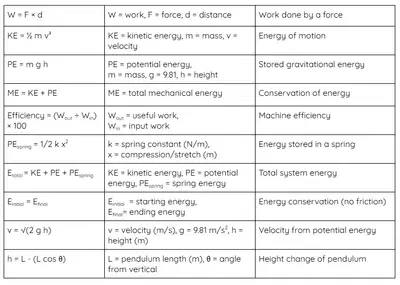
W = F × d


Work

6

Multiple Choice

Question image
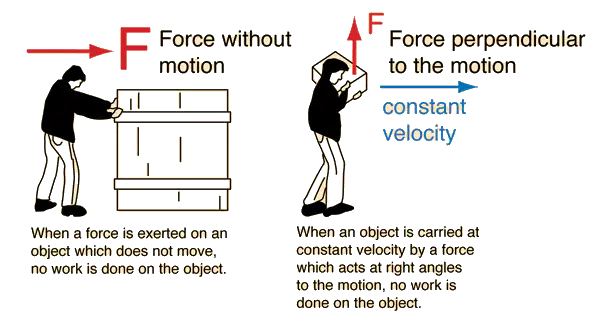
Consider the two examples below. In which instance is more work done? 
1
Example A 
2
Example B 
3
Example A and Example B represent the same amount of work. 
4
Neither example represents any work done. 

7

Multiple Choice

Question image

A student pushes a 15 kg box with a force of 50 N across the floor for a distance of 4 m. The box moves at a constant speed.

How much work does the student do, and why does this work not increase the box’s kinetic energy?

1

200 J; because the work is used to overcome friction rather than change kinetic energy.

2

200 J; because all of the work is stored as potential energy.

3

600 J; because the box has a mass of 15 kg and the force is applied.

4

50 J; because the box is moving at a constant speed and no work is done.

8

media
  • Formula: v = √(2gh)

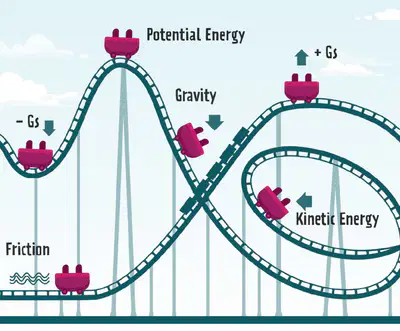
  • At the bottom of a hill, potential energy (mgh) becomes kinetic (½mv²).

Conservation of Energy

9

Draw

A skateboarder of mass 60 kg starts from rest at the top of a 20 m ramp. Ignoring friction and air resistance, what is the skateboarder’s velocity at the bottom of the ramp?

10

Multiple Choice

Two roller coasters, A and B, both start at a height of 40 m. Coaster A is smooth with no friction, while Coaster B loses 25% of its mechanical energy to friction by the time it reaches the bottom.

Which statement best describes their velocities and the role of friction?

1

Both coasters reach the same velocity of 28.0 m/s because mass cancels out in the equation.

2

Coaster A reaches about 28.0 m/s, while Coaster B is slower at about 24.3 m/s, because some of its energy is transformed into heat due to friction.

3

Coaster A and Coaster B both stop at the bottom because friction cancels all energy.

4

Coaster A is faster because it has less mass than Coaster B.

11

media

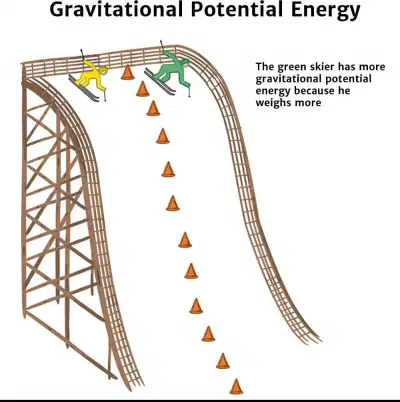
PE = mass x gravity x height

Gravitational Potential Energy

12

Multiple Choice

Question image

A 0.60 kg snowball is dropped from a 4.0 m roof. Ignoring air resistance, what is its gravitational potential energy before release?

1

12 J

2

19 J

3

24 J

4

30 J

13

media

ME = KE + PE

KE = ½ m v²
PE = m g h

Mechanical Energy

14

Drag and Drop

Question image
A 1,200 kg car is driving up a hill at a speed of 15 m/s. The hill is 10 m tall. What is the car’s total mechanical energy at that point?​
Drag these tiles and drop them in the correct blank above
135,000J
270,000J
112,000J
252,720J

15

media
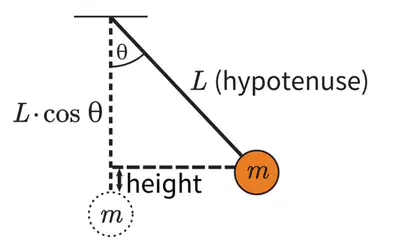
  • Find the height change: h = L – (L cos θ)

  • Use energy conservation:

    v = √(2gh)

Pendulum Velocity

16

Open Ended

Question image

A 3.5 m pendulum is released from 40°. What is its velocity at the lowest point?

17
media
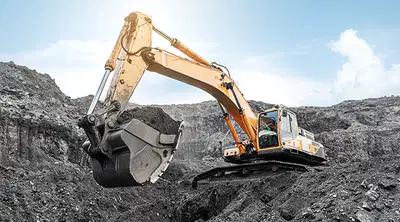
  • Formula: Efficiency = (Wout ÷ Win) × 100

  • No machine is 100% efficient

  • Some input energy is always lost as heat, sound, or friction

​Machine Efficiency

18

Math Response

A machine takes in 800 J of input work and outputs 500 J. What is its efficiency?

Type answer here
Deg°
Rad

19

Multiple Choice

A student carries their heavy backpack (15 kg) straight up three flights of stairs, while another student uses the same amount of energy to slowly walk the same backpack up a long ramp to the same height. The student who used the ramp did less work because the ramp made the climb easier.

1
True
2

False

20

Poll

How confident are you in your ability to perform well on the U5: Work & Energy test?

🔴 Not ready – I still need a lot more practice.

🟠 Getting there – I understand some parts but still get confused.

🟡 Almost ready – I can solve most problems but need to review a little more.

🟢 Test ready! – I feel confident and prepared.

Energy & Work Test Review

​Physics: Unit 5

media

Show answer

Auto Play

Slide 1 / 20

SLIDE