

Terrestrial Biomes Review

Presentation
•
Science
•
11th Grade
•
Practice Problem
•
Medium
+4
Standards-aligned

Tristian Barronton
Used 5+ times
FREE Resource
38 Slides • 11 Questions
1


2
3
4
5
6
7
Multiple Choice
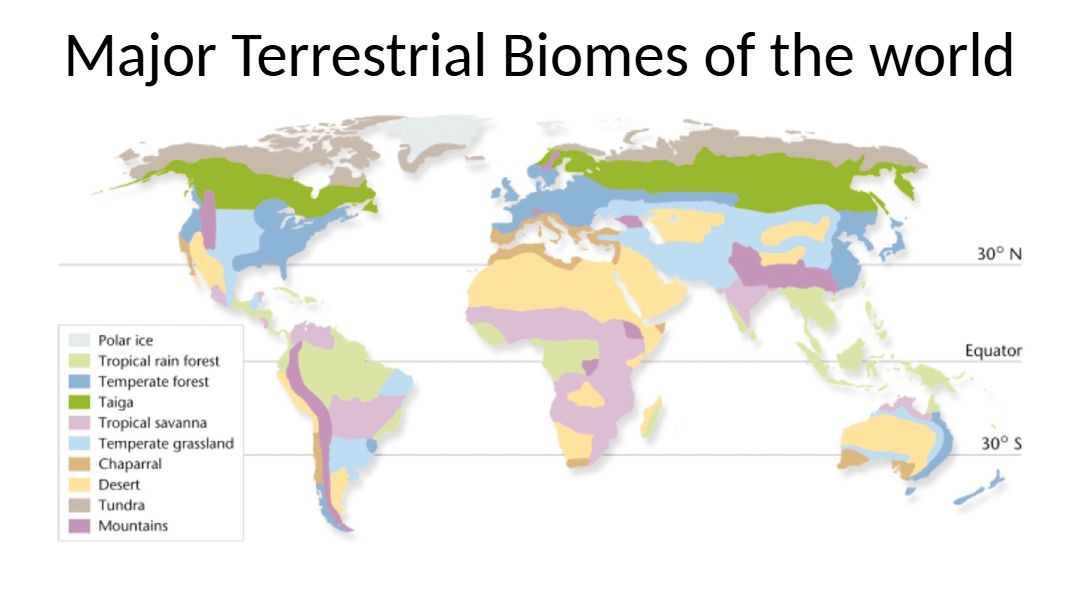
According to the map of major terrestrial biomes, which biome is most commonly found near the equator?
Desert
Tundra
Tropical rain forest
Taiga
8
9
Fill in the Blanks
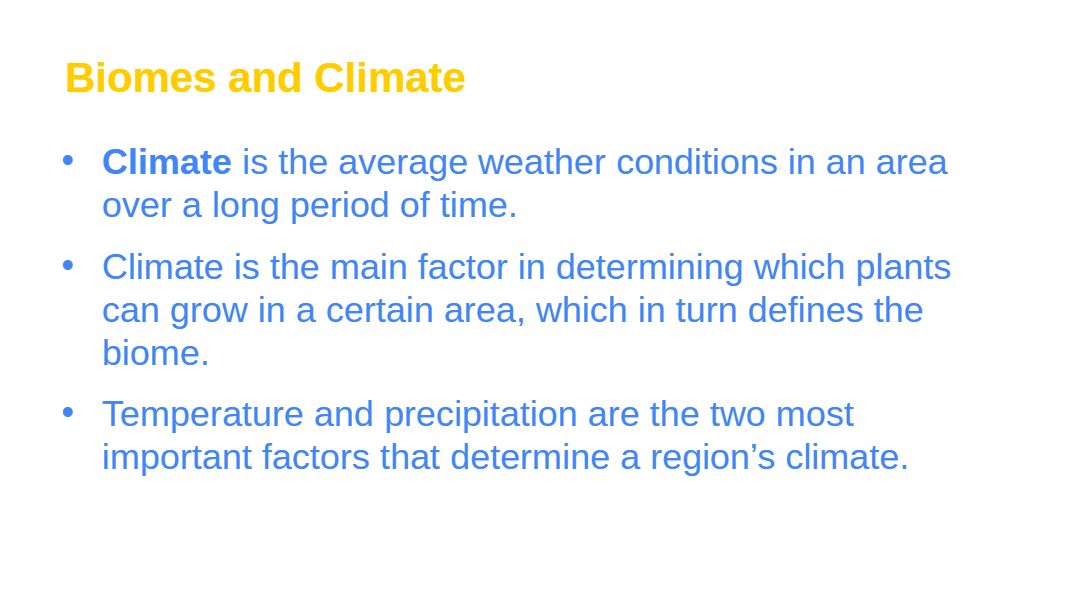
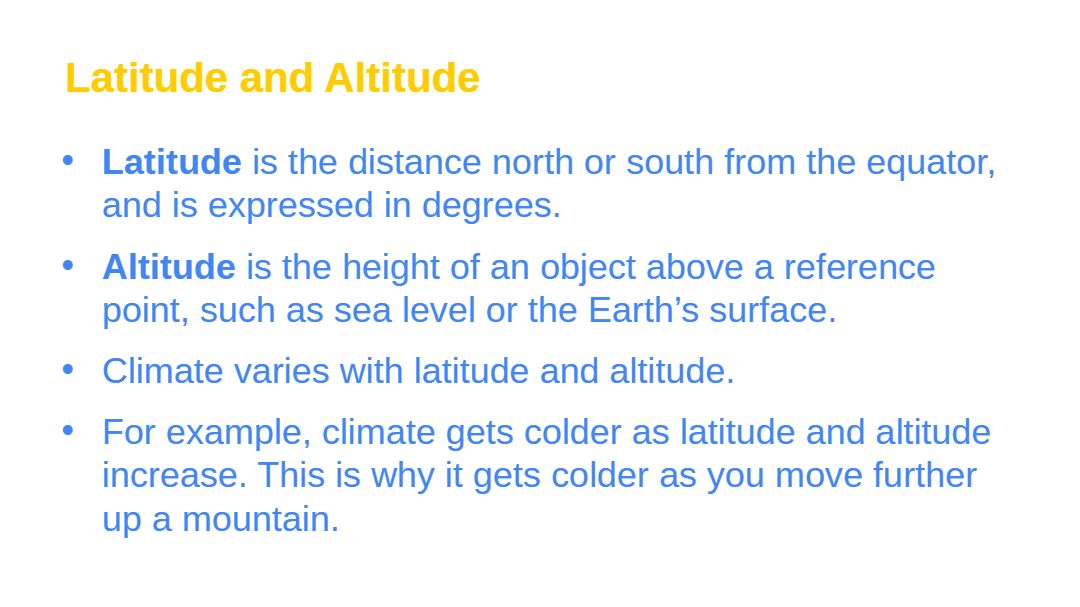
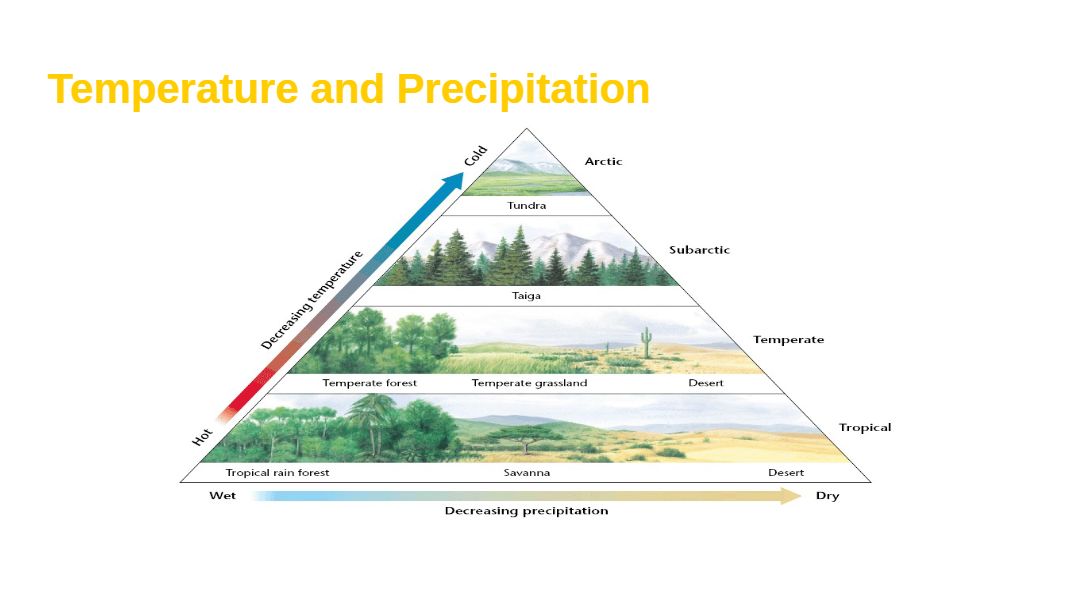
The two most important factors that determine a region’s climate are temperature and
10
11
12
Multiple Choice
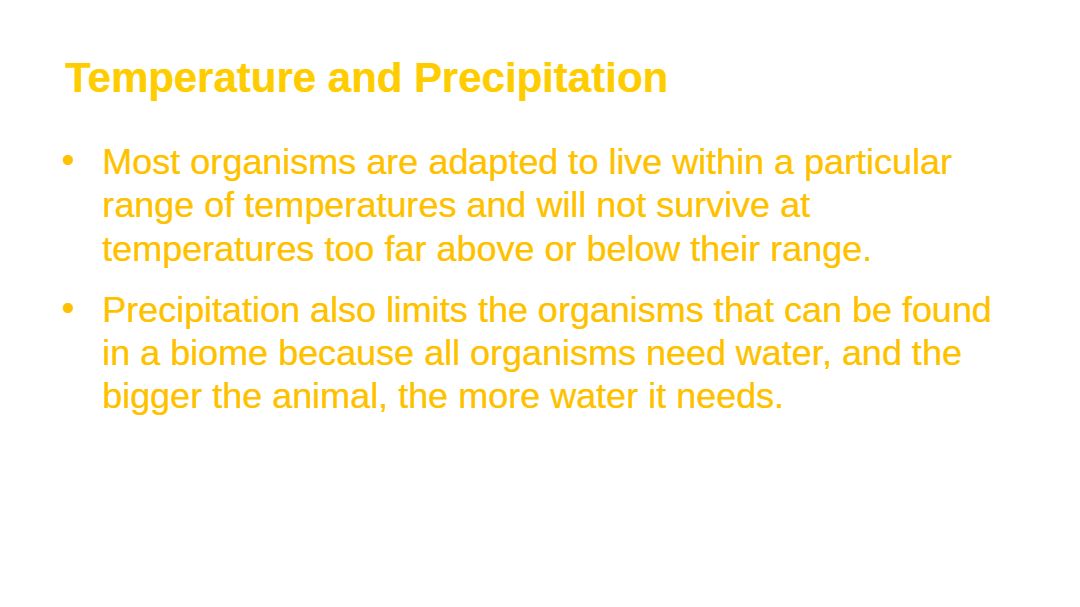
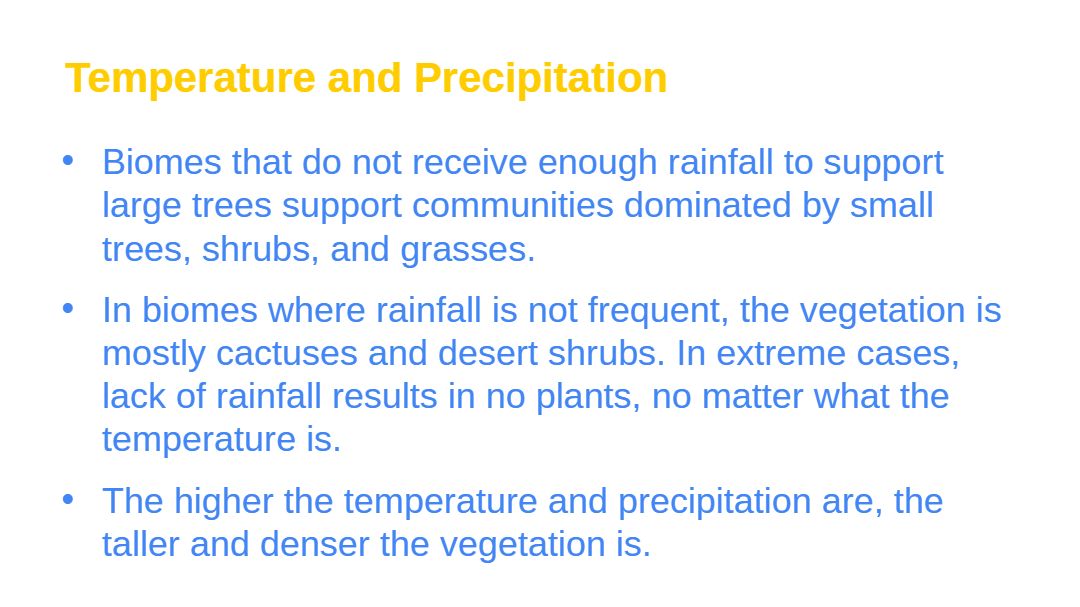
Which of the following best explains why biomes with low rainfall do not support large trees?
Because small trees, shrubs, and grasses are better adapted to survive with less water.
Because large trees require more sunlight than is available in these biomes.
Because the soil in these biomes is too rich for large trees.
Because animals in these biomes eat all the large trees.
13
14
15
Multiple Choice
How do temperature and precipitation together influence the types of vegetation found in different biomes?
16
17
Fill in the Blanks
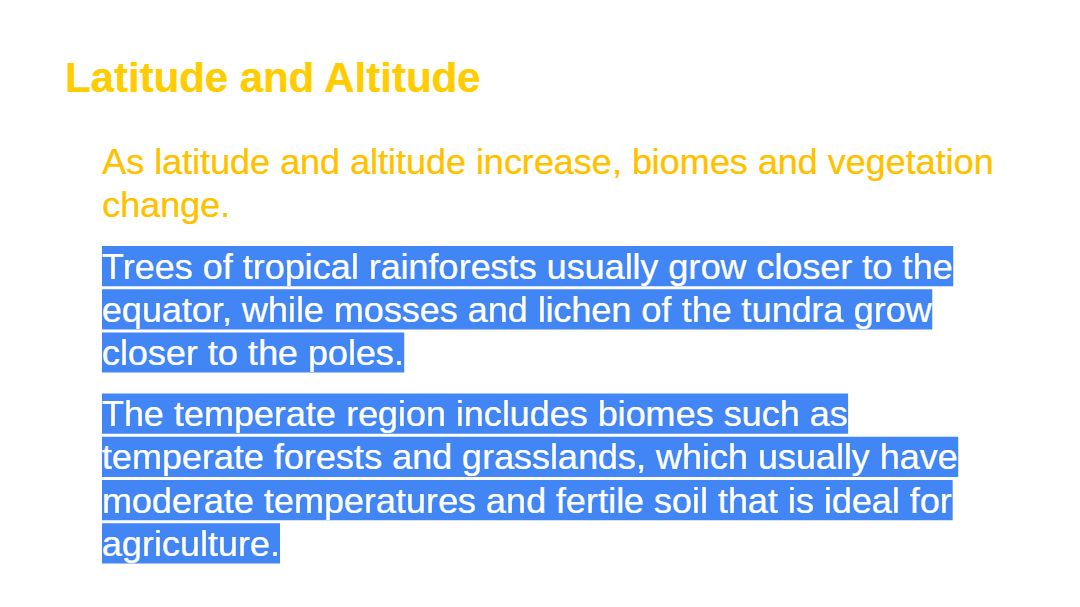
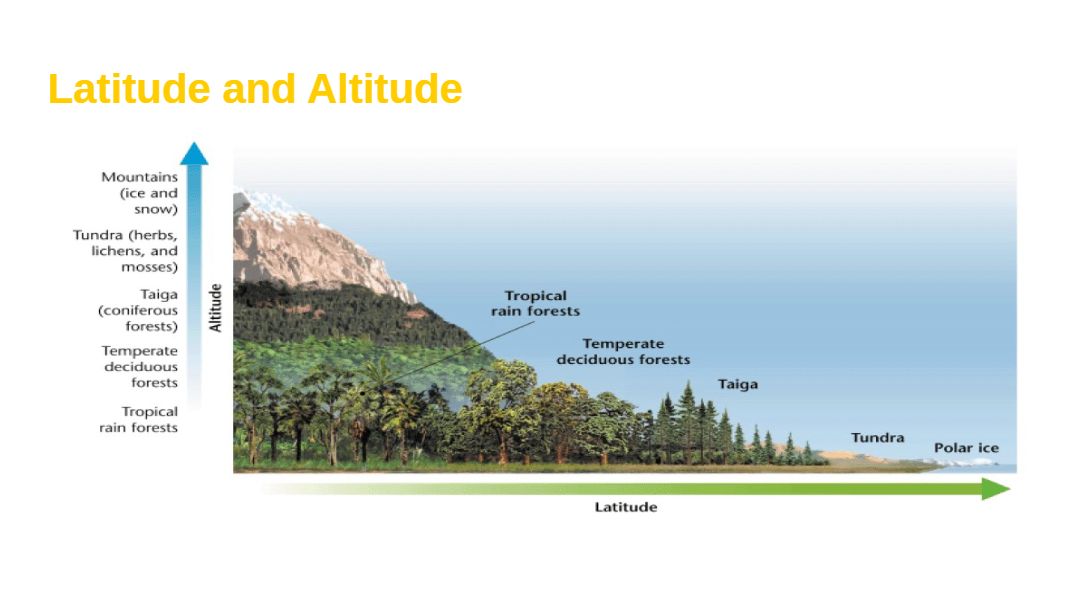
As latitude and altitude increase, biomes and vegetation change. Trees of tropical rainforests usually grow closer to the ___ , while mosses and lichen of the tundra grow closer to the ___.
18
19
20
21

22
23
Fill in the Blanks
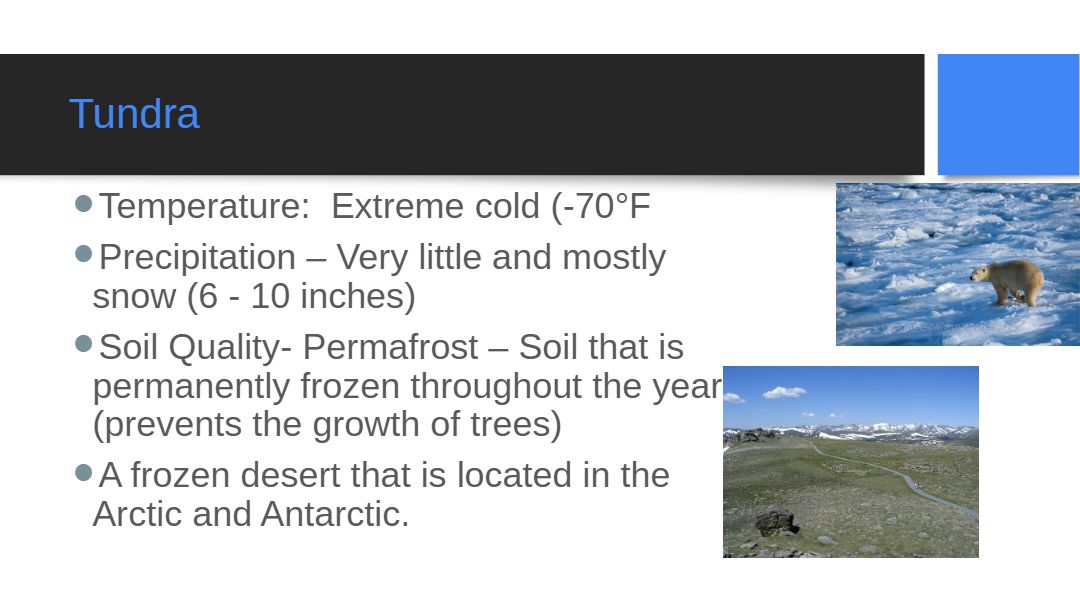
The soil in the tundra biome is permanently frozen and is called
24
25
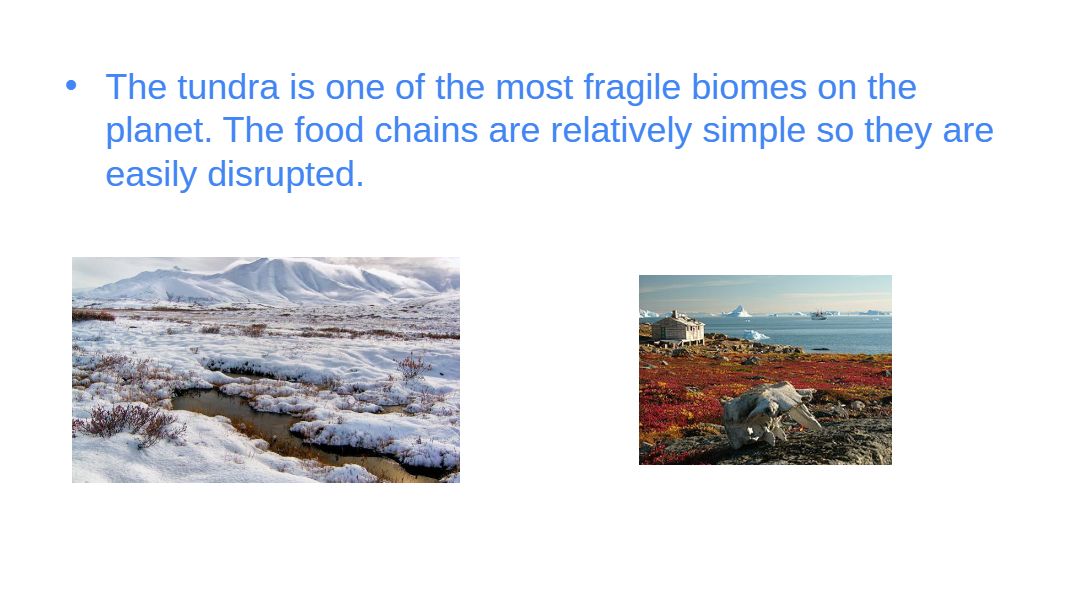
Will have fur and/ or blubber to help keep warm.
Will migrate here only in the summer when food is available.
Will hibernate during winter.
Animals
Plants will often be low to the ground and covered with a fuzzy covering to help keep warm.
They will only grow for a short time in the summer.
Plants


26
Oil Drilling is a big threat to Tundra Stability.
Climate Change is rapidly melting the snow and making the summer longer.
Human Over-hunting.


27
28

Fur color can change to help camouflage during the winter months.
Animals will hibernate during winter due to a lack of food.
Animals will have feet to help walk on snow/rocky ground
Animals
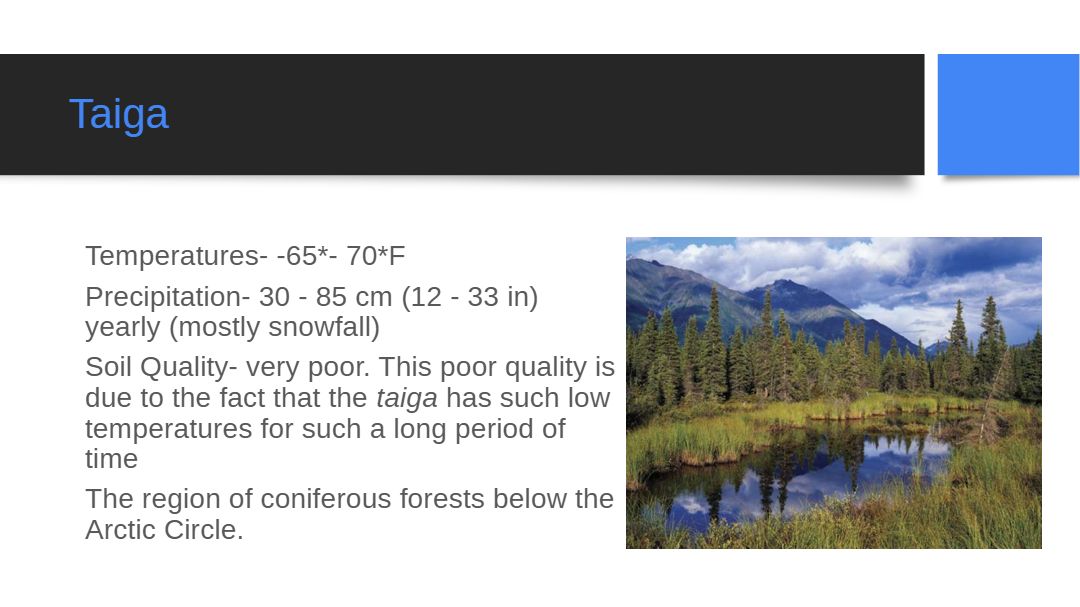
Dominated by Evergreen Coniferous Trees (Pine, Christmas).
Have small or needle-like leaves that stay green all year round.
Have deep roots to stay upright during heavy snowfalls.
Plants

29
Deforestation is the biggest threat to the Taiga.
Forest Fires
Human Over-hunting.


30
Multiple Choice
What is a major reason for the poor soil quality in the taiga biome?
High temperatures year-round
Excessive rainfall
Long periods of low temperatures
Frequent wildfires
31
32
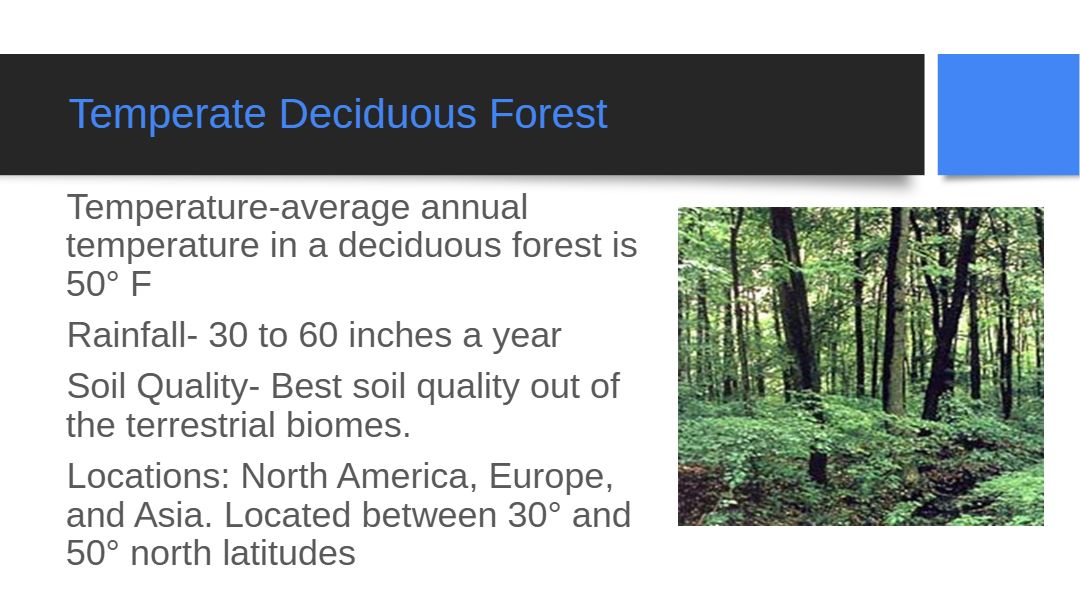
Many can survive in many seasons.
Will hibernate during winter.
They will breed during the warm summer months.
Have brown or light-colored camouflage.
Animals
Trees will change with the seasons.
Leaves will change color in the fall and fall in the winter.
Plants will go dormant in the winter months.
Plants


33
Deforestation.
Wildfires
Human encroachment.
Pollution from human activities
Overhunting of animals.
*** Only biome that has 4 distinct seasons!! (Fall, winter, summer, fall)***


34
35
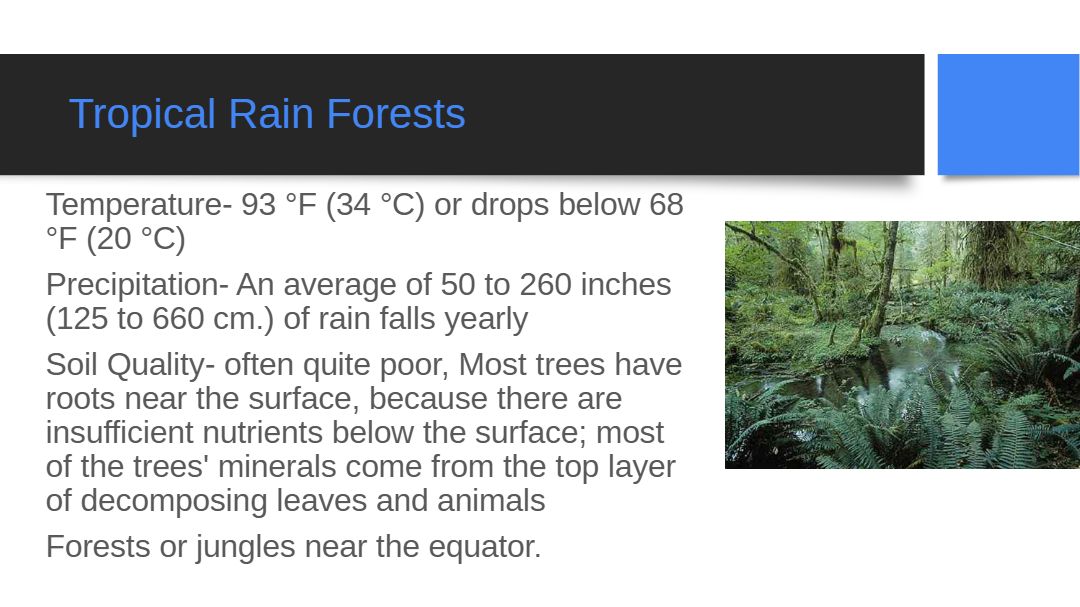
Rainforest animals have adaptations for climbing and movement, like strong limbs and tails (e.g., spider monkeys).
Camouflage is common, with patterns and colors like the jaguar's spots mimicking dappled light or the sloth's algae-covered fur blending with leaves.
Many also have poison for defense, signaled by bright warning colors, such as the poison dart frog.
Animals
Plants will have waxy leaves to prevent being waterlogged.
Trees will grow very high with leaves high in the canopy.
Trees will have a smooth bark.
Vines will have grippy parts to be able to grow up the tall trees.
Plants on the ground will have large leaves to collect limited sunlight,
Plants on the ground often have poison or spikes to protect from predators.
Plants often attract pollinators by emitting unpleasant odors, such as those of rotting flesh.
Plants


36
Deforestation.
Wildfires
Humans are cutting down trees for agriculture.
Pollution from human activities
Overhunting of animals.

37
38
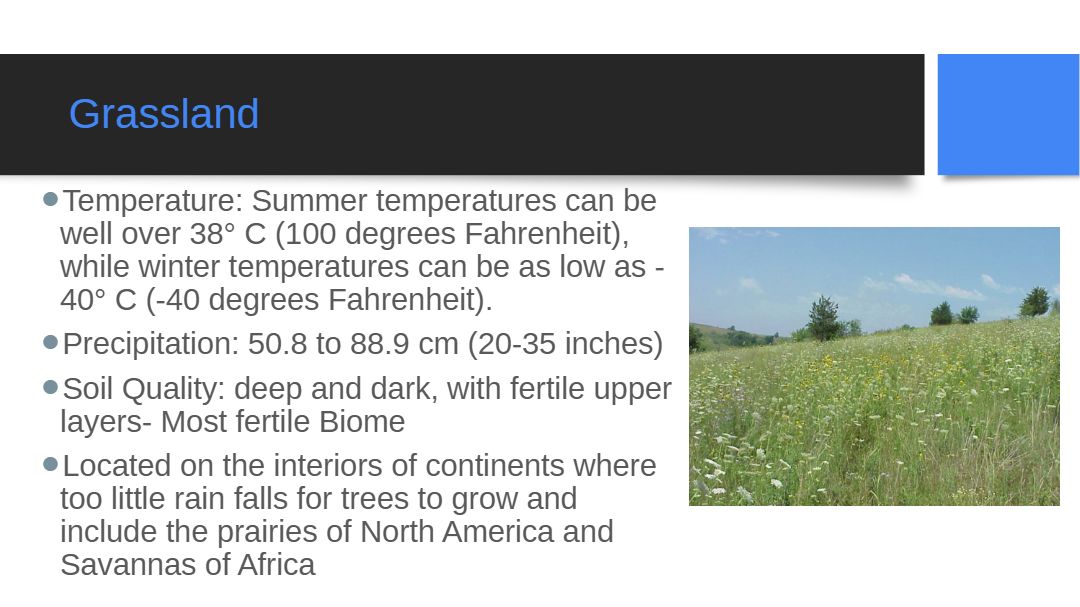
Many will live underground.
Most will have a light color or stripes to blend into the grasses.
They are generalist species that can live anywhere and eat a wide range of foods.
They are small and can hide in the tall grass.
Animals
Very few trees can grow.
Dominated by grasses and wild flowers.
It will be able to grow back better after a wildfire.
Seeds travel through the wind and are dispersed by animals to spread.
They can store water during the dry months and have very deep roots.
Plants


39
Wildfires
Humans are building cities in these areas.
Pollution from human activities
Climate change is intensifying weather patterns.
Drought


40
Multiple Choice
Which of the following statements about grasslands is correct?
Grasslands have the most fertile soil of any biome.
Grasslands receive more rainfall than tropical rain forests.
Grasslands are located near the equator.
Grasslands have poor soil quality.
41
Open Ended
Explain how precipitation influences the diversity of species in a biome, using examples from the slides.
42

43
Migration, burrowing, and nocturnal activity
Speed and hooves for escaping predators on open plains
Camouflaged or striped patterns for hiding
Specialized teeth for digesting tough grasses, and
Traits like long necks to reach food sources
Animals
Deep root systems to absorb water
Dormancy during dry periods
Storage of water in bulbs and corms
Plants also develop defenses such as thorns, toxic chemicals, or symbiotic relationships with ants to deter herbivores
Some possess thick bark that protects against fire
Plants


44
Wildfires
Humans are building cities in these areas.
Pollution from human activities
Poaching and Hunting of animals
Drought

45
Multiple Select
Select all adaptations that help animals survive in grassland and savanna biomes.
Migratory behavior
Giving birth during rainy season
Camouflage
Deep root systems
46
47
Nocturnal activity (being active at night)
Burrowing
Large ears for cooling
Light-colored coats to reflect heat
Efficient kidneys to conserve water, and specialized feet to walk on sand
They also obtain water from food, store it, or use unique methods like the Thorny Devil which drinks through its skin
Animals
Store water in their stems and leaves
Develop deep or wide root systems to access scarce water
Have waxy, hairy, or small leaves to reduce water loss
Some plants also avoid drought with short life cycles
Grow spines for protection
Become dormant during dry periods
Plants


48
Humans are building cities in these areas.
Pollution from human activities
Poaching and Hunting of animals
Drought
Oil Drilling


49
Multiple Choice
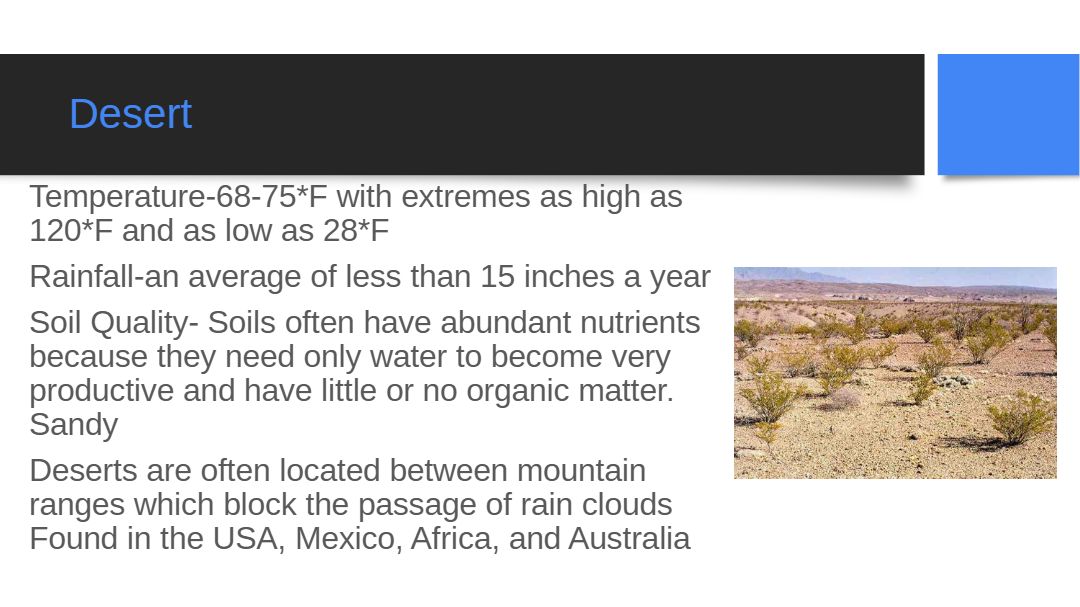
Which of the following statements best describes the soil quality in deserts?
Desert soils are rich in organic matter and nutrients.
Desert soils are sandy, have little or no organic matter, but can be productive if water is available.
Desert soils are always clayey and waterlogged.
Desert soils are acidic and support dense vegetation.
Show answer
Auto Play
Slide 1 / 49
SLIDE
Similar Resources on Wayground

44 questions
7.05 & 7.06
Presentation
•
12th Grade
43 questions
Biogeochemical Cycles Lesson
Presentation
•
10th Grade
47 questions
Earth Subsystem
Presentation
•
11th Grade
45 questions
Adaptations, GE, Evolution
Presentation
•
11th Grade
44 questions
Muscles Day 2
Presentation
•
11th - 12th Grade
40 questions
Respiratory System
Presentation
•
11th Grade
41 questions
Theme(Food) for Reception
Presentation
•
KG
Popular Resources on Wayground
21 questions
Continents and Oceans

Quiz
•
6th Grade
20 questions
Parts of Speech
Quiz
•
5th Grade
16 questions
Subject & Predicate
Quiz
•
5th Grade
25 questions
Multiplication Facts
Quiz
•
5th Grade
12 questions
Map Skills
Quiz
•
3rd Grade
22 questions
Continents and Oceans
Quiz
•
5th Grade
15 questions
Rounding Decimals
Quiz
•
5th Grade
20 questions
Brand Labels
Quiz
•
5th - 12th Grade
Discover more resources for Science
14 questions
Periodic Trends

Interactive video
•
11th Grade
7 questions
Newton's Laws Video Quiz
Interactive video
•
9th - 12th Grade
28 questions
Asexual vs. Sexual Reproduction
Quiz
•
9th - 12th Grade
19 questions
Understand Roles of Organisms in Food Chains
Quiz
•
9th - 12th Grade
10 questions
Understand Cell Functions and Organelles
Quiz
•
9th - 12th Grade
12 questions
Understand Organism Roles in Energy Transfer
Quiz
•
9th - 12th Grade
19 questions
Explore Macromolecules in Living Organisms
Quiz
•
9th - 12th Grade
25 questions
Ecology Review (9th grade biology)
Quiz
•
9th - 12th Grade