

Earth's Changing Surface

Presentation
•
Science
•
6th - 8th Grade
•
Medium
Standards-aligned

Barbara White
Used 6+ times
FREE Resource
9 Slides • 13 Questions
1

Middle School

2
Define and differentiate between weathering, erosion, and deposition.
Distinguish between gradual and catastrophic changes to Earth's surface.
Identify landforms created by different types of erosion.
Explain how natural processes and human activities can affect the rate of erosion.


3
Key Vocabulary
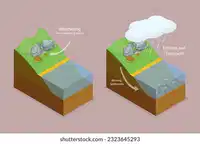
Weathering
The natural process of breaking down rocks and soil into smaller particles over a long period.
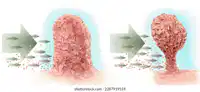
Erosion
The process of transporting weathered rocks and soil from one place to another by natural forces.
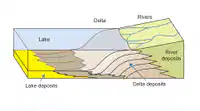
Deposition
The natural process where eroded sediment is dropped and builds up in a new location.

Gradual Change
A slow process that alters Earth's surface over thousands or millions of years, like mountain formation.
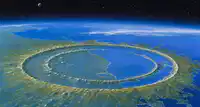
Catastrophic Change
A sudden, dramatic event that rapidly changes the Earth's surface, such as a large asteroid impact.
4
Weathering, Erosion, and Deposition
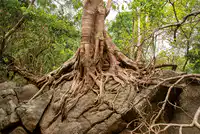
Weathering
This is the destructive process that breaks down rock or soil.
Forces like wind, water, and ice can slowly break rocks apart.
Plant roots and temperature changes also contribute to breaking down rocks.
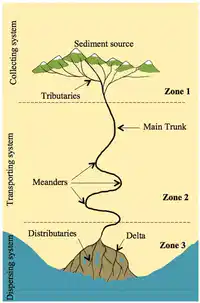
Erosion
This destructive process transports weathered materials from one place to another.
Natural forces like gravity, wind, and water carry loose material away.
Human activities, like removing plants from a field, can increase erosion.

Deposition
This is the constructive process where eroded sediment is dropped or settles.
It happens when the transporting force, like wind or water, slows down.
Deposition creates new landforms, such as deltas and beautiful sand dunes.
5
Multiple Choice
Which statement correctly identifies the roles of weathering, erosion, and deposition?
Weathering drops materials, erosion breaks them down, and deposition moves them to a new place.
Weathering breaks down rock, erosion moves the pieces, and deposition drops them in a new place.
Weathering moves materials, erosion breaks them down, and deposition drops them in a new place.
Weathering breaks down rock, erosion drops the pieces, and deposition moves them to a new place.
6
Multiple Choice
What is the primary cause of deposition?
Human activities, like clearing a field of plants, expose loose soil.
Gravity pulls loose material from one place to another.
The force carrying sediment, like wind or water, slows down.
Plant roots grow into cracks in rocks, breaking them apart.
7
Multiple Choice
Over millions of years, a river carves a deep canyon and then forms a large, fan-shaped delta where it meets the ocean. Which statement best explains this sequence?
Deposition created the canyon, and weathering formed the delta.
Deposition was the main process that carved the canyon.
Erosion was the main process that formed the delta.
Weathering and erosion carved the canyon, while deposition formed the delta.
8
Gradual Changes
These changes occur slowly over thousands or even millions of years, gradually altering the landscape.
Processes like erosion by water or wind wear away landforms over vast periods of time.
Mountain formation from the slow collision of tectonic plates is another example of gradual change.

Catastrophic Changes

These events happen very quickly and dramatically, often in just moments, days, or months.
They cause sudden and major transformations to the Earth's surface and environment.
Examples include volcanic eruptions, earthquakes, floods, hurricanes, and large asteroid impacts.
9
Multiple Choice
What is the primary difference between gradual and catastrophic changes to the Earth's surface?
The type of animals affected by the change
The location where the change takes place
The time frame over which the change happens
The season in which the change occurs
10
Multiple Choice
Which of the following describes the relationship between tectonic plate collisions and mountain formation?
Mountains are formed catastrophically by sudden plate collisions.
Tectonic plates only cause catastrophic events like earthquakes, not mountain formation.
Mountain formation is a rapid process, while plate collisions are slow.
Mountains are formed gradually by the slow collision of plates over time.
11
Multiple Choice
A coastal area is struck by a major hurricane, causing widespread flooding and reshaping the shoreline in just a few days. Which statement best explains why this is considered a catastrophic event?
Because it caused a major transformation very quickly.
Because it happened near the ocean.
Because it was a natural process.
Because it will slowly change the landscape over millions of years.
12
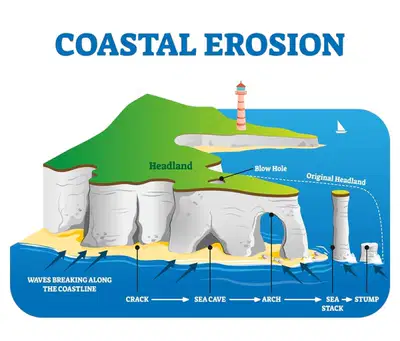
Coastal Erosion
The power of waves and currents wears away rocks on the shore.
This process carves out landforms like sea caves, arches, and stacks.
The constant action of water reshapes the edge of the land.
Glacial Erosion

Large masses of ice called glaciers scrape and smooth the land.
As they move forward, they carve out the ground beneath them.
When the glaciers melt, they can form new rivers and lakes.
13
Multiple Choice
What is the primary way that erosion affects land?
It builds up new layers of soil.
It helps new types of plants grow.
It wears away, carves, or reshapes the land.
It causes glaciers and ice to form.
14
Multiple Choice
What is the key difference between coastal erosion and glacial erosion?
Coastal erosion happens quickly, while glacial erosion happens slowly.
Coastal erosion is caused by waves and currents, while glacial erosion is caused by large masses of ice.
Coastal erosion is caused by moving ice, while glacial erosion is caused by moving water.
Coastal erosion creates lakes, while glacial erosion creates sea caves.
15
Multiple Choice
A large glacier carves a deep valley over thousands of years. Based on the information provided, what is a likely outcome after this glacier melts?
The valley will be filled in by the action of waves and currents.
Sea caves and arches will begin to form in the valley.
The land will quickly return to its original, flat shape.
A new river or lake may form in the space the glacier carved out.
16
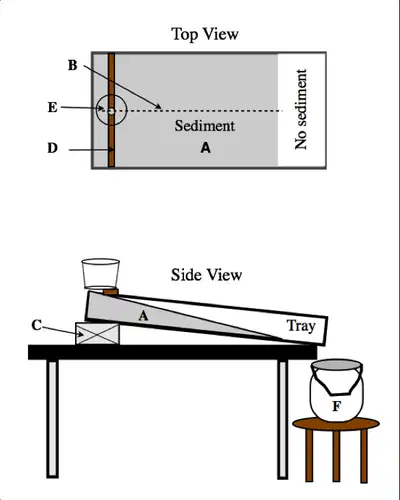
Modeling Erosion
Scientists use models like stream tables to study how erosion shapes the land.
They change one factor at a time, a variable, to observe its effects.
Key variables include the table’s tilt and the amount of water flow.
Other variables are the amount of vegetation and the type of soil used.

17
Multiple Choice
What is the main purpose of using a model like a stream table in science?
To demonstrate how to build a real river
To provide a habitat for small aquatic animals
To create a decorative water feature for a classroom
To study how the process of erosion shapes the land
18
Multiple Choice
When using a stream table, why would a scientist choose to change only the amount of water flow in an experiment?
To make the experiment last longer
To test how well different types of soil absorb water
To isolate and observe the specific effect of water flow on erosion
To see how multiple changes affect the outcome at once
19
Multiple Choice
A scientist is modeling erosion and wants to investigate how plants can help protect a hillside. Which experimental setup would best test this idea?
Comparing two tables with different tilts but the same vegetation
Comparing two tables with different amounts of water flow but the same tilt
Comparing two tables with different types of soil but the same water flow
Comparing two tables with and without vegetation, but with the same soil, tilt, and water flow
20
Misconception | Correction |
|---|---|
Weathering and erosion are the same thing. | Weathering breaks down rock, while erosion moves the pieces to a new location. |
All changes to Earth's surface happen very slowly. | Sudden events like floods and volcanoes can change the surface very quickly. |
Erosion is only a destructive process. | Erosion is linked to deposition, a constructive process that builds new landforms. |
21
Earth's surface is shaped by gradual processes and catastrophic events.
Weathering breaks down rock, erosion moves it, and deposition builds new land.
Water, ice, wind, and human activities are powerful forces of erosion.
Scientists use models to understand the variables that affect erosion.
22
Poll
On a scale of 1-4, how confident are you about the concepts covered in today's review?
1
2
3
4
Middle School
Show answer
Auto Play
Slide 1 / 22
SLIDE
Similar Resources on Wayground

18 questions
Law of Conservation of Mass
Presentation
•
6th - 8th Grade
16 questions
Climate
Presentation
•
6th - 8th Grade
19 questions
10.3 Active Transport & Meiosis/Mitosis Study Guide
Presentation
•
6th - 8th Grade
17 questions
Respiratory System Review
Presentation
•
6th - 8th Grade
16 questions
Net Force
Presentation
•
6th - 8th Grade
18 questions
Heat Transfer
Presentation
•
6th - 8th Grade
18 questions
Earth, Sun, and Moon Systems
Presentation
•
6th - 8th Grade
18 questions
Domains And Kingdoms Practice
Presentation
•
6th - 8th Grade
Popular Resources on Wayground
10 questions
How much do you know about our Portrait of an Eagle?

Quiz
•
10th Grade
10 questions
Fast Food Slogans
Quiz
•
6th - 8th Grade
21 questions
Continents and Oceans
Quiz
•
6th Grade
20 questions
Parts of Speech
Quiz
•
5th Grade
16 questions
Subject & Predicate
Quiz
•
5th Grade
25 questions
Multiplication Facts
Quiz
•
5th Grade
12 questions
Map Skills
Quiz
•
3rd Grade
22 questions
Continents and Oceans
Quiz
•
5th Grade
Discover more resources for Science
17 questions
7.6D Aqueous Solutions
Quiz
•
7th Grade
20 questions
Scientific Method and Variables
Quiz
•
8th Grade
20 questions
Scientific method and variables
Quiz
•
8th Grade
27 questions
Counting Atoms - Subscripts
Quiz
•
8th Grade
10 questions
6.6D - Relative Density Review
Quiz
•
6th Grade
20 questions
Claim, Evidence and Reasoning (CER)
Quiz
•
6th - 8th Grade
18 questions
Counting Atoms
Quiz
•
7th - 8th Grade
20 questions
Density
Quiz
•
6th Grade