

Earth, Moon, and Sun System

Presentation
•
Science
•
6th - 8th Grade
•
Medium
+1
Standards-aligned

Barbara White
Used 157+ times
FREE Resource
9 Slides • 13 Questions
1

Earth, Moon, and Sun System
Middle School

2
Learning Objectives
Describe Earth's rotation and revolution and how they relate to days and years.
Explain how the tilt of Earth's axis is the primary cause of the seasons.
Illustrate the different phases of the Moon and explain the reasons why they occur.
Differentiate between the characteristics of a solar eclipse and a lunar eclipse.


3
Key Vocabulary

Rotation
The spinning of a celestial body, such as a planet, on its own axis.
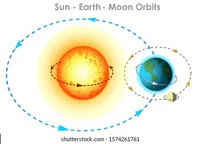
Revolution
The motion of one celestial body as it travels in a path around another in space.

Solstice
Sunlight is at its maximum in one hemisphere and at a minimum in the other one.

Equinox
On a specific day, sunlight shines equally on the Northern and Southern Hemispheres of Earth.

Solar Eclipse
This occurs when the Moon passes between the Sun and Earth, casting a large shadow.

Lunar Eclipse
This happens when the Moon moves into Earth's shadow during the full moon phase.
4
Earth's Motions: Rotation & Revolution
Rotation
Rotation is the spinning of Earth on an imaginary axis.
This spinning motion causes the daily cycle of day and night.
It takes Earth about 24 hours to complete one full rotation.

Revolution

Revolution is the movement of Earth in an orbit around the Sun.
This journey takes about 3651/4 days, which we define as a year.
Earth’s orbital path is not a perfect circle; it is an ellipse.
5
Multiple Choice
What is defined as the spinning of Earth on an imaginary axis?
An ellipse
Rotation
Revolution
A year
6
Multiple Choice
What is the primary difference between the outcomes of Earth's rotation and revolution?
Rotation determines the elliptical shape of the orbit, while revolution determines the 24-hour day.
Rotation causes the cycle of day and night, while revolution causes the cycle of a year.
Rotation causes Earth to move around the Sun, while revolution causes it to spin.
Rotation causes the cycle of a year, while revolution causes the cycle of day and night.
7
Multiple Choice
If Earth's rotation took 36 hours instead of 24, but its revolution in an elliptical orbit stayed the same, what would be the most likely result?
The cycle of day and night would be longer.
The number of days in a year would stay the same.
The length of a year would increase.
The orbital path would become a perfect circle.
8
Earth's Tilt and The Seasons
Earth’s axis is tilted at an angle of 23.5 degrees, causing the seasons.
A hemisphere tilted towards the Sun gets more direct sunlight, causing summer.
A hemisphere tilted away from the Sun gets less direct sunlight, causing winter.
Solstices mark the longest and shortest days; equinoxes have equal day and night.

9
Multiple Choice
What is the primary cause of Earth's seasons?
The 23.5-degree tilt of Earth's axis.
The varying distance between the Earth and the Sun.
The rotation of the Earth on its axis.
The dates of the solstice and equinox.
10
Multiple Choice
How does Earth's tilt lead to warmer temperatures in a hemisphere?
It causes the hemisphere to be physically closer to the Sun.
It makes the days longer, allowing more time for heat to build up.
It causes the hemisphere to receive more direct sunlight.
It reduces cloud cover over the hemisphere.
11
Multiple Choice
If a planet's axis had no tilt, what would be the most likely effect on its seasons and the length of its days?
The longest and shortest days would be marked by solstices.
The length of day and night would be roughly equal year-round.
One hemisphere would have summer while the other has winter.
The planet would experience extreme seasonal changes.
12
The Moon's Motion and Phases
The Moon revolves around Earth, completing one orbit in about a month.
Its rotation and revolution periods are the same, so we always see one side.
Phases are the changing angles at which we see the Moon's sunlit surface.
The cycle waxes from New Moon to Full Moon, then wanes back to New Moon.

13
Multiple Choice
What are the phases of the Moon?
The changing views of the Moon's sunlit half as it orbits Earth
The shadows Earth casts upon the Moon's surface
Different sides of the Moon that face Earth each night
The monthly cycle of the Moon's rotation on its axis
14
Multiple Choice
Why do we always see the same side of the Moon from Earth?
Because the Moon does not rotate on its axis
Because the Moon is tidally locked to the Sun
Because the Earth's gravity prevents it from turning
Because the Moon's rotation and revolution are balanced
15
Multiple Choice
If the Moon's orbit around Earth took two months instead of one, but its rotation speed stayed the same, what would be the most likely outcome?
We would be able to observe all sides of the Moon
We would no longer see the same side of the Moon
The cycle of phases from New Moon to New Moon would take longer
The Moon would appear to have no phases at all
16
Solar and Lunar Eclipses
Solar Eclipse
This occurs when the Moon passes directly between the Sun and Earth, blocking sunlight.
It can only happen during the New Moon phase when the alignment is just right.
The Moon's shadow is cast upon the Earth, creating a temporary darkness during the day.

Lunar Eclipse

This occurs when Earth passes directly between the Sun and the Moon, blocking sunlight.
It can only happen during the Full Moon phase when the alignment is correct.
Earth's shadow is cast upon the Moon, making it appear dim or coppery red.
17
Multiple Choice
What occurs during a solar eclipse?
The Moon passes between the Sun and Earth, casting a shadow on the Earth.
The Sun passes between the Earth and Moon, making the Moon appear red.
The Earth's atmosphere blocks the sunlight from reaching the Moon.
The Earth passes between the Sun and Moon, casting a shadow on the Moon.
18
Multiple Choice
What is the relationship between the phase of the Moon and the type of eclipse that can occur?
Solar eclipses happen during a Full Moon, while lunar eclipses happen during a New Moon.
The phase of the Moon does not affect when an eclipse can happen.
Solar eclipses happen during a New Moon, while lunar eclipses happen during a Full Moon.
Both types of eclipses can only happen during a Full Moon.
19
Multiple Choice
If you were standing on the surface of the Moon when Earth experiences a lunar eclipse, what would you observe?
The Sun being blocked from view by the Earth.
The Earth appearing as a thin crescent.
The Sun appearing much brighter and larger than usual.
The Earth moving to pass behind the Sun.
20
Common Misconceptions
Misconception | Correction |
|---|---|
Seasons are caused by Earth's changing distance from the Sun. | Seasons are caused by the 23.5-degree tilt of Earth's axis. |
The 'dark side' of the Moon never receives sunlight. | The Moon rotates, so all its parts receive sunlight. |
A solar and lunar eclipse happens every month. | The Moon's tilted orbit means eclipses happen only a few times a year. |
21
Summary
Earth's rotation on its axis causes the 24-hour day-night cycle.
Earth's revolution around the Sun defines the 365.25-day year.
The 23.5-degree tilt of Earth's axis is the primary cause of the seasons.
The phases of the Moon and eclipses result from the alignment of the Sun, Earth, and Moon.
22
Poll
On a scale of 1-4, how confident are you about the concepts covered in today's review?
1
2
3
4
Earth, Moon, and Sun System
Middle School
Show answer
Auto Play
Slide 1 / 22
SLIDE
Similar Resources on Wayground

17 questions
The Circulatory System
Presentation
•
6th - 8th Grade
16 questions
Counting Atoms
Presentation
•
6th - 8th Grade
18 questions
Photosynthesis and Cellular Respiration
Presentation
•
6th - 8th Grade
18 questions
Energy
Presentation
•
6th - 8th Grade
18 questions
Energy and Its Transformations
Presentation
•
6th - 8th Grade
16 questions
The Scientific Method
Presentation
•
6th - 8th Grade
18 questions
Gravity and the solar system
Presentation
•
6th - 8th Grade
17 questions
Carbohydrates
Presentation
•
6th - 8th Grade
Popular Resources on Wayground
6 questions
PRIDE Always and Everywhere
Presentation
•
12th Grade
20 questions
Lab Safety Quiz

Quiz
•
6th Grade
26 questions
KOR Review Kahoot Questions
Quiz
•
8th Grade
21 questions
Continents and Oceans
Quiz
•
6th Grade
12 questions
Unit Zero lesson 2 cafeteria
Presentation
•
9th - 12th Grade
20 questions
Parts of Speech
Quiz
•
5th Grade
10 questions
Riddles Riddles fun Riddles
Quiz
•
6th - 12th Grade
16 questions
Subject & Predicate
Quiz
•
5th Grade
Discover more resources for Science
20 questions
Lab Safety Quiz
Quiz
•
6th Grade
20 questions
Lab Safety
Quiz
•
5th - 8th Grade
20 questions
Scientific Method and Variables
Quiz
•
8th Grade
20 questions
Scientific method and variables
Quiz
•
8th Grade
27 questions
Counting Atoms - Subscripts
Quiz
•
8th Grade
10 questions
6.6D - Relative Density Review
Quiz
•
6th Grade
10 questions
Scientific Method and Variables
Quiz
•
6th Grade
14 questions
Science Variables
Quiz
•
7th Grade