

RESERVATIONS

Presentation
•
Other
•
University
•
Practice Problem
•
Easy

Anny Gabriela Molina Ochoa
Used 1+ times
FREE Resource
27 Slides • 23 Questions
1

2

3

4

5

6

7

8
Multiple Choice
Which of the following statements best describes the nature of reservations made by States to the International Covenant on Civil and Political Rights (ICCPR) as of November 1994?
All reservations made by States were identical and did not affect their obligations under the Covenant.
Reservations varied significantly, with some being very specific (excluding certain rights), others more general (preserving domestic laws), and some even limiting the Human Rights Committee’s competence.
Reservations only increased the obligations of States under the Covenant
No State made any reservations to the ICCPR by November 1994.
9
Multiple Choice
How can the number, content, and scope of reservations to the ICCPR affect the Covenant?
They ensure that all States interpret and implement the Covenant in exactly the same way.
They have no impact on the implementation or clarity of the Covenant’s obligations.
They can undermine the effective implementation of the Covenant and create uncertainty about States’actual obligations.
They strengthen the respect for and clarity of all State obligations under the Covenant.
10
Multiple Choice
What is the main difference between a “reservation” and an “interpretative declaration” madeby a State at the time of ratifying a treaty?
A reservation is a statement of purpose or policy, while an interpretative declaration formallylimits the State’s legal obligations.
A reservation is a formal limitation or modification of a State’s legal obligations, while aninterpretative declaration is a statement about how the State understands a provision, withoutchanging its legal effect.
Both are legally binding modifications to the treaty.
Both have no impact on the interpretation or application of the treaty.
11

12

13

14

15

16

17

18

19

20

21

22

23

24

25
26
Multiple Choice
Which of the following best describes the obligations of States under Article 2 of the International Covenant on Economic, Social and Cultural Rights (ICESCR)?
States must immediately achieve all rights in full, regardless of practical constraints.
States are allowed to make gradual progress in realizing rights due to practical constraints, but must take immediate steps to prevent discrimination and ensure meaningful protection from the outset.
States are only required to take action if they have surplus resources.
States can delay all actions until they have achieved economic stability.
27
Multiple Choice
Which of the following best describes how States must implement their obligations under the International Covenant on Economic, Social and Cultural Rights?
Only by passing new legislation
By using all suitable methods, including but not limited to legislation, and explaining and justifying their choices, while the Committee ultimately judges if the measures are adequate and appropriate
By following the exact same methods as other States
Only by providing financial assistance
28
Multiple Choice
What are States required to do soon after ratifying the International Covenant on Economic, Social and Cultural Rights (ICESCR)?
Wait until they have unlimited resources before taking any action.
Begin taking meaningful, intentional, and specific actions focused on achieving the rights recognized in the Covenant
Only act if other States have already implemented the rights
Delay action until all economic, social, and cultural rights can be fully realized at once
29
Multiple Choice
Why are judicial remedies considered crucial for certain rights under the Covenant?
Because judicial remedies replace the need for constitutional provisions
Because they allow States to avoid reporting to the Committee
Because they ensure that rights can be enforced in court and are not just theoretical, and States must report which rights are justiciable and any constitutional changes affecting this
Because only legislative remedies are effective
30
Multiple Choice
What does the term “other appropriate measures” refer to in the context of realizing economic, social, and cultural rights?
Only passing new laws
Actions limited to judicial remedies
A broad set of actions, including administrative, financial, educational, and social initiatives, beyond just passing laws
Only financial initiatives
31
Multiple Choice
What does the principle of "progressive realization" require States to do regarding economic, social, and cultural rights?
Achieve all rights immediately, regardless of available resources
Take immediate action, make continuous real progress, and avoid any backward steps unless fully justified by exceptional circumstances
Only act when they have surplus resources
Delay action until all conditions are perfect
32
Multiple Choice
What is a key feature of the Covenant’s principles regarding their application in different countries?
They only apply to countries with democratic political systems
They are designed to be applied universally, regardless of a country’s political or economic system, as long as human rights are respected and protected
They require all countries to adopt the same economic policies
They exclude countries with different cultural backgrounds
33
Multiple Choice
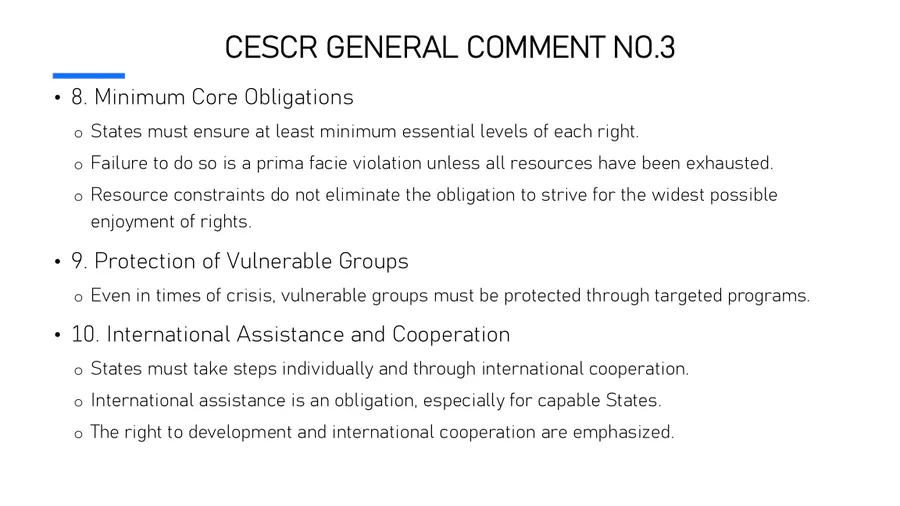
Which statement best reflects a State's obligations regarding the minimum essential levels of economic, social, and cultural rights?
States must guarantee full enjoyment of all rights only when resources are abundant.
States must always ensure at least the minimum essential levels of each right for everyone, and if they fail, it is a violation unless they can prove they have done everything possible with their available resources.
States can delay providing minimum rights until economic conditions improve.
States are only required to provide rights to the majority of the population.
34
Multiple Choice
According to the information provided, what are States required to do regarding vulnerable populations during times of economic crisis or limited resources?
Postpone protection of vulnerable groups until the economy recovers.
Use the economic crisis as a justification for neglecting the needs of vulnerable populations.
Actively design and implement programs to ensure the protection of vulnerable groups and uphold their basic rights, regardless of economic difficulties.
Reduce all social programs equally, regardless of group vulnerability.
35
Multiple Choice
Which of the following statements best reflects the obligations of States regarding economic, social, and cultural rights?
States are only responsible for fulfilling these rights within their own borders.
International assistance is optional and depends solely on political interests.
States must make efforts both domestically and through international cooperation to fulfill economic, social, and cultural rights, and international assistance is a legal duty for those able to help.
The right to development can be fully realized without international cooperation.
36

37

38

39

40

41
Multiple Choice
Which of the following statements is TRUE regarding State obligations under the Covenant?
Only the national government is bound by the Covenant, not regional or local authorities.
States can use their internal laws as a justification for not complying with the Covenant.
All parts and levels of government are bound by the Covenant, obligations are immediate, and reservations to Article 2 are not permitted.
States may delay implementation of obligations until their internal laws are updated.
42
Multiple Choice
Which best describes States’ obligations under the Covenant regarding economic, social, and cultural rights?
States only need to avoid directly violating rights and do not have to take further action.
States must both avoid violating rights and take positive steps to realize them, using all available tools, and ensure any restrictions are justified, limited, and never undermine the core of a right.
States are free to impose any restrictions on rights as they see fit.
States can rely solely on education to fulfill their obligations.
43
Multiple Choice
What is a State’s responsibility regarding rights violations committed by private actors?
States are not responsible for violations committed by private individuals or organizations.
States must protect individuals from rights violations by private actors, and if they fail to prevent, punish, or remedy such acts, the State itself may be held responsible.
States only need to protect rights from violations by government officials.
States can delegate all responsibility for rights protection to private companies.
44
Multiple Choice
Which of the following best describes how rights are enjoyed under the Covenant?
All rights under the Covenant are enjoyed only by individuals and never collectively.
While individuals are the main rights holders, many rights—such as those related to religion, association, and minority groups—are often enjoyed collectively, reflecting the social and communal nature of human rights.
Only groups, not individuals, can enjoy rights related to religion and association.
Rights related to minority groups are not recognized under the Covenant.
45
Multiple Choice
According to the Covenant, who must States respect and ensure rights for?
Only citizens within their physical borders.
Only people who are physically present in the country and hold citizenship.
Everyone within their territory or under their effective control, including non-citizens, people abroad under their authority, and during armed conflict, with protection determined by control and jurisdiction, not just borders or citizenship.
Only people who have lived in the country for more than five years.
46
Multiple Choice
What is a binding obligation of States under international human rights law regarding theremoval, deportation, or extradition of individuals?
States may remove individuals to any country, regardless of risk.
States are encouraged, but not required, to consider potential harm before removal.
States are prohibited from removing individuals to any country where they would face a real risk of serious, irreparable harm, such as torture or threats to life.
States can remove individuals if it is in their national interest, even if there is a risk of harm.
47
Multiple Choice
Which of the following statements best describes States' obligations regarding the implementation of Covenant rights in domestic law?
States can delay implementing Covenant rights until internal challenges are resolved.
States must ensure their domestic laws protect Covenant rights, change any inconsistent laws, and act immediately to implement these rights. Incorporation into domestic law is encouraged but not strictly required.
States are only required to protect Covenant rights if they are already part of domestic law.
States may avoid taking steps to implement Covenant rights if it is inconvenient.
48
Multiple Choice
What are States required to do when addressing violations of rights under the Covenant?
Provide only financial compensation for victims.
Offer accessible and effective remedies, including judicial and administrative options, and ensure comprehensive reparation such as compensation, restitution, rehabilitation, satisfaction, and guarantees of non-repetition, while also stopping ongoing violations and preventing future ones.
Limit remedies to judicial actions only.
Address violations only after a formal complaint is lodged with the United Nations.
49
Multiple Choice
What are States required to do regarding perpetrators of serious human rights violations?
Allow amnesties or immunities to prevent prosecution.
Ensure that perpetrators are prosecuted and cannot escape justice through amnesties or immunities, and cooperate with other States to bring such individuals to justice.
Only prosecute perpetrators if they commit violations within their own territory.
Focus solely on compensating victims, not prosecuting perpetrators.
50
Multiple Choice
What must States report to the Committee regarding remedies for rights violations?
Only the remedies that exist in their laws.
Only successful cases of enforcing rights.
Any barriers that make remedies ineffective in practice, not just the remedies that exist in law.
The number of complaints received each year.
Show answer
Auto Play
Slide 1 / 50
SLIDE
Similar Resources on Wayground

49 questions
Lifespan Psychology and Developmental Theories
Presentation
•
University
45 questions
Unit 309 Session 2 Central heating components
Presentation
•
KG - University
47 questions
LAW084 Branches of Malaysian Government
Presentation
•
University
47 questions
A treasure trove of inspiring people: the game
Presentation
•
University
43 questions
Copy of G2_K8_L7_22-23
Presentation
•
KG - Professional Dev...
42 questions
Starters
Presentation
•
University
46 questions
Who Has Captain?
Presentation
•
University - Professi...
44 questions
Apps & applications
Presentation
•
Professional Development
Popular Resources on Wayground
20 questions
"What is the question asking??" Grades 3-5

Quiz
•
1st - 5th Grade
20 questions
“What is the question asking??” Grades 6-8
Quiz
•
6th - 8th Grade
10 questions
Fire Safety Quiz
Quiz
•
12th Grade
20 questions
Equivalent Fractions
Quiz
•
3rd Grade
34 questions
STAAR Review 6th - 8th grade Reading Part 1
Quiz
•
6th - 8th Grade
20 questions
“What is the question asking??” English I-II
Quiz
•
9th - 12th Grade
20 questions
Main Idea and Details
Quiz
•
5th Grade
47 questions
8th Grade Reading STAAR Ultimate Review!
Quiz
•
8th Grade
Discover more resources for Other
15 questions
LGBTQ Trivia
Quiz
•
University
36 questions
8th Grade US History STAAR Review
Quiz
•
KG - University
25 questions
5th Grade Science STAAR Review
Quiz
•
KG - University
16 questions
Parallel, Perpendicular, and Intersecting Lines
Quiz
•
KG - Professional Dev...
20 questions
5_Review_TEACHER
Quiz
•
University
10 questions
Applications of Quadratic Functions
Quiz
•
10th Grade - University
10 questions
Add & Subtract Mixed Numbers with Like Denominators
Quiz
•
KG - University
20 questions
Block Buster Movies
Quiz
•
10th Grade - Professi...