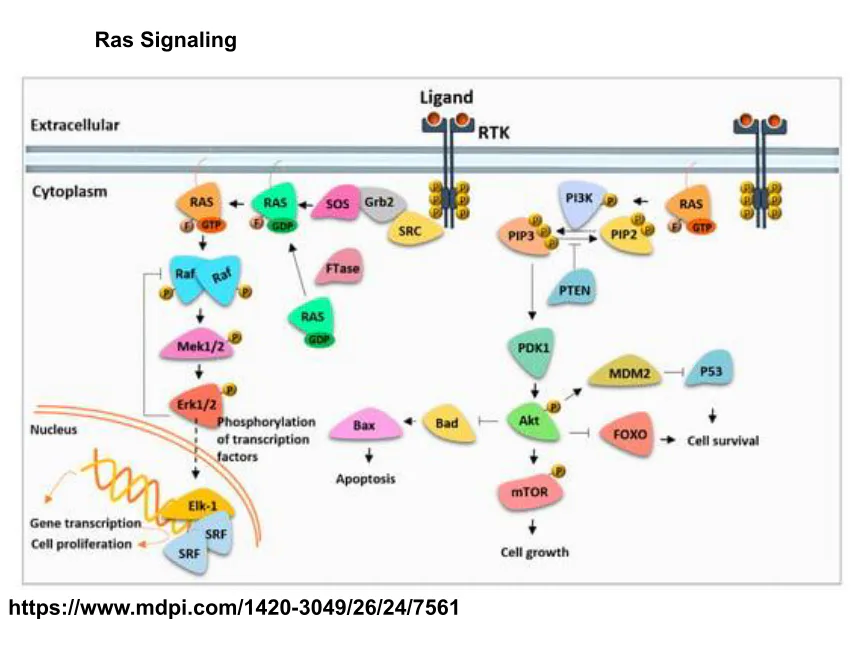
Intracellular Signalling
Presentation
•
Science
•
University
•
Hard
+2
Standards-aligned
Lee Ott
FREE Resource
32 Slides • 36 Questions
1
2
Multiple Choice
Which of the following is a possible cause of mutations in DNA?
X-rays
Exercise
Balanced diet
Regular sleep
3
4
Open Ended
Why is it important to understand how mutations affect genetic material in living organisms?
5
6
Multiple Choice
Which type of mutation involves the replacement of one base in the template strand of DNA with another?
Point mutation
Deletion mutation
Insertion mutation
Silent mutation
7
8
Multiple Choice
What is the correct sequence of events from DNA to protein synthesis as shown in the diagram?
Transcription → Translation → Amino acid sequence
Translation → Transcription → Amino acid sequence
Amino acid sequence → Transcription → Translation
Transcription → Amino acid sequence → Translation
9
10
Open Ended
Explain how a point mutation can affect the amino acid sequence of a protein.
11
12
Fill in the Blanks
13
14
Multiple Select
Which of the following changes in the DNA template strand would result in a different amino acid sequence after translation?
Point mutation
Deletion mutation
Insertion mutation
All of the above
15
Hotspot
Which two are Frameshift Mutations?
16
Match
Match the following
Deletion
Inversion
Duplication
Insertion
Translocation
Deletion
Inversion
Duplication
Insertion
Translocation
17
18
Open Ended
Describe the potential consequences of a mutation that alters the amino acid sequence of a protein, as explained in the slides.
19
20
Multiple Choice
Identify each type of mutation as a point, deletion, or insertion mutation. A. Cytosine (C) enters the DNA sequence. B. One adenosine is removed from the DNA sequence. C. A base sequence of TGA in DNA changes to TAA.
A: insertion, B: deletion, C: point
A: point, B: insertion, C: deletion
A: deletion, B: point, C: insertion
A: insertion, B: point, C: deletion
21
22
23
Multiple Select
Which of the following statements about water-soluble hormones is/are correct?
They act on plasma membrane receptors.
They can enter the cell directly.
They act via G protein second messengers.
They act on intracellular receptors.
24
Open Ended
Explain the difference between water-soluble and lipid-soluble hormones in terms of their receptor location and mechanism of action.
25
26
Fill in the Blanks
Type answer...
27
28
Multiple Choice
Place the following steps of the cyclic AMP (cAMP) signaling mechanism in the correct order: 1. Adenylate cyclase converts ATP to cAMP. 2. Hormone binds to receptor. 3. cAMP activates protein kinases. 4. Receptor activates a G protein. 5. G protein activates adenylate cyclase.
2, 4, 5, 1, 3
2, 5, 4, 1, 3
1, 2, 4, 5, 3
4, 2, 5, 1, 3
29
30
Open Ended
What is the role of phosphodiesterase in the cAMP signaling pathway, and why is it important for cellular regulation?
31
32
33
34
35
Multiple Choice
What is the primary function of a receptor in cell signaling?
To degrade the ligand
To bind to a ligand and initiate a cellular response
To transport ions across the membrane
To synthesize proteins
36
Multiple Choice
How do protein kinases and protein phosphatases regulate cellular activities?
By synthesizing new proteins
By adding or removing phosphate groups from proteins
By degrading proteins
By transporting proteins across membranes
37
Multiple Choice
Which step in the cyclic AMP second-messenger mechanism involves the conversion of ATP to cAMP?
Hormone binds to receptor
Receptor activates G protein
G protein activates adenylate cyclase
Adenylate cyclase converts ATP to cAMP
38
39
Multiple Choice
What is a G protein?
specific type of membrane-receptor protein
a second messenger
membrane-bound enzyme
relay protein
40
Multiple Choice
What is the primary role of cAMP in the second-messenger system shown in the diagrams?
It acts as the first messenger
It activates protein kinases
It binds to the receptor
It converts ATP to GTP
41
Multiple Choice
Explain how G-protein coupled receptors (GPCRs) initiate a cellular response upon ligand binding.
GPCRs directly phosphorylate proteins.
GPCRs activate G-proteins, which then trigger a signaling cascade.
GPCRs open ion channels directly.
GPCRs degrade the ligand to initiate a response.
42
43
Multiple Choice
Which of the following statements best describes the function of phospholipase C in the PIP2-calcium signaling mechanism?
It converts ATP to cAMP
It splits PIP2 into DAG and IP3
It activates G proteins
It binds to hormone receptors
44
Multiple Select
Which of the following are second messengers in the PIP2-calcium signaling mechanism?
Diacylglycerol (DAG)
Adenylate cyclase
Inositol trisphosphate (IP3)
Phospholipase C
45
46
47
48
49
50
51
52
53
Multiple Choice
54
Multiple Choice
Cancer creates abnormal cells by disrupting
the regulation of cell cycle
red blood cell formation
DNA replication
ATP synthesis
55
56
Multiple Choice
What happens when p53 is absent or non-functional in the cell cycle?
Uncontrolled cell division and increased risk of cancer
Decreased cell growth
Normal cell division
Decreased risk of cancer
57
Multiple Choice
What are the consequences of p53 mutation in the cell cycle?
Impaired cell division, disrupted DNA damage repair, and decreased risk of cancer development.
The consequences of p53 mutation in the cell cycle include impaired DNA damage repair, disrupted cell cycle checkpoints, and increased risk of cancer development.
Enhanced cell cycle checkpoints, improved DNA damage repair, and decreased risk of cancer development.
Increased cell division, reduced DNA damage repair, and decreased risk of cancer development.
58
Multiple Choice
What is the function of p53 in preventing cancer?
p53 inhibits DNA repair and promotes cancer development.
p53 regulates the cell cycle, promotes DNA repair, and induces apoptosis to prevent cancer.
p53 promotes cell division and tumor growth.
p53 has no role in preventing cancer.
59
Multiple Choice
What happens when p53 detects DNA damage during the cell cycle?
It promotes cell division.
It inhibits DNA repair mechanisms.
It has no effect on the cell cycle.
It activates DNA repair mechanisms or triggers apoptosis.
60
61
Multiple Choice
What happens to MDM2 when a cell encounters stressful conditions?
It binds with p53
It is released, allowing p53 to be transported into the cell nucleus
It deactivates p53 in the cell
It promotes cell division
62
Multiple Choice
What is the main strategy to tackle p53 associated cancers?
Restoring activity of MDM2
Re-activating p53 that is bound up by too much MDM2
Increasing cell division in cancer cells
Reducing the levels of p53 in cancer cells
63
Multiple Choice
64
65
Multiple Choice
This diagram shows transduction of a signal. How is the signal being transduced to its target location in the cell?
A hormone is binding to an intracellular protein receptor
Transport vesicles are passing neurotransmitters to neighboring cells
Enzymes are passing phosphate groups down a series of proteins
cAMP is formed activating a desired response
66
Multiple Choice
What does the diagram represent?
Amplification
Specificity in Cell Response
Apoptosis
Intracellular Receptors
67
Multiple Choice
What is being depicted in the image?
Amplification of the signal molecule
Enzymatic proteins inhibiting process of the signal transduction pathway
Kinase groups adding dimer groups to other enzymes
Diffusion of molecules within the cell due to the signaling molecule
68
Show answer
Auto Play
Slide 1 / 68
SLIDE

Similar Resources on Wayground
59 questions
CHAPTER 6 NEW
Presentation
•
University
62 questions
Bahasa Inggris 2 Meeting 12 dan 13
Presentation
•
University
60 questions
Intro to American Government
Presentation
•
12th Grade
64 questions
HB Skin
Presentation
•
KG - University
61 questions
Introduction to Microsoft Excel
Presentation
•
KG - University
66 questions
Parts of speech_Determiners
Presentation
•
KG - University
63 questions
Topic 2 & 3 Networking Fundamentals Part I
Presentation
•
University
63 questions
MS EXCEL
Presentation
•
University
Popular Resources on Wayground
20 questions
STAAR Review Quiz #3
Quiz
•
8th Grade
20 questions
Equivalent Fractions
Quiz
•
3rd Grade
6 questions
Marshmallow Farm Quiz
Quiz
•
2nd - 5th Grade
20 questions
Main Idea and Details
Quiz
•
5th Grade
20 questions
Context Clues
Quiz
•
6th Grade
20 questions
Inferences
Quiz
•
4th Grade
19 questions
Classifying Quadrilaterals
Quiz
•
3rd Grade
12 questions
What makes Nebraska's government unique?
Quiz
•
4th - 5th Grade