C02.6 Periodicity Pt 2 Lecture
Presentation
•
Chemistry
•
9th - 12th Grade
•
Practice Problem
•
Medium
+2
Standards-aligned
Bill Habiger
Used 10+ times
FREE Resource
50 Slides • 24 Questions
1
You will need your periodic table.
2
Multiple Select
Which of these cause the electrostatic force between charges to increase? pick two
Increasing the charge of the particles
Decreasing the distance between the charges
Decreasing the charge of the particles
Increasing the distance between the charges
3
4
5
6
7
Multiple Choice
Based on the periodic table trends, which direction does atomic/ionic radius increase?
From right to left and top to bottom
From left to right and bottom to top
From top to bottom and left to right
From right to left and bottom to top
8
Multiple Choice
Do you have your periodic table out?
Yes
No
9
Fill in the Blanks
10
11
Fill in the Blanks
12
13
14
15
16
17
18
19
20
21
22
23
24
25
26
Answer the Ionization Energy Example Problems
Use your periodic table and notes.
27
Poll
When you have answered the examples, click ready.
Ready
Need more time
28
Multiple Choice
Which element is more likely to lose an electron?
Element X
IE = 450 kJ/mol
Element Y
IE = 325 kJ/mol
29
30
Open Ended
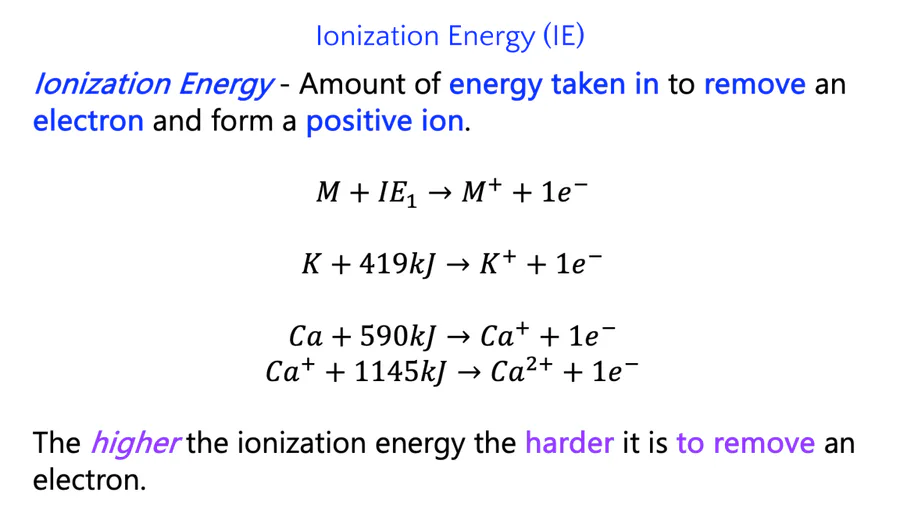
Which of these period 3 elements has a higher ionization energy, sodium or phosphorous?
(Answer in a complete sentence.)
31
32
Multiple Choice
Which element has a higher ionization energy, fluorine or iodine?
F
I
33
34
Reorder
Put these elements in order by increasing ionization energy. (Low to high, L to R)
Sr
Ca
Si
P
O
35
36
Multiple Choice
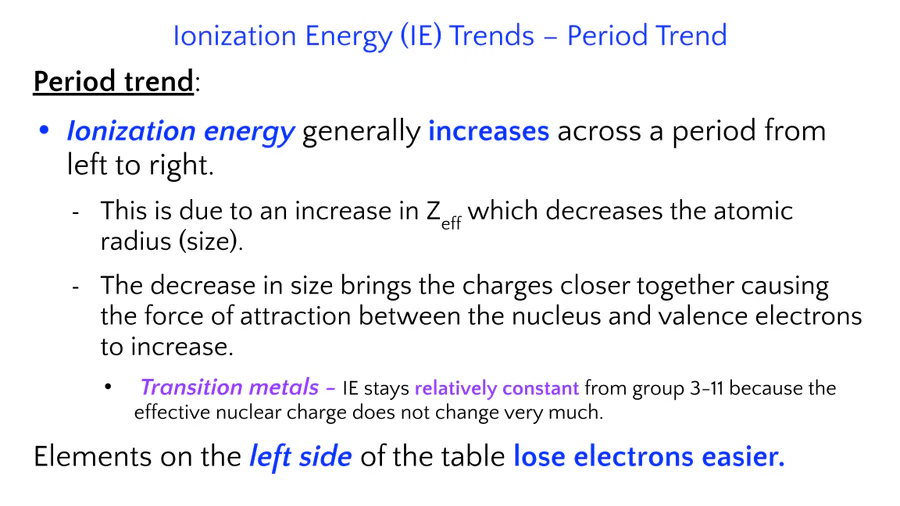
Which of the following statements best explains the trend in ionization energy across a period in the periodic table?
Ionization energy increases from left to right due to increasing nuclear charge.
Ionization energy decreases from left to right due to decreasing atomic size.
Ionization energy remains constant across a period.
Ionization energy decreases due to increasing electron shielding.
37
38
39
40
41
42
43
44
45
46
Answer the Electron Affinity Example Problems
Use your periodic table and notes.
47
Poll
When you have answered the examples, click ready.
Ready
Need more time
48
Multiple Choice
Which one has a higher electron affinity, Cs or Hg?
Cs
Hg
49
50
Multiple Choice
Which one has a higher electron affinity, Sr or P?
Sr
P
51
52
Multiple Choice
Which element is more likely to gain an electron?
Element W
EA = -450 kJ/mol
Element Z
EA = -325 kJ/mol
53
54
55
56
57
58
59
60
61
62
63
64
Self-Pace Mode Activate
Use your notes to answer the following questions.
65
Multiple Select
Which of the following statements about the group trend in ionization energy are correct? (Pick 2)
Ionization energy decreases down a group.
Atoms get smaller down a group.
Valence electrons move closer to the nucleus down a group.
Elements further down a group lose electrons easier.
66
Multiple Choice
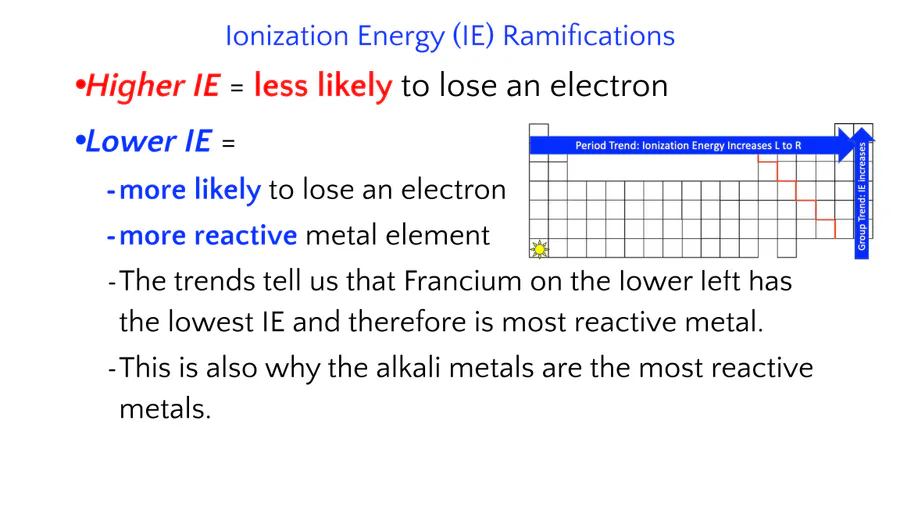
Which elements are most likely to lose electrons and form positive ions according to the periodic table?
Li and Be
O and F
Ne and He
C and N
67
Multiple Choice
Why are alkali metals the most reactive metals according to ionization energy trends?
They have the lowest ionization energies.
They have the highest ionization energies.
They have full electron shells.
They are nonmetals.
68
Multiple Choice
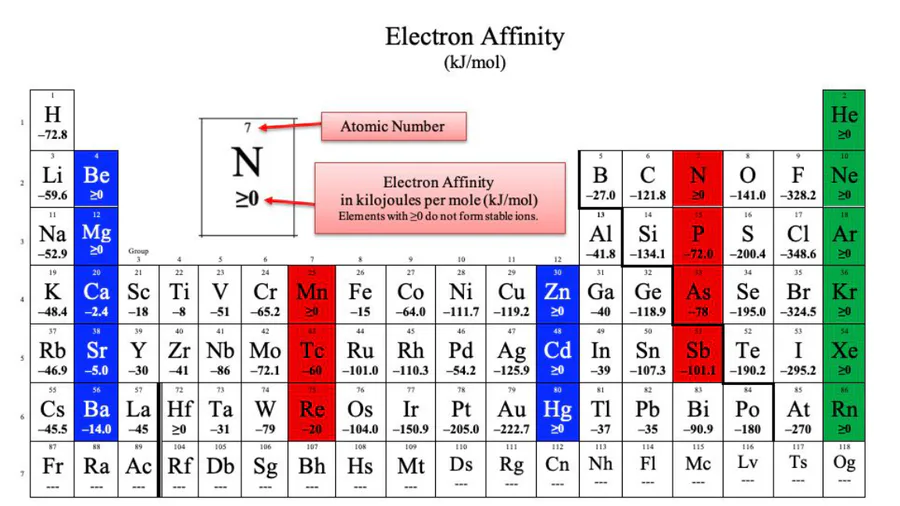
Which of the following statements is true about electron affinity.
as electron affinity increases the likelihood that an electron will be gained also increases
as electron affinity increases the likelihood that an electron will be gained decreases
electron affinity has no affect on the gaining of electrons only the amount of energy change
69
Multiple Choice
Which of the following statements is true about the period trend for electron affinity.
electron affinity decreases L to R across a row
electron affinity increases L to R across a row
electron affinity does not change across a row
electron affinity goes up and down across a row
70
Open Ended
How does understanding Coulomb's Law help you explain trends in the periodic table?
71
Multiple Choice
Which elements are most likely to gain electrons and form negative ions according to the periodic table?
Li and Be
O and F
Ne and He
C and N
72
Multiple Choice
Which element has the strongest attraction to shared electrons?
Na
H
O
Se
Al
73
Multiple Choice
Which element is the most reactive?
Sodium
Magnesium
Aluminum
Zinc
74
The End
You can exit the presentation.
You will need your periodic table.
Show answer
Auto Play
Slide 1 / 74
SLIDE

Similar Resources on Wayground
65 questions
Respect Lesson - Biology class - Wayground
Presentation
•
9th - 12th Grade
64 questions
Informal Commands
Presentation
•
9th - 12th Grade
69 questions
Introduction to Equilibrium Chemistry
Presentation
•
10th - 11th Grade
68 questions
Class Review # 3
Presentation
•
9th - 12th Grade
66 questions
Lesson 3: Reactions | Mr.Q
Presentation
•
9th - 12th Grade
69 questions
Reflexive Verbs - Spanish
Presentation
•
9th - 12th Grade
66 questions
Using the subjunctive in context
Presentation
•
9th Grade - University
69 questions
Properties and Chemical Reactions Lesson
Presentation
•
9th - 12th Grade
Popular Resources on Wayground
20 questions
STAAR Review Quiz #3
Quiz
•
8th Grade
20 questions
Equivalent Fractions
Quiz
•
3rd Grade
6 questions
Marshmallow Farm Quiz
Quiz
•
2nd - 5th Grade
20 questions
Main Idea and Details
Quiz
•
5th Grade
20 questions
Context Clues
Quiz
•
6th Grade
20 questions
Inferences
Quiz
•
4th Grade
19 questions
Classifying Quadrilaterals
Quiz
•
3rd Grade
12 questions
What makes Nebraska's government unique?
Quiz
•
4th - 5th Grade