
The Periodic Table and Elements

Presentation
•
Science
•
8th Grade
•
Medium
+1
Standards-aligned

Will Nicholson
Used 3+ times
FREE Resource
24 Slides • 22 Questions
1
2
3
Multiple Choice
Why is the periodic table considered one of the most important tools in chemistry?
Because it organizes all known elements and predicts properties of new ones.
Because it is colorful and easy to memorize.
Because it was invented recently.
Because it only lists metals.
4
5
6
7
Multiple Choice
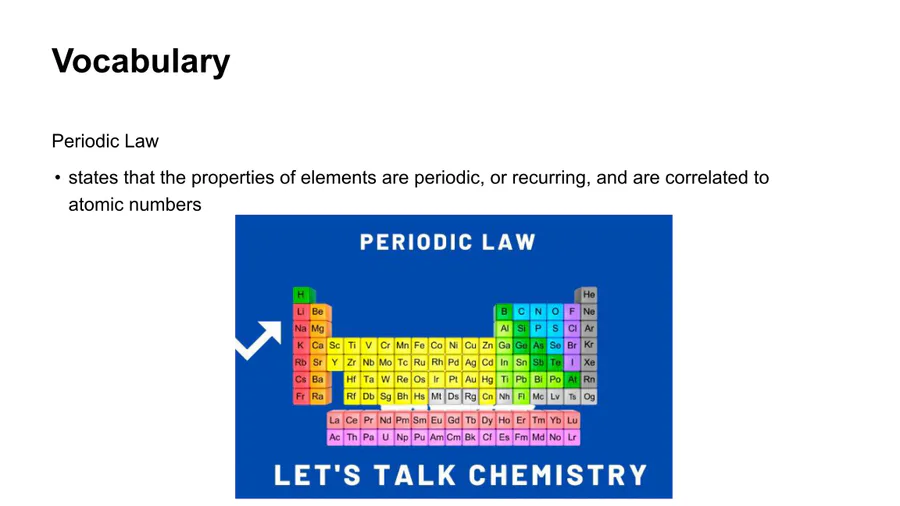
Which statement best describes the periodic law?
The properties of elements are periodic and related to atomic numbers.
Elements are arranged by their color.
All elements have the same properties.
Elements are grouped by their melting points.
8
9
10
Multiple Select
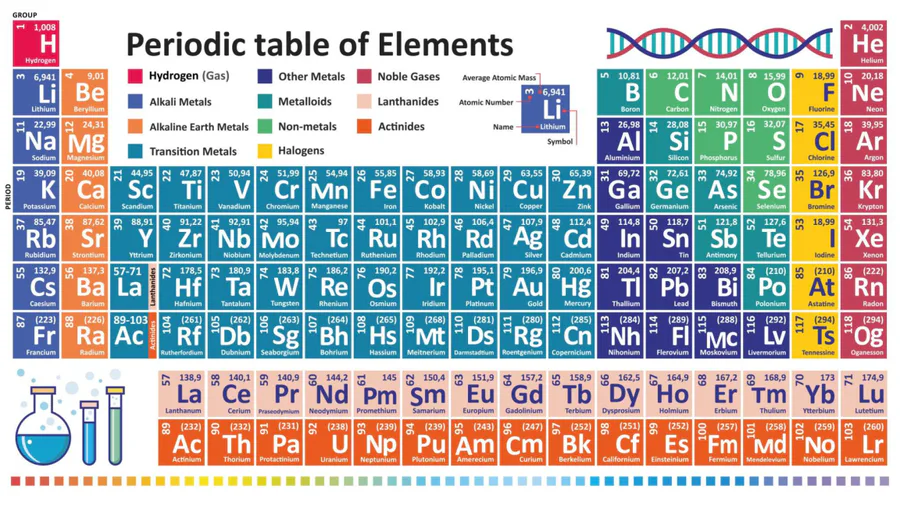
Which of the following are true about the modern periodic table?
It organizes elements by increasing atomic number.
It groups elements with similar properties together.
It arranges elements by their alphabetical order.
It is used as a reference for chemical properties.
11
12
Multiple Choice
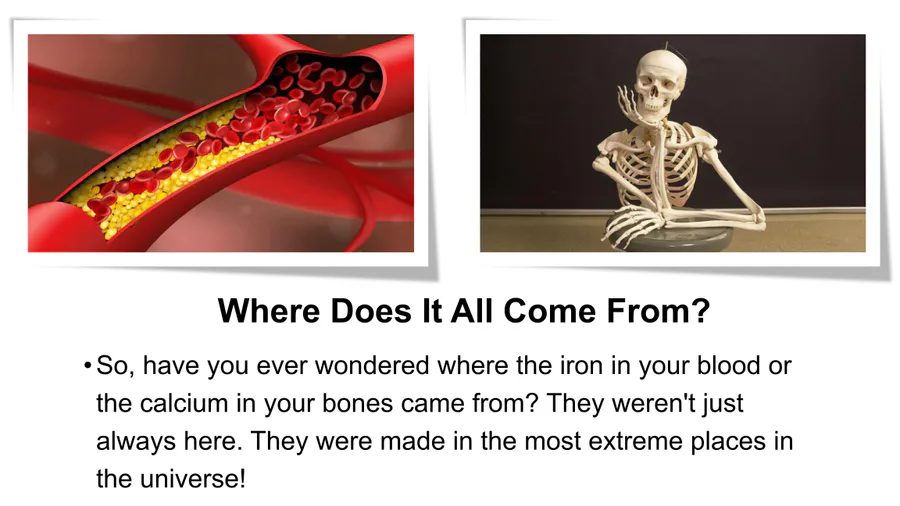
Where do most elements, such as the iron in your blood or the calcium in your bones, originate from according to the lesson?
They are made in the most extreme places in the universe.
They have always existed on Earth.
They are created in laboratories.
They come from plants.
13
14
Multiple Select
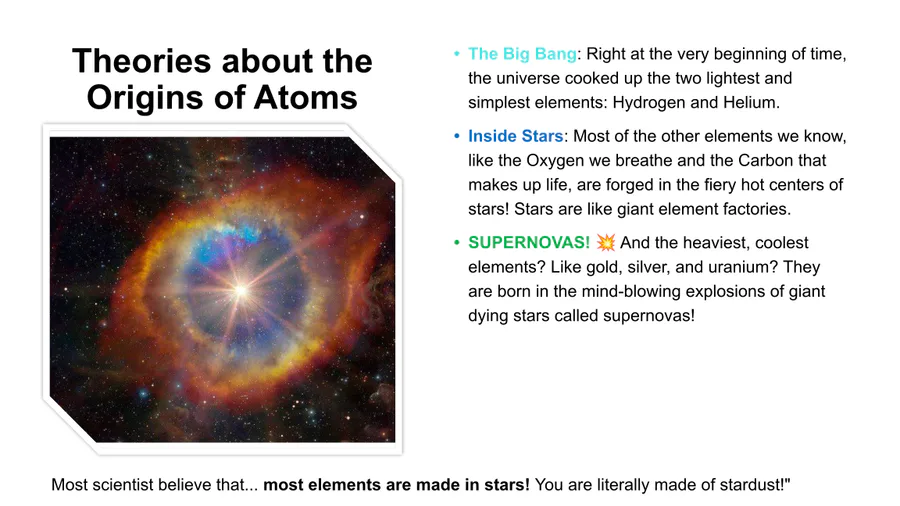
Which of the following are ways elements can be created in the universe, according to the lesson?
(Choose 3)
The Big Bang
Inside stars
Supernovas
On the surface of the Moon
15
Multiple Choice
According to most scientists, where are most elements in the universe made?
Inside stars
On planets
In black holes
In comets
16
17
Multiple Select
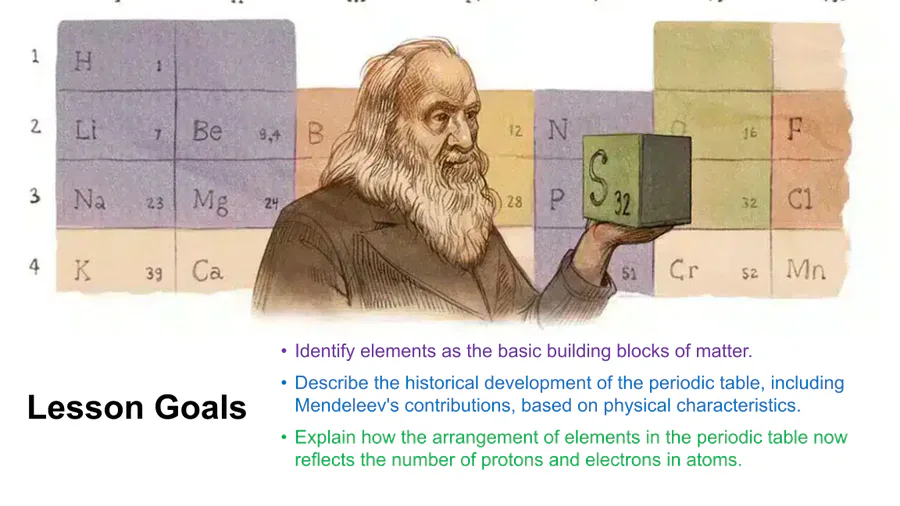
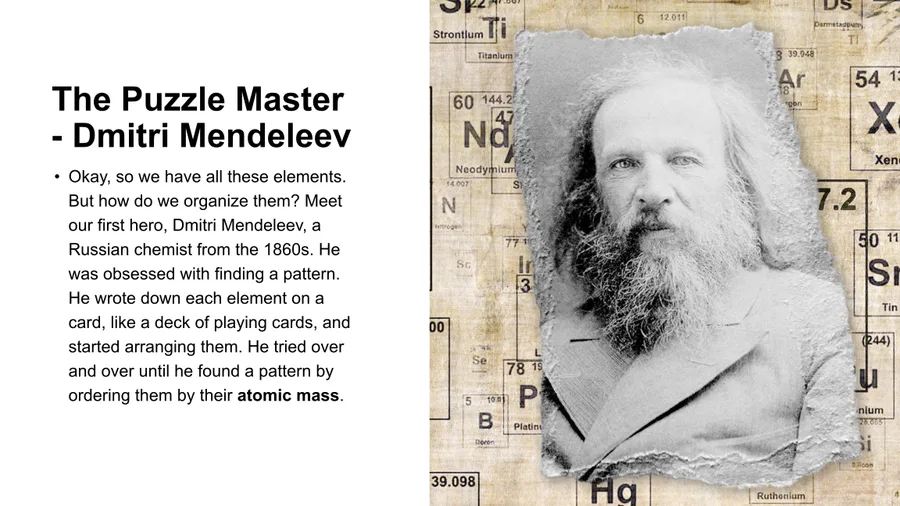
Which of the following statements about Dmitri Mendeleev are correct?
He organized elements by atomic mass.
He predicted the existence of new elements.
He used X-rays to discover atomic number.
He was a Russian chemist from the 1860s.
18
19
Multiple Choice
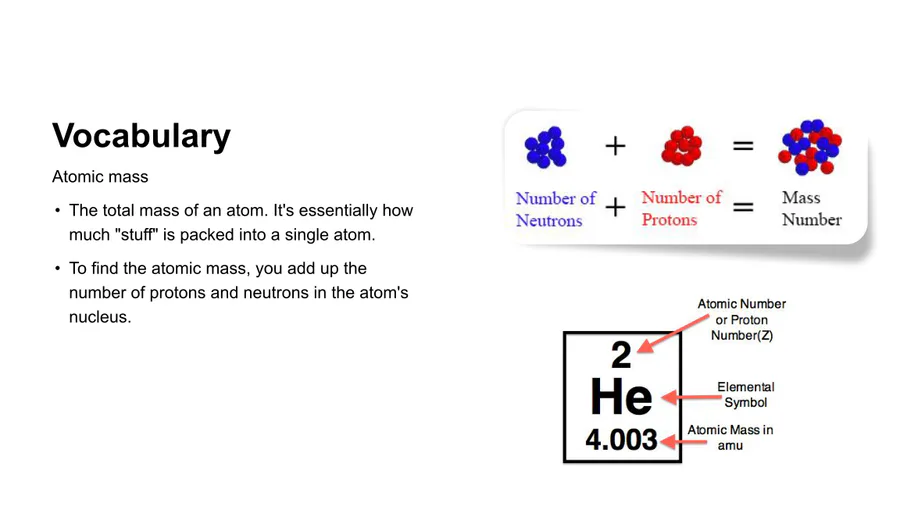
To find the atomic mass of an atom, you add the number of protons and ___ in the nucleus.
20
21
Multiple Choice
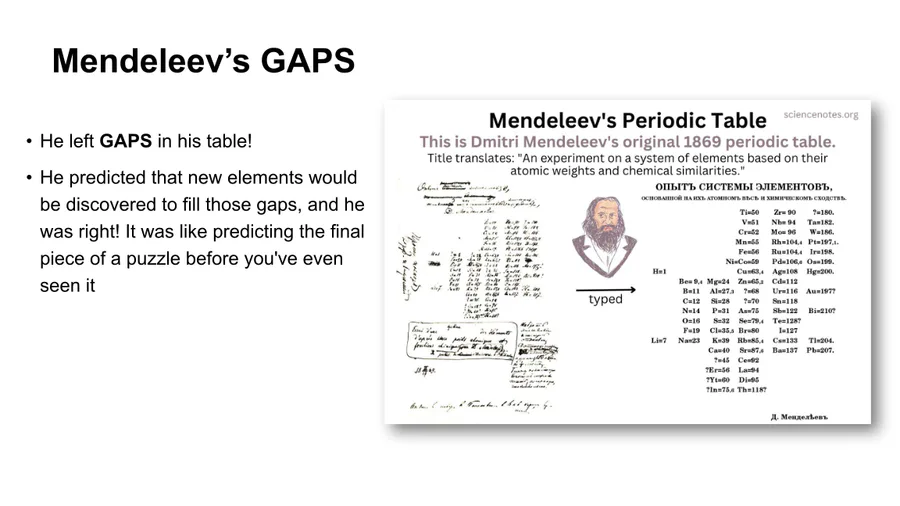
Mendeleev predicted that new ________ would be discovered to fill those gaps, and he was right!
22
23
Multiple Choice
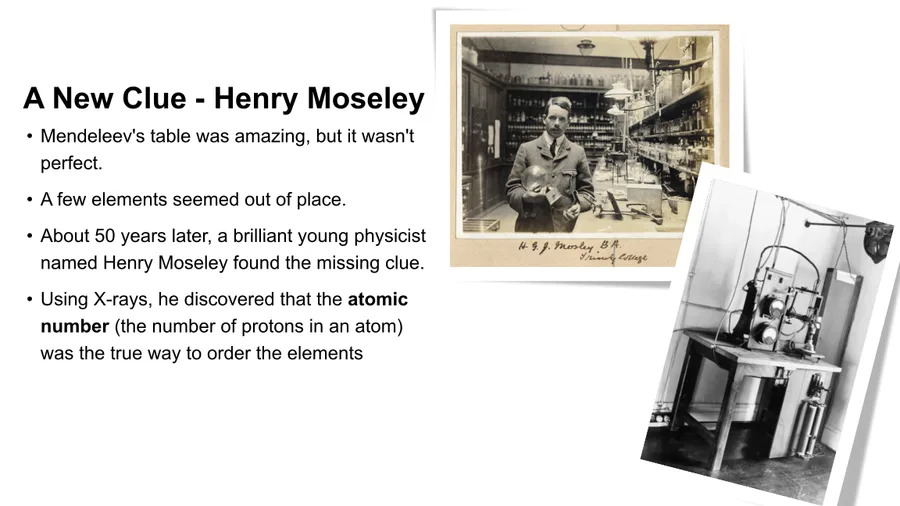
What was the main clue that helped Henry Moseley improve the periodic table?
Atomic number
Atomic mass
Melting point
Density
24
25
Multiple Choice
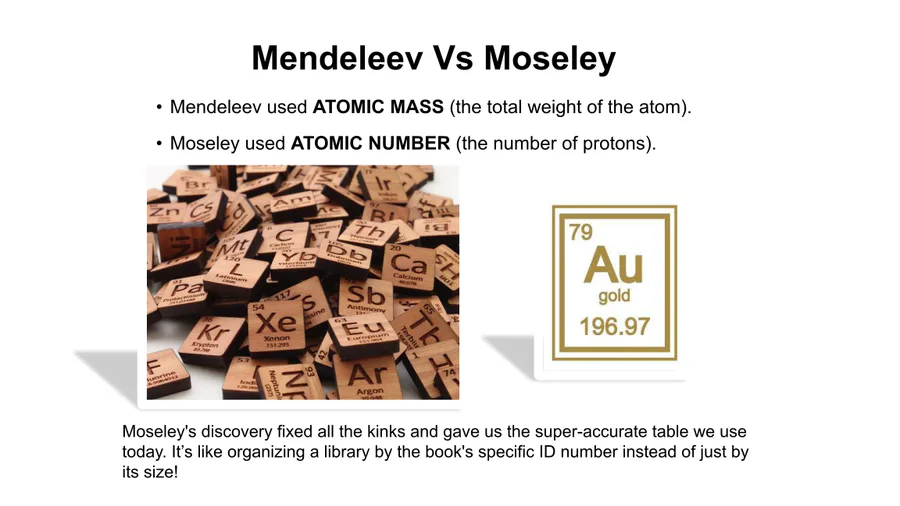
Which scientist used atomic number to organize the periodic table, and why was this method more effective than using atomic mass?
Mendeleev used atomic number, which was more effective because it matched chemical properties.
Moseley used atomic number, which was more effective because no two elements have the same number of protons
Mendeleev used atomic mass, which was more effective because it matched chemical properties.
Moseley used atomic mass, which was more effective because it matched chemical properties.
26
27
Multiple Choice
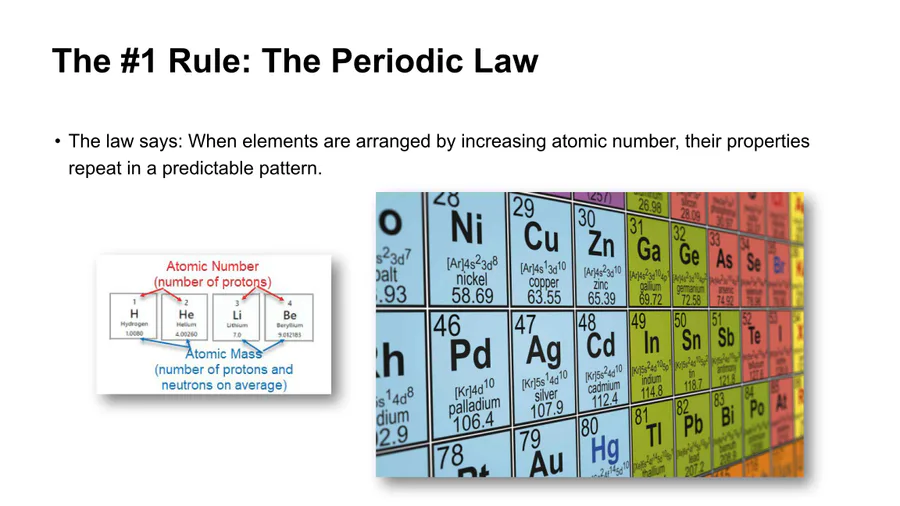
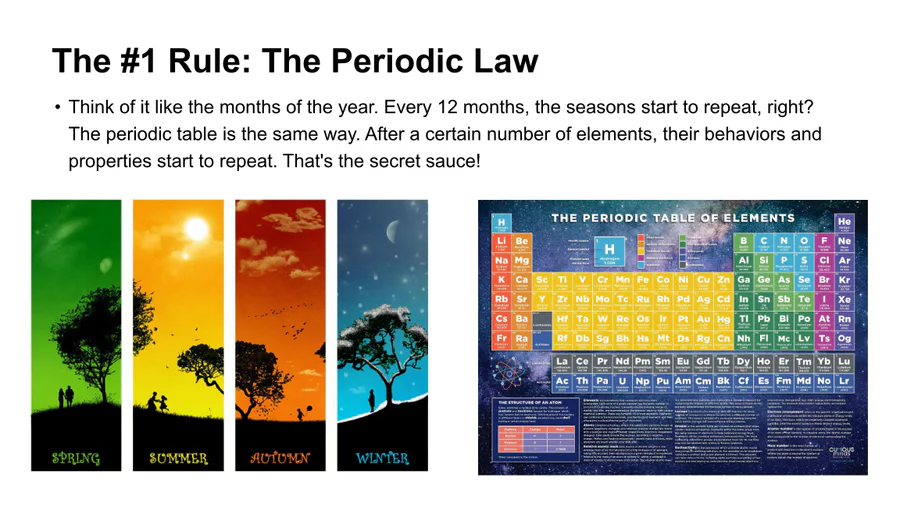
When elements are arranged by increasing atomic number, their properties ______ in a predictable pattern
repeat
28
29
30
Multiple Choice
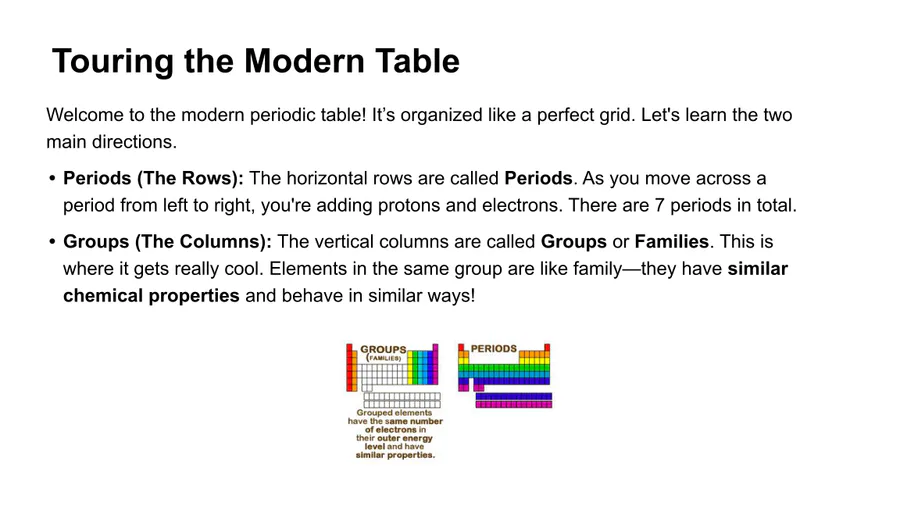
Elements in the same ___ have similar chemical properties.
31
Multiple Choice
Which of the following statements about periods and groups in the periodic table is/are correct?
Periods are vertical columns and groups are horizontal rows.
Periods are horizontal rows and groups are vertical columns.
There are 7 groups and many periods.
Elements in the same group have similar chemical properties.
32
33
34
Multiple Choice
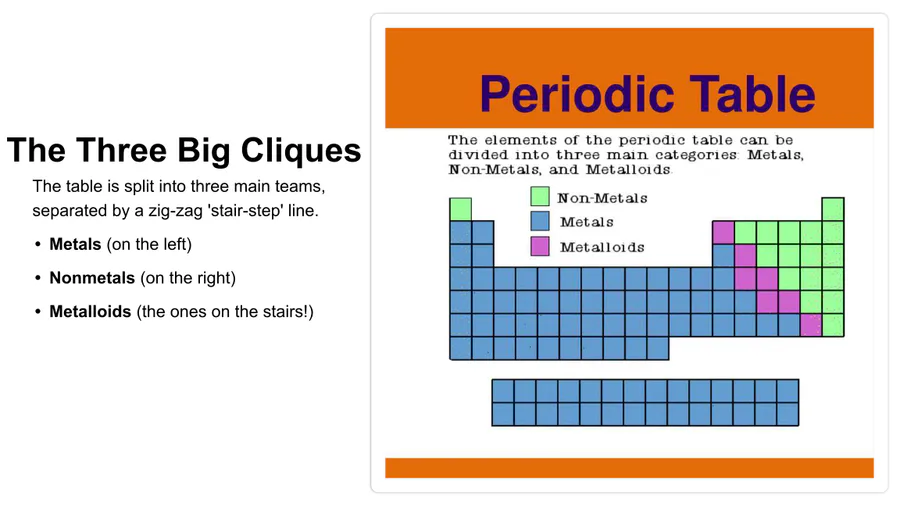
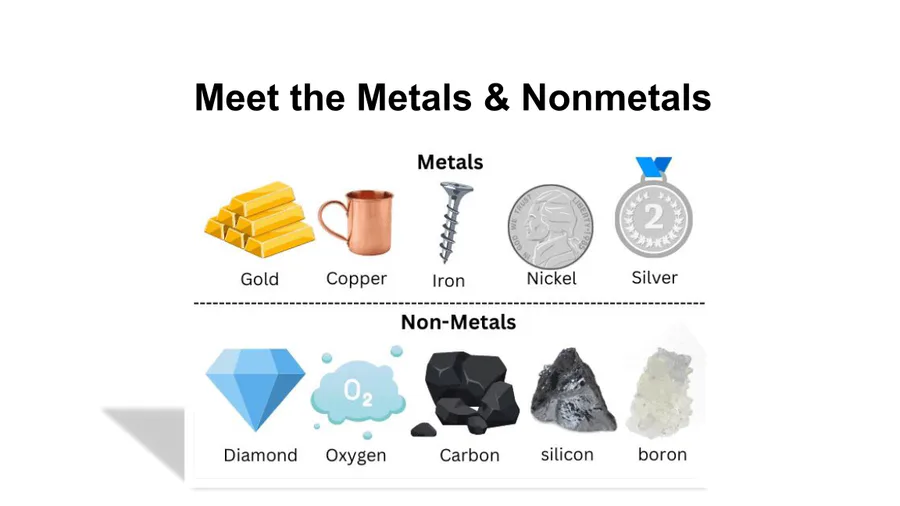
What are the three main categories into which elements in the periodic table are divided, and where is each category generally located?
Metals (left), Nonmetals (right), Metalloids (middle stair-step line)
Nonmetals (left), Metals (right), Metalloids (bottom)
Metalloids (left), Metals (middle), Nonmetals (right)
Metals (right), Nonmetals (left), Metalloids (top)
35
36
37
Multiple Choice
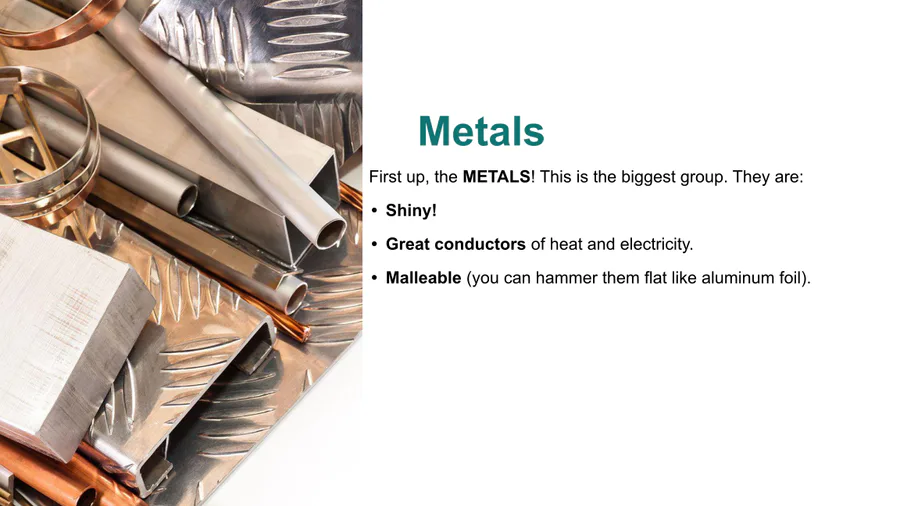
Which of the following is a property of metals?
They are shiny
They are poor conductors
They are usually gases at room temperature
They are dull
38
39
Multiple Select
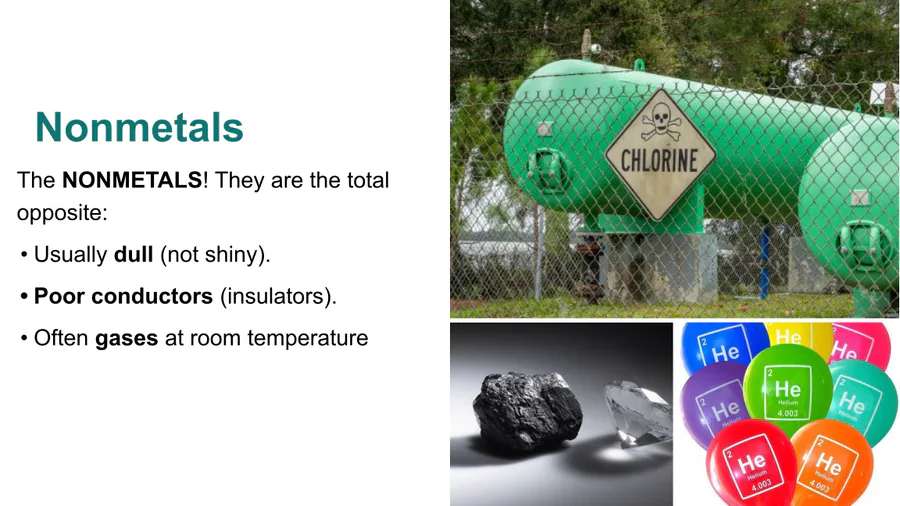
Which of the following are examples of nonmetals?
(Select 3)
Oxygen
Carbon
Gold
Boron
40
41
Multiple Choice
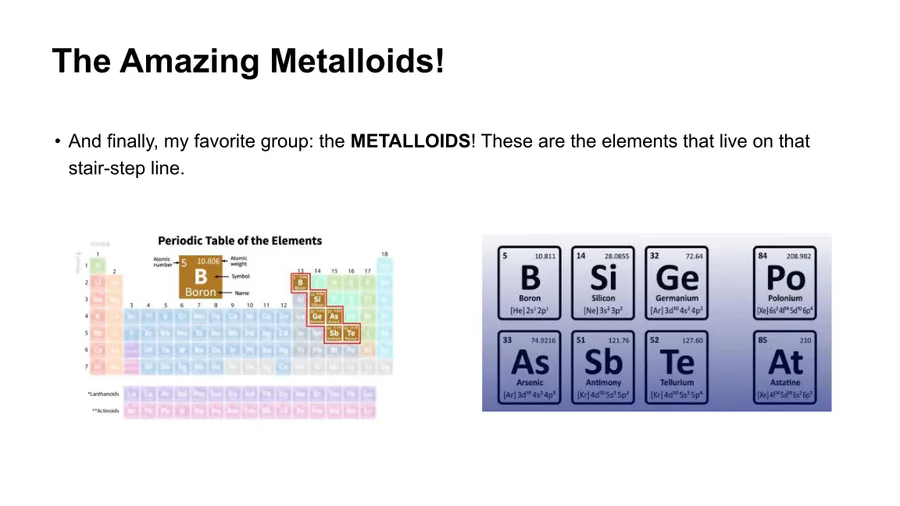
Which element is NOT a metalloid?
Silicon
Gold
Boron
Arsenic
42
43
Multiple Choice
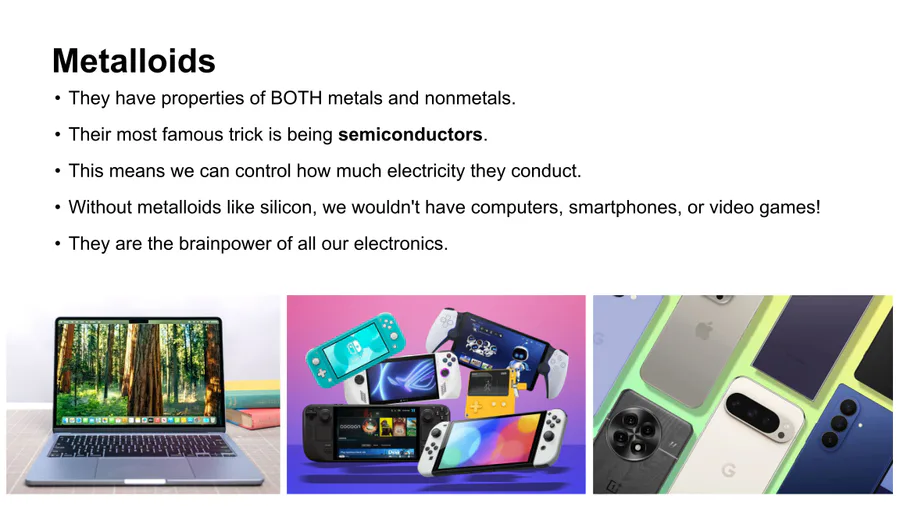
Metalloids are important in electronics because they can act as ___, allowing us to control electricity.
44
Multiple Choice
How are metalloids different from metals and nonmetals in terms of their properties and uses?
Metalloids differ from metals and nonmetals in that they can act as semiconductors that are used in electronics.
45
Multiple Choice
True or False: The arrangement of elements in the periodic table reflect the number of protons and electrons in atoms.
46
Multiple Choice
Which scientist is credited with the development of the periodic table based on physical characteristics?
Dmitri Mendeleev
Albert Einstein
Marie Curie
Isaac Newton
Show answer
Auto Play
Slide 1 / 46
SLIDE
Similar Resources on Wayground

39 questions
Natural Selection and Change Over Time
Presentation
•
8th Grade
41 questions
25-26 Q2 Procedures Review
Presentation
•
8th Grade
39 questions
LIght technology
Presentation
•
8th Grade
42 questions
Structure & Function of Matter Review
Presentation
•
8th Grade
43 questions
Superposition Notes
Presentation
•
8th Grade
41 questions
Rivers and Streams Self-paced lesson
Presentation
•
8th Grade
39 questions
TCi Photo/Resp with Fermentation 2023
Presentation
•
8th Grade
37 questions
Fossils Review
Presentation
•
8th Grade
Popular Resources on Wayground
6 questions
PRIDE Always and Everywhere
Presentation
•
12th Grade
20 questions
Lab Safety Quiz

Quiz
•
6th Grade
26 questions
KOR Review Kahoot Questions
Quiz
•
8th Grade
21 questions
Continents and Oceans
Quiz
•
6th Grade
12 questions
Unit Zero lesson 2 cafeteria
Presentation
•
9th - 12th Grade
20 questions
Parts of Speech
Quiz
•
5th Grade
10 questions
Riddles Riddles fun Riddles
Quiz
•
6th - 12th Grade
16 questions
Subject & Predicate
Quiz
•
5th Grade
Discover more resources for Science
20 questions
Lab Safety
Quiz
•
5th - 8th Grade
20 questions
Scientific Method and Variables
Quiz
•
8th Grade
20 questions
Scientific method and variables
Quiz
•
8th Grade
27 questions
Counting Atoms - Subscripts
Quiz
•
8th Grade
22 questions
Scientific Method and Variables
Quiz
•
8th Grade
18 questions
Counting Atoms
Quiz
•
7th - 8th Grade
10 questions
Exploring Chemical and Physical Changes

Interactive video
•
6th - 10th Grade
18 questions
Elements, Compounds, and Mixtures
Quiz
•
8th Grade