Search Header Logo
Sumamtive 1 Analysis

Sumamtive 1 Analysis

Assessment

Presentation

•

Science

•

6th - 8th Grade

•

Hard

•
NGSS
MS-PS1-1

Standards-aligned

Created by

Stephanie Serna

Used 4+ times

FREE Resource

28 Slides • 29 Questions

1

media

2

Multiple Choice

Question image
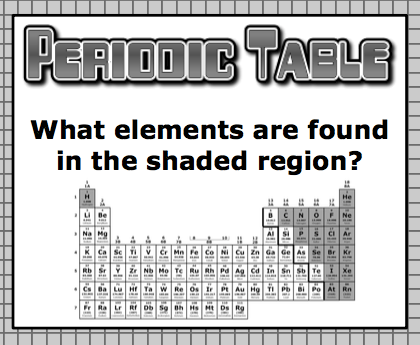
The atoms along the staircase are called 
1
metals
2
nonmetals
3
metalloids
4
noble gases

3

Multiple Choice

Question image
Most of the elements on the periodic table are classified as _____.
1
Metals
2
Nonmetals
3
Metalloids
4
Periods

4

Multiple Choice

Question image
1
Metals
2
Nonmetals
3
Metalloids

5

Categorize

Options (11)

Lustrous (shiny)

Malleable (can be pounded into sheets and shaped)

Ductile (can be made into wires)

Conducts heat and electricty

Brittle (breaks easily)

Dull (not shiny)

Gases or liquids at room temperature

Insulators (traps heat and electricity)

Semiconductors

Can be malleable or brittle

Can be lustrous or dull

Organize these options into the right categories

Metals
Nonmetals
Metalloids

6

media

7

media

8

media

9

Multiple Choice

What will you do to improve your understanding of the material?

1

Reflect on the questions I got wrong

2

Ignore my mistakes

3

Ask the teacher for help

4

Study alone

10

Multiple Choice

Which statement about changes in scientific thought is TRUE?

1

Changes in scientific thought show that the general public can never really rely on science.

2

Changes in scientific include having the ability to self-correct and improve.

3

Scientific thought and interpretations will never change over time.

11

media

12

Multiple Choice

What steps should a good scientist take after making mistakes on a test?

1

Go to eduphoria

2

View your score

3

Write down the questions you missed

4

All of the above

13

media

14

Multiple Choice

What should good scientists do when discussing answers?

1

Argue with each other

2

Listen and discuss

3

Ignore others' opinions

4

Only focus on their own answers

15

Multiple Choice

Scientists stay in touch in many ways. What is the MOST important reason that scientists work so hard to stay in touch?

1

to discuss their work and ideas

2

to keep up with the local news

3

to make new friends

4

to look important

16

media

17

Multiple Select

Where does each liquid end up in the container? Select two answers.

1

A. Saltwater is the top layer.

2

B. Saltwater is the bottom layer.

3

C. Turpentine is the top layer.

4

D. Turpentine is the bottom layer.

5

E. Olive oil is the top layer.

18

media

19

Multiple Choice

Based on the density column, what is the MOST LIKELY density of liquid soap?

1

1.05 g/ml

2

0.79 g/ml

3

0.915 g/ml

4

1.6 g/ml

20

media

21

Multiple Choice

Which conclusion best compares a property of cooking oil and water shown in this investigation?

1

Cooking oil is less dense than water.

2

Water is less dense than cooking oil.

3

Water dissolves in cooking oil.

4

Cooking oil dissolves in water.

22

media

23

Multiple Choice

Question image
A student reads the label on the bottle of salad dressing.  Why would the student shake the salad dressing before using it?
1
Vinegar and oil have different densities
2
Vinegar and oil easily form a solution
3
Vinegar and oil both contain water
4
Vinegar and oil are both liquids

24

media

25

Multiple Choice

Question image

Students performed investigations using water and three chemicals, baking soda, calcium chloride, and phenol red solution.  The student observations are shown in the table.

Which investigations above provide supporting evidence that a new substance formed?

1

Investigations 1, 2, and 3

2

Investigations 1, 3, and 5

3

Investigations 2, 3, and 4

4

Investigations 3, 4, and 5

26

media

27

media

28

Multiple Choice

Which change most likely occurs to the sugar when it is added to the water?

1

The sugar breaks down to form a new substance in the solution.

2

The sugar changes water into a new substance in the solution.

3

The sugar floats on the surface of the water in the solution.

4

The sugar completely dissolves in the solution.

29

media

30

media

31

media

32

Multiple Choice

Which statement best explains the difference in particle motion among solids, liquids, and gases?

1

The amount of energy in the particles is greatest in gases and least in solids.

2

The amount of energy in the particles is the same in all states of matter.

3

The particles in solids have more energy than those in liquids and gases.

4

The particles in gases vibrate in place, just like solids.

33

media

34

Multiple Select

Bowl 1 contains soup and Bowl 2 contains fruit salad. Which statements below BEST DESCRIBE the substances in Bowl 1 and Bowl 2?

1

Bowl 2 contains a solution.

2

Bowl 1 contains a gas.

3

Bowl 1 contains a solution.

4

Bowl 2 contains a mixture.

5

Bowl 1 contains a solid.

35

media

36

Multiple Choice

Some students were studying different types of mixtures. They stirred together one cup of oil and one cup of water in a large glass beaker. They observed that the water settled to the bottom and the oil floated to the top. Which of the following does this investigation demonstrate?

1

The oil completely mixed with the water.

2

The oil maintained its physical properties.

3

The oil caused the water to become more dense.

4

The oil melts in water.

37

media

38

Multiple Choice

Which of the following best explains the changes that occurred on a molecular level? Energy is removed ___ from the molecules in the ice cream mixture, causing them to expand and slow down, hardening into a solid.

1

added

2

removed

3

transferred

4

converted

39

media

40

Multiple Choice

Which of the following best describes what happens when most substances change from a solid state to a liquid state?

1

The molecules slow down.

2

The molecules move farther apart.

3

The molecules get smaller.

4

The molecules lose energy.

41

media

42

Multiple Choice

The malleable item placed in the gap of the circuit is a ___ because it ___ electricity.

1

metalloid

2

conducts

3

insulates

4

nonmetal

43

media

44

Multiple Choice

Identify the elements in the chart as either a metal, nonmetal, or metalloid.

1

Metal

2

Nonmetal

3

Metalloid

4

None of the above

45

media

46

Multiple Choice

Question image

Guess what! We have a mystery picture here. Can you tell us which physical property it represents?

1

Malleability

2

Ductility

3

Solubility

4

Conductivity

47

media

48

Multiple Choice

Question image

An element has a metallic-grey appearance. It also has the properties of both a metal and a nonmetal. In which section of the periodic table indicated in the illustration would the element most likely be found?

1

1

2

2

3

3

4

4

49

media

50

Multiple Choice

Which statement BEST supports your answer to Part A?

1

Hydrogen (H) is a gaseous element. This physical property allows electricity to flow through to complete the circuit.

2

Phosphorous (P) is a dull element. This physical property allows electricity to flow through to complete the circuit.

3

Carbon (C) is a brittle element. This physical property allows electricity to flow through to complete the circuit.

4

Copper (Cu) is a conductive element. This physical property allows electricity to flow through to complete the circuit.

51

media

52

media

53

Multiple Choice

What does the quote "Success is not the absence of failure, it’s the persistence through failure" imply about the nature of success?

1

Success comes easily

2

Failure is not important

3

Persistence is key to success

4

Success is guaranteed

54

media

55

Open Ended

What topics do you think you might still need some help on?

56

Open Ended

Describe science this year in one word.

57

Poll

How confident do you feel about this topic now?

Very confident
Somewhat confident
Not confident
media

Show answer

Auto Play

Slide 1 / 57

SLIDE