
ESS2.1 Day 2 2025/26

Presentation
•
Science
•
6th Grade
•
Easy
Standards-aligned

Brittany Williams
Used 12+ times
FREE Resource
12 Slides • 2 Questions
1
By Brittany Williams
2
EQ:
How does the uneven heating of earth create convection patterns in the ocean and atmosphere?
3
Open Ended
How would you break the standard apart?
How does the uneven heating of earth create convection patterns in the ocean and atmosphere?
4
Engage:
Why is the equator hot and the poles cold even though they are on the same planet with the same sun?
On the next slide, you will observe Earth's air and ocean currents.
5
6
Open Ended
What patterns did you notice?
Why do you think the air and water move like that?
7
Explore: Fill out the explore part of your notes!
8
Explain
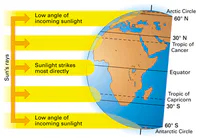
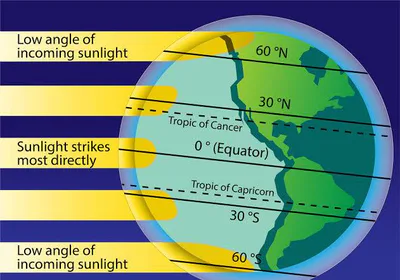
The Sun doesn’t heat the Earth evenly. The equator gets more direct sunlight than the poles. Land heats up faster than water, and surfaces with different colors (like snow vs. dark soil) absorb different amounts of heat.
9
10
The main idea:
The Earth is unevenly heated because of its shape, tilt, and surface features — not every part of Earth gets the same amount of sunlight.
11
1. Earth’s Curved Shape
The Earth is round, so sunlight doesn’t hit all parts equally.
Near the equator, sunlight shines directly (straight on), so it’s stronger and hotter.
Near the poles, sunlight hits at a slant, spreading over a larger area, so it’s weaker and cooler.
12
2. Earth’s Tilt
Earth is tilted about 23.5°, and that tilt causes seasons.
When one hemisphere tilts toward the Sun, it gets more direct sunlight (summer).
The other hemisphere tilts away, getting less sunlight (winter).
13
Why It Matters...
Because Earth is unevenly heated, we get winds, ocean currents, and weather patterns. Warm air rises, cool air sinks — and that movement drives convection currents in the atmosphere and oceans!
14
By Brittany Williams
Show answer
Auto Play
Slide 1 / 14
SLIDE
Similar Resources on Wayground

10 questions
Forms of Precipitation
Presentation
•
5th Grade
10 questions
WATER CYCLE
Presentation
•
5th Grade
12 questions
Food Web and Food Chains
Presentation
•
6th Grade
12 questions
Energy Transformation Review
Presentation
•
6th Grade
11 questions
Calculating & Graphing Speed
Presentation
•
6th - 7th Grade
13 questions
Motion and Measurement of Distance
Presentation
•
6th Grade
10 questions
Density and Buoyancy
Presentation
•
6th Grade
10 questions
Rotation and Revolution
Presentation
•
5th Grade
Popular Resources on Wayground
21 questions
Continents and Oceans

Quiz
•
6th Grade
20 questions
Parts of Speech
Quiz
•
5th Grade
16 questions
Subject & Predicate
Quiz
•
5th Grade
25 questions
Multiplication Facts
Quiz
•
5th Grade
12 questions
Map Skills
Quiz
•
3rd Grade
22 questions
Continents and Oceans
Quiz
•
5th Grade
15 questions
Rounding Decimals
Quiz
•
5th Grade
20 questions
Brand Labels
Quiz
•
5th - 12th Grade
Discover more resources for Science
20 questions
Elements, compounds, and mixtures
Quiz
•
6th Grade
10 questions
6.6D - Relative Density Review
Quiz
•
6th Grade
20 questions
Claim, Evidence and Reasoning (CER)
Quiz
•
6th - 8th Grade
10 questions
Exploring Chemical and Physical Changes

Interactive video
•
6th - 10th Grade
20 questions
Rocks and The Rock Cycle
Quiz
•
6th Grade
20 questions
6th Grade Force & Motion
Quiz
•
6th Grade
18 questions
Interpreting Distance/Time Graphs
Quiz
•
6th Grade
16 questions
Kinetic Energy and Potential Energy
Presentation
•
6th Grade