

Police Liability

Presentation
•
Other
•
University
•
Medium

ML Rodriguez
Used 1+ times
FREE Resource
8 Slides • 28 Questions
1
2
3
4
5

6
Multiple Choice
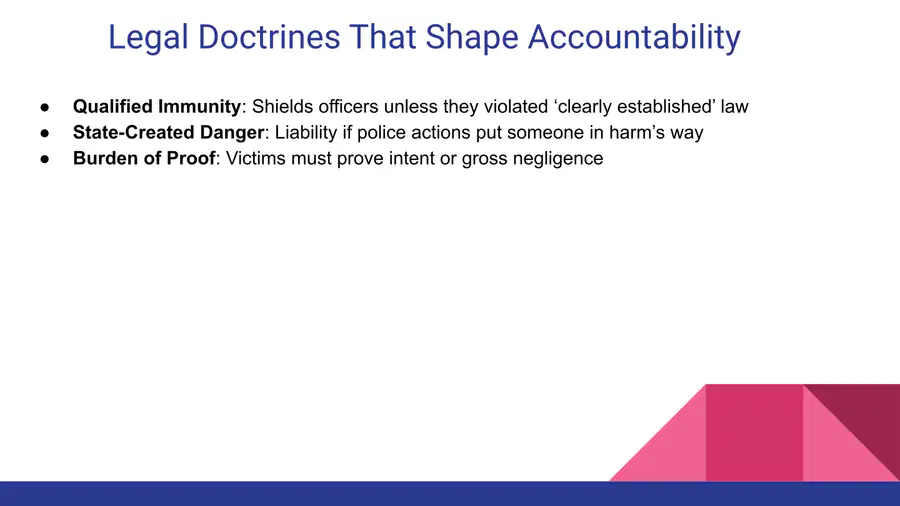
What is qualified immunity?
7
8
Multiple Choice
What is injunctive relief?
9
10

11
Multiple Choice
Allows police to stop, question, and do a limited pat down of a suspected criminal, based on less than probable cause, but it must be more than a hunch
probable cause
consent
interrogate
reasonable suspicion
12
Multiple Choice
Consent searches under the Fourth Amendment are valid if:
The consent is given by someone who does not have authority over the property.
The consent is obtained through deception.
The consent is voluntary.
The person is under arrest.
13
Multiple Choice
What was the significance of the Terry v. Ohio case?
It established the legal standard of reasonable suspicion
It abolished the Fourth Amendment
It allowed police to arrest without cause
It limited police powers
14
Multiple Choice
True or false: In all states, if the person runs from the police upon being asked for identification, that flight may give the officer reasonable suspicion to stop the person again, at which point the person is not free to walk away.
True
False
15
Multiple Choice
Which level of law enforcement typically responds to 911 calls and enforces city ordinances?
Federal
State
Local
Tribal
16
Multiple Choice
What legal standard did Terry v. Ohio establish for stop-and-frisk procedures?
Probable cause
Clear and convincing evidence
Reasonable suspicion
Preponderance of the evidence
17
Multiple Choice
Which constitutional amendment protects individuals from unreasonable searches and seizures?
First Amendment
Second Amendment
Fourth Amendment
Eighth Amendment
18
Multiple Choice
Legal responsibility for harm defines what term?
Remedy
Libel
Judgment
Liability
19
Multiple Select
Joe and Mary decide to burglarize Superior Jewelers. Their friend Carl, a former employee at Superior, helps by telling them the location of the store vault. Carl will be charged as...
the principle
an accomplice
an accessory before the fact
an accessory after the fact
20
Multiple Choice
When you have a legal responsibility that is called
liability
tort
settlement
defamation
21
Multiple Choice
What are some examples of police misconduct?
Excessive force
False arrest
Sexual assault
All of the above
22
Multiple Choice
What is the standard of proof required in criminal cases?
Beyond reasonable doubt
Preponderance of evidence
Clear and convincing evidence
Probable cause
23
Multiple Choice
Which law protects individuals with disabilities from discrimination?
Title VI
ADA & Section 504
34 U.S.C. § 12601
18 U.S.C. §§ 241, 242
24
Multiple Select
What are the four methods of police accountability listed in the table?
Civilian Oversight
Internal Affairs
Consent Decrees
Public Policy
25
Multiple Choice
The Civil Rights Act of 1957 established a Civil Rights Division within the US Department of Justice. What was the main purpose of this division?
To enforce laws prohibiting discrimination
To integrate public schools
To enforce privacy protections
To integrate the armed forces
26
Multiple Choice
What are the key components of consent decrees?
Court-enforced reform agreement
Enforced by state courts
Triggered by civil rights violations
DOJ negotiates reforms
27
Multiple Choice
28
Multiple Choice
(2019) The Civil Rights Act of 1957 established a Civil Rights Division within the U.S. Department of Justice. What was the main purpose of this division?
To enforce laws prohibiting discriminaton
To integrare public schools
To enforce privacy protections
To integrate the armed forces
29
Multiple Choice
What was the result of the pattern of unconstitutional stops, searches, and arrests in Ferguson, MO?
Increased community trust
DOJ consent decree
Higher crime rates
More fines issued
30
Multiple Choice
What was the focus of the DOJ investigation after George Floyd's death?
Excessive force and racial bias
Community policing
Traffic violations
Drug-related crimes
31
Multiple Choice
What was the trigger for the Ferguson case?
Revenue-driven policing
George Floyd's death
Excessive force
Racial bias
32
Multiple Choice
What is the role of Data Dashboards in police reform?
Record encounters
Document stops/pursuits
Public misconduct stats
None of the above
33
Multiple Choice
What are the main legal controversies that are debated over?
Qualified immunity
Police unions
Federal oversight
All of the above
34
Multiple Choice
What are the key components of the George Floyd Justice in Policing Act?
Chokeholds
No-knock warrants
Duty to intervene
All of the above
35
Multiple Choice
What are the key components of Community Engagement & Public Trust?
Transparency
Cultural competency
Feedback mechanisms
All of the above
36
Multiple Choice
Accountability =
Show answer
Auto Play
Slide 1 / 36
SLIDE
Similar Resources on Wayground

30 questions
Repasando contenidos - Diseño de proyectos II
Presentation
•
University
29 questions
Análisis proporcional
Presentation
•
University
30 questions
Basic Competencies 9
Presentation
•
KG - University
30 questions
Quizizz Lesson
Presentation
•
KG
30 questions
Respiratory Review Two
Presentation
•
University
31 questions
U4 W1 L4 - Rural vs. Urban
Presentation
•
KG
28 questions
Comparative and superlative adjectives
Presentation
•
University
32 questions
Routines and Creativity
Presentation
•
University
Popular Resources on Wayground
5 questions
A Home on the Shore

Quiz
•
3rd Grade
28 questions
US History Regents Review
Quiz
•
11th Grade
6 questions
A Horse Tale
Quiz
•
3rd Grade
20 questions
Math Review
Quiz
•
3rd Grade
10 questions
Juneteenth History and Significance

Interactive video
•
5th - 8th Grade
20 questions
Dividing Fractions
Quiz
•
5th Grade
55 questions
A Long Walk to Water Final Review
Quiz
•
6th - 8th Grade
10 questions
Equation Word Problems
Quiz
•
7th Grade