
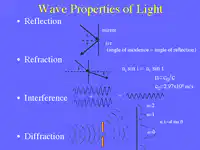
4.PS.4-2_Topic 2 Lesson 3-Light Waves

Presentation
•
Science
•
1st - 5th Grade
•
Hard
+10
Standards-aligned

Jessica Freeman
FREE Resource
44 Slides • 63 Questions
1
Light Waves
By Jessica Freeman
2
By Shayla Roberson
3

4
Fill in the Blanks
Light is a kind of energy that you can
Type answer...
5
Multiple Choice
•Most objects give off their own light.
True
False
6

7
Fill in the Blanks
Light waves travel in a straight path called a
Type answer...
8

9
Open Ended
List one natural and one man-made light source below.
10
Open Ended
look around your house. Find one light source and show it on camera. When you show the light source, select list it below.
11

12

13
Multiple Choice
1. If an object allows almost all light to pass through it then it is...
opaque
transparent
translucent
cold
14
Multiple Choice
The windows that you can easily see through is transparent.
true
false
15

16
Multiple Select
A _________ object lets some light pass through it.
transparent
opaque
translucent
17
Open Ended
Name an item that you think is translucent
18

19
Multiple Choice
•An _________object lets no light pass through it.
opaque
translucent
transparent
20
Multiple Choice
A block of wood is opaque.
true
false
21
Multiple Choice
A clear window is opaque
true
false
22
Multiple Choice
If you were building a house in Alaska (where it can be daylight for months!), what type of material would be best to cover your windows with that would help keep the Sun out of your room so you can sleep?
transparent material
translucent material
glass material
opaque material
23
Multiple Choice
Your grandma has plants in her kitchen. They need lots of light! What type of windows should she have installed that will be best for her indoor garden?
transparent material
translucent material
glass material
opaque material
24
Multiple Choice
The windows that you can easily see through is transparent.
true
false
25

26
Multiple Choice
What is the only form of energy we can see?
Prism
Light
Mirror
27
Fill in the Blanks
What is our main source of light?
Type answer...
28
Multiple Choice
Which light source causes shadows in the outdoor environment?
The sun
The light bulb
The house
The school
29
Open Ended
A shadow is a place where light _________________
30

31

32
Multiple Choice
Shining a flashlight on a flat mirror proves that light can
pass through objects.
only travel in a straight line.
be reflected.
be absorbed by the mirror.
33
Multiple Choice
What word is used to describe light as it strikes a smooth, shiny surface and bounces off?
shadow
energy
reflection
wave length
34
Multiple Select
Light travels in ---------
Wave
Straight line
35

36
Multiple Choice
When light bounces back it is _____
Reflected
Refracted
Absorbed
Optical Density
37
Multiple Choice
When light bends it is ______
Reflection
Absorption
refraction
optical density
38
Multiple Choice
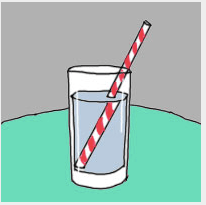
Why does the straw appear to be bent?
light is reflected
light is absorbed
light is turned
light is refracted
39
Multiple Choice
Light traveling through the air moves in a straight line. An object viewed through water looks different because light rays that travel through water are –
bent.
bounced.
reflected.
absorbed.
40
Multiple Choice

What is happening in this picture?
Reflection
Refraction
41
Multiple Choice
Refraction is when light...
Bounces
Transmits
Bends
Absorbs
42

43

44

45

46
Multiple Choice
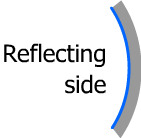
The following is a picture of what type of mirror?
Convex Mirror
Concave Mirror
Plane Mirror
Flat Mirror
47
Multiple Choice
Which of the mirrors is used as rearview mirror in vehicles?
Concave
Convex
Plane
48
Multiple Choice
Convex mirrors cause light to spread out.
True
False
49
Multiple Choice
A ___ lens makes objects appear bigger.
concave
convex
prism
flat
50

51

52

53

54
Multiple Choice
Why does a banana appear to be yellow?
When white light strikes a banana, all colors of light except for yellow are reflect it. Yellow light is absorbed from the banana. You see the banana yellow.
The seven colors are absorbed.
When white light strikes a banana, all colors of light except for yellow are absorbed. Yellow light is reflected from the banana. You see the banana as yellow.
When white light strikes a banana, the yellow and all the other colors are reflected.
55
Multiple Choice
Which colors make up white light?
Red, Orange, and Yellow
All colors
Reds and Violets
56
Multiple Choice

Which color absorbs all light?
White
Black
Orange
Green
57
Multiple Choice
The color you see is the color that is ___.
reflected
absorbed
58
We measure light by 3 different properties:
Brightness
Color
Visibility

59
Light, or "white light", is made up of ALL colors of light mixed together.
If white light passes through a prism, it can be separated into all of the colors.
Those colors are red, orange, yellow, green, blue, and violet -- the colors of the rainbow!

60
The intensity of light is how we measure how much light we can see.
The closer the source of light is, the brighter it is.
Think of a flashlight. If you hold it up close to your face, it hurts your eyes to look at.
The farther away the source of light is, the less bright it is.
If someone with a flashlight is far away from you, you can still see the light, but looking at the flashlight won't hurt your eyes as much.

61
In order for us to see an object, it has to either give off its own light or reflect light.
What are some objects that gives off their own light?
This means everything that does not make its own light reflects light to be seen.
That even means us! Think about it, if we are in a dark room, you can't see another person or objects. This is because there is no light for us to reflect.

62
Light can do 3 things when it hits an object. It can be:
Reflected
Refracted
Absorbed
63
When light is reflected, it bounces back from a surface.
This is how we see objects that don't make their own light - it bounces off the surface/object and reflects light into our eyes.
When light hits a shiny or smooth surface, like a mirror or still water, it is reflected and can show us a reflection very similar to the object seen.
The color of the light that is reflected is the color we see. For example, something red only reflects red light.
64
When light is refracted it passes from one type of material and changes direction.
A great example of this is a magnifying glass. When light passes through, it changes directions, which lets us see a much bigger version of what we are looking at.
65
When light is absorbed it does not reflect or pass through the object. It remains in the material as a form of energy,
The colors of objects are determined by the light that is not absorbed and then reflected for us to see. All other colors of light striking the object are absorbed.
For example - if you are wearing a blue shirt - white light strikes your shirt. All colors EXCEPT for blue are absorbed. Blue is reflected to our eyes.
66
Multiple Choice
What was this lesson about?
Light
Fractions
Space
The Solar System
67
Open Ended
What are the 3 properties that we look at to measure light?
68
Open Ended
What happens when light hits objects? (Think about the 3 things that light can do.)
69
What was this lesson about? SPACE
What are the 3 properties that we use to measure light? BRIGHTNESS, COLOR, VISIBILITY
In our "Color" slide, we talked about what happens to light when it passes through a prism. What happens to that white light? IT SEPARATES INTO ALL OF THE OTHER COLORS.
What happens when light hits objects? IT CAN BE REFLECTED, REFRACTED, or ABSORBED.
70
71

72
Multiple Choice

When a person walks into the water at the beach, it appears that their feet are separated from their legs. This occurs because the light waves bend as they pass between air and the water. This is an example of...
reflection of light
transmission of light
absorption of light
refraction of light
73
Multiple Choice
When waves bend due to a change in their speed as they pass from one medium to another, we are referring to ...
reflection
transmission
absorption
refraction
74

- The bending of waves due to a change in speed
- Sound waves are refracted when changing mediums (solids to liquids to gas) or travel through different temperatures
- Light travels through a material and changes speed and is bent
Ex: pencil in water
Refraction

75
Multiple Choice
A student looks at a shiny object and sees themselves. What is happening to MOST of the light that is hitting the shiny object?
The light is being absorbed
The light is being reflected
The light is being transmitted
The light is being transmitted
76


- The bouncing back of a wave when the wave hits an object
- An echo is a mechanical wave reflecting into the medium from which it came
- Light waves bounce off a surface
ex: light on shiny surfaces and mirrors
77
Multiple Select
In what ways do waves change their behavior when they encounter a new medium?
refraction
reflection
absorption
cancellation
78

79
A form of energy we can see

80
Multiple Choice
Light is energy we can touch.
True
False
81
Give off light
reflect light (bounce light off the surface)

82
Multiple Select
What are the two ways objects can be seen?
It gives off light
It smokes.
It reflects light.
It rusts.
83
Light travels this way until it hits something

84
Multiple Choice
Light always travels in a strait line, even when it hits something.
True
False
85
Light bounced off an object with a smooth surface.
Light will reflect at the same angle that it hit the reflective object.
Rough surfaces scatter light instead of reflecting it.

86
Multiple Choice
Light reflects off a smooth surface the same way it reflects off a rough surface.
True
False
87
Light is absorbed (taken in) by an object.
The object gets warmer as the light changes to heat (thermal) energy.

88
Multiple Choice
When light gets taken in by an object, it is
absorption
reflection
refraction
transmission
89
Multiple Choice
The more light an object absorbs, the more heat energy it will make.
True
False
90
Light transmits through an object.
It changes direction when it passes from one material (medium) to another.
It is the bending of light.

91
Multiple Choice
When light goes from one medium (material) to another, it will bend. This is called
absorption
reflection
refraction
transmission
92
Different materials absorb more light of certain colors and reflect more light of other colors.
Colors are the way we see reflected light.

93
Multiple Choice
The colors we see are the light that gets reflected off of the object.
True
False
94
The object absorbs most colors of light
Light energy changes to heat energy

95
Multiple Choice
What color is only seen when most of the colors of light are absorbed by an object?
black
green
orange
white
96
The object reflects most colors of light
Not as much chance for light energy to change to heat energy.

97
Multiple Choice
What color is only seen when most the colors of light are reflected off the object?
black
green
orange
white
98
Multiple Choice
Which of the following is an artificial light source?
99
Multiple Choice
How does a light bulb work?
A wick inside the bulb is burned
An electric current is passed through a filament.
White light is passed through a prism
Ambient light is reflected by a small mirror.
100
Multiple Choice

What can you infer about the environment the anglerfish lives in?
It must be extremely bright.
It must be extremely dark
It must be filled with other fish.
It must be empty of other fish.
101
Multiple Choice
What device produces light by running an electric current through a gas?
An incandescent light bulb
A flashlight
A neon sign
A prism
102
Multiple Choice
What could you use to split white light into its component colors?
A flashlight
A capacitor
A light bulb
A prism
103
Multiple Choice
Why does refraction occur?
Light travels through different materials at different speeds
Different colors of light travel at different speeds.
Different materials physically twist light around.
Light from different sources travels at different rates.
104
Multiple Choice
Only a minute portion of the electromagnetic spectrum can be seen with the human eye. In this context, what does "minute" mean?
Colorful
Large
60 Seconds
Small
105
Multiple Choice
When you look at your teacher's face, how can you see it?
Light reflects off of her face.
Her face emanates light.
Light refracts through her face
Her face emits electromagnetic radiation.
106
Multiple Choice
Light can behave as both a ______ and a _______.
Ray; beam
Wave; particle
Natural source; unnatural source
Refraction; reflection
107
Multiple Choice
Why does the light we see from stars take thousands of years to reach us?
Because the light is slowed down by gases in outer space
Because the light is reflected off of other stars
Because the stars are very far away
Because light travels very slowly
Light Waves
By Jessica Freeman
Show answer
Auto Play
Slide 1 / 107
SLIDE
Similar Resources on Wayground

93 questions
Grammar Concepts
Presentation
•
1st - 5th Grade
103 questions
Fraction Review
Presentation
•
4th Grade
99 questions
MOVERS
Presentation
•
1st - 7th Grade
94 questions
Unit 4
Presentation
•
1st - 5th Grade
94 questions
Place Value, Negative Numbers, Multiply/Divide 10,100,1000
Presentation
•
2nd - 5th Grade
106 questions
A Difficult Decision
Presentation
•
KG
106 questions
Unit 3 25
Presentation
•
1st - 5th Grade
Popular Resources on Wayground
10 questions
Safety Day 2026 – Student Review

Quiz
•
9th Grade
21 questions
Continents and Oceans
Quiz
•
6th Grade
20 questions
Parts of Speech
Quiz
•
5th Grade
16 questions
Subject & Predicate
Quiz
•
5th Grade
25 questions
Multiplication Facts
Quiz
•
5th Grade
12 questions
Map Skills
Quiz
•
3rd Grade
22 questions
Continents and Oceans
Quiz
•
5th Grade
15 questions
Rounding Decimals
Quiz
•
5th Grade
Discover more resources for Science
20 questions
Mixtures and Solutions Practice
Quiz
•
5th Grade
10 questions
Mixtures and Solutions
Quiz
•
4th Grade
20 questions
Food Chains and Food Webs Review
Quiz
•
5th Grade
20 questions
GC Interim #1 Review 2026
Quiz
•
5th Grade
10 questions
Severe Weather Around Us
Quiz
•
2nd Grade
20 questions
5.3 Force and Motion Study Guide Review
Quiz
•
5th Grade
15 questions
Force and Motion
Presentation
•
5th Grade
19 questions
3rd Grade CUA #1 Review GC
Quiz
•
3rd Grade