Search Header Logo
Module 7: Introduction to Chemistry

Module 7: Introduction to Chemistry

Assessment

Presentation

•

Chemistry

•

9th - 12th Grade

•

Medium

•
NGSS
HS-PS1-1, HS-PS1-2, MS-PS1-1

+3

Standards-aligned

Used 1+ times

FREE Resource

49 Slides • 43 Questions

1

media

2

Multiple Choice

Question image

A scientist uses an instrument to study the small particles in a piece of matter. The diagram shows what the scientist sees.


What state of matter is the scientist most likely observing?

1

gas

2

solid

3

liquid

4

vapor

3

media

4

media

5

media

6

Multiple Choice

What does the quantum mechanical model of an atom describe?

1

The structure of the nucleus

2

The probability of finding electrons

3

The mass of the atom

4

The charge of the atom

7

media

8

Categorize

Options (7)

Positive Charge

No Charge

Negative Charge

Orbit Nucleus

Along with protons, determines the atom’s mass.

Determines the atom’s elemental identity

Determines what chemical bonds the atom will form.

Identify each statement as describing a proton (p), neutron (n), or electron (e). - Positively charged. - Negatively charged. - No charge. - Orbit the nucleus. - Determines the atom’s elemental identity. - Determines what chemical bonds the atom will form. - Along with protons, determines the atom’s mass.

Proton
Neutron
Electron

9

media

10

Reorder

Question image

Order the following elements from smallest to largest atomic number

H

F

Na

Ar

1
2
3
4

11

media

12

Multiple Choice

Question image
Based on the atomic diagram showing lithium-7 with its nuclear composition, how many neutrons are present in this isotope?
1
8
2
3
3
4
4
5

13

media

14

Multiple Choice

Question image

By definition the term "anion​" means ​ ​

​ ​

1
negatively charged (-1,-2,-3)
2
positively charged (+1,+2, +3)
3

No charge

15

media

16

Multiple Choice

Question image

How many valence electrons are shown in the diagram?

1

16

2

7

3

6

4

2

17

media

18

Multiple Choice

What is the total number of electrons in an atom with a charge (ion)?

1

Atomic number + charge

2

Atomic number - charge

3

Charge - atomic number

4

Atomic number

19

media

20

Multiple Choice

Question image

How many electrons does the following ion have?

1

3

2

7

3

10

4

14

21

media

22

Fill in the Blank

Question image

How many valence electrons are in this ion?

HINT: There's a charge!

23

media

24

Multiple Choice

Question image

This could be the dot diagram of

1

Mg

2

Cl

3

C

4

O

25

Multiple Choice

How many valence electrons should Magnesium have in its Lewis dot model?

1

1

2

2

3

3

4

4

26

Multiple Choice

Question image

This is a correct dot diagram for neon (Ne)

1

true

2

false

27

Multiple Choice

Question image
This could be the dot diagram of
1
Al
2
Si
3
Na
4
Mg

28

media

29

Multiple Choice

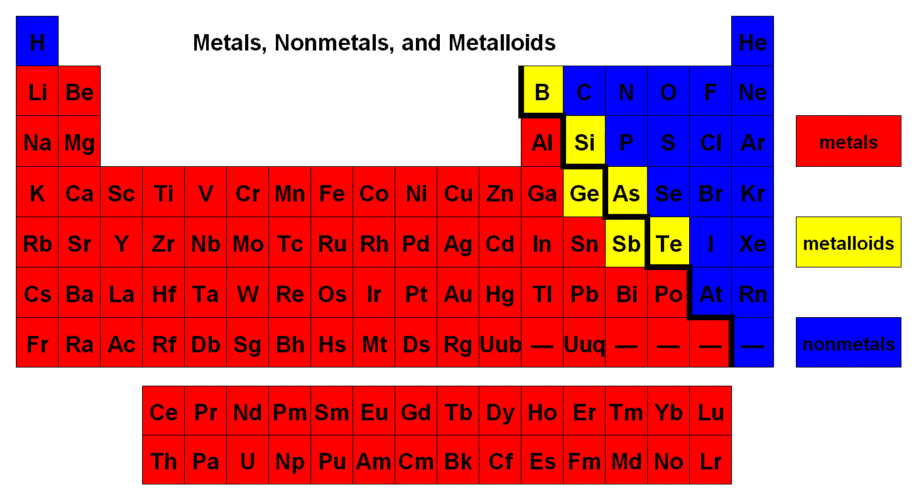
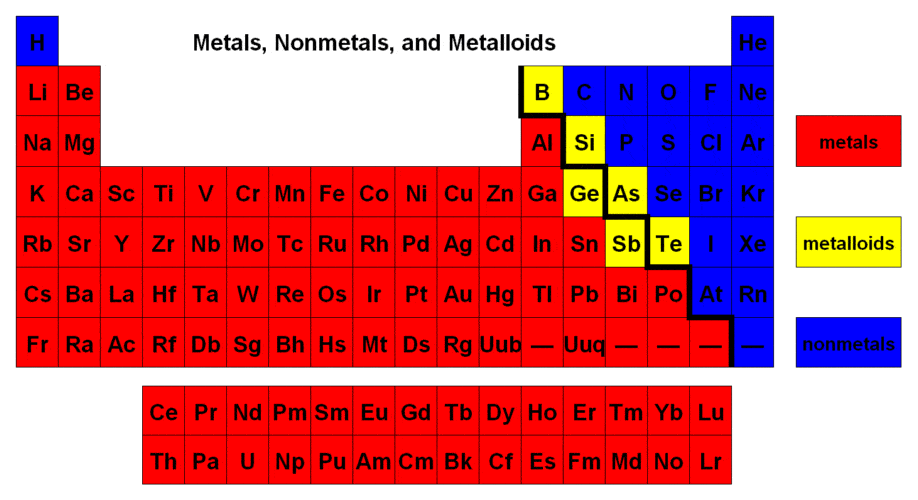
Which of the following statements is true regarding metals, nonmetals, and metalloids?

1

Metals are poor conductors of heat and electricity.

2

Nonmetals are shiny and malleable.

3

Metalloids conduct heat and electricity moderately well.

4

Nonmetals are good conductors of heat.

30

media

31

Multiple Choice

What is the trend in reactivity of Group 1 metals as you move down the group?

1

Increases

2

Decreases

3

Remains the same

4

Varies randomly

32

media

33

media

34

Multiple Choice

Which transition metal has the highest melting point?

1

Tungsten

2

Iron

3

Copper

4

Gold

35

media

36

media

37

Multiple Choice

What is the significance of silicon in the Earth's crust?

1

It is the most abundant element

2

It is the second most abundant element

3

It is the least abundant element

4

It has no significance

38

media

39

Multiple Choice

What do all the group 5 elements have in common?

1

They are all gases

2

They have five valence electrons

3

They are all metals

4

They are all non-metals

40

Multiple Choice

Which element is the only metallic element present in Group 5?

1

Nitrogen

2

Bismuth

3

Antimony

4

Phosphorus

41

Multiple Choice

What is the most abundant element in the Earth's atmosphere?

1

Oxygen

2

Nitrogen

3

Carbon Dioxide

4

Hydrogen

42

media

43

Multiple Select

Which of the following statements is true about the chalcogens?

1

All of the solid chalcogens are soft and don't conduct heat well.

2

Oxygen makes up 65% of the human body.

3

All of the group 6 elements have six valence electrons.

4

All of the compounds of hydrogen with chalcogens are toxic.

44

media

45

media

46

media

47

media

48

media

49

media

50

media

51

media

52

media

53

media

54

media

55

media

56

media

57

media

58

media

59

media

60

media

61

media

62

media

63

media

64

media

65

media

66

media

67

media

68

media

69

media

70

media

71

media

72

Multiple Choice

Question image
What elements generally make an ionic bond?
1
metal and nonmetal
2
2 or more nonmetals
3
metal
4
none of the above

73

Multiple Choice

Question image
What elements generally make a covalent bond?
1
metal and nonmetal
2
2 or more nonmetals
3
metal
4
none of the above

74

Multiple Choice

Predict the bond that will form between Cu and F.

1

Ionic

2

Covalent

3

Metallic

75

Multiple Choice

Predict the bond that will form between Se and Cl.

1

Ionic

2

Covalent

3

Metallic

76

Multiple Choice

Predict the bond that will form between Sr and S.

1

Ionic

2

Covalent

3

Metallic

77

Multiple Choice

What is the correct name for CF4

1

Carbon fluoride

2

Carbon IV fluoride

3

Carbon tetrafluoride

78

Multiple Choice

What is the correct name of the compound P2O5

1

phosphorous oxide

2

diphosphorous pentoxide

3

phosphorous pentoxide

79

Multiple Choice

What formula represents dinitrogen trioxide?

1

N3O2

2

NO2

3

N2O3

80

Multiple Choice

What is the name of the compound P4S10

1

phosphorous sulfide

2

tetraphosphide decasulfate

3

phosphorous decasulfate

4

tetraphosphorous decasulfide

81

Multiple Choice

What is the name of Al2O3

1

aluminum oxide

2

dialuminum trioxide

3

aluminum III oxide

82

Multiple Choice

The correct oxidation number for the Beryllium ion is

1

0

2

+2

3

-2

4

+4

83

Multiple Choice

When a metal reacts with a nonmetal in the formation of an ionic compound, the metal ion will always

1

share its valence e-

2

transfer valence e- to the nonmetal

3

accept valence e- from the nonmetal

4

neither transfer or share e- with the nonmetal

84

Multiple Choice

What is the correct name for the compound RhP?

1

Rhodium Phosphide

2

Rhodium Phosphite

3

Rhodium Phosphate

4

Rhodium Monophosphide

85

Multiple Choice

Write the symbol for aluminum ion.

1

Al3+

2

Al3-

3

Al5+

86

Multiple Choice

Sulfide

1

S2-

2

S-

3

SO32-

4

SO42-

87

Multiple Choice

Element: Calcium

Ion Name: ? Formula ?

1

Calcium: Ca2+

2

Calcide: Ca2+

3

Calcate: Ca2+

4

Calcite: Ca2+

88

Multiple Choice

Na+ and Cl- create...

1

Na2Cl

2

NaCl2

3

Na2Cl2

4

NaCl

89

Multiple Choice

Which of the following has a full valence shell?
1
Oxygen
2
Neon
3
Barium
4
Carbon

90

Multiple Choice

Ionic bonds are formed when one atom gives electrons to another atom.
1
True
2
False

91

Fill in the Blank

K2O

92

Fill in the Blank

MgI2

media

Show answer

Auto Play

Slide 1 / 92

SLIDE