

ling

Presentation
•
Science
•
9th Grade
•
Practice Problem
•
Hard
Standards-aligned

曾小玲 曾小玲
Used 2+ times
FREE Resource
35 Slides • 22 Questions
1
2
Multiple Choice

3
Multiple Choice
What is the significance of Newton's laws of motion in understanding the relationship between force and movement?
They explain how objects interact with forces and predict motion.
They only describe the motion of planets.
They are only relevant for objects at rest.
They are used to calculate the mass of objects.
4

5
Open Ended
Explain how an external force can cause acceleration in an object, using an example from sports or daily life.
6

7

8
Multiple Choice
Which of the following statements best describes the relationship between the direction of force and the direction of acceleration?
They are always in the same direction.
They are always in opposite directions.
They are unrelated.
They are sometimes in the same direction, sometimes not.
9

10
Open Ended
Explain how the direction of motion, acceleration, and force are related in different types of motion such as linear, projectile, and circular motion.
11

12

13
Fill in the Blanks
Fill in the blank: For objects of the same mass, the greater the force applied, the greater the
Type answer...
14
Multiple Choice
When the same force is applied to objects of different masses, what happens to the acceleration of the objects?
The object with greater mass has less acceleration.
The object with greater mass has more acceleration.
Both objects have the same acceleration.
Acceleration does not depend on mass.
15

16

17

18

19

20

21
Fill in the Blanks
甲、乙兩車所受外力與所產生加速度的關係圖,試回答下列問題:①甲、乙兩車的質量何者較大?②若甲車質量為30 kg,則F1為多少牛頓?③若甲車質量為45 kg,則乙車質量為?④將甲、乙兩車綁在一起,則所得關係圖應在哪一區?
Type answer...
22

23
Fill in the Blanks
Fill in the blank: The equation that relates force, mass, and acceleration is F =
Type answer...
24

25
Multiple Choice
What is the SI unit of force?
Newton
Joule
Watt
Pascal
26

27
Open Ended
Explain how to convert between Kg·w and Newtons using the gravitational acceleration constant. Provide an example calculation.
28

29
Multiple Choice
Which of the following correctly describes the relationship between gravitational acceleration (g) and the distance from the center of the Earth (R)?
g is directly proportional to R
g is inversely proportional to R
g is directly proportional to R squared
g is inversely proportional to R squared
30

31
Fill in the Blanks
The weight of an object is the force it experiences due to ______ (重力) or ______ (地心引力).
Type answer...
32

33
Multiple Choice
A 3 kg object on a frictionless horizontal surface is acted on by a 12 N horizontal force. What is the acceleration of the object?
4 m/s²
3 m/s²
6 m/s²
12 m/s²
34

35
Multiple Choice
A 50 kg cart on a rough surface is pushed by a 200 N horizontal force and accelerates at 3 m/s². What is the frictional force acting on the cart?
50 N
150 N
200 N
100 N
36

37
Multiple Choice
Compare the acceleration of a mass m on a smooth surface versus a rough surface when the same force F is applied. What is the main reason for the difference?
The mass is different
Friction is present on the rough surface
The force is different
Gravity is stronger on the rough surface
38

39
Multiple Choice
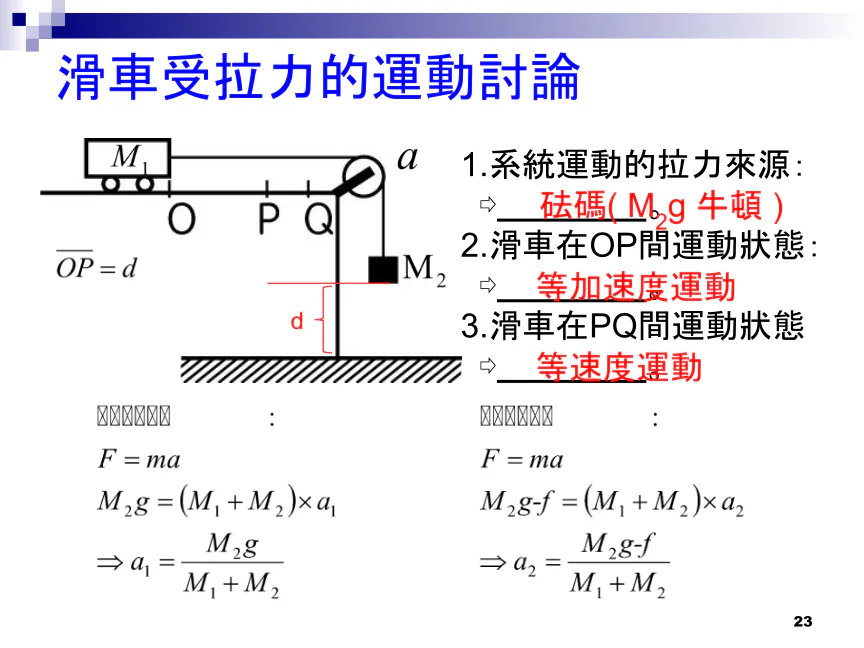
In a system with two masses connected and pulled by a force F on a frictionless surface, how do you calculate the acceleration of the system?
a = F/m1
a = F/(m1 + m2)
a = F/m2
a = F/(m1 - m2)
40
41
Fill in the Blanks
Fill in the blank: When a cart and a hanging mass are connected and the hanging mass is released, the acceleration of the system is given by a =
Type answer...
42
Open Ended
Explain how the acceleration of a system changes when friction is introduced, using the example of a cart and hanging mass connected by a string.
43

44

45
Multiple Choice
Which of the following statements about the motion of the cart in the experiment described is correct?
The cart moves with constant velocity between O and P.
The cart accelerates between O and P.
The cart decelerates between O and P.
The cart is stationary between O and P.
46

47
Multiple Choice
A block of mass 8 kg is acted on by a force of 2 N and moves 3 meters in 6 seconds on a horizontal table. Calculate its acceleration.
0.17 m/s²
0.25 m/s²
0.33 m/s²
0.5 m/s²
48

49

50

51

52

53

54

55

56

57
Multiple Choice
How does an external force affect the acceleration of an object?
It causes the object to accelerate.
It causes the object to stop moving.
It has no effect on the object's motion.
It only affects the object's direction, not speed.
Show answer
Auto Play
Slide 1 / 57
SLIDE
Similar Resources on Wayground

49 questions
LESSON 6.3: DISTRIBUTION& TRANSMISSION OF ELECTRICAL ENERGY
Presentation
•
9th Grade
49 questions
Biology 8.3
Presentation
•
9th Grade
56 questions
Matter Around Us Lesson
Presentation
•
9th Grade
50 questions
Infectious diseases
Presentation
•
9th Grade
48 questions
Lesson: Electricity Introduction
Presentation
•
9th Grade
51 questions
4.4 Covalent Bonds Notes
Presentation
•
9th Grade
51 questions
Grudge Ball Review
Presentation
•
9th Grade
51 questions
Unit 3: Chapter 2 (M3 Class)
Presentation
•
9th Grade
Popular Resources on Wayground
10 questions
Safety Day 2026 – Student Review

Quiz
•
9th Grade
21 questions
Continents and Oceans
Quiz
•
6th Grade
20 questions
Parts of Speech
Quiz
•
5th Grade
16 questions
Subject & Predicate
Quiz
•
5th Grade
25 questions
Multiplication Facts
Quiz
•
5th Grade
12 questions
Map Skills
Quiz
•
3rd Grade
22 questions
Continents and Oceans
Quiz
•
5th Grade
15 questions
Rounding Decimals
Quiz
•
5th Grade
Discover more resources for Science
10 questions
Exploring Chemical and Physical Changes

Interactive video
•
6th - 10th Grade
20 questions
Atomic Structure
Quiz
•
9th Grade
10 questions
Exploring the Electromagnetic Spectrum for Middle School Science
Interactive video
•
6th - 10th Grade
10 questions
Exploring Force and Motion Concepts
Interactive video
•
6th - 10th Grade
10 questions
Exploring Air Masses and Weather Fronts
Interactive video
•
6th - 10th Grade
10 questions
Exploring the States of Matter
Interactive video
•
6th - 10th Grade
10 questions
Exploring Forces: Net Force, Normal Force, Gravity, and Friction
Interactive video
•
6th - 10th Grade
10 questions
Differentiating Thermal Energy and Temperature
Interactive video
•
6th - 10th Grade