

Chapter 6: Lesson 1- Living Things

Presentation
•
Science
•
6th Grade
•
Practice Problem
•
Medium
+11
Standards-aligned

Takia Miller
Used 3+ times
FREE Resource
17 Slides • 21 Questions
1

2
Fill in the Blanks
All organisms are organized, grow and develop, reproduce, use energy, and respond to their
3
4
Multiple Choice
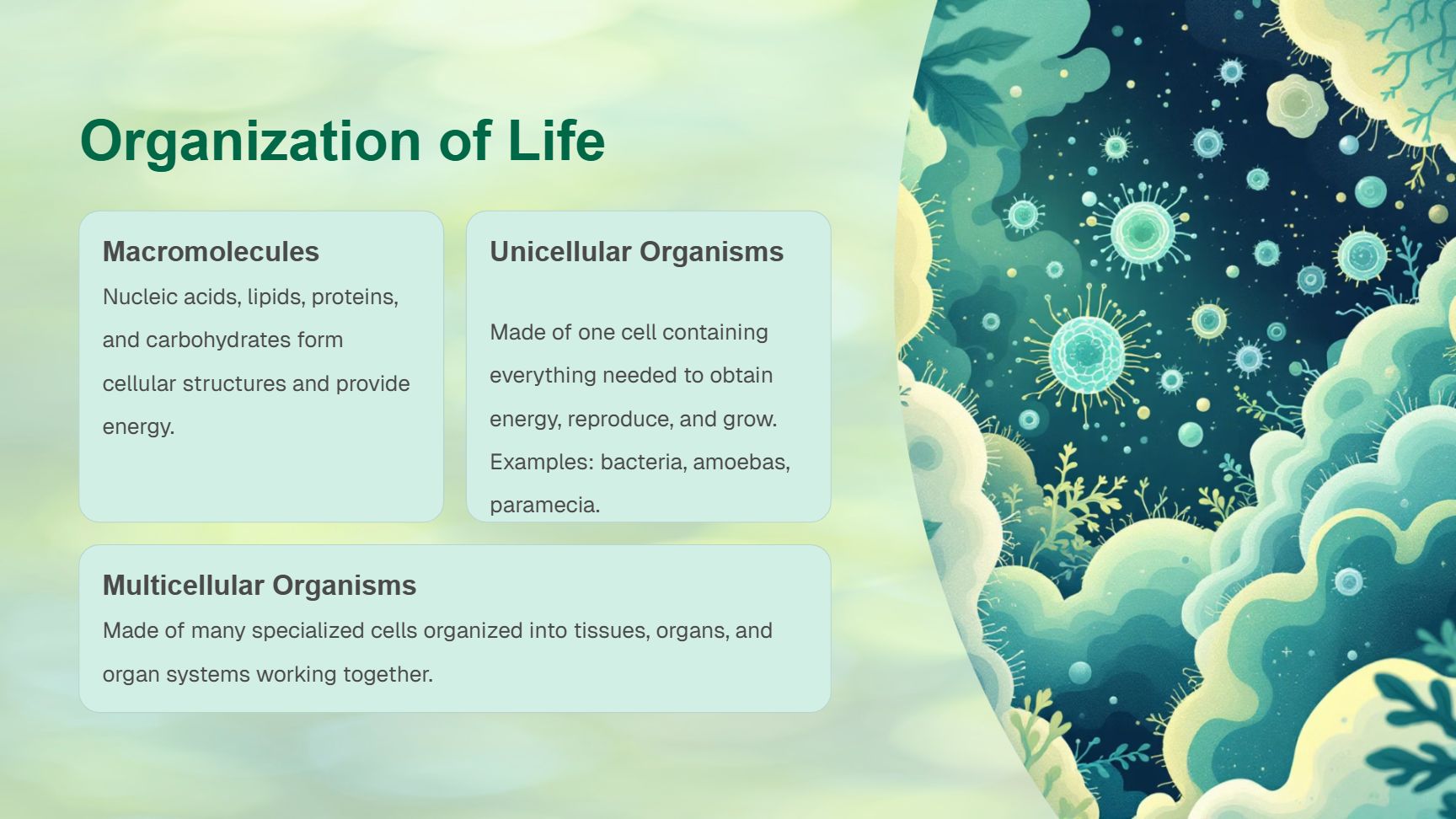
Which of the following best describes a multicellular organism?
Made of one cell containing everything needed to survive
Made of many specialized cells organized into tissues, organs, and organ systems
Composed only of macromolecules like proteins and carbohydrates
A single cell that can reproduce and grow independently
5

6
Multiple Choice
Which of the following best describes the difference between asexual and sexual reproduction?
Asexual reproduction involves two parents, while sexual reproduction involves one parent.
Asexual reproduction results in genetically identical offspring, while sexual reproduction results in genetically diverse offspring.
Asexual reproduction only occurs in animals, while sexual reproduction only occurs in plants.
Asexual reproduction requires fertilization, while sexual reproduction does not.
7
8
Open Ended
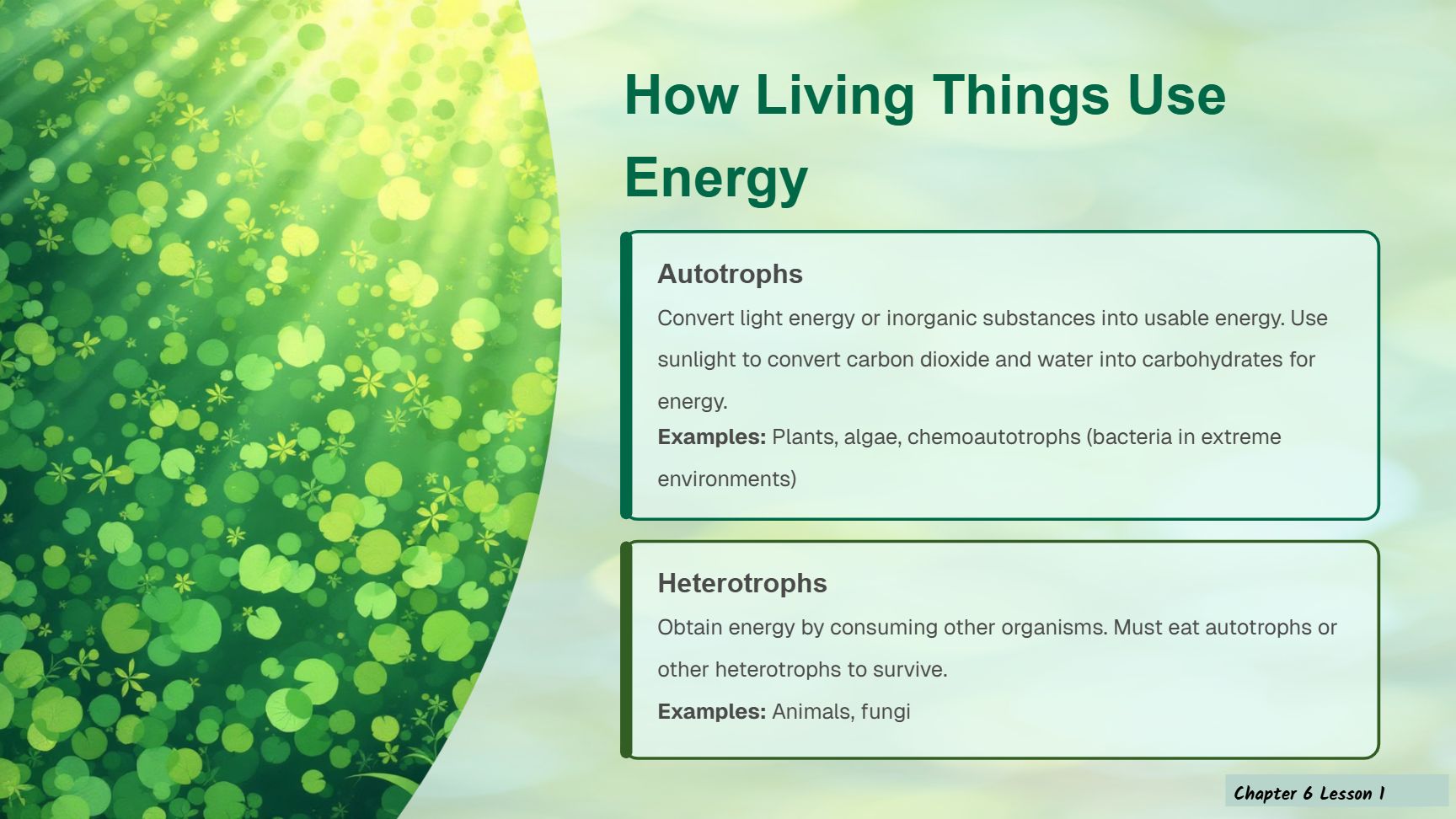
Explain how autotrophs obtain energy and give an example.
9
Open Ended
Explain how heterotrophs obtain energy and give an example.
10

11
Multiple Select
Which of the following are examples of responses to stimuli in living things?
An octopus releasing ink when threatened
A plant growing towards sunlight
A rock rolling down a hill
A dog barking at a stranger
12
13
Fill in the Blanks
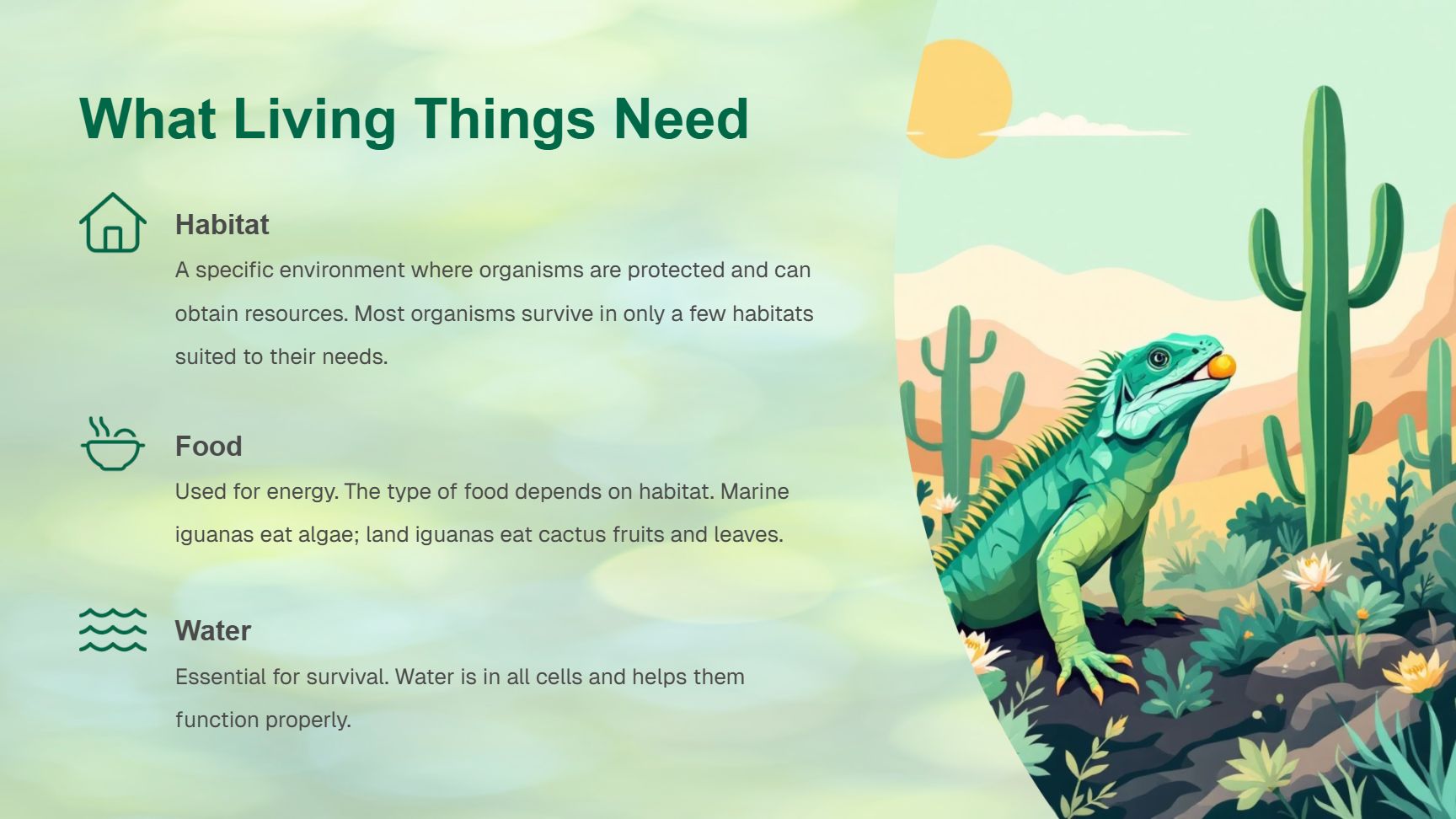
Water is essential for survival because it is found in all
14
15
Multiple Choice
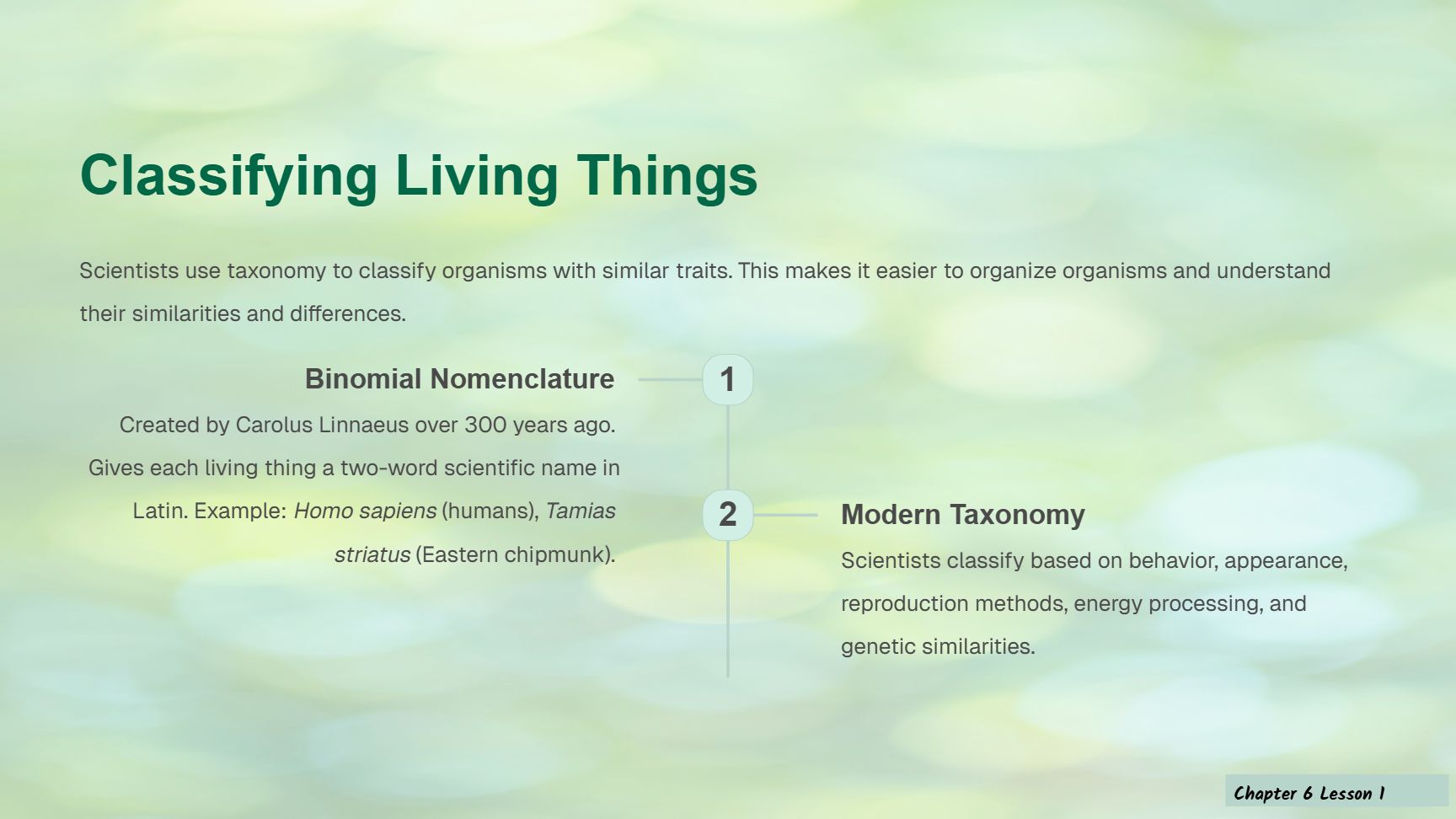
What is the purpose of binomial nomenclature in classifying living things?
To give each organism a common name
To organize organisms based on their habitat
To provide a universal scientific name for each organism
To classify organisms by their energy source
16

17
Open Ended
Describe the levels of taxonomic hierarchy and explain why classification is important in biology.
18

19
Multiple Choice
Which of the following is the correct hierarchical order for classifying the Eastern Chipmunk, starting from the broadest to the most specific category?
Kingdom, Domain, Phylum, Class, Order, Family, Genus, Species
Domain, Kingdom, Phylum, Class, Order, Family, Genus, Species
Domain, Phylum, Kingdom, Class, Order, Family, Genus, Species
Kingdom, Domain, Class, Phylum, Order, Family, Genus, Species
20
21

22
Multiple Choice
Which of the following best describes the purpose of binomial nomenclature?
To classify organisms based on their evolutionary relationships
To provide a two-part scientific name for unique identification
To organize organisms into a nested hierarchy
To describe the physical characteristics of organisms
23

24
Multiple Select
Select all the characteristics that should be avoided when creating a dichotomous key.
Traits that are subjective
Traits that require specialized equipment
Traits that are objective and observable
Traits that are highly variable within a species
25
Open Ended
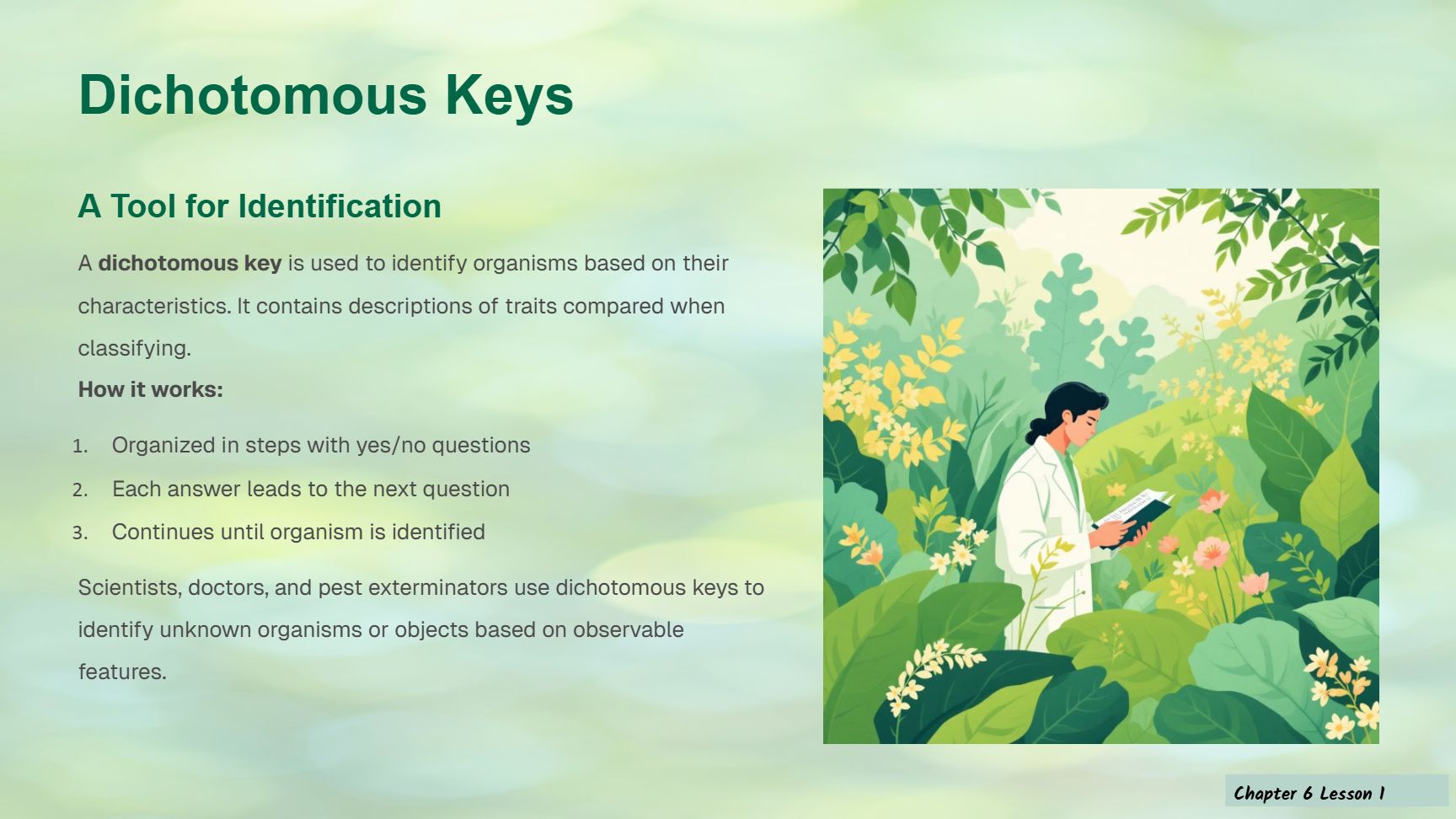
Explain how dichotomous keys assist scientists in identifying unknown organisms.
26

27
Fill in the Blanks
Fill in the blank: Scientists use classification systems to group organisms based on shared traits and
Type answer...
28
29
Open Ended
Explain the difference between an autotroph and a heterotroph.
30

31
Match
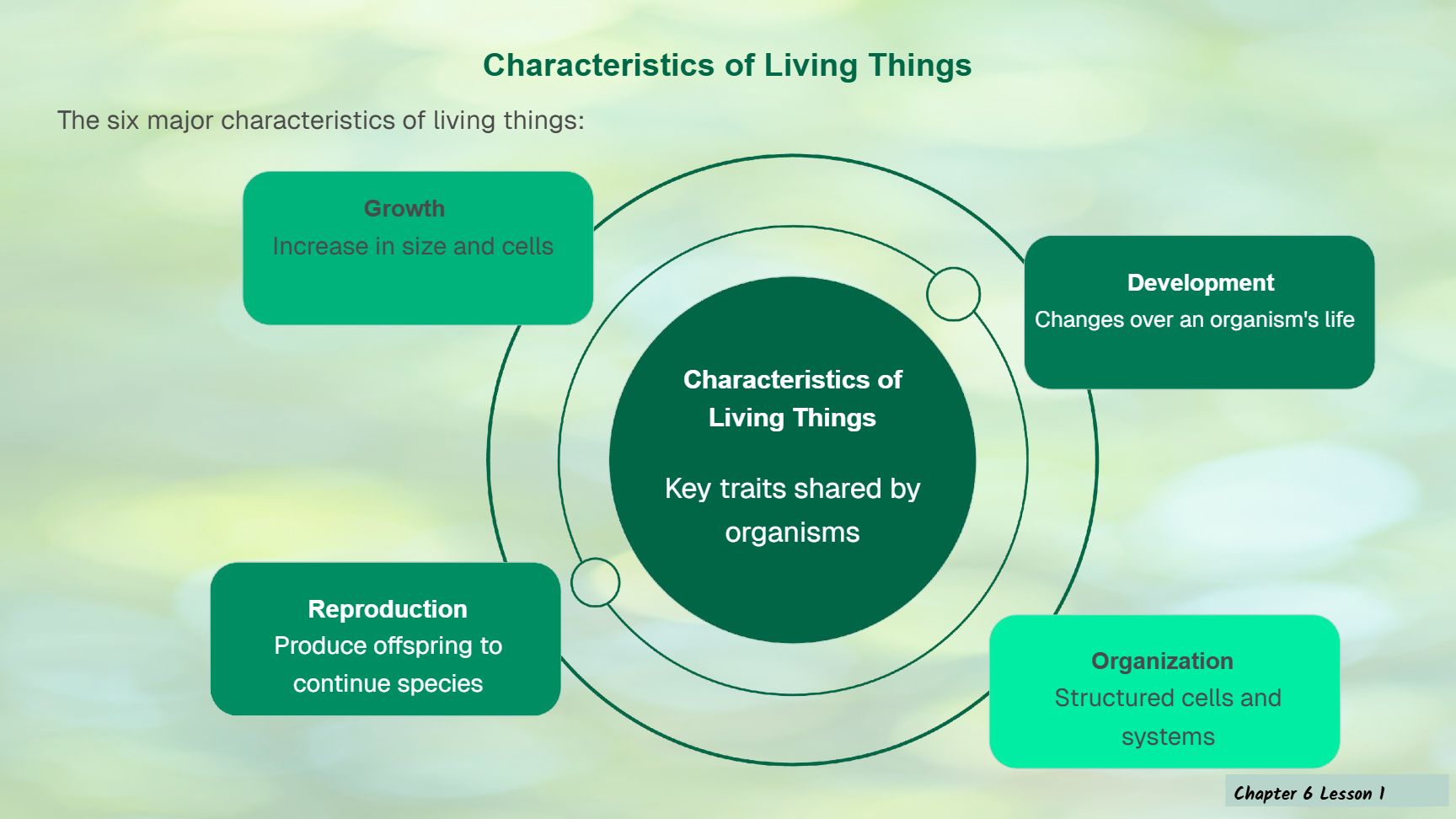
Match the characteristic to the summary
Growth
Development
Reproduction
Organization
Increase in size and cells
Changes over an organism's life
Produce offspring to continue species
Structured cells and systems
Increase in size and cells
Changes over an organism's life
Produce offspring to continue species
Structured cells and systems
32
33
Fill in the Blanks
The process by which organisms produce offspring to continue the species is called
34
Multiple Select
Select all characteristics that are shared by living things according to the graphic organizer.
Growth
Development
Reproduction
Organization
35
Multiple Choice
Which of the following is NOT one of the six major characteristics of living things?
Growth
Development
Reproduction
Photosynthesis
36
37
Open Ended
Based on the characteristics of living things, explain why a virus is generally considered living (or borderline living) while a crystal is considered nonliving. Focus on specific criteria.
38
Fill in the Blanks
Fill in the blank: Organisms made of many specialized cells organized into tissues, organs, and organ systems are called
Show answer
Auto Play
Slide 1 / 38
SLIDE
Similar Resources on Wayground

32 questions
Earth's Atmosphere
Presentation
•
6th Grade
37 questions
Physical Properties of Matter
Presentation
•
6th Grade
33 questions
Jobs
Presentation
•
6th Grade
33 questions
RFMS Science: 5 Levels of Environmental Organization Lesson 22
Presentation
•
6th Grade
34 questions
Currents
Presentation
•
6th Grade
32 questions
Intro to Engineering
Presentation
•
6th Grade
33 questions
Planetary Motion
Presentation
•
6th Grade
30 questions
Clouds Lesson
Presentation
•
6th Grade
Popular Resources on Wayground
10 questions
Safety Day 2026 – Student Review

Quiz
•
9th Grade
21 questions
Continents and Oceans
Quiz
•
6th Grade
20 questions
Parts of Speech
Quiz
•
5th Grade
16 questions
Subject & Predicate
Quiz
•
5th Grade
25 questions
Multiplication Facts
Quiz
•
5th Grade
12 questions
Map Skills
Quiz
•
3rd Grade
22 questions
Continents and Oceans
Quiz
•
5th Grade
15 questions
Rounding Decimals
Quiz
•
5th Grade
Discover more resources for Science
20 questions
Elements, compounds, and mixtures
Quiz
•
6th Grade
10 questions
6.6D - Relative Density Review
Quiz
•
6th Grade
10 questions
Exploring Chemical and Physical Changes

Interactive video
•
6th - 10th Grade
20 questions
CONDUCTION,CONVECTION AND RADIATION
Quiz
•
6th Grade
20 questions
Rocks and The Rock Cycle
Quiz
•
6th Grade
19 questions
Describing and Classifying Matter
Presentation
•
6th Grade
21 questions
Waves and Wave Properties
Quiz
•
6th - 8th Grade
20 questions
Phases of the Moon
Quiz
•
6th Grade