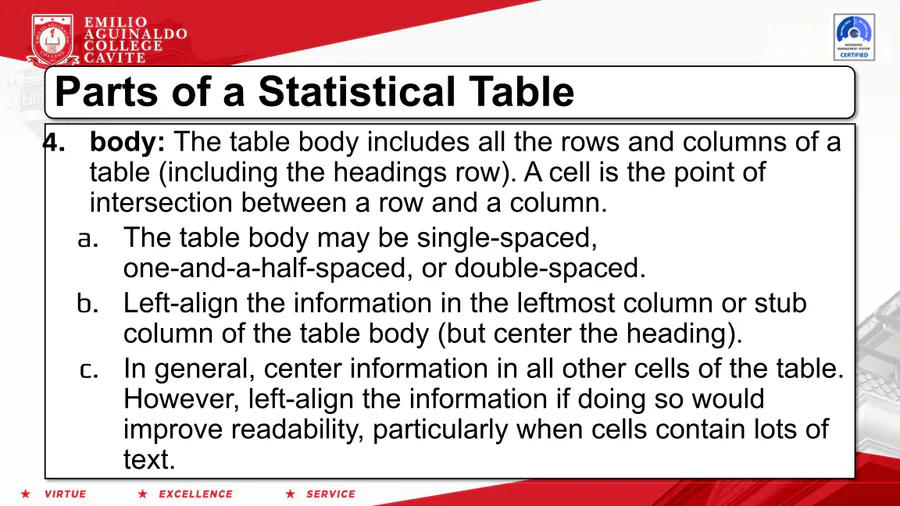
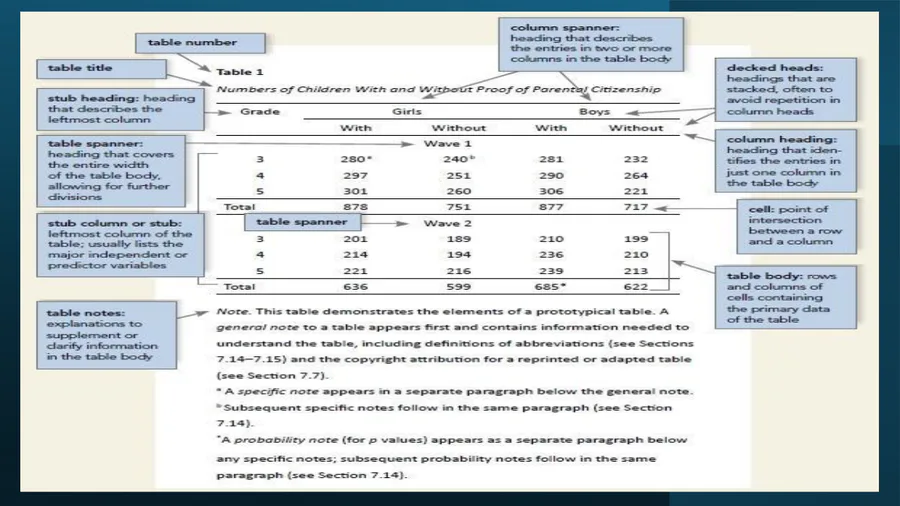
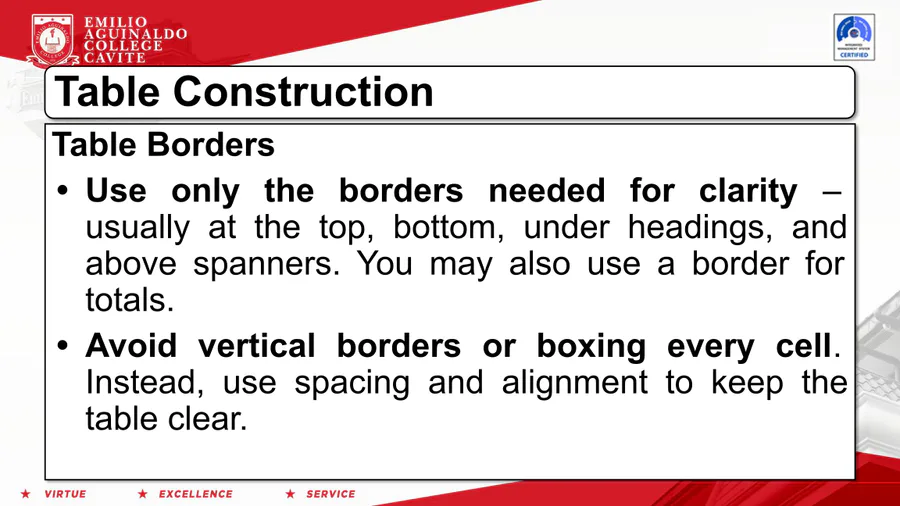
Data Presentation (Business Statistics / Statistics)
Presentation
•
Mathematics
•
University
•
Practice Problem
•
Easy
DEONNY ALAGOS
Used 4+ times
FREE Resource
94 Slides • 21 Questions
1
2
3
4
5
6
7
8
9
10
11
12
13
14
15
16
17
18
19
Multiple Choice
The study included 200 tourism professionals. Of these, 50% (n = 60) specialized in travel and tour operations, 30% (n = 90) in event management, and 20% (n = 40) in hospitality services.
What is the error in this passage?
The total sample size was not mentioned clearly.
The percentages and frequencies do not match correctly.
The variable “tourism professionals” should be capitalized.
The sequence of items violates APA alphabetical ordering.
20
Multiple Choice
An assessment of food safety knowledge showed that the average score was 85.3 (SD = 15.2). This result suggests that hotel staff have low competency in food safety and sanitation.
What is the error in this passage?
The mean score contradicts the interpretation of “low competency.”
The standard deviation value is missing decimal consistency.
The mean should be expressed as a percentage.
The statement lacks sample size information.
21
Multiple Choice
The survey included 120 AB Communication students. Among them, 40% (n = 20) specialized in journalism, 35% (n = 60) in advertising, and 25% (n = 40) in public relations.
What is the error in this passage?
The table title is missing.
The sample group is not clearly described.
The percentages and frequencies do not correspond correctly.
The percentages should appear in descending order.
22
Multiple Choice
Out of 150 tour guides, 70% (n = 100) followed eco-tourism guidelines consistently, 20% (n = 30) sometimes, and 15% (n = 25) rarely.
What is the main error in this passage?
The percentages and frequencies do not total 100% or 150 respondents.
The data uses inconsistent wording for frequency categories.
The percentages should appear before the “n” values.
The sample description should include location information.
23
24
25
26
27
28
29
30
31
32
33
34
35
36
37
38
39
40
41
42
43
44
45
46
47
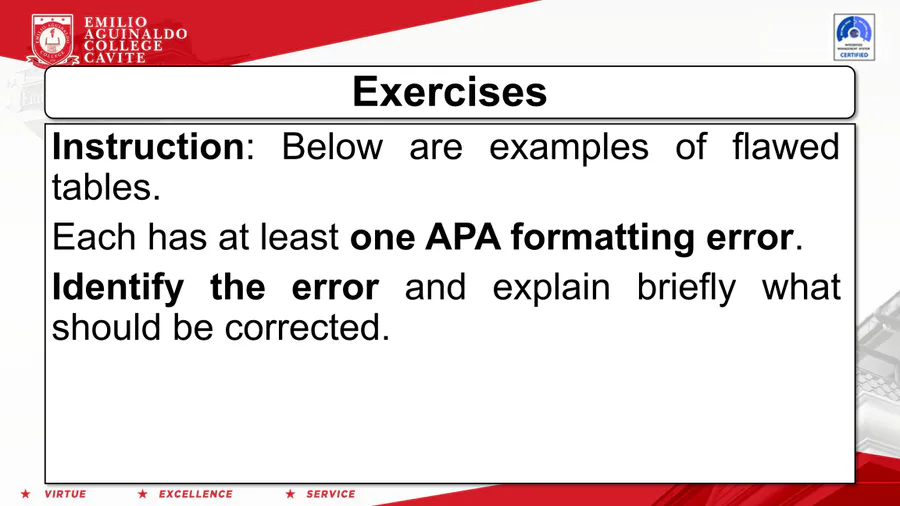
Open Ended
Below is a sample table extracted from a research paper. Each table contains at least one APA formatting error. Identify the APA formatting error present in the Table and explain briefly what should be corrected.
48
Open Ended
Below is a sample table extracted from a research paper. Each table contains at least one APA formatting error. Identify the APA formatting error present in the Table and explain briefly what should be corrected.
49
Open Ended
Below is a sample table extracted from a research paper. Each table contains at least one APA formatting error. Identify the APA formatting error present in the Table and explain briefly what should be corrected.
50
Open Ended
Below is a sample table extracted from a research paper. Each table contains at least one APA formatting error. Identify the APA formatting error present in the Table and explain briefly what should be corrected.
51
Open Ended
Below is a sample table extracted from a research paper. Each table contains at least one APA formatting error. Identify the APA formatting error present in the Table and explain briefly what should be corrected.
52
53
54
55
56
57
58
59
60
61
62
63
64
65
66
67
68
69
70
71
72
73
74
75
76
77
78
79
80
81
82
83
Multiple Choice
A researcher presents the number of students by course using a bar graph, but the bars are drawn with unequal widths. What is wrong with this presentation?
Unequal widths distort comparisons between categories.
The graph should have used percentages instead of frequencies.
The bars should be vertical, not horizontal.
84
Multiple Choice
A survey on favorite school activities is presented in a pie chart with 12 categories, making most slices too small to read. Why is this graph ineffective?
Unequal widths distort comparisons between categories.
The chart includes too many categories, making the slices difficult to interpret and compare.
The chart should have used frequencies instead of percentages.
The chart lacks a title and numerical labels for each category.
85
Multiple Choice
A health study compares the diet composition of three groups (athletes, office workers, retirees) using a component bar graph. What makes this graph effective compared to a pie chart?
It shows total values but not proportions.
It allows comparison of parts across groups.
It is easier to construct than a pie chart.
It eliminates the need for percentages.
86
Multiple Choice
A school uses a Pareto chart to analyze causes of student absences as follows: Illness (50), Transportation (30), Family (20), and Others (10). Why is the Pareto chart more useful than a simple bar graph?
It lists categories alphabetically.
It shows which problems contribute most to the total.
It removes the need for frequencies.
It makes the chart more colorful.
87
Multiple Choice
To compare how three organizations spend their budgets, one researcher uses a pie chart while another uses a component bar graph. Which graph is more appropriate for comparison between groups?
Pie Chart – clearer for total proportions.
Component Bar Graph – better for comparing across multiple groups.
Both are equally effective.
Neither, only histograms should be used.
88
Multiple Choice
A bar graph shows gender distribution (60% female, 40% male), but the y-axis does not start at zero, making the female bar look much larger than it is. What principle was violated?
The use of percentages in categorical data.
The zero-baseline principle, which prevents exaggeration.
The need to display data in a line chart.
The requirement to use stacked bar graphs.
89
90
91
92
93
94
95
96
97
98
99
100
101
102
103
104
105
106
Multiple Choice
A researcher uses a line graph to show students’ average grades in four subjects during one semester. However, the x-axis categories are subjects (English, Math, Science, History), not time. What is wrong with this?
Line graphs should only be used for categorical data.
Line graphs are only valid when the x-axis shows time or continuous data.
Subjects must always be arranged alphabetically.
The line graph should have been replaced with a pie chart.
107
Multiple Choice
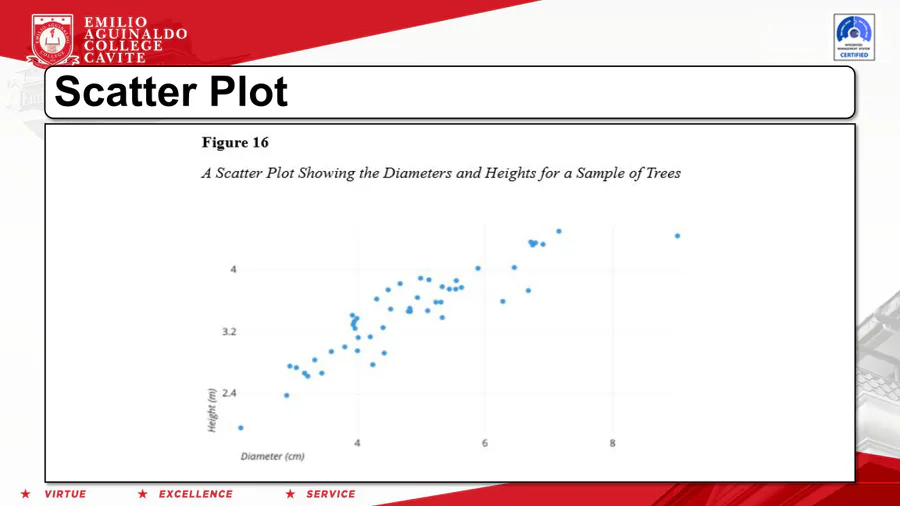
A scatter plot shows the relationship between hours of study and exam scores. The points form an upward trend. What does this suggest?
More study hours are unrelated to exam scores.
There is a negative correlation between study hours and scores.
There is a positive correlation between study hours and scores.
Scatter plots cannot be used for exam data.
108
Multiple Choice
A boxplot of student test scores shows a median of 80, quartiles at 70 and 90, and one dot at 45 far below the box. What does the dot at 45 represent?
The highest score.
The average score.
An outlier in the dataset.
A missing value.
109
Multiple Choice
A researcher uses a line graph to compare the number of students in different colleges (Engineering, Education, Nursing) during one school year. Why is this presentation misleading?
Line graphs are inappropriate for categorical data like college names.
The y-axis should start at zero.
Bar graphs should only use vertical bars.
Percentages must replace frequencies.
110
Multiple Choice
A teacher uses a stem-and-leaf plot for a dataset of 500 exam scores. Students find the plot difficult to interpret. What is the best evaluation of this choice?
Correct, because stem-and-leaf plots are best for large datasets.
Incorrect, because stem-and-leaf plots are better for smaller datasets.
Correct, because stem-and-leaf plots always highlight outliers.
Incorrect, because stem-and-leaf plots should only be used for qualitative data.
111
Multiple Choice
Two researchers want to show the trend of monthly sales for one year. Researcher A uses a line graph, while Researcher B uses a histogram. Which choice is more appropriate and why?
Histogram, because it shows percentages.
Line graph, because it shows continuous data over time.
Histogram, because it is easier to design.
Both are equally appropriate.
112
113
114
115
Show answer
Auto Play
Slide 1 / 115
SLIDE

Similar Resources on Wayground
102 questions
Topic 3: Bonding and Structure Independent Learning
Presentation
•
11th Grade - University
118 questions
Unbenannte Präsentation
Presentation
•
University
111 questions
Review ITB
Presentation
•
University
118 questions
untitled
Presentation
•
KG - University
103 questions
US History CLEP Practice Questions
Presentation
•
12th Grade
119 questions
MSU 405 whole
Presentation
•
University
112 questions
AMBLYOPIA
Presentation
•
University
113 questions
DC Government
Presentation
•
12th Grade
Popular Resources on Wayground
20 questions
"What is the question asking??" Grades 3-5
Quiz
•
1st - 5th Grade
20 questions
“What is the question asking??” Grades 6-8
Quiz
•
6th - 8th Grade
10 questions
Fire Safety Quiz
Quiz
•
12th Grade
20 questions
Equivalent Fractions
Quiz
•
3rd Grade
34 questions
STAAR Review 6th - 8th grade Reading Part 1
Quiz
•
6th - 8th Grade
20 questions
“What is the question asking??” English I-II
Quiz
•
9th - 12th Grade
20 questions
Main Idea and Details
Quiz
•
5th Grade
47 questions
8th Grade Reading STAAR Ultimate Review!
Quiz
•
8th Grade
Discover more resources for Mathematics
16 questions
Parallel, Perpendicular, and Intersecting Lines
Quiz
•
KG - Professional Dev...
10 questions
Applications of Quadratic Functions
Quiz
•
10th Grade - University
10 questions
Add & Subtract Mixed Numbers with Like Denominators
Quiz
•
KG - University
10 questions
Improper & Mixed Numbers
Quiz
•
4th Grade - University
14 questions
Identify Functions 8th Grade Math STAAR Review
Quiz
•
8th Grade - University
20 questions
Math EOG Review
Quiz
•
KG - University
19 questions
TSI Math 2.0 Practice 2026
Quiz
•
9th Grade - University