

7.2 Earth is in the milky way galaxy

Presentation
•
Science
•
10th Grade
•
Practice Problem
•
Easy

Rahan Rahman
Used 1+ times
FREE Resource
18 Slides • 20 Questions
1
2
Multiple Choice
Why is it significant that Earth is located in the Milky Way Galaxy?
Because it helps us understand our cosmic neighborhood and origins.
Because it determines the weather on Earth.
Because it affects Earth's gravity.
Because it influences Earth's rotation.
3

4
Open Ended
What do you find most fascinating about the structure of the Milky Way or Earth's place within it?
5

6

7
Open Ended
Considering what we've covered, what do you already know about Earth's place in the universe, and how do you think scientists measure the vast distances in space?
8
9

10
Multiple Choice
Which of the following statements best describes a galaxy?
A massive collection of stars, gas, dust, and dark matter held together by gravity
A single star surrounded by planets
A small group of planets and moons
A cloud of gas and dust with no stars
11
12
Fill in the Blanks
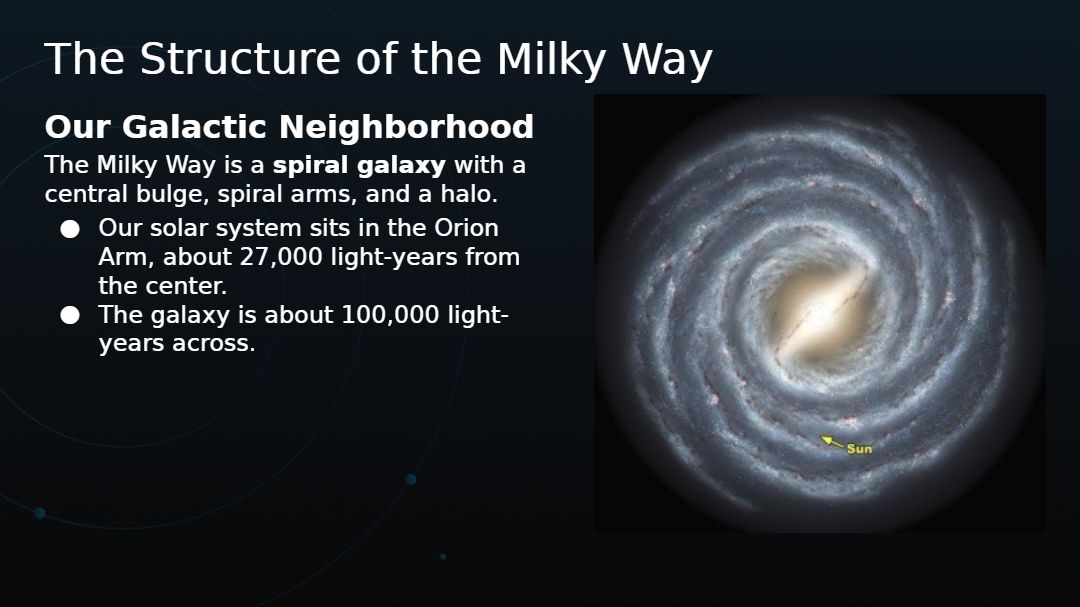
The Milky Way is about
13
Multiple Select
Which of the following are true about the Milky Way galaxy?
It is a spiral galaxy
It contains over 100 billion stars
It is the only galaxy in the universe
Our solar system is located in the Orion Arm
14
15
Fill in the Blanks
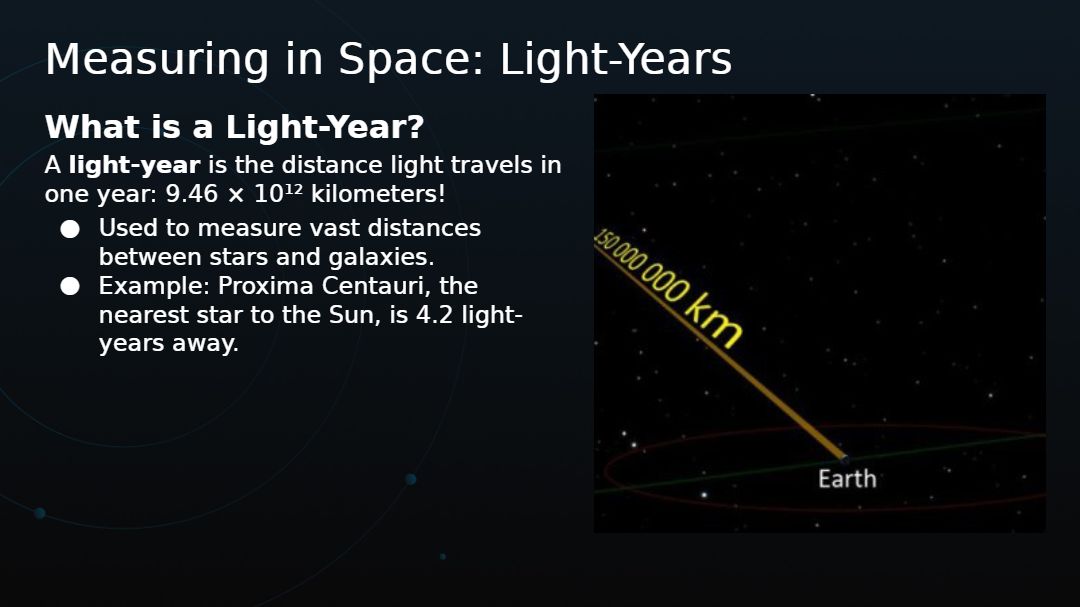
Proxima Centauri, the nearest star to the Sun, is
16
Open Ended
Explain why light-years are used to measure distances in space instead of kilometers or miles.
17
18
Multiple Choice
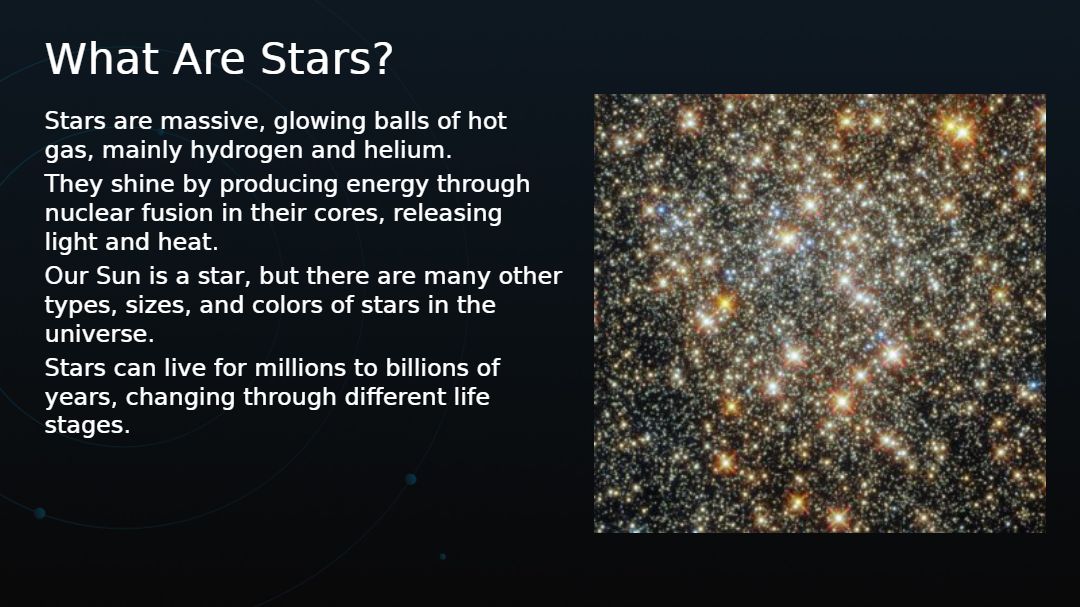
Which elements are stars primarily made of?
Hydrogen and helium
Oxygen and nitrogen
Carbon and iron
Silicon and magnesium
19
20
21
Open Ended
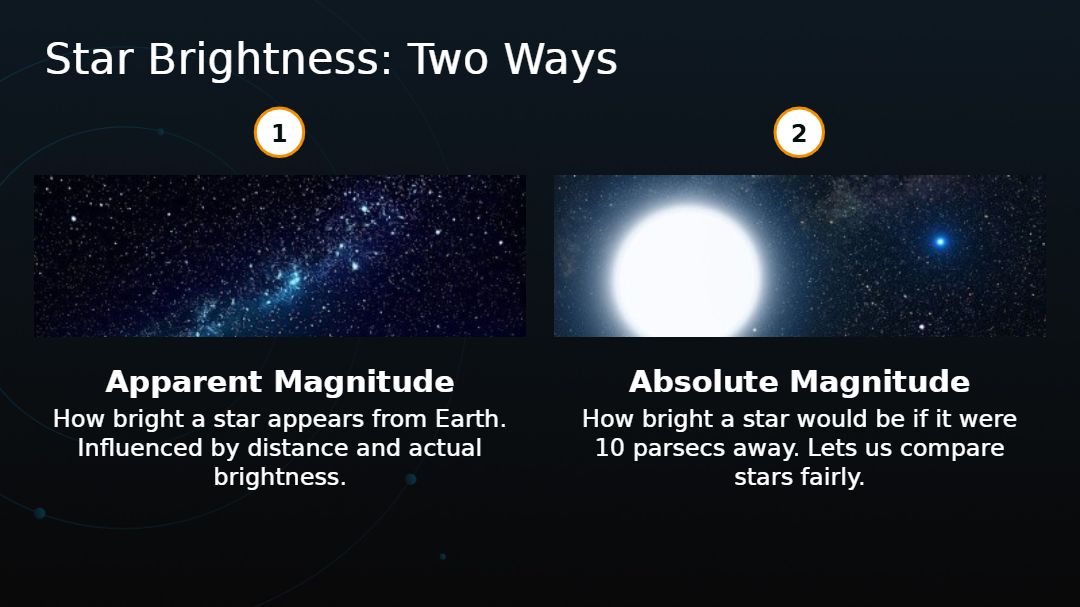
Explain how the concept of apparent magnitude and absolute magnitude helps astronomers compare the brightness of stars.
22
23
Multiple Choice
Based on the information from the slides, what are two main factors that influence how bright a star appears from Earth?
Distance from Earth and actual brightness
Star's color and temperature
Size of the star and its age
Position in the galaxy and its speed
24
Multiple Select
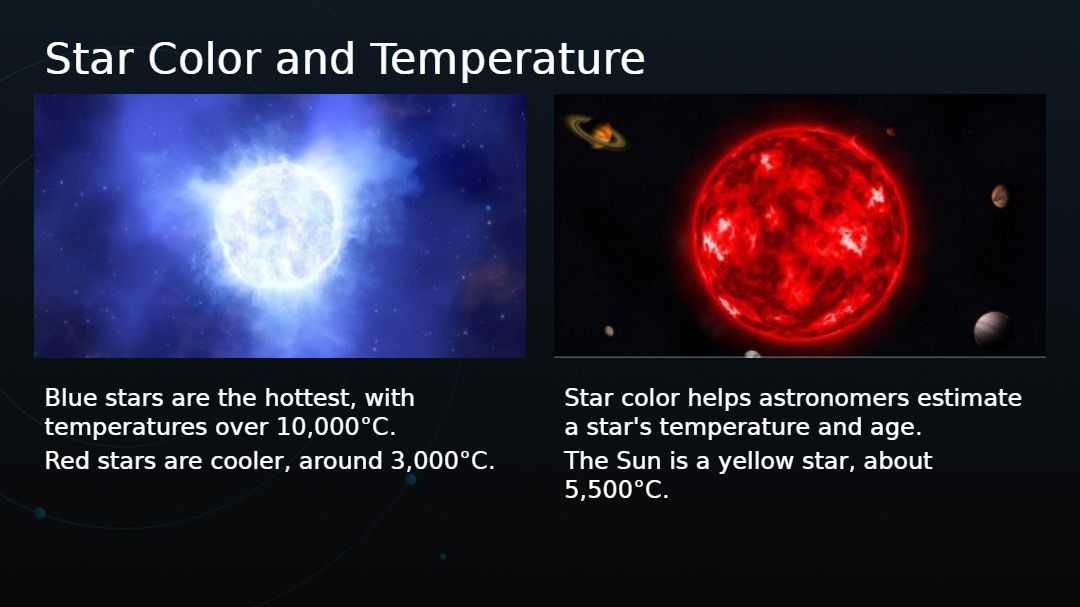
Which of the following statements about star color and temperature are correct?
Blue stars are the hottest.
Red stars are cooler than blue stars.
The Sun is a yellow star with a temperature of about 5,500°C.
Red stars are hotter than blue stars.
25
26
Fill in the Blanks
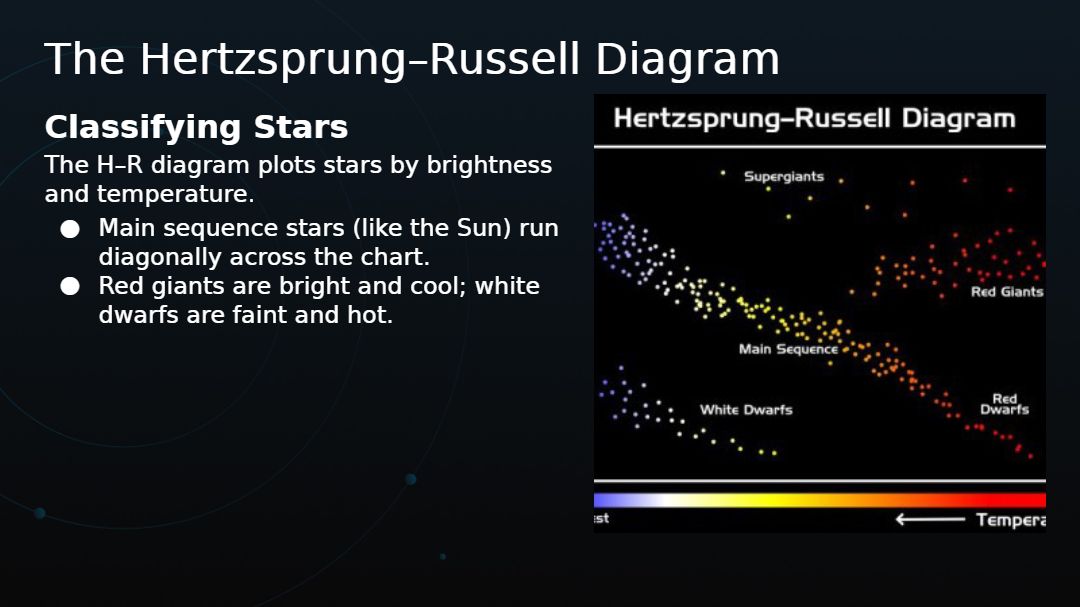
The Hertzsprung–Russell diagram plots stars by brightness and
27
28
Open Ended
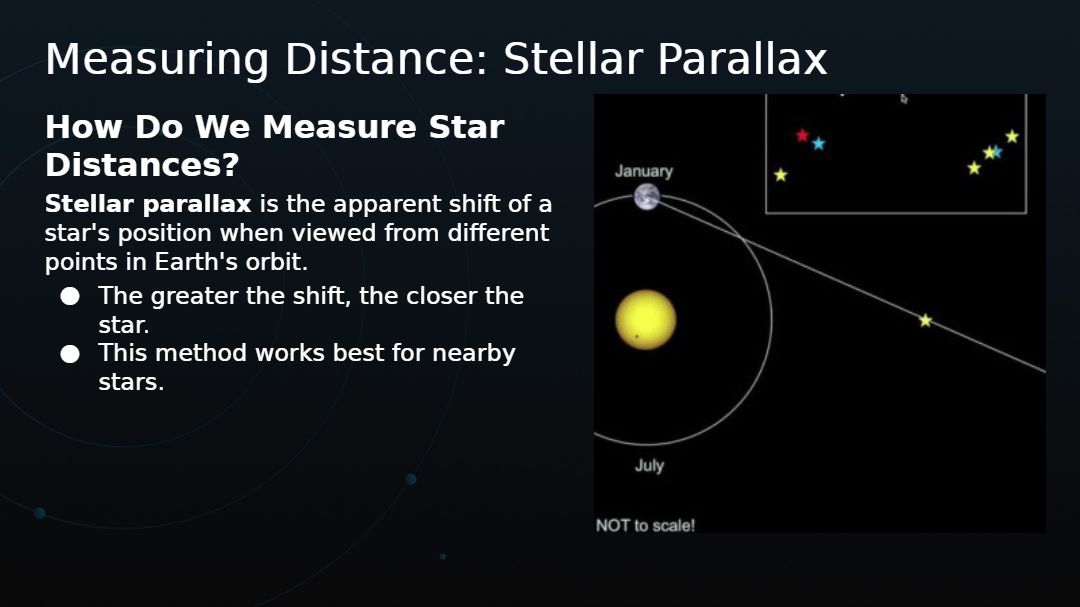
Describe how stellar parallax is used to measure the distance to stars and why this method is most effective for nearby stars.
29
30
Open Ended
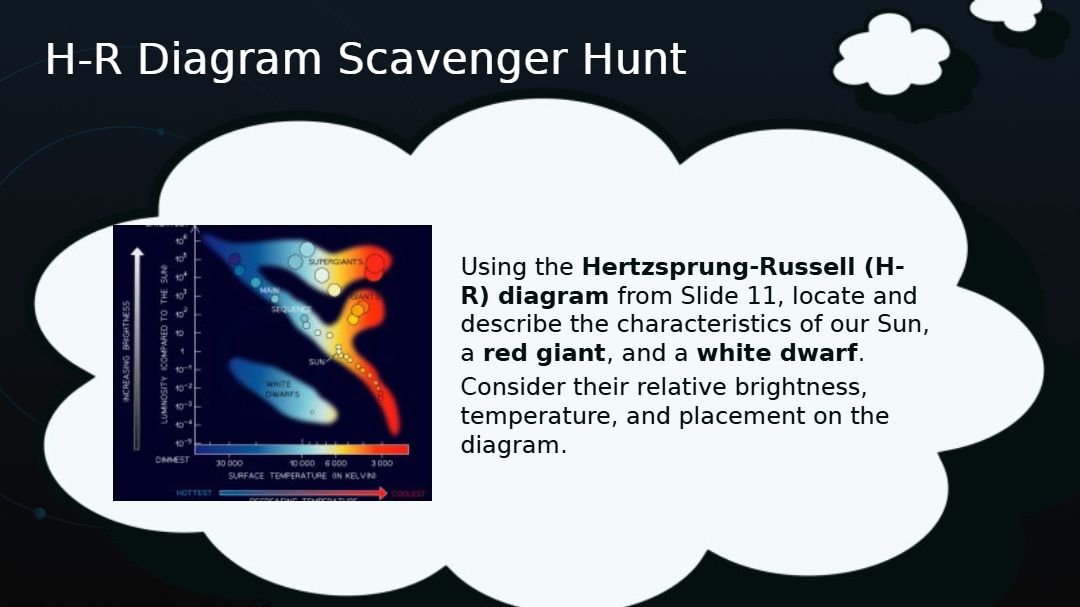
Using the Hertzsprung-Russell (H-R) diagram, locate and describe the characteristics of our Sun, a red giant, and a white dwarf. Consider their relative brightness, temperature, and placement on the diagram.
31
32
Fill in the Blanks
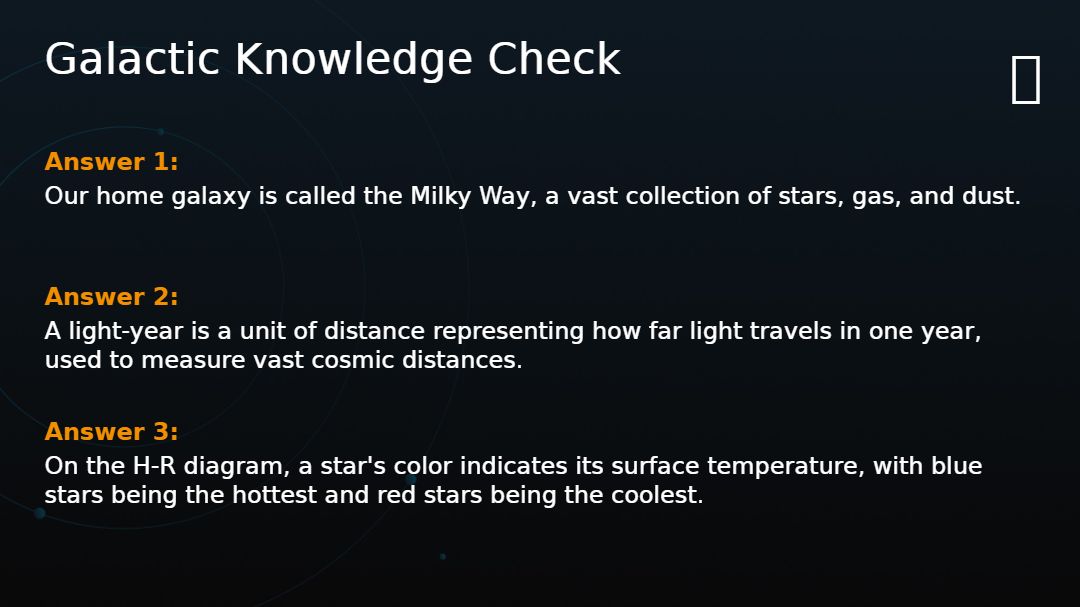
What is the name of our home galaxy?
33
34
35
Multiple Select
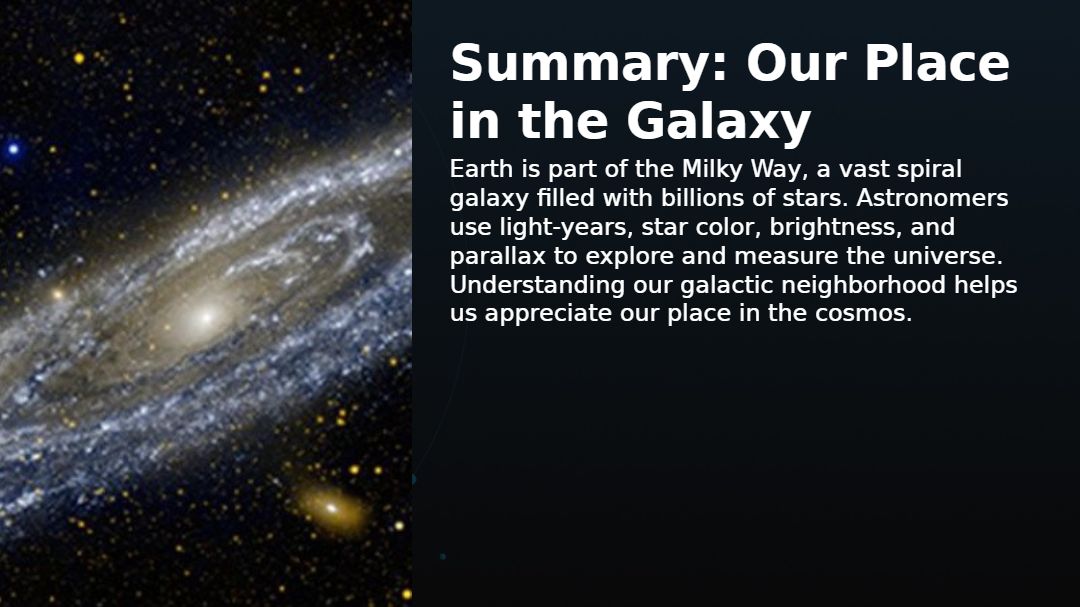
Which of the following are tools astronomers use to explore and measure the universe?
Light-years
Star color
Brightness
Parallax
36
Multiple Choice
Which of the following statements about the Milky Way galaxy is correct?
It is a spiral galaxy containing billions of stars.
It is the only galaxy in the universe.
It is smaller than most other galaxies.
It does not contain any planets.
37
Multiple Choice
Which of the following methods do astronomers use to measure the distance to stars?
Parallax
Spectroscopy
Radar
Sonar
38
Open Ended
Reflecting on today's lesson, what is one thing you learned about the Milky Way Galaxy and Earth's place in it that surprised you or made you curious to learn more?
Show answer
Auto Play
Slide 1 / 38
SLIDE
Similar Resources on Wayground

31 questions
Absolute Value Inequalities
Presentation
•
10th Grade
31 questions
Cell terms part 2 - 2023
Presentation
•
10th Grade
32 questions
Nucleosynthesis
Presentation
•
KG
34 questions
Levels of Organization, Food Chains, and Webs
Presentation
•
10th Grade
32 questions
Climate
Presentation
•
10th Grade
29 questions
Lab Safety Is Common Sense
Presentation
•
KG
30 questions
World War I
Presentation
•
10th Grade
30 questions
The Molecules of Life
Presentation
•
10th Grade
Popular Resources on Wayground
10 questions
How much do you know about our Portrait of an Eagle?

Quiz
•
10th Grade
10 questions
Fast Food Slogans
Quiz
•
6th - 8th Grade
21 questions
Continents and Oceans
Quiz
•
6th Grade
20 questions
Parts of Speech
Quiz
•
5th Grade
16 questions
Subject & Predicate
Quiz
•
5th Grade
25 questions
Multiplication Facts
Quiz
•
5th Grade
12 questions
Map Skills
Quiz
•
3rd Grade
22 questions
Continents and Oceans
Quiz
•
5th Grade
Discover more resources for Science
10 questions
Exploring Chemical and Physical Changes

Interactive video
•
6th - 10th Grade
10 questions
Decoding the Periodic Table of Elements
Interactive video
•
6th - 10th Grade
10 questions
Exploring the Periodic Table
Interactive video
•
6th - 10th Grade
14 questions
Physical and Chemical Changes
Quiz
•
10th Grade
22 questions
Periodic Table Review
Quiz
•
9th - 12th Grade
10 questions
Exploring the States of Matter
Interactive video
•
6th - 10th Grade
10 questions
Exploring Physical and Chemical Changes
Interactive video
•
6th - 10th Grade
21 questions
Macromolecules and Enzymes Study Guide
Quiz
•
9th - 10th Grade