

7.3 Stars have a life cycle

Presentation
•
Science
•
10th Grade
•
Practice Problem
•
Easy

Rahan Rahman
Used 1+ times
FREE Resource
16 Slides • 17 Questions
1
2
3
Fill in the Blanks
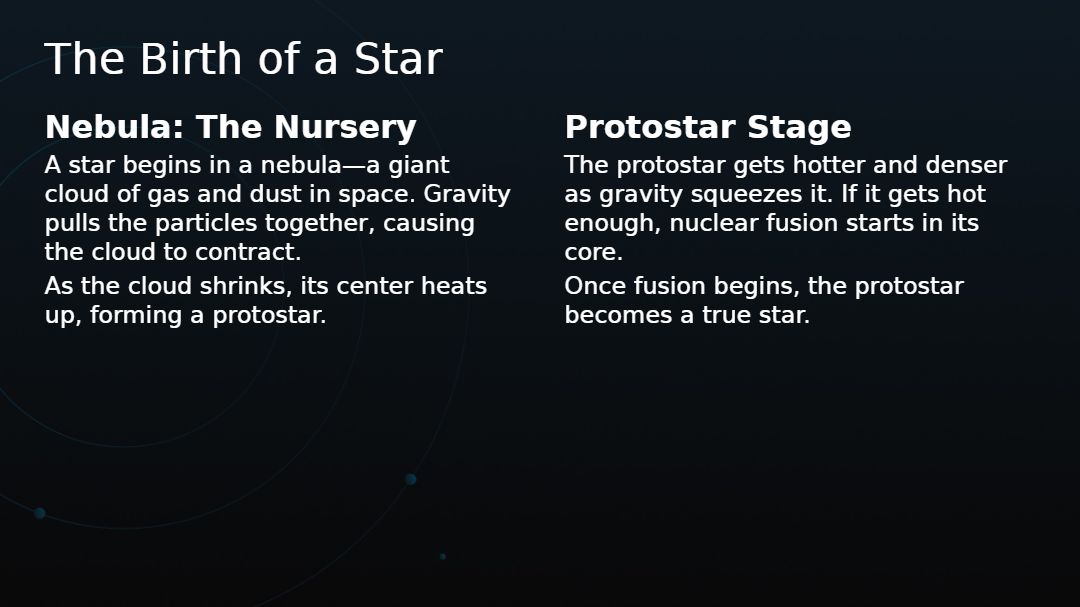
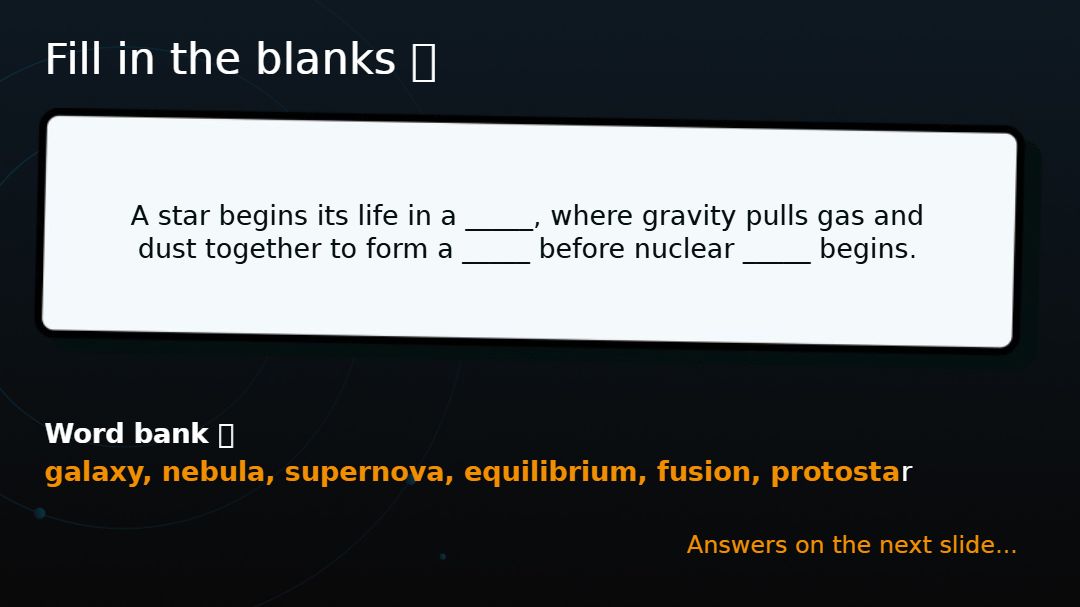
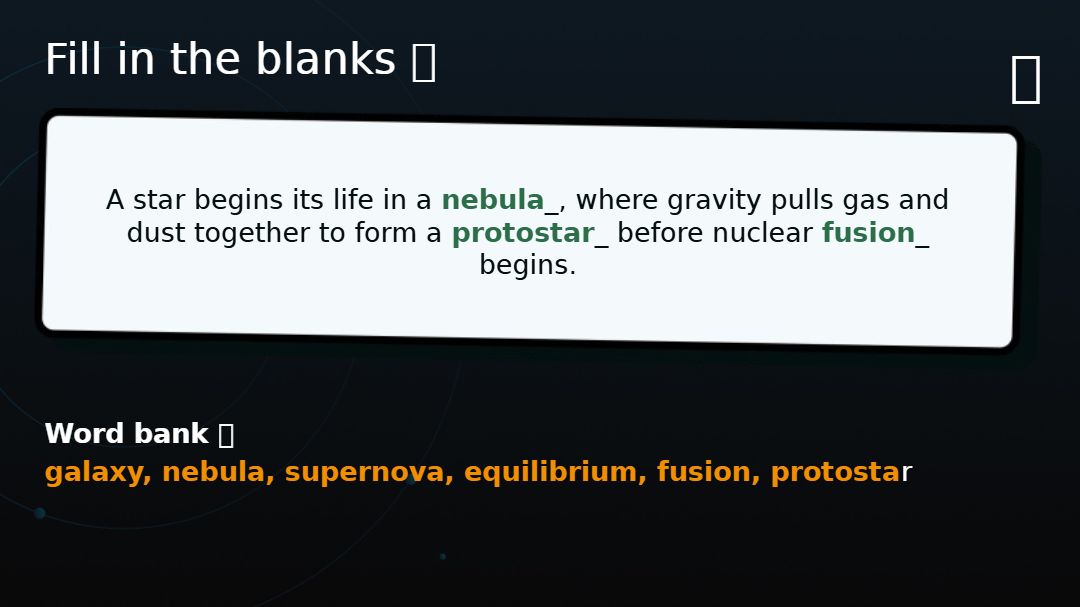
A star begins its life in a ___, where gravity pulls gas and dust together to form a ___ before nuclear ___ begins.
4
Open Ended
Why is it important to understand the life cycle of stars in the study of the universe?
5
6
Multiple Choice
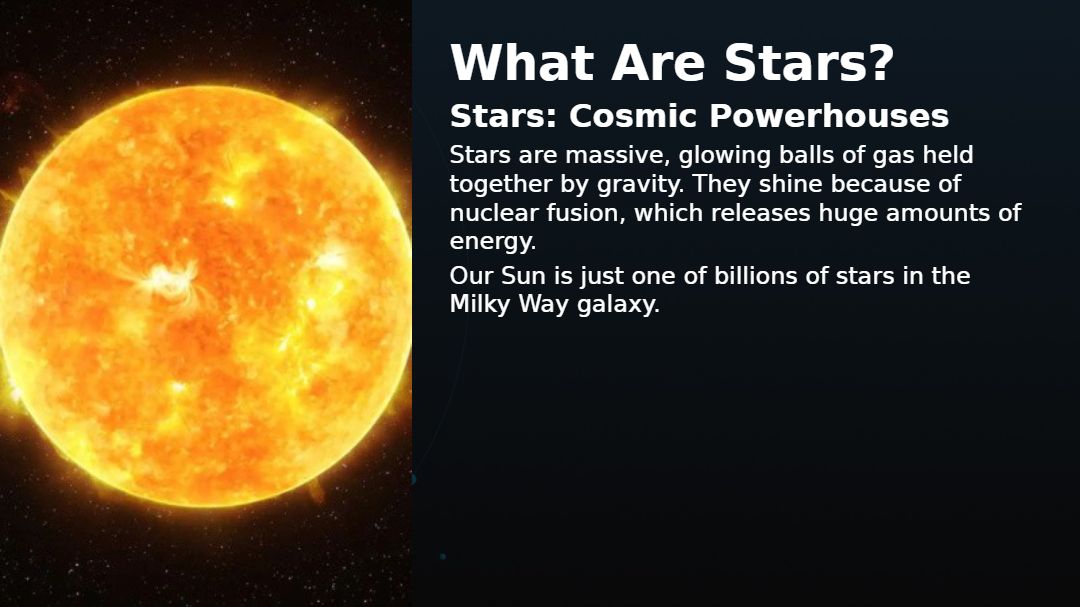
What process causes stars to shine and release huge amounts of energy?
Nuclear fusion
Chemical reaction
Radioactive decay
Photosynthesis
7
8
Open Ended
Describe the process by which a star is formed from a nebula.
9
10
Multiple Select
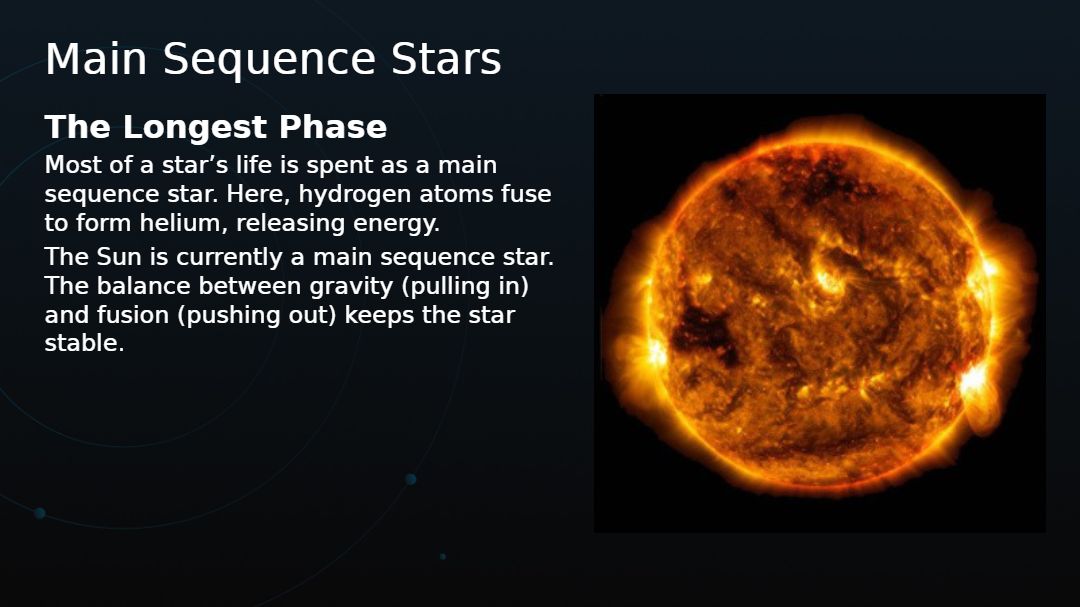
Which of the following are true about the main sequence phase of a star's life?
Most of a star's life is spent in this phase.
Hydrogen atoms fuse to form helium.
The Sun is currently in this phase.
Stars become black holes during this phase.
11
12
Fill in the Blanks
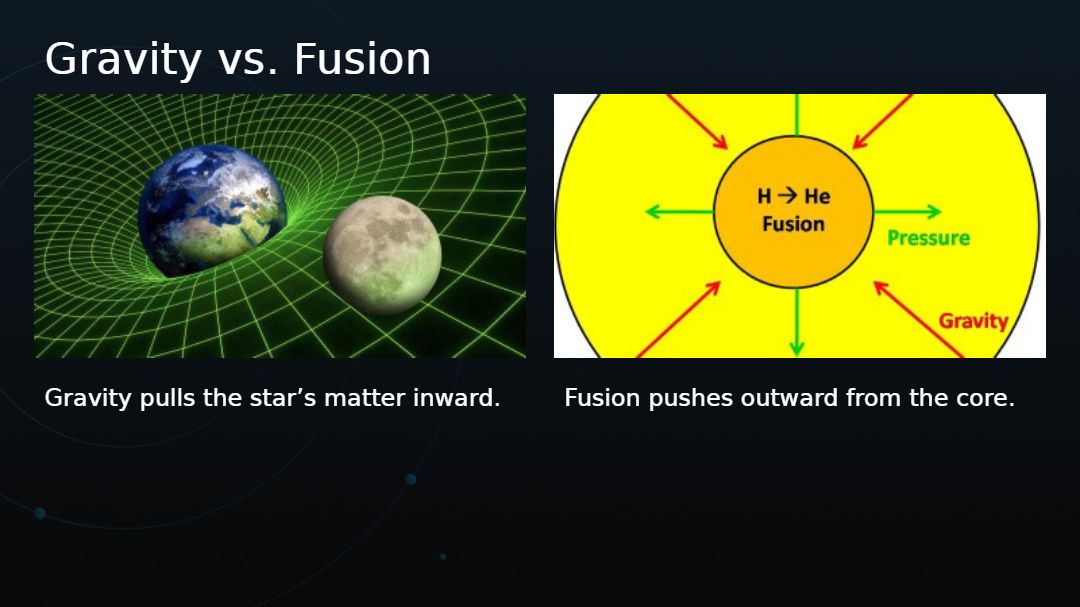
Gravity pulls the star's matter inward, while fusion pushes matter
13
14
Open Ended
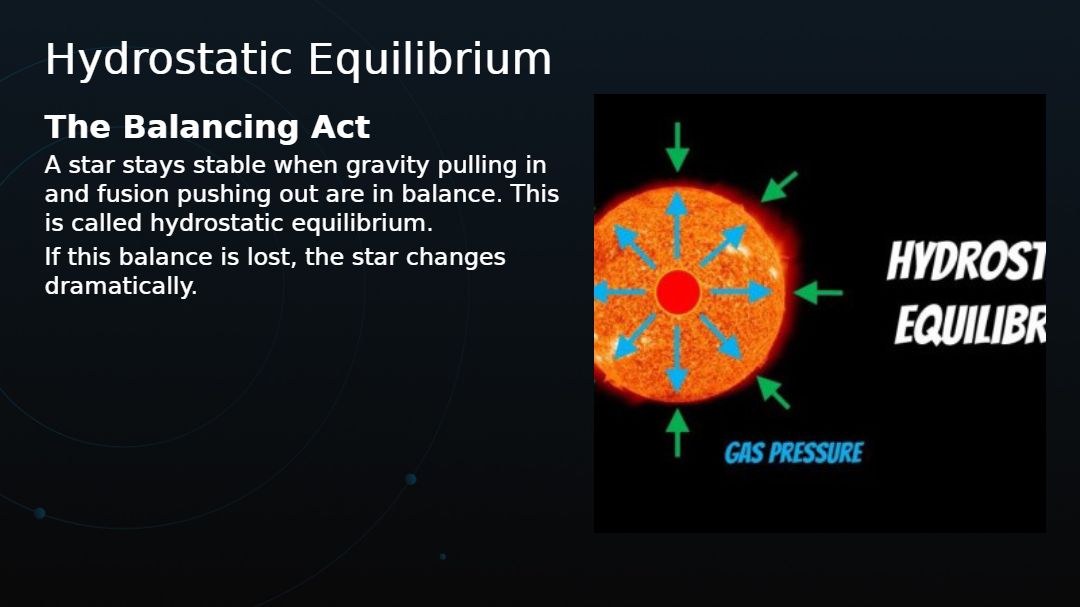
What is hydrostatic equilibrium and why is it important for a star's stability?
15
16
Multiple Choice
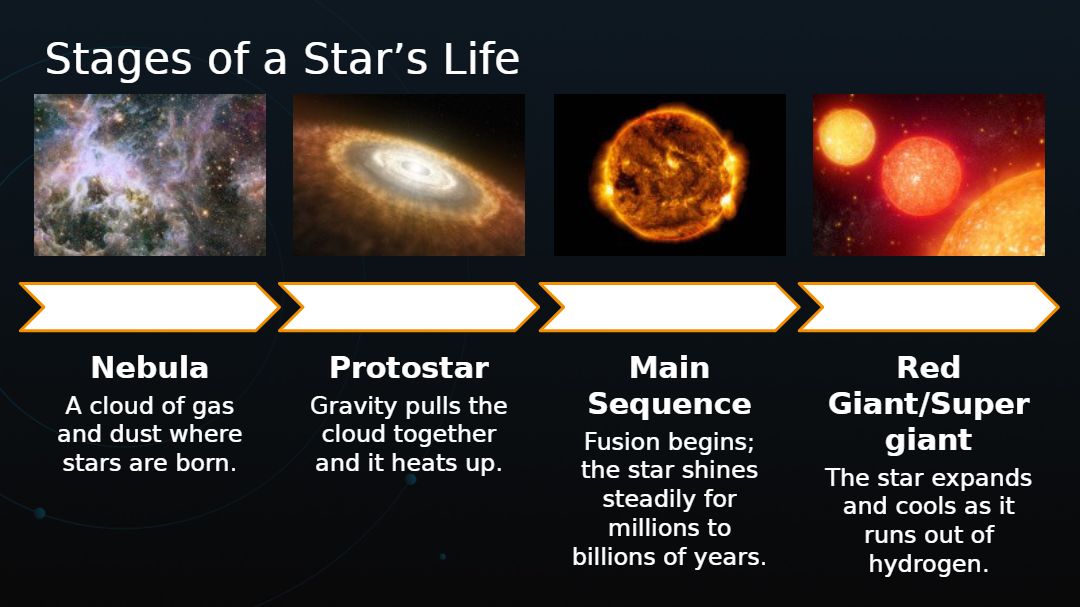
Arrange the following stages of a star's life in the correct order: Protostar, Red Giant/Supergiant, Main Sequence, Nebula.
Nebula, Protostar, Main Sequence, Red Giant/Supergiant
Protostar, Nebula, Main Sequence, Red Giant/Supergiant
Main Sequence, Nebula, Protostar, Red Giant/Supergiant
Nebula, Main Sequence, Protostar, Red Giant/Supergiant
17
18
Multiple Choice
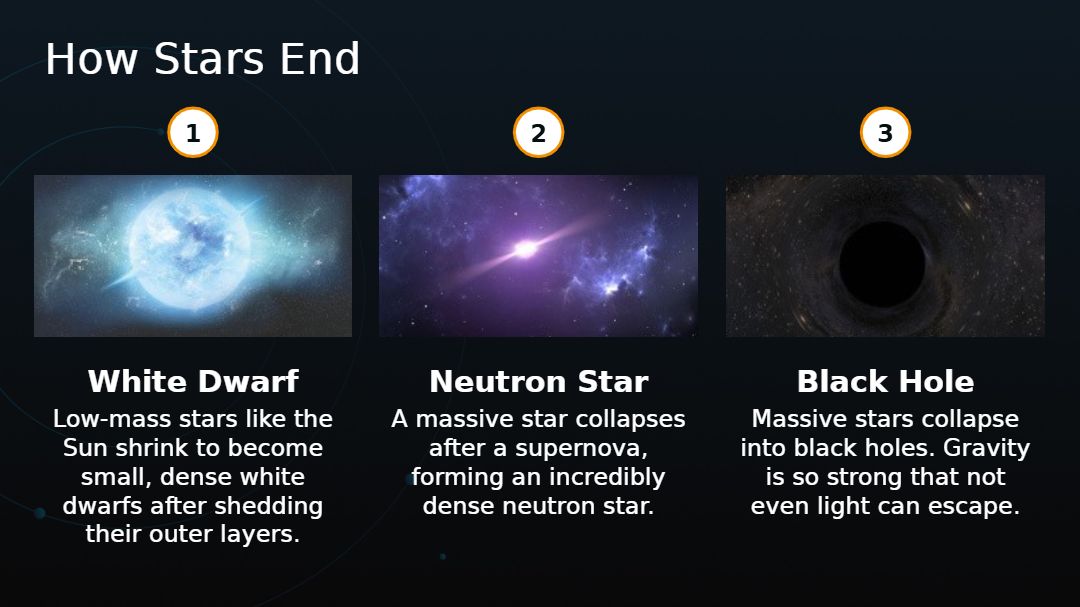
Which of the following is the final stage for a low-mass star like the Sun?
White Dwarf
Neutron Star
Black Hole
Red Giant
19
20
21
22
23
Open Ended
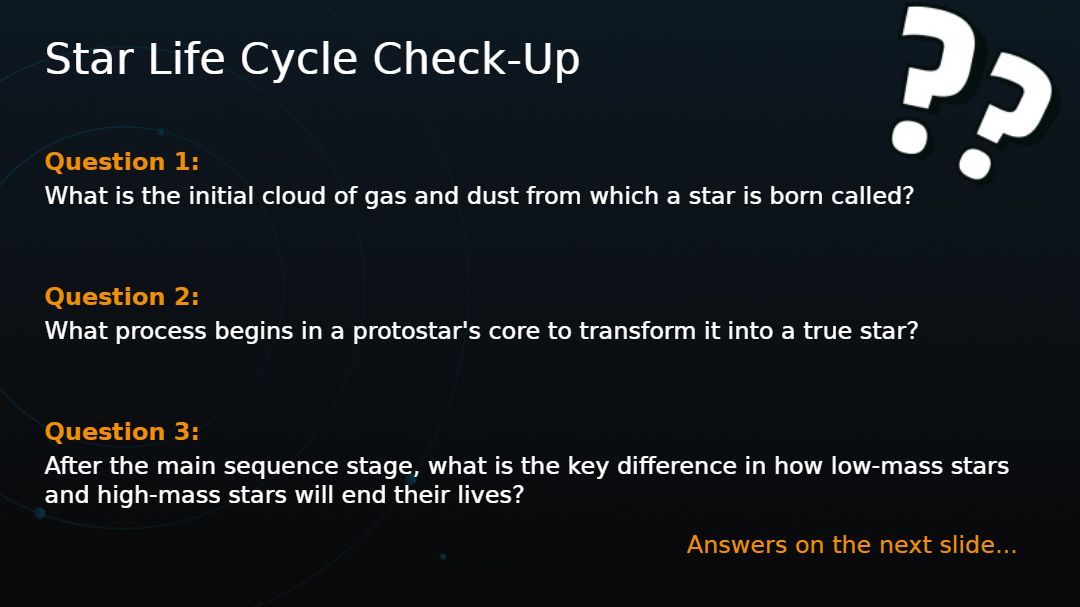
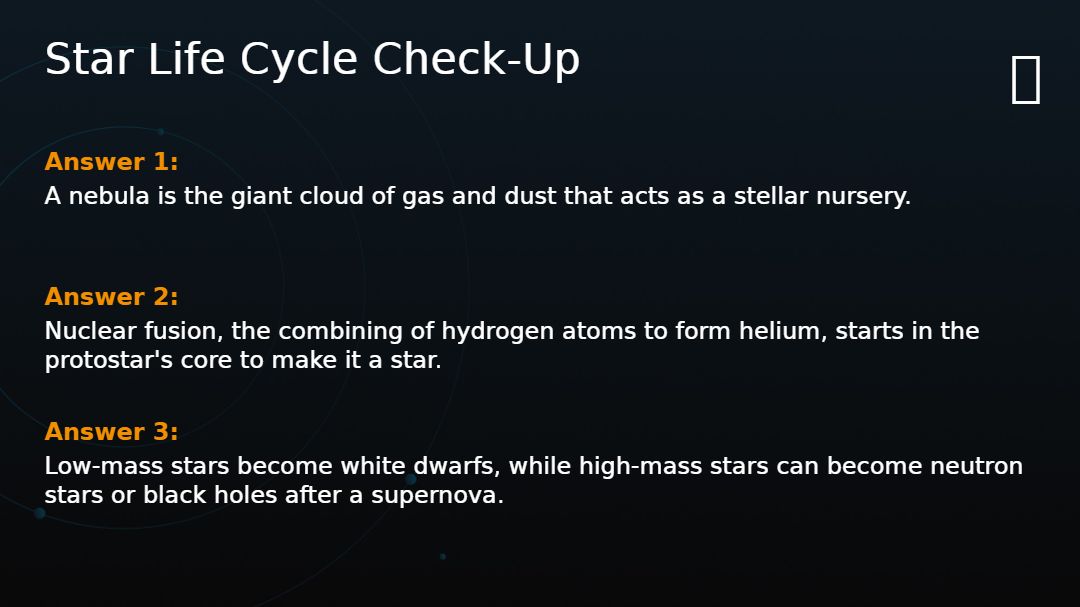
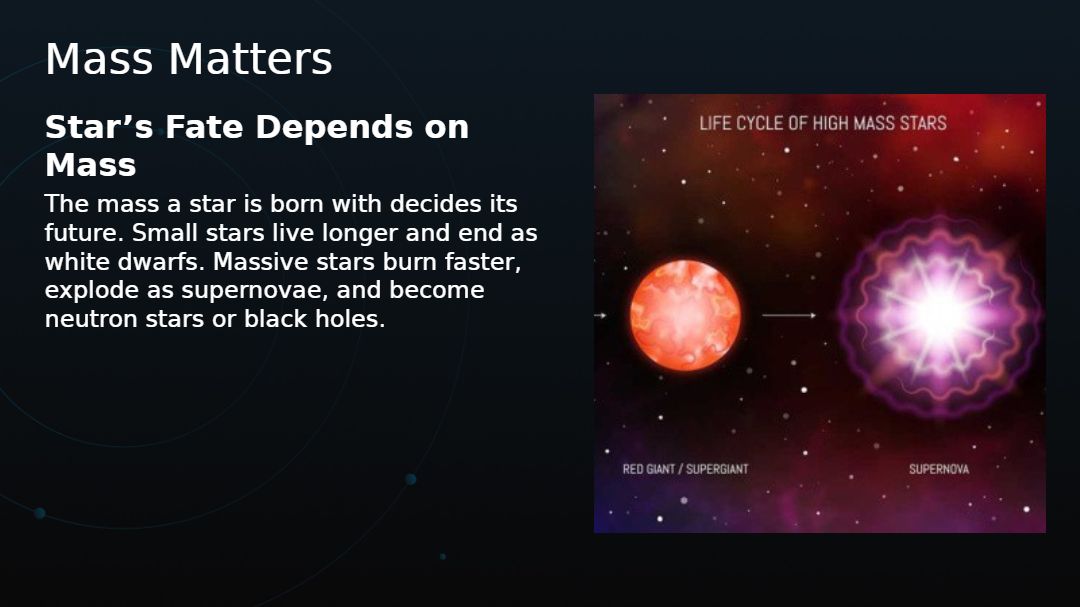
What is the key difference in the fate of low-mass and high-mass stars after the main sequence stage?
24
Multiple Select
After a supernova, what are the possible outcomes for a high-mass star?
Neutron star
Black hole
White dwarf
Red giant
25
Multiple Choice
What is the main factor that determines whether a star will end its life as a white dwarf, neutron star, or black hole?
Its mass
Its temperature
Its distance from Earth
Its color
26
27
Open Ended
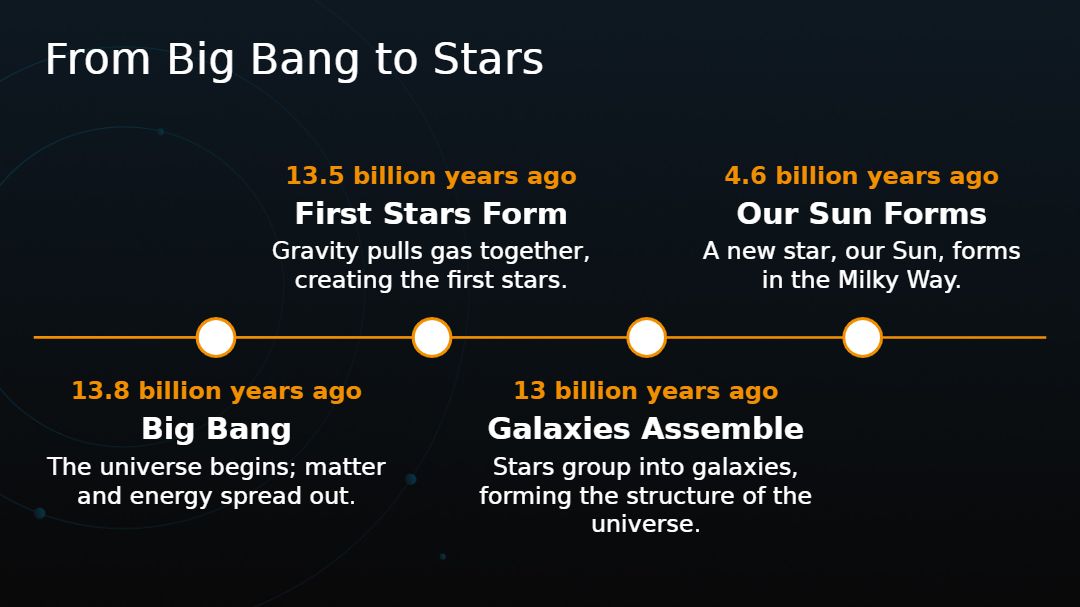
Describe how the timeline of the universe led to the formation of our Sun, referencing key events and their approximate ages.
28
29
30
Multiple Choice
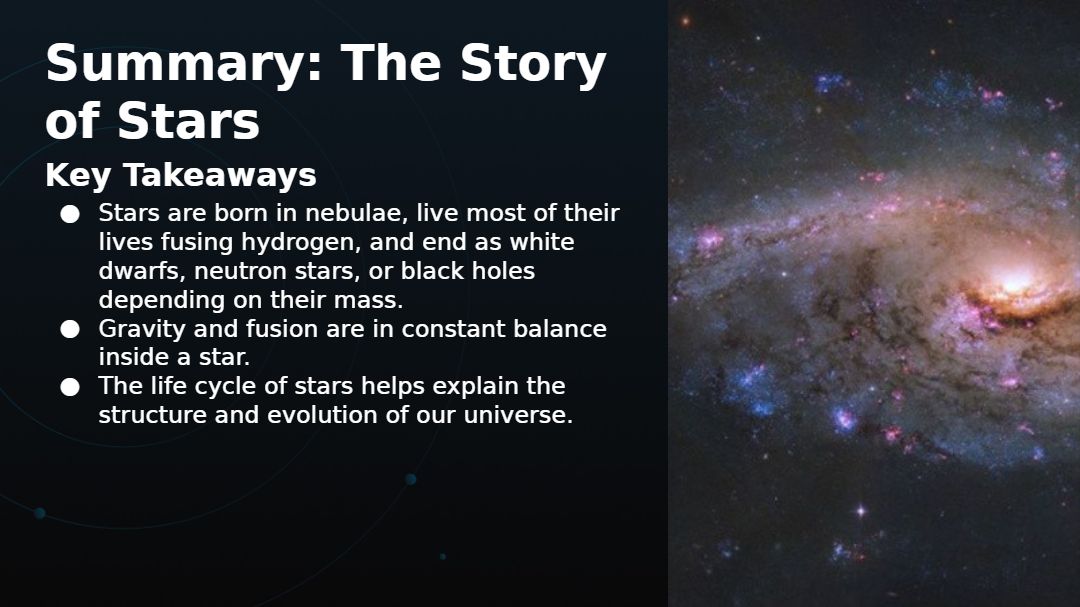
Which of the following best explains why gravity and fusion are important in the life of a star?
They keep the star in balance and determine its evolution.
They cause the star to explode immediately.
They make the star change color constantly.
They prevent the star from forming at all.
31
Open Ended
Describe the process by which a star is formed and the role of gravity and fusion in its life cycle.
32
Open Ended
Reflecting on what you have learned about the life cycle of stars, what is one question you still have or something you would like to know more about?
33
Multiple Choice
What are the possible final stages in the life cycle of a star?
Black hole and neutron star
White dwarf and red giant
Supernova and main sequence
Protostar and planetary nebula
Show answer
Auto Play
Slide 1 / 33
SLIDE
Similar Resources on Wayground

28 questions
Cells Theory, Microscopes, and Types of Cells
Presentation
•
10th Grade
24 questions
Concave and Convex Mirrors
Presentation
•
10th Grade
27 questions
Groundwater
Presentation
•
9th - 10th Grade
23 questions
Scientific Method
Presentation
•
9th - 10th Grade
28 questions
Section 2 Lesson 5-Empirical Formulas
Presentation
•
10th Grade
24 questions
Periodic Table Introduction
Presentation
•
9th Grade
27 questions
Human reproductive systems
Presentation
•
10th Grade
27 questions
World War 1
Presentation
•
10th Grade
Popular Resources on Wayground
10 questions
Safety Day 2026 – Student Review

Quiz
•
9th Grade
21 questions
Continents and Oceans
Quiz
•
6th Grade
20 questions
Parts of Speech
Quiz
•
5th Grade
16 questions
Subject & Predicate
Quiz
•
5th Grade
25 questions
Multiplication Facts
Quiz
•
5th Grade
12 questions
Map Skills
Quiz
•
3rd Grade
22 questions
Continents and Oceans
Quiz
•
5th Grade
15 questions
Rounding Decimals
Quiz
•
5th Grade
Discover more resources for Science
10 questions
Exploring Chemical and Physical Changes

Interactive video
•
6th - 10th Grade
10 questions
Exploring the Electromagnetic Spectrum for Middle School Science
Interactive video
•
6th - 10th Grade
10 questions
Exploring Force and Motion Concepts
Interactive video
•
6th - 10th Grade
10 questions
Exploring Air Masses and Weather Fronts
Interactive video
•
6th - 10th Grade
10 questions
Exploring the States of Matter
Interactive video
•
6th - 10th Grade
10 questions
Exploring Forces: Net Force, Normal Force, Gravity, and Friction
Interactive video
•
6th - 10th Grade
10 questions
Differentiating Thermal Energy and Temperature
Interactive video
•
6th - 10th Grade
10 questions
Exploring the States of Matter and Thermal Energy
Interactive video
•
6th - 10th Grade