Search Header Logo
​Unit 2 Classical Empires Chapter 3 Lessons 11-15

​Unit 2 Classical Empires Chapter 3 Lessons 11-15

Assessment

Presentation

Social Studies

1st - 5th Grade

Practice Problem

Medium

Created by

Sean Falasca

Used 5+ times

FREE Resource

40 Slides • 66 Questions

1

​Unit 2 Classical Empires
Chapter 3

By Sean Falasca

2

media

3

Lesson 11

4

Multiple Choice

A person controlled by a ruler or king

1

Subject

2

Military

3

Architecture

5

Multiple Choice

The design and construction of buildings

1

Conquer

2

Religion

3

Architecture

6

Multiple Choice

Vocab Review: A period of time

1

DNA

2

Era

3

BCE

7

Multiple Choice

Vocab Review: A group of people sharing similar

beliefs and behavior

1

Pre-History

2

Empire

3

Culture

8

Multiple Choice

Vocab Review: The power structure to represent,

control, and organize a society

1

Government

2

City-State

3

Civilization

9

Turn to page 50.


Classical empires controlled large areas and population

10

Open Ended

Question image

Name an area around the Mediterranean Sea that the Roman Empire controlled? (Hint: Use the picture for help!)

11

CLassical empires controlled huge populations

12

media

13

Multiple Choice

Question image

Which empire had the smallest population?

1

Persian

2

Gupta

3

Roman

4

Han

14

Multiple Choice

Question image

Which empire had the largest population?

1

Persian

2

Gupta

3

Roman

4

Han

15

Multiple Choice

Question image

Which empire started first?

1

Persian

2

Gupta

3

Roman

4

Han

16

Multiple Choice

Question image

Which empire started last?

1

Persian

2

Gupta

3

Roman

4

Han

17

Turn to page 51

18

media

19

Multiple Choice

What was once the largest empire in the world?

1

Persian

2

Roman

3

Gupta

20

Multiple Choice

What ended the Persian Empire?

1

Alexander the Great from Greece

2

Ghengis Khan

3

Mark Antony

21

The word "Until" tells us that after this point in history, things were different, and things became different when Alexander the Great invaded

22

media
media

Middle East then

Middle East now

23

Open Ended

Question image

Name a modern day country that was a part of the Persian Empire

24

Multiple Choice

What did governments do in classical empires?

1

Act as subjects

2

Control subjects and defend borders

3

Control very few people

25

Multiple Choice

What was once the largest empire in the world?

1

The Persians

2

Egypt

3

The Olmecs

26

End of Lesson 11

27

Lesson 12

media

28

Multiple Choice

A set of beliefs that include a

higher power, like a god

1

Military

2

Religion

3

Subject

29

Multiple Choice

An army of trained soldiers

1

Religion

2

Military

3

Architecture

30

Multiple Choice

Vocab Review: The design and construction of buildings

1

Architecture

2

Government

3

Empire

31

Multiple Choice

Vocab Review: The power structure to represent,

control, and organize a society

1

City-State

2

Government

3

Empire

32

Multiple Choice

Vocab Review: A group of states or nations ruled

by one powerful government

1

Religion

2

Military

3

Empire

33

Turn to page 52

Classical empires had grand architecture

34

media

The Colosseum in Rome was built between69-96 CE

CE means Commone Ear, like how BCE means Before Common Era.

35

Multiple Choice

Question image

When was the Colosseum built

1

69-96 BCE

2

69-96 CE

3

It was never built

36

media

37

media
media
media

Sistine CHapel

Religious

Art

The lourve

History

The Colosseum

38

media

GOvernment

U.S. Capitol

39

media
media

Colosseum

​Compare (Similarities) and contrast (differences) between these two buildings

Parthenon

40

Open Ended

What is one famous building you know of? (locally, nationally, or international)

41

Multiple Choice

Question image

What do aqueducts do?

1

Transport people from one place to another

2

Transport water to populated places

3

Transport grains to a populated places

42

Turn to page 53

43

media

44

Multiple Choice

What was another name for the eastern Roman Empire?

1

British Empire

2

Ottoman Empire

3

Byzantine Empire,

45

media

Hagia Sophia has been used for two different religions over time.

46

media

To the left, the Eastern and Western Roman Empire.

To the right, all the countries that are now where the roman empire was. How many countriues were apart of the roman empire?

media

47

Multiple Choice

What is one example of Roman architecture?

1

The Parthenon

2

The Colosseum

3

Great Pyramid of Giza

48

Multiple Choice

What was unique about Byzantine architecture?

1

Tall columns

2

Symmetry

3

Domes and impressive interiors

49

End of Lesson 12

50

media

Beginning of Lesson 13

51

Multiple Choice

To take control of people or a place by force

1

Military

2

Conquer

3

Subject

52

Multiple Choice

The powerful ruler of an empire

1

Emperor

2

Subject

3

Religion

53

Multiple Choice

Vocab Review: A group of states or nations ruled

by one powerful government

1

Civilization

2

Government

3

Empire

54

Multiple Choice

Vocab Review: An army of trained soldiers

1

Subjects

2

Military

3

Empire

55

Multiple Choice

A period of 100 years

1

Century

2

Era

3

Culture

56

Classical empires had strong militaries

media

57

Multiple Choice

What is considered one of the most effective armies in history?

1

Roman

2

Gupta

3

Minoan

58

media

59

Open Ended

What did armies use their well trained militaries for? (Hint: Use page 54!)

60

media
media

Would you describe there warriors as brave?

61

media
media

​Contantine the 1st, also known as Constantine the Great, was the emperor of Roman in the 4th century CE.

Constantine the 1st

62

Turn to page 55

63

media

64

Open Ended

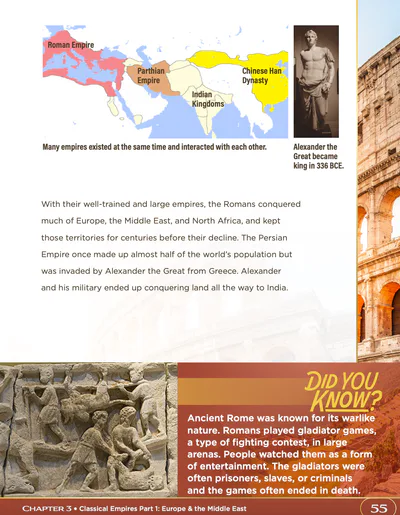
Where did the Romans conquer? (Hint: Use page 55!)

65

Open Ended

Question image

What existed at the same time and interacted with each other? (Hint: Use the picture found at the top of page 55!)

66

Multiple Choice

Question image

Alexander the Great became king in 336 BCE; Constantine the 1st became emperor in Rome from 306-337 CE

Who was emperor first, Constantine the 1st in Rome or Alexander the Great in Greece?

1

Constantine the 1st in Rome

2

Alexander the Great in Greece

67

Multiple Choice

What did militaries do in classical empires?

1

Defend borders and conquer other areas

2

Build impressive architecture

3

Write laws

68

Multiple Choice

Where did the Romans conquer?

1

North America

2

Europe, the Middle East, and North Africa

3

Australia and South Africa

69

End of lesson 13

70

beginning of Lesson 14

Turn to page 56

71

Multiple Choice

An organized fight between

groups or countries

1

War

2

Soldiers

3

Market

72

Multiple Choice

To exchange goods or services

1

Market

2

Trade

3

Government

73

Multiple Choice

A group of states or nations ruled

by one powerful government

1

War

2

Empire

3

Trade

74

Multiple Choice

A city and surrounding territories

governed as one state

1

Civilization

2

Government

3

City-State

75

Multiple Choice

A group of people sharing similar

beliefs and behavior

1

Culture

2

Religion

3

Social Class

76

Multiple Choice

To take control of people or a place by force

1

Subject

2

Military

3

Conquer

77

Open Ended

What fought each other?

78

media

79

Open Ended

Who eventually led the largest empire in the world?

80

Open Ended

Question image

Whose empire covered many countries and different cultures?

81

media

82

Multiple Choice

What is another name for exchanging goods?

1

Stealing

2

Trading

3

Borrowing

83

Multiple Choice

Who did the Roman Empire trade with?

1

India

2

China

3

India & China

4

No one

84

Multiple Choice

Question image

Who was Darius the 1st?

1

A Roman Emperor

2

A Persian King

3

An Egyptian Pharaoh

85

Open Ended

Question image

We just read about this in the passage. What were the four stages that all classical empires went through?

86

Multiple Choice

Who defeated the Greek Empire in 300 BCE?

1

Hannibal

2

The Egyptians

3

Alexander the Great

87

Multiple Choice

What happened to all classical empires?

1

They lasted forever

2

They collapsed

3

They were conquered at the same time

88

End of lesson 14

89

Beginning of Lesson 15

Turn to pages 58 + 59

90

Multiple Choice

Vocab Review: A place where goods are bought and sold

1

Centruy

2

Religion

3

Market

91

Multiple Choice

Vocab Review: A period of 100 years

1

Decade

2

Century

3

Conquer

92

Multiple Choice

Vocab Review: A group of states or nations ruled

by one powerful government

1

Civilization

2

City-State

3

Empire

93

Multiple Choice

Vocab Review: A group of people sharing similar

beliefs and behavior

1

Culture

2

Religion

3

Military

94

Multiple Choice

Vocab Review: To exchange goods or services

1

Borrowing

2

Trading

3

Stealing

95

Multiple Choice

Vocab Review: A set of beliefs that include a

higher power, like a god

1

Culture

2

Religion

3

Trade

96

Classical Empires traveled long distances to trade

97

Open Ended

What did Classical Empires do to trade?

98

media

99

media

​These Empires were far away from each other, but still traded with each other.

​Which countries did Rome trade with on the SIlk Road?

100

Open Ended

Question image

What brings different cultures together? (Hint: Use the caption at the bottom of page 58!)

101

media

102

Open Ended

Who were important ancient traders in the 5th century BCE? (Hint: Use the beginning of page 59!)

103

Multiple Choice

What was Carthage?

1

A religion

2

An Emperor

3

A city

4

A crop

104

Multiple Select

What was traded on the incense road? (Hint: There is more than 1 correct answer!)

1

Spices

2

Incense

3

Food

4

Weapons

105

Multiple Choice

Why did classical empires trade with each other?

1

They needed resources other regions had

2

They had advanced technology

3

They all spoke the same language

106

Multiple Choice

What was the color of royalty, especially for the Romans?

1

Red

2

Purple

3

Green

4

​Unit 2 Classical Empires
Chapter 3

By Sean Falasca

Show answer

Auto Play

Slide 1 / 106

SLIDE