

Target 2 Remediation: Citing Evidence

Presentation
•
English
•
7th Grade
•
Easy
+14
Standards-aligned

Christine Houck
Used 1+ times
FREE Resource
7 Slides • 23 Questions
1

2
Multiple Choice
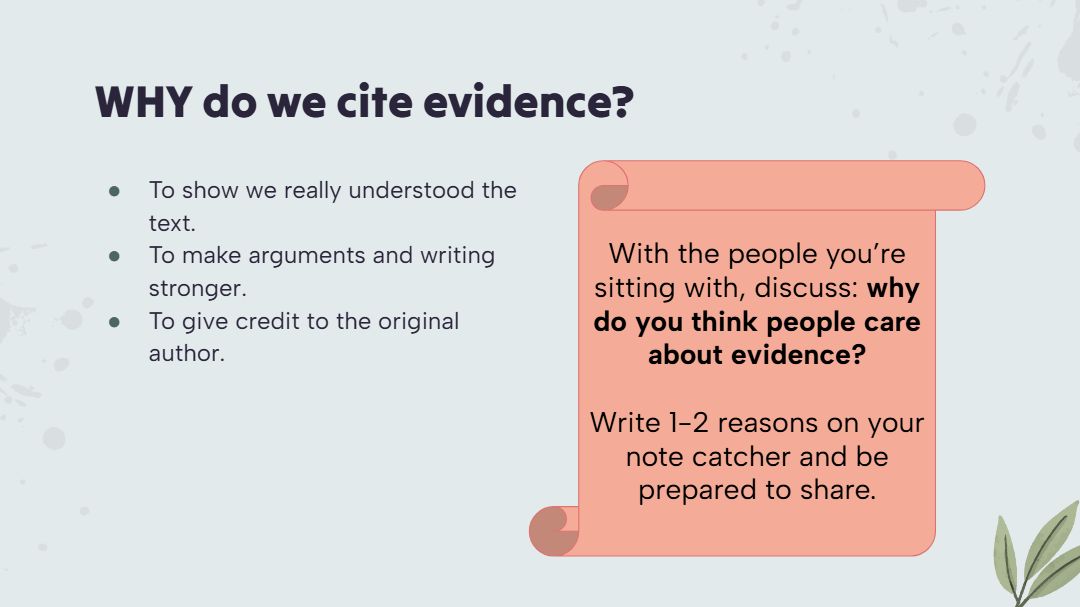
What is the purpose of citing evidence in writing?
To support conclusions
To confuse the reader
To make the text longer
To have good writing
3
4
Multiple Choice
What is the primary purpose of citing evidence in your writing?
To fill up space in your essay
To support your arguments and provide credibility
To make your writing more complex
To show off how many sources you have read
5
6
Multiple Choice
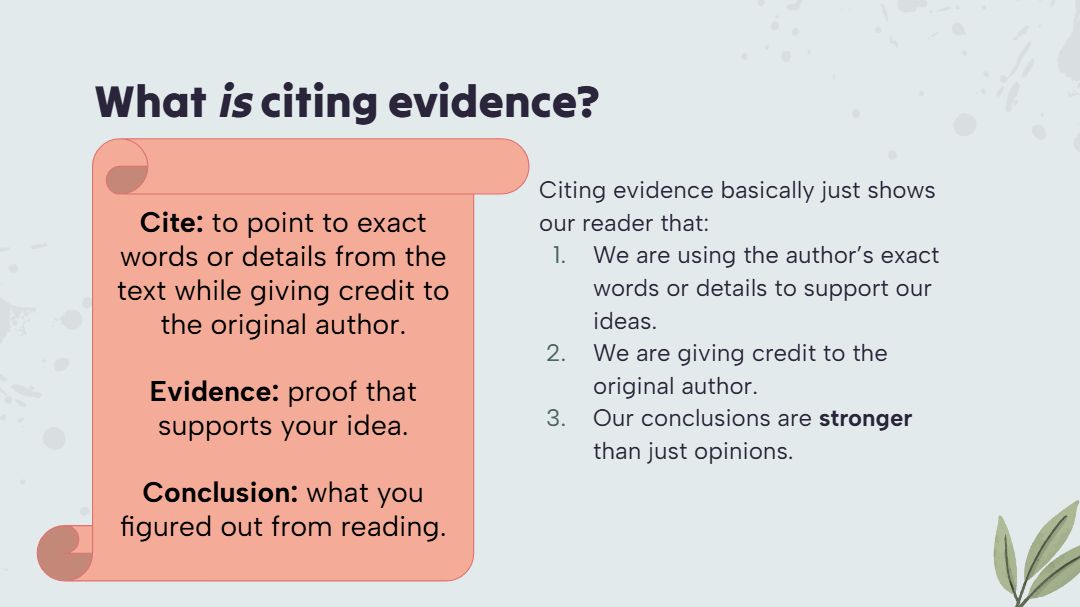
What is evidence?
What you figured out from reading
Author's name and page number
Proof that supports your idea
The big ideas of a text
7
Multiple Choice
When citing textual evidence, what information should be included?
The page number
Author's last name and page number
Author's first and last name
Author's first and last name and page number
8
Multiple Select
What are two ways to cite evidence? Choose two.
Copying the whole page
Copying the author's exact words
Referring to the author's ideas or details
Writing a summary of the whole text
9
Multiple Choice
What does making a conclusion mean?
It's evidence
It's giving credit to the author
It's the ending of a story
It's what you figure out from reading
10
11
Multiple Choice
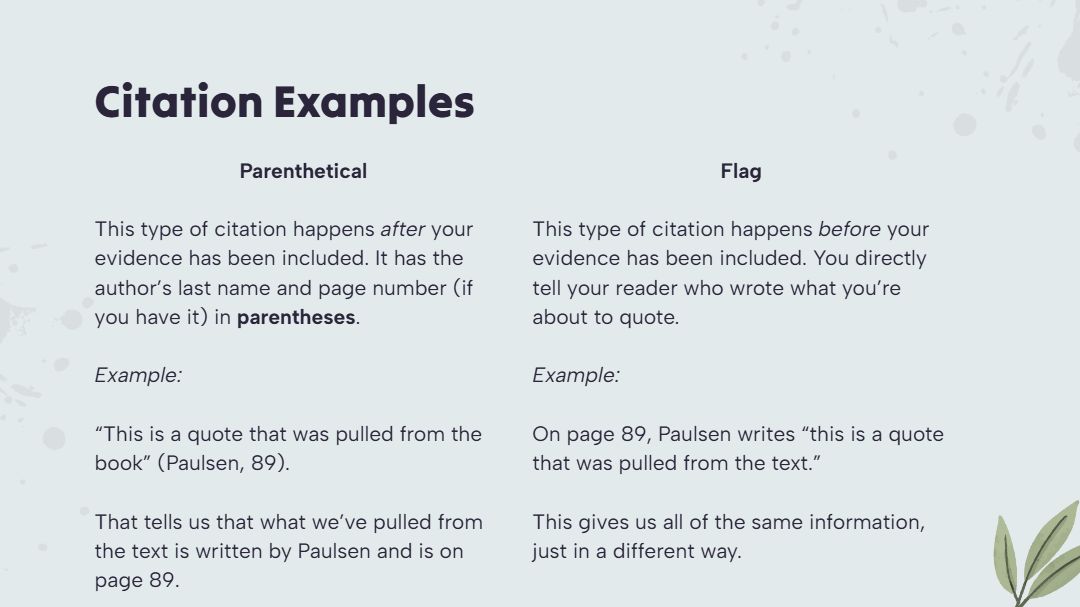
What is the difference between parenthetical and flag citations?
Flag citations occur after the evidence and parenthetical citations occur before evidence
Flag citations include the author's name in parentheses
Parenthetical citations occur after evidence and flag citations occur before
Flag citations are not used in academic writing
12
13
Multiple Choice
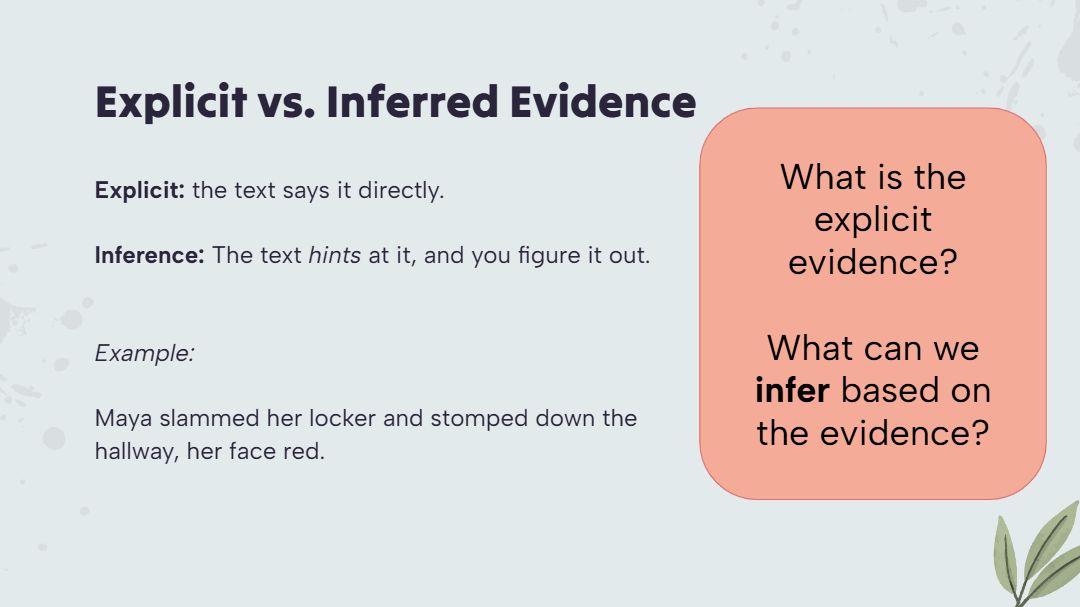
What is explicit evidence?
There are hints about the big idea
The text says it directly
The author gives clues
Evidence that is outside of the story
14
Multiple Choice
Implicit is:
When the narrator is in first person
When the answer isn't in the text at all
When the answer is hidden in the text
When the answer is obvious in the text
15
Multiple Choice
When something is implicit then the reader can go back and find the information directly in the story.
True
False
16
Multiple Choice
Identify the implicit information in the article below:
Maggie was getting ready to walk to school. She put on her coat and grabbed her backpack.
Maggie was late to school.
Maggie lives close to the school.
Maggie was in primary school.
Maggie is excited about going to school.
17
Multiple Choice
Read the following passage and answer the question:
Maggie was getting ready to walk to school. She put on her coat and grabbed her backpack.
Which of the following is explicitly stated in the paragraph?
Maggie lives close to the school.
Maggie put on her coat and grabbed her backpack.
Maggie is in primary school.
Maggie is never late to school.
18
Multiple Choice
Read the passage below. Identify the explicit information.
Omar hurried out of the house so he wasn't late for work. He wore overalls and carried a toolbox with wrenches in it. He hopped in his truck and drove off. The sign on his truck said, “Pipe Masters.”
Omar hurried out of the house so he wasn't late for work.
Omar enjoys his job.
Omar is a plumber.
Omar has a red truck.
19
Multiple Choice
Which of the following would be considered explicit textual evidence?
20
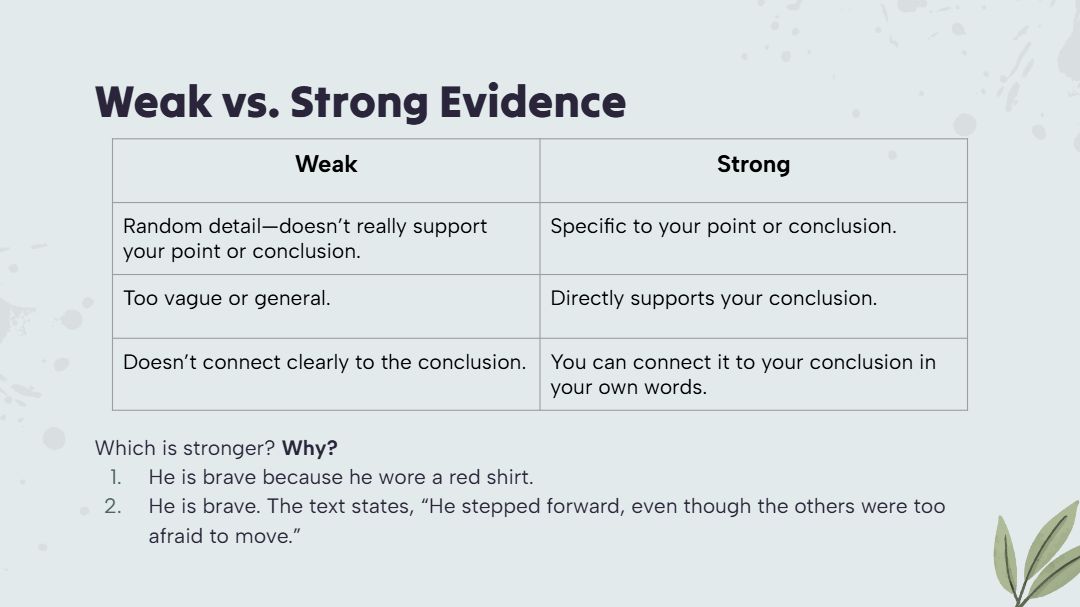
21
Multiple Select
What makes strong evidence? Choose two.
Inferences
Facts
Quotes from experts
Opinions
22
Multiple Choice
Claim: Children who grow up with siblings have more opportunities to develop communication skills.
Evidence: My sister says that talking to me helped her learn how to express her emotions.
The evidence is strong
The evidence is weak because it does not support the claim.
The evidence is weak because it is not a fact
The evidence is strong because it's a fact
23
Multiple Choice
Which detail would be relevant to this main idea? There are many fun things to do at the beach.
Playing kickball can be lots of fun.
It is fun to walk along the shore and look for shells.
Some people burn easily in the sun.
Unfortunately, we don't live that close to a beach.
24
Multiple Choice
Which of the following best represents a piece of evidence that is both strong and relevant?
A quote from a celebrity about a scientific matter.
A recent study from a credible institution that directly addresses the topic.
A popular opinion found on social media.
An excerpt from a novel that metaphorically relates to the topic.
25
26
Match
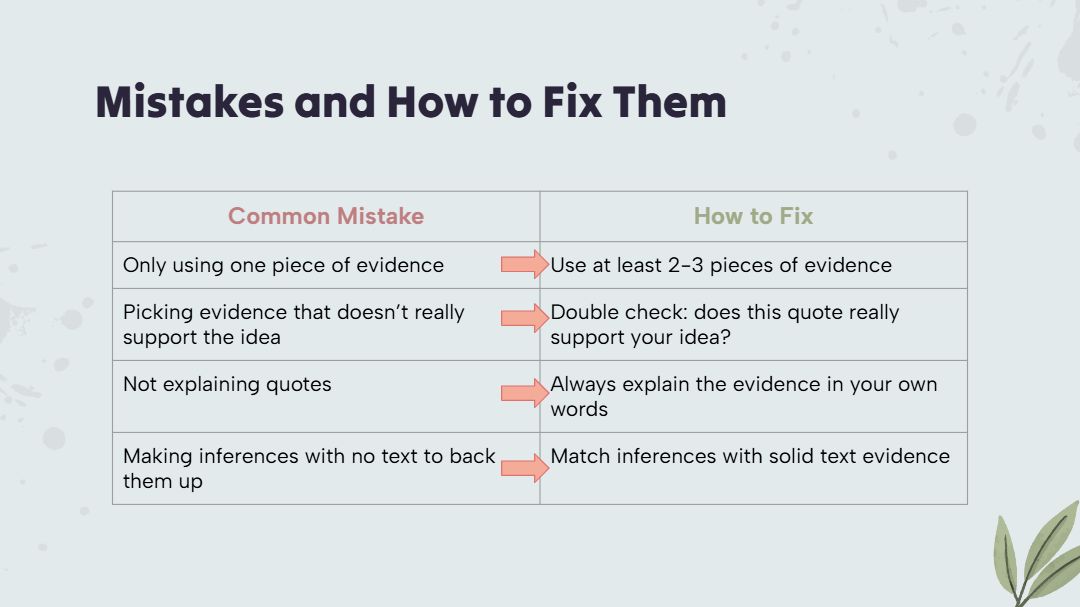
Match the common mistakes with how to fix them
Only using one piece of evidence
Picking evidence that doesn’t really support the idea
Not explaining quotes
Making inferences with no text to back them up
Use at least 2 pieces of evidence
Check if the quote supports your idea
Explain the evidence in your own words
Support your inferences with quotes
Use at least 2 pieces of evidence
Check if the quote supports your idea
Explain the evidence in your own words
Support your inferences with quotes
27
Multiple Choice
Tornadoes are destructive. Which piece of evidence supports this claim?
The tornado was 2 miles wide.
3 out of 4 families in our community are without power and 35 have lost parts of their house or roof.
The tornado's wind speeds reached 100 mph.
It was an F1 tornado.
28
Multiple Choice
A pet dog is a huge responsibility. Which evidence best supports this claim?
"Make sure you put shoes away because puppies like to chew them," Dr. Brinson, vetericarian.
Always keep your dog on a leash in public.
The cost of food is roughly $6.00 a week.
Dogs require several hours of your time and attention every week, between feeding, exercising, and taking them out to the bathroom.
29
Multiple Choice
Recycling helps our planet. Which piece of evidence best supports this claim?
The sea turtle population has decreased by 20% because of straws polluting the ocean.
There are three main types of pollution, air, water, and land.
50% of the paper used in the U.S. is recycled.
Only 1 in 10 people currently recycle.
30
Multiple Choice
What should you do after citing textual evidence?
Ask someone else to explain the evidence.
Explain how the evidence supports your argument or claim.
Ignore the evidence and move on to the next point.
Provide a summary of the evidence.
Show answer
Auto Play
Slide 1 / 30
SLIDE
Similar Resources on Wayground

26 questions
Dialogue Rules
Presentation
•
7th Grade
24 questions
Influence of setting
Presentation
•
7th Grade
20 questions
Subjective vs. Objective and Author's Perspective
Presentation
•
7th Grade
22 questions
Point of View
Presentation
•
7th Grade
22 questions
Symbolism
Presentation
•
7th Grade
25 questions
Adverb
Presentation
•
7th Grade
21 questions
Debate
Presentation
•
7th Grade
22 questions
Tone and Mood
Presentation
•
KG
Popular Resources on Wayground
10 questions
Safety Day 2026 – Student Review

Quiz
•
9th Grade
21 questions
Continents and Oceans
Quiz
•
6th Grade
20 questions
Parts of Speech
Quiz
•
5th Grade
16 questions
Subject & Predicate
Quiz
•
5th Grade
25 questions
Multiplication Facts
Quiz
•
5th Grade
12 questions
Map Skills
Quiz
•
3rd Grade
22 questions
Continents and Oceans
Quiz
•
5th Grade
15 questions
Rounding Decimals
Quiz
•
5th Grade
Discover more resources for English
10 questions
Inference and Textual Evidence
Quiz
•
7th Grade
25 questions
Making Inferences
Quiz
•
6th - 8th Grade
10 questions
Figurative Language
Quiz
•
7th Grade
14 questions
3 Types of Sentences
Presentation
•
6th - 7th Grade
16 questions
Theme Practice
Quiz
•
7th Grade
12 questions
Chemical Reactions

Interactive video
•
7th Grade
17 questions
Figurative Language
Quiz
•
7th Grade
20 questions
Simple, Compound, and Complex Sentences
Quiz
•
7th Grade