

First Person Accounts of the Transatlantic Slave Trade

Presentation
•
History
•
9th - 12th Grade
•
Practice Problem
•
Easy

Isiah Jones
Used 5+ times
FREE Resource
11 Slides • 5 Questions
1
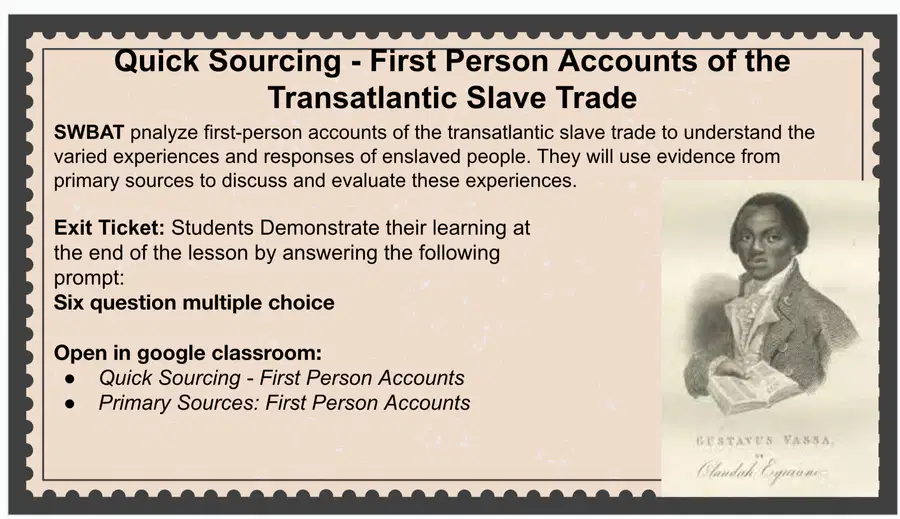
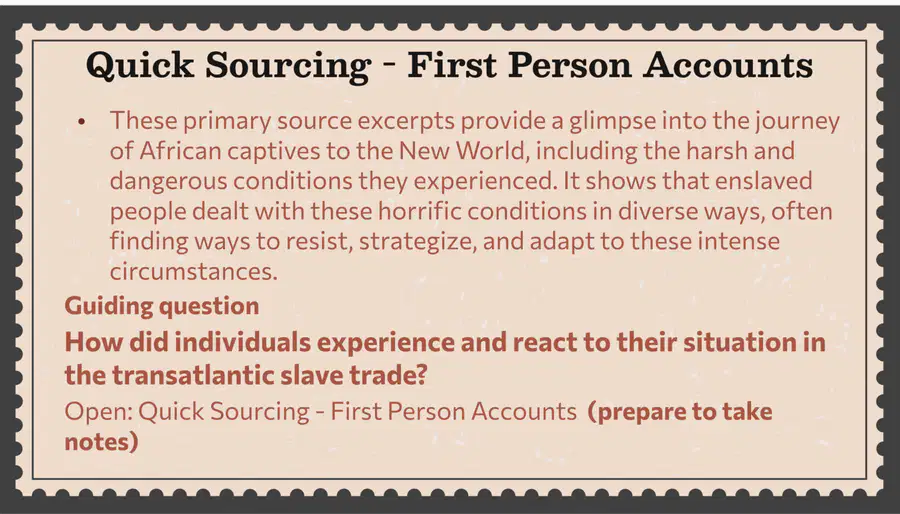
First Person Accounts - Transatlantic Slave Trade
By Isiah Jones
2
Open Ended

When you think of 'resistance' against a powerful, unfair system, what actions or behaviors come to mind? Think big or small. List 3-4 examples.
Brainstorm individually for 2 minutes, then share with a partner for 2 minutes. Then Write your answer
3
4
5
6

7
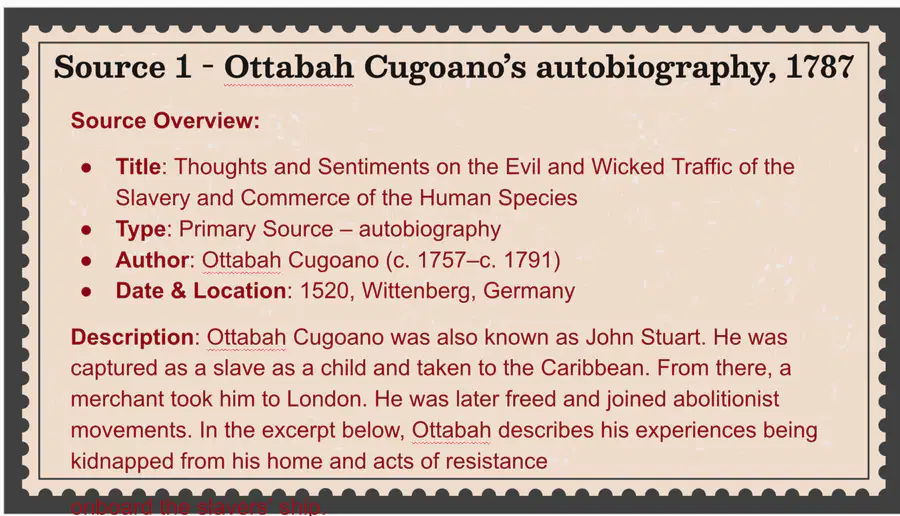
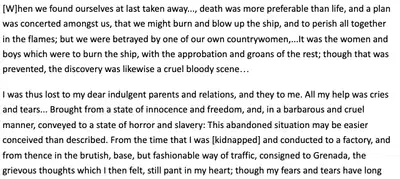
Summarize (Part 1): "So, Cugoano is describing being kidnapped and his plan to blow up the ship with others. He talks about his despair and betrayal. This shows me that one reaction was organized, violent resistance, even if it meant death."
HAPPY Analysis (Part 2):
Historical Context: "He wrote this in 1787 in London. Why is that important? This was when the abolitionist movement was starting to grow in Britain. He's publishing this to influence that debate."
Audience: "He's writing for the 'Inhabitants of Great-Britain.' He's trying to convince the British public and politicians that slavery is evil. This means he might be choosing stories that will shock and persuade them."
8
Summarize (Part 1): "So, Cugoano is describing being kidnapped and his plan to blow up the ship with others. He talks about his despair and betrayal. This shows me that one reaction was organized, violent resistance, even if it meant death."
HAPPY Analysis (Part 2):
Point of View (POV): "His POV is crucial. He is a former enslaved person, now a free abolitionist. His CORNPEG: Class: formerly enslaved, now educated author. Occupation: abolitionist. Nationality: African, then British. His entire purpose now is to end the slave trade. This shapes how he tells his story—he's building a case."
Purpose: "His purpose is clearly to persuade and inform. He wants to expose the brutality of the slave trade to help end it."
9
Summarize (Part 1): "So, Cugoano is describing being kidnapped and his plan to blow up the ship with others. He talks about his despair and betrayal. This shows me that one reaction was organized, violent resistance, even if it meant death."
HAPPY Analysis (Part 2):
Why Significant?: "This is significant because it shows us that enslaved people were not passive. They actively resisted, even in extreme ways. But we also have to remember he's writing with a specific goal—to end slavery—which influences his narrative."
10
Multiple Choice
What does the "H" in HAPPY stand for?
A) Historical Context
B) Happy Analysis
C) Human Perspective
D) Historical Purpose
11
Multiple Choice
According to Document 1, what was Ottobah Cugoano's plan for resistance?
A) To refuse to eat
B) To jump overboard
C) To burn and blow up the ship
D) To start a disease outbreak
12
Multiple Choice
Why is it important that Cugoano wrote his account after he was free and living in London?
A) It means his story is probably made up.
B) It shows he could speak freely to advocate for abolition, which shapes his purpose.
C) It proves that all enslaved people felt the same way he did.
D) It indicates he was working for the slave traders.
13
Multiple Choice
A historian reads Cugoano's account. Which question would be MOST critical for the historian to ask, based on HAPPY analysis?
A) How long did the voyage take?
B) What specific year was he kidnapped?
C) How might his role as an abolitionist have influenced which details he included?
D) What was the name of the ship?
14
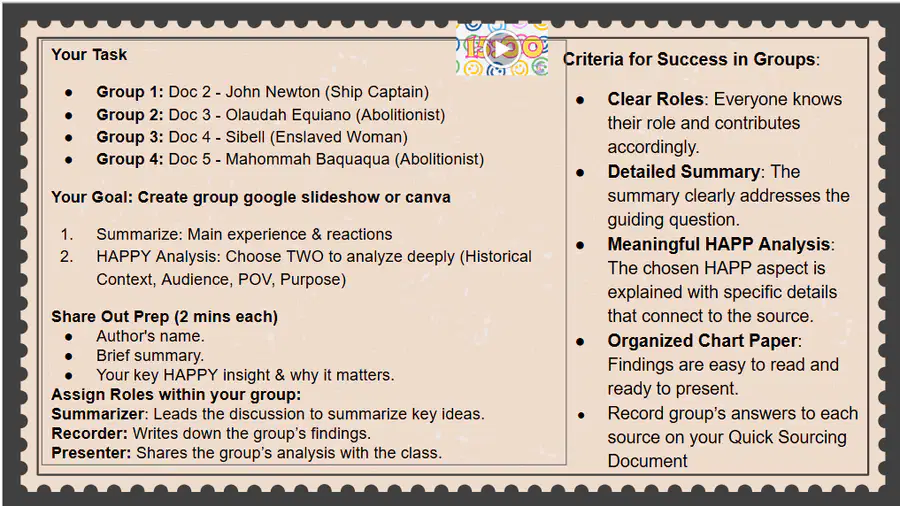
15
Experiences & Reactions | Resistance & Adaptation |
|---|---|
| |
| |
| |
| |
| |
16
Exit Ticket: Criteria for Success Prompt: Evaluate the claim: "The diverse ways enslaved people reacted to the Middle Passage is powerful evidence of their humanity, despite attempts to dehumanize them." Use evidence from two documents.
Criteria for Success:
can state my position clearly.
I can use specific evidence from two different documents.
I can explain how my evidence supports my position.
I can use relevant vocabulary.
First Person Accounts - Transatlantic Slave Trade
By Isiah Jones
Show answer
Auto Play
Slide 1 / 16
SLIDE
Similar Resources on Wayground

11 questions
Must and Mustn't
Presentation
•
9th - 12th Grade
13 questions
9/11 Activity
Presentation
•
9th - 12th Grade
12 questions
Alg. 1 10-5
Presentation
•
9th - 12th Grade
12 questions
Suffixes y and ly
Presentation
•
9th - 12th Grade
12 questions
Using Line of Best Fit to Make Predictions
Presentation
•
9th - 12th Grade
12 questions
In-text Citations
Presentation
•
9th - 12th Grade
13 questions
Area of a Sector
Presentation
•
9th - 12th Grade
10 questions
9/11
Presentation
•
9th - 12th Grade
Popular Resources on Wayground
6 questions
Secondary Safety Quiz
Presentation
•
9th - 12th Grade
10 questions
Afterschool Activities & Sports

Quiz
•
6th - 8th Grade
19 questions
ROAR Week 2026
Quiz
•
9th - 12th Grade
20 questions
Lab Safety Quiz
Quiz
•
6th Grade
15 questions
Cool Tool:Chromebook
Quiz
•
6th - 8th Grade
22 questions
would you rather
Quiz
•
3rd - 11th Grade
21 questions
Continents and Oceans
Quiz
•
6th Grade
20 questions
Parts of Speech
Quiz
•
5th Grade
Discover more resources for History
23 questions
1.2 (Indus River Valley)
Quiz
•
9th - 10th Grade
10 questions
The Journey Through Atomic Theory

Interactive video
•
6th - 10th Grade
10 questions
Comparing the Southern and New England Colonies
Quiz
•
10th Grade
10 questions
American Revolution Pre-Quiz
Quiz
•
4th - 11th Grade
5 questions
SPY 1 (SSUSH3, 4, & 5)
Quiz
•
11th Grade
18 questions
1.1 and 1.2- Colonial America
Quiz
•
11th Grade
25 questions
Amendments
Quiz
•
11th Grade
25 questions
World Civ Unit 1 Vocab
Quiz
•
10th Grade