

Asexual Reproduction

Presentation
•
Science
•
6th Grade
•
Practice Problem
•
Easy
Standards-aligned

Barbara White
Used 18+ times
FREE Resource
9 Slides • 9 Questions
1

Asexual Reproduction
Middle School

2
Learning Objectives
Define asexual reproduction and identify its key characteristics.
Describe four types of asexual reproduction.
Compare the advantages and disadvantages of asexual reproduction.
Explain why offspring from asexual reproduction are genetically identical to the parent.


3
Key Vocabulary
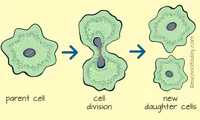
Asexual Reproduction
The process of creating offspring from only one parent, resulting in genetically identical offspring.
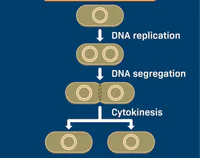
Binary Fission
A form of asexual reproduction where a single parent cell splits into two identical daughter cells.
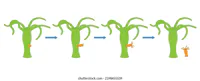
Budding
A process where a new organism grows as a small bud on the parent's body.
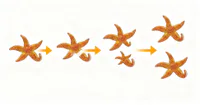
Fragmentation
A method where an organism breaks into pieces, with each piece growing into a new individual.
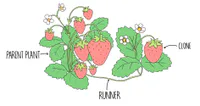
Vegetative Propagation
A type of asexual reproduction in plants where new plants grow from parent plant parts.

Parthenogenesis
The process in which an unfertilized egg develops into a new individual, common among insects.
4
What is Asexual Reproduction?
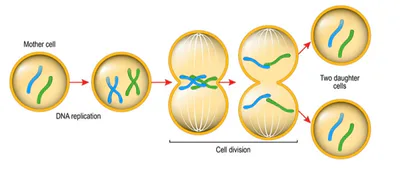
It involves only one parent, and offspring are genetically identical to the parent.
There is no mixing of genes, as reproduction happens through cell division (mitosis).
Offspring have the same diploid (2n) number of chromosomes as the parent.
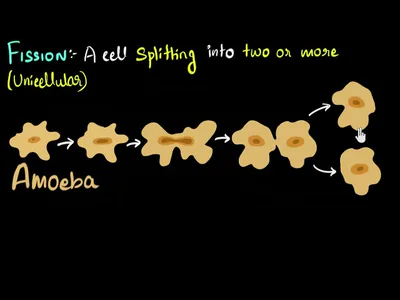
This type of reproduction is common in bacteria, amoeba, fungi, and plants.
5
Multiple Choice
What is the primary reason that offspring from asexual reproduction are genetically identical to the parent?
They grow attached to the parent.
They are created through mitosis without the fusion of genetic information.
They are produced from two parents.
They have a haploid (n) number of chromosomes.
6
Types of Asexual Reproduction
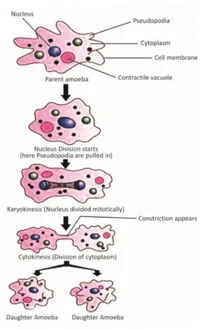
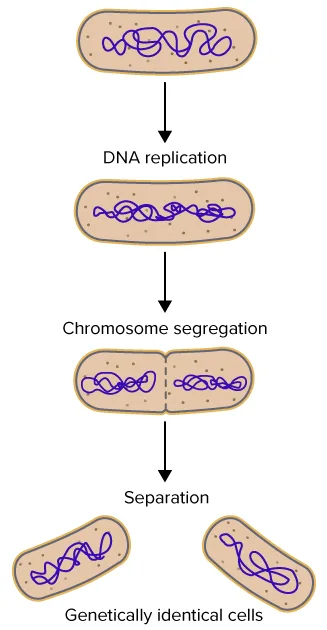
Binary Fission
A single parent cell splits into two identical new cells.
This is common in organisms like amoeba and bacteria.
The new cells are exact copies of the parent cell.
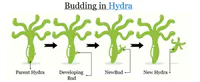
Budding
A new organism grows as a small bud on the parent.
The bud separates from the parent once it is fully grown.
This is seen in organisms such as hydra and yeast.
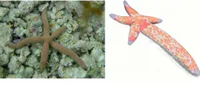
Fragmentation
An organism’s body breaks into multiple pieces or fragments.
Each fragment can then grow into a complete new organism.
Starfish and planaria are examples of organisms that can do this.
7
Multiple Choice
Which type of asexual reproduction involves a new organism growing as an outgrowth on the parent's body?
Fragmentation
Budding
Binary Fission
Regeneration
8
Types of Asexual Reproduction (Part 2)
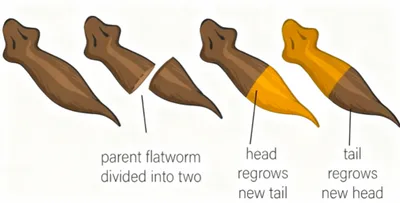
Regeneration
A new organism can grow from a broken piece of the parent's body.
The detached part must be large enough to grow into a whole new organism.
The example of a lizard growing back its lost tail is a type of regrowth.
Vegetative Propagation
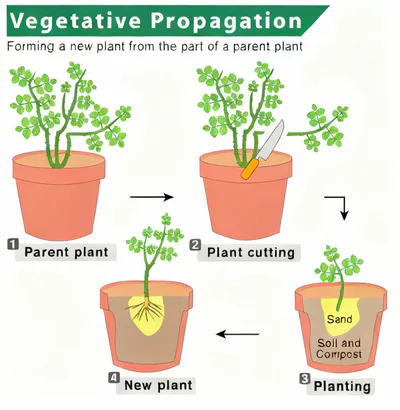
This type of asexual reproduction is found in many types of plants.
New plants grow from parts of the parent plant, such as the stem.
These new plants are genetically identical to the original parent plant.
9
Multiple Choice
A gardener takes a cutting from a rose bush to grow a new, identical bush. What is this an example of?
Regeneration
Parthenogenesis
Sporulation
Vegetative Propagation
10
Advantages and Disadvantages of Asexual Reproduction
Population can grow quickly from a single parent, using less energy.
It is helpful for organisms that cannot move to find mates.
The main disadvantage is the lack of genetic variation in offspring.
This makes populations unable to adapt and vulnerable to diseases.
11
Multiple Choice
What is the most significant disadvantage of asexual reproduction?
It leads to a lack of genetic variation.
It requires a lot of energy.
It requires finding a mate.
It is a very slow process.
12
Common Misconceptions
Misconception | Correction |
|---|---|
Asexual reproduction only happens in single-celled organisms. | Many complex organisms, like starfish and plants, also reproduce asexually. |
It is a 'weaker' or less evolved form of reproduction. | It is an effective and efficient strategy in stable environments. |
Offspring are small copies that stay attached to the parent. | Offspring separate to become independent organisms that grow and mature. |
13
Multiple Choice
How does the genetic makeup of offspring from asexual reproduction differ from those produced by sexual reproduction?
There is no difference in the genetic makeup.
Offspring are genetically identical to two parents.
Offspring have more genetic variation than in sexual reproduction.
Offspring are genetically identical to one parent, unlike the unique offspring from two parents in sexual reproduction.
14
Multiple Choice
Why is the ability to reproduce quickly considered a major advantage of asexual reproduction?
It increases genetic diversity within the population.
It guarantees survival in changing environments.
It allows for rapid population growth to colonize a favorable environment.
It allows populations to decline rapidly.
15
Multiple Choice
A population of asexually reproducing bacteria is exposed to a new virus, and the entire population is eliminated. What does this outcome most likely suggest about the population?
The population had high genetic variation, but the virus was too strong.
The bacteria were able to adapt quickly, but the environment changed too fast.
The bacteria reproduced too slowly to fight the virus.
The population lacked the genetic variation needed for some individuals to survive the virus.
16
Multiple Choice
A farmer wants to grow a crop of potatoes that all have the same desirable traits for taste and texture. Which reproductive strategy should be used and why?
Budding, because it is the fastest method for plants.
Asexual reproduction (vegetative propagation), to create genetically identical clones of the best parent plant.
Fragmentation, to ensure genetic diversity in the crop.
Sexual reproduction, to introduce new traits.
17
Summary
Asexual reproduction involves one parent and produces genetically identical offspring.
It occurs through mitosis, and offspring have a diploid (2n) chromosome number.
Common methods include binary fission, budding, and vegetative propagation.
It allows for rapid population growth but creates a lack of genetic variation.
18
Poll
On a scale of 1-4, how confident are you about the concepts covered in today's review?
1
2
3
4
Asexual Reproduction
Middle School
Show answer
Auto Play
Slide 1 / 18
SLIDE
Similar Resources on Wayground

13 questions
Climate Change
Presentation
•
6th Grade
12 questions
Non renewable Resources
Presentation
•
6th Grade
15 questions
Science Variables Lesson
Presentation
•
6th Grade
16 questions
Electromagnetism
Presentation
•
6th Grade
16 questions
The Theory of Evolution
Presentation
•
8th Grade
10 questions
Force and type of forces
Presentation
•
6th Grade
14 questions
Plate Tectonics: Lesson 1
Presentation
•
6th Grade
13 questions
Formation of a New Substance Notes
Presentation
•
6th Grade
Popular Resources on Wayground
10 questions
Impact of 9/11 and the War on Terror

Interactive video
•
10th - 12th Grade
21 questions
Continents and Oceans

Quiz
•
6th Grade
5 questions
9/11
Interactive video
•
9th Grade
20 questions
Parts of Speech
Quiz
•
5th Grade
16 questions
Subject & Predicate
Quiz
•
5th Grade
10 questions
Riddles Riddles fun Riddles
Quiz
•
6th - 12th Grade
21 questions
Lab Safety
Quiz
•
10th Grade
6 questions
PRIDE in the Hallways and Bathrooms
Presentation
•
12th Grade
Discover more resources for Science
20 questions
Lab Safety
Quiz
•
5th - 8th Grade
10 questions
6.6D - Relative Density Review
Quiz
•
6th Grade
20 questions
Elements, compounds, and mixtures
Quiz
•
6th Grade
20 questions
Claim, Evidence and Reasoning (CER)
Quiz
•
6th - 8th Grade
10 questions
Exploring Chemical and Physical Changes
Interactive video
•
6th - 10th Grade
22 questions
Metals, nonmetals, metalloids
Quiz
•
6th Grade
11 questions
Science 6-8 Vocab #1
Quiz
•
6th - 8th Grade
10 questions
Scientific Method
Quiz
•
6th Grade