

Data Model

Presentation
•
Computers
•
2nd Grade
•
Practice Problem
•
Hard

FAKHRUL ZAKI
FREE Resource
56 Slides • 25 Questions
1

2

3
Multiple Choice
Which of the following is NOT a typical objective when learning about data models in database systems?
To understand how major data models evolved
To describe the basic data-modeling building blocks
To memorize the names of all database vendors
To explain how data models can be classified by their level of abstraction
4
Open Ended
Why do you think data models are important in the context of database systems?
5

6
Multiple Choice
Which of the following is an example of semi-structured data?
Excel spreadsheets
Comma-separated value file (.csv)
Hypertext Markup Language (HTML) files
Images such as .jpeg or .png files
7

8
Multiple Select
Which characteristics are true for unstructured data?
Easily machine-readable and analyzed without major pre-processing
Tags or markers separate elements and enforce hierarchies
Can take any form and is often easily consumable for humans
Most of the data created today is unstructured
9
Open Ended
Explain the main differences between structured, semi-structured, and unstructured data in terms of organization and example formats.
10

11
Fill in the Blanks
12

13
Open Ended
Why is data modeling important in database design?
14

15
Multiple Choice
Which of the following best describes the conceptual data model?
Describes how data is stored on physical storage
Provides concepts close to the way users perceive data
Hides details of data storage disk
For computer specialists
16

17

18
Multiple Choice
Which of the following best describes a 'relationship' in the context of data model basic building blocks?
A characteristic of an entity
A restriction placed on data
An association among entities
A person, place, thing, or event about which data is collected
19

20
Open Ended
Explain how business rules help in establishing entities, relationships, and constraints within an organization.
21

22
Multiple Choice
Which of the following are sources of business rules?
Company managers
Policy makers
Department managers
All of the above
23

24
Open Ended
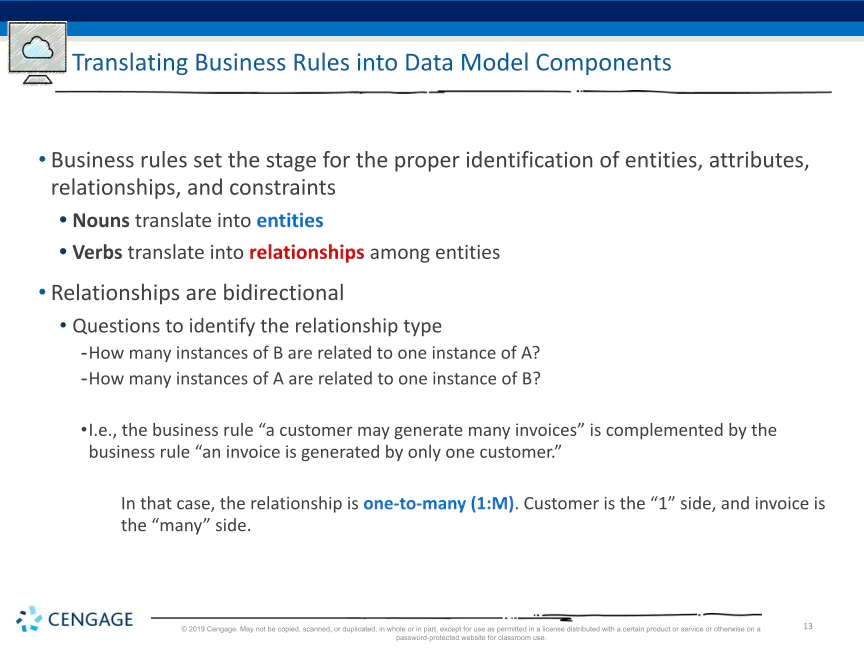
Identify two reasons for documenting business rules.
25
26
Fill in the Blanks
27

28
Multiple Select
Which of the following are requirements for proper entity naming conventions?
Be descriptive of the objects in the business environment
Use terminology familiar to users
Be required to be descriptive of the data represented by the attribute
Facilitate communication between parties
29

30

31

32
Multiple Choice
Which concepts introduced by the network model are still used by modern data models?
Schema and subschema
Tuples and attributes
Primary and foreign keys
Normalization
33

34
Fill in the Blanks
35

36
Open Ended
What are the advantages of using a relational database management system (RDBMS) over hierarchical and network DBMS systems?
37

38
Multiple Choice
In the relational model, which field is used to connect the AGENT and CUSTOMER tables, and what type of relationship does it represent?
AGENT_NAME, 1:1
AGENT_CODE, 1:M
CUS_PHONE, M:N
AGENT_ADDRESS, 1:1
39

40
Open Ended
Explain how SQL contributes to the flexibility and power of the relational data model.
41
Multiple Choice
Which of the following is NOT a component of a SQL-based relational database application?
End-user interface
Collection of tables stored in the database
SQL engine
Entity relationship diagram
42

43
Multiple Choice
Which of the following terms is used to label the relationship types in an Entity Relationship Model?
Entity
Attribute
Connectivity
Instance
44

45
Multiple Select
Match the following ER model notations with their relationship types: One-to-Many, Many-to-Many, One-to-One.
Chen Notation - One-to-Many, Crow's Foot Notation - Many-to-Many, UML Class Diagram - One-to-One
Chen Notation - Many-to-Many, Crow's Foot Notation - One-to-One, UML Class Diagram - One-to-Many
Chen Notation - One-to-One, Crow's Foot Notation - One-to-Many, UML Class Diagram - Many-to-Many
Chen Notation - One-to-Many, Crow's Foot Notation - One-to-Many, UML Class Diagram - One-to-One
46

47
Fill in the Blanks
Type answer...
48

49

50

51

52

53
54

55

56
57

58

59

60

61

62

63

64

65

66

67

68

69

70

71

72

73

74

75

76

77

78

79
80
Multiple Choice
Which of the following is NOT a learning objective for this chapter?
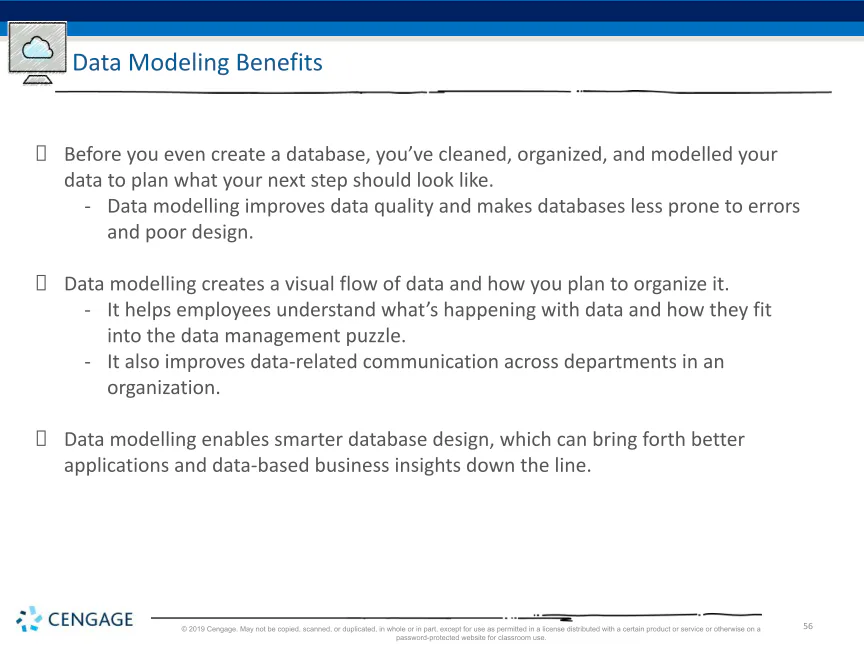
Discuss data modeling and why data models are important
Describe the basic data-modeling building blocks
Explain the process of database normalization
List emerging alternative data models and the needs they fulfill
81
Open Ended
Reflecting on today's lesson about data models, what is one concept you found most interesting or would like to learn more about?
Show answer
Auto Play
Slide 1 / 81
SLIDE
Similar Resources on Wayground

78 questions
bài 7,8,9
Presentation
•
1st Grade
72 questions
3rd grade fsa math practice test
Presentation
•
3rd Grade
82 questions
Telling Time
Presentation
•
KG - 3rd Grade
74 questions
Identifying DNA as the genetic material
Presentation
•
KG
78 questions
Oxford discovery 1 REVIEW
Presentation
•
2nd - 3rd Grade
72 questions
8.2 EFFECT OF FORCE (LEVER AND MOMENT OF FORCE)
Presentation
•
2nd Grade
76 questions
Ketumpatan
Presentation
•
3rd Grade
75 questions
OD4 Unit 3
Presentation
•
3rd Grade
Popular Resources on Wayground
6 questions
Secondary Safety Quiz
Presentation
•
9th - 12th Grade
10 questions
MyPath Diagnostic Overview
Presentation
•
6th - 8th Grade
20 questions
Lab Safety Quiz

Quiz
•
6th Grade
21 questions
Continents and Oceans
Quiz
•
6th Grade
20 questions
Adding and Subtracting Decimals
Quiz
•
5th Grade
20 questions
Parts of Speech
Quiz
•
5th Grade
16 questions
Subject & Predicate
Quiz
•
5th Grade
21 questions
Lab Safety
Quiz
•
10th Grade
Discover more resources for Computers
20 questions
addition facts
Quiz
•
2nd Grade
8 questions
Week 1.2 Step-up to 3rd Grade TEK 2.2A
Quiz
•
2nd Grade
20 questions
Addition Facts within 20
Quiz
•
1st - 3rd Grade
17 questions
Greetings and Farewells in Spanish
Quiz
•
1st - 6th Grade
30 questions
Multiplication Facts 1-12
Quiz
•
2nd - 5th Grade
17 questions
2nd Grade Graphs (Bar & Picture)
Quiz
•
2nd Grade
20 questions
Addition and Subtraction facts
Quiz
•
1st - 3rd Grade
22 questions
Addition and Subtraction Facts
Quiz
•
1st - 2nd Grade