

Lesson 3 & 4: Big Business & The Rise of the Labor Movement

Presentation
•
Social Studies
•
9th - 12th Grade
•
Practice Problem
•
Medium

Giuseppina Spillane
Used 1+ times
FREE Resource
20 Slides • 22 Questions
1
2
Open Ended
How did late-19th-century industrial growth shape the strategies of modern companies?
3
4
Multiple Choice
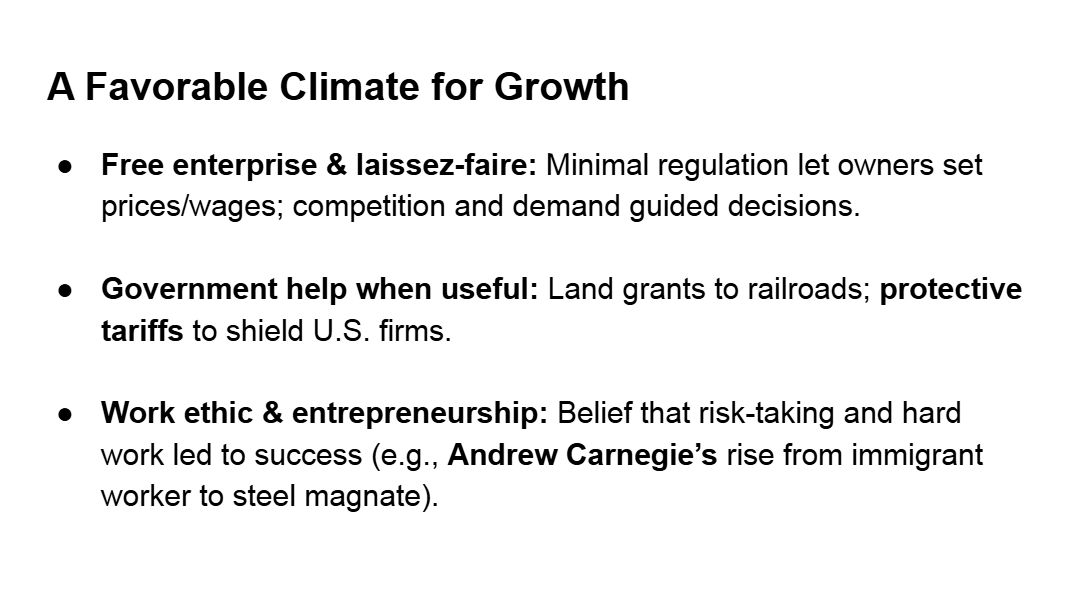
Which of the following best describes the concept of laissez-faire as it relates to business growth in the late 19th century?
Government sets strict regulations on prices and wages.
Owners are free to set prices and wages with minimal regulation.
Workers collectively decide on prices and wages.
Foreign companies control domestic markets.
5
6
Multiple Choice
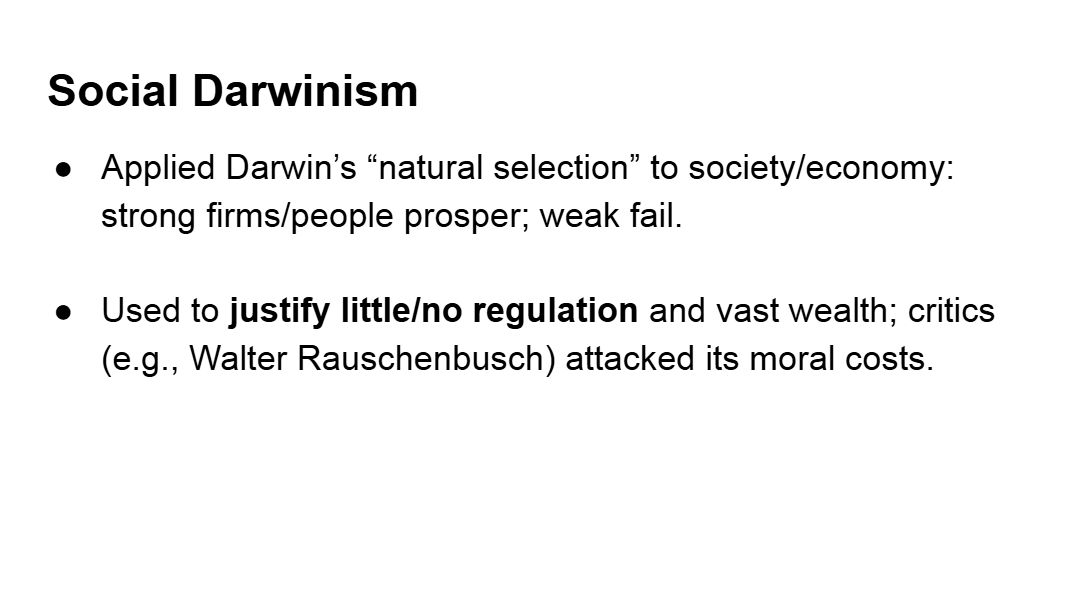
Which concept was used to justify little or no regulation in the economy, leading to vast wealth for some and criticism for its moral costs?
Social Darwinism
Philanthropy
Monopoly
Horizontal integration
7
8
Multiple Select
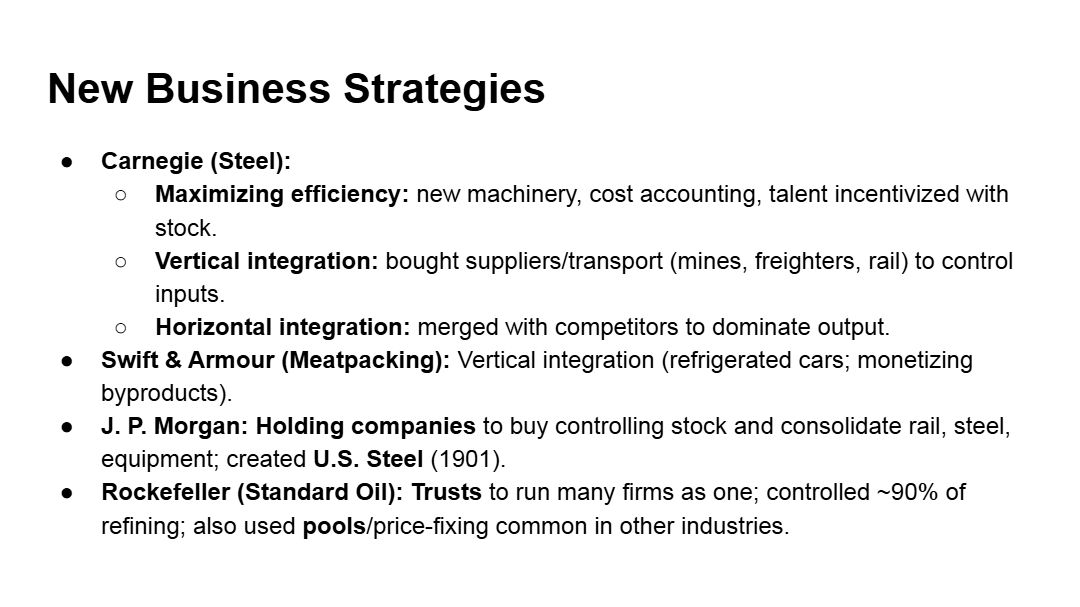
Which of the following strategies were used by Carnegie in the steel industry?
Maximizing efficiency
Vertical integration
Horizontal integration
Trusts
9
10
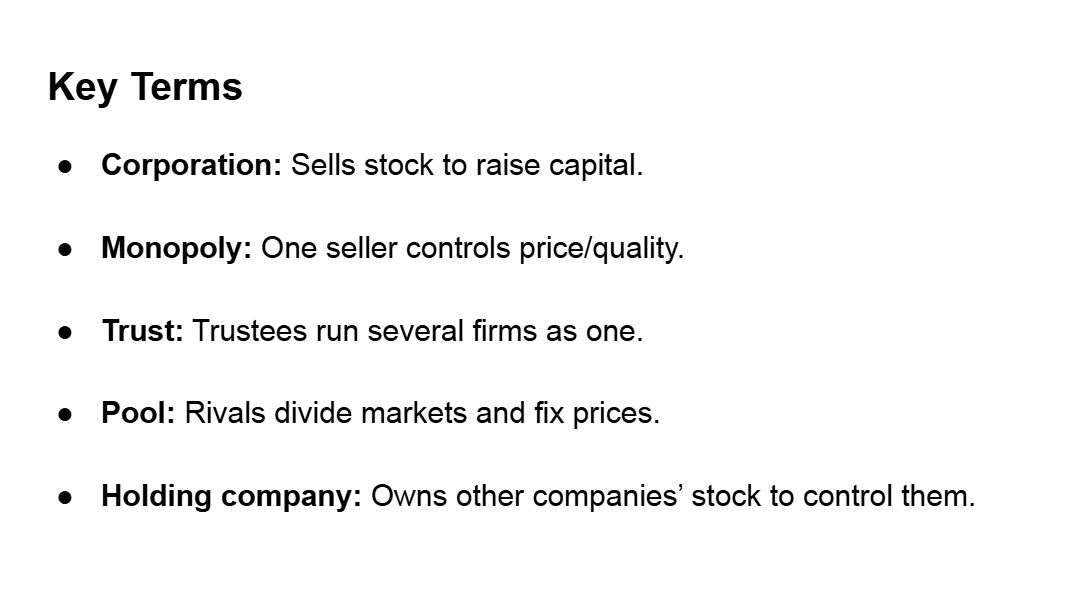
Fill in the Blanks
A
Type answer...
11
12
Open Ended
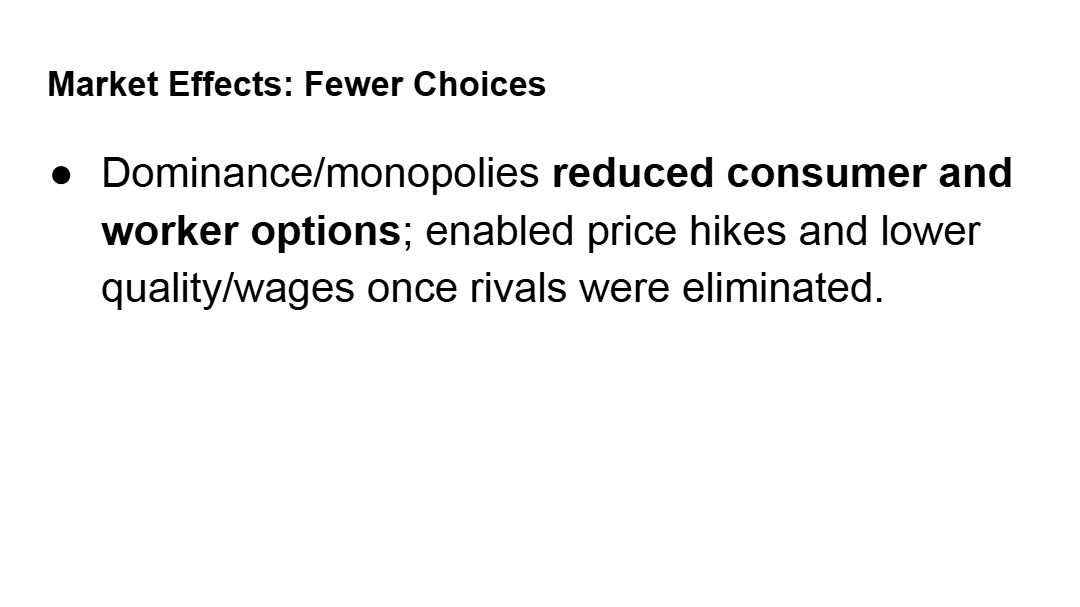
How did the dominance of monopolies affect consumers and workers in the market?
13
14
Multiple Choice
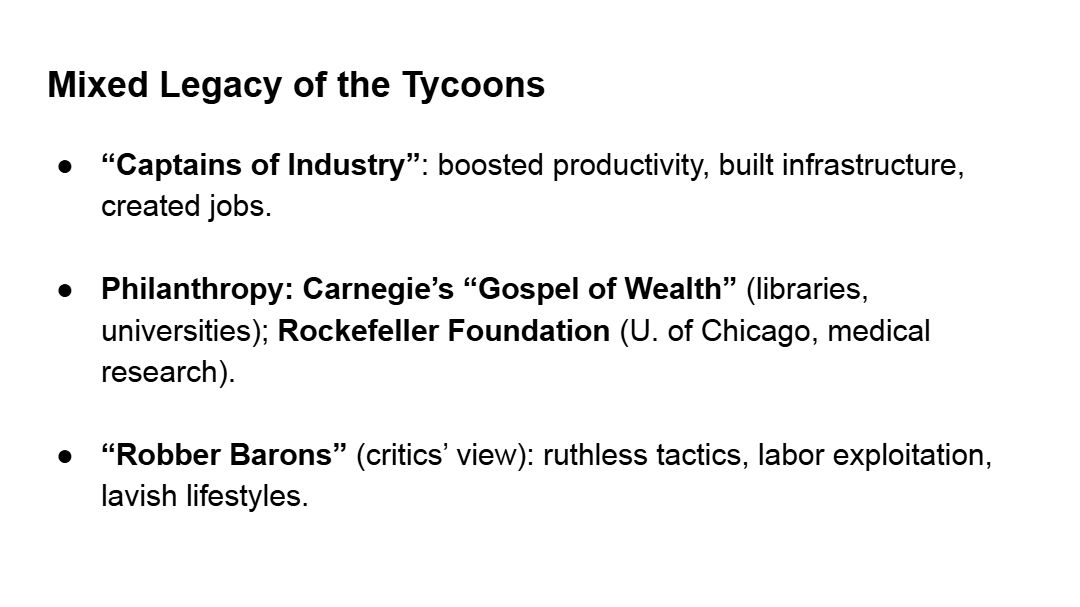
Which of the following best describes the mixed legacy of the tycoons during the industrial era?
They were seen as both 'Captains of Industry' and 'Robber Barons'.
They only focused on philanthropy.
They were universally admired for their business tactics.
They avoided labor exploitation.
15
16
Multiple Choice
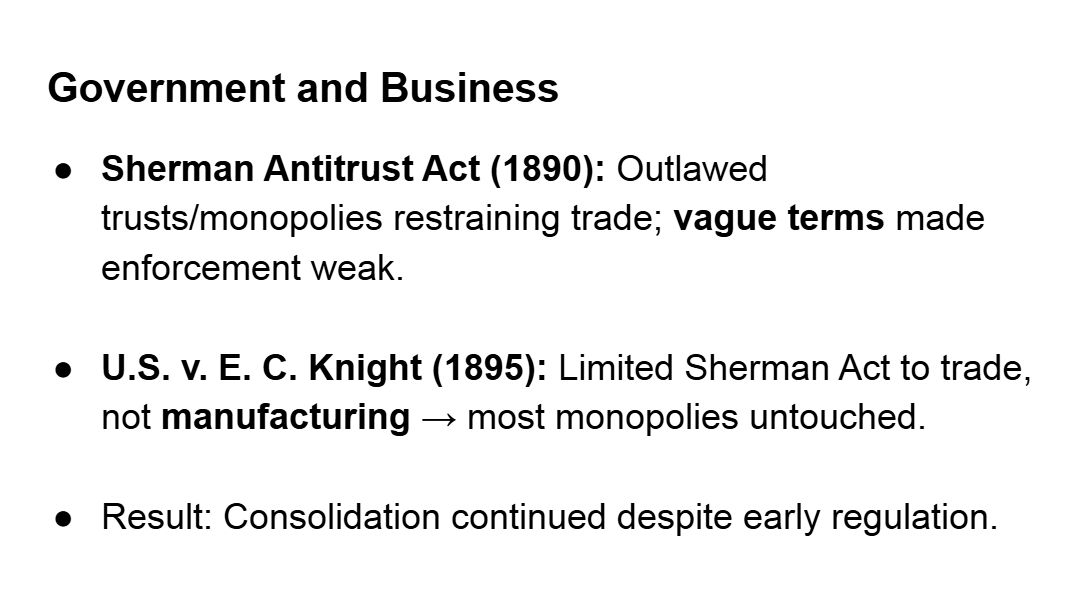
What was one major limitation of the Sherman Antitrust Act (1890) in regulating monopolies?
It used vague terms that made enforcement weak.
It banned all forms of business consolidation.
It only applied to manufacturing.
It was never enforced at all.
17
18
Multiple Choice
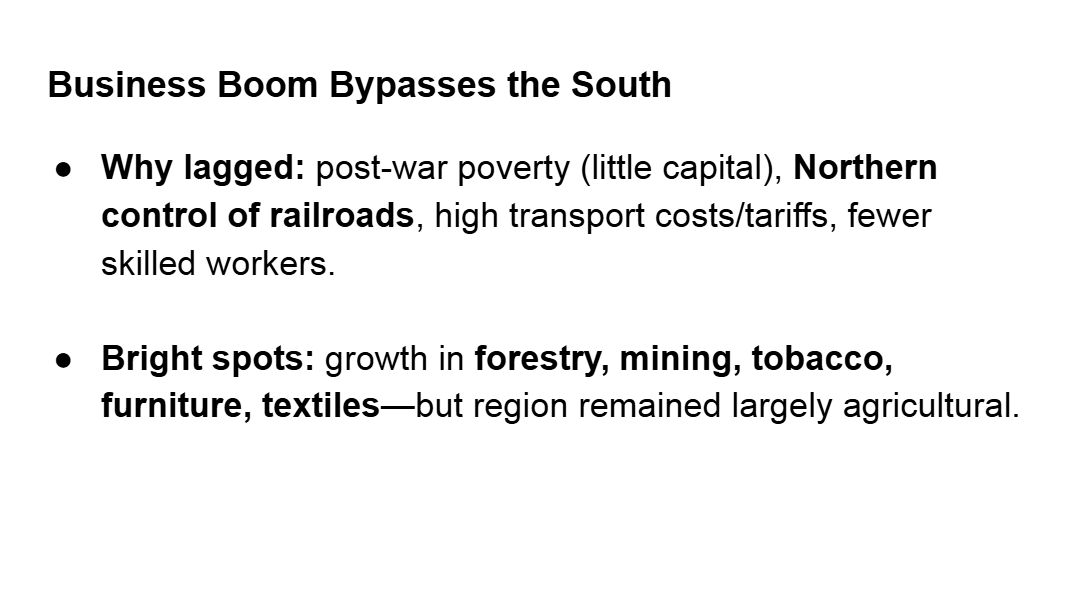
Which of the following was NOT a reason why the business boom bypassed the South after the Civil War?
Post-war poverty and little capital
Northern control of railroads
Abundance of skilled workers
High transport costs/tariffs
19
20
Open Ended
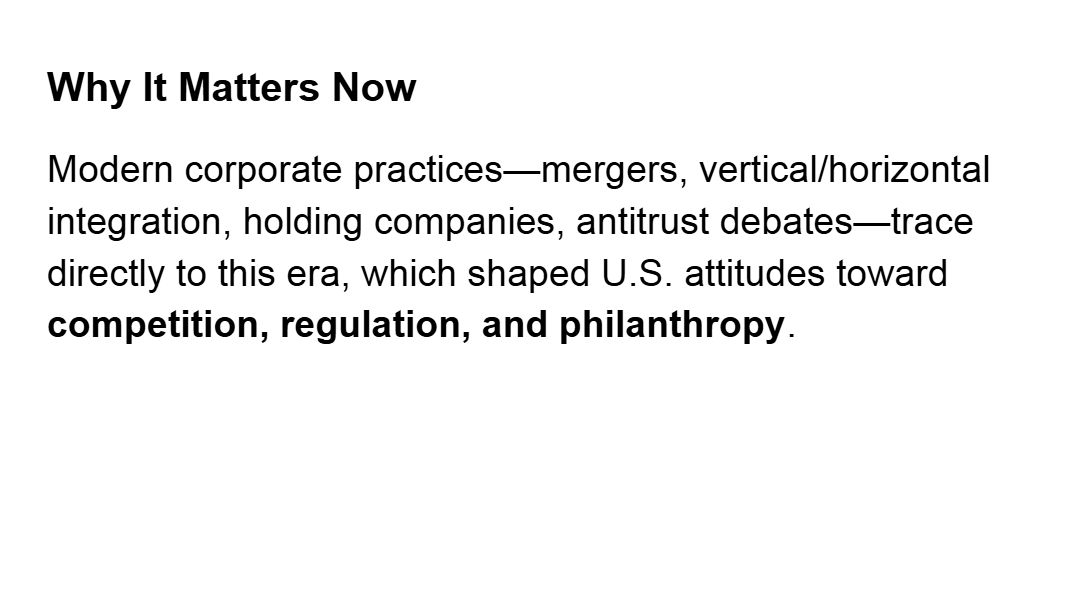
How did modern corporate practices such as mergers and antitrust debates from the late 19th century shape U.S. attitudes toward competition and regulation today?
21
22
Fill in the Blanks
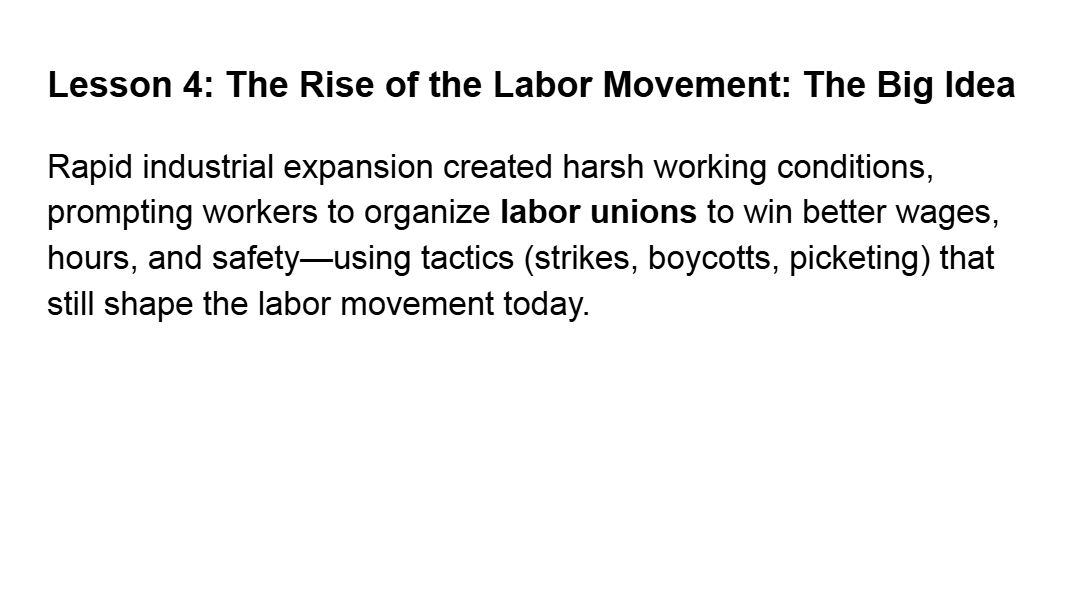
Rapid industrial expansion led workers to organize
Type answer...
23
24
Open Ended
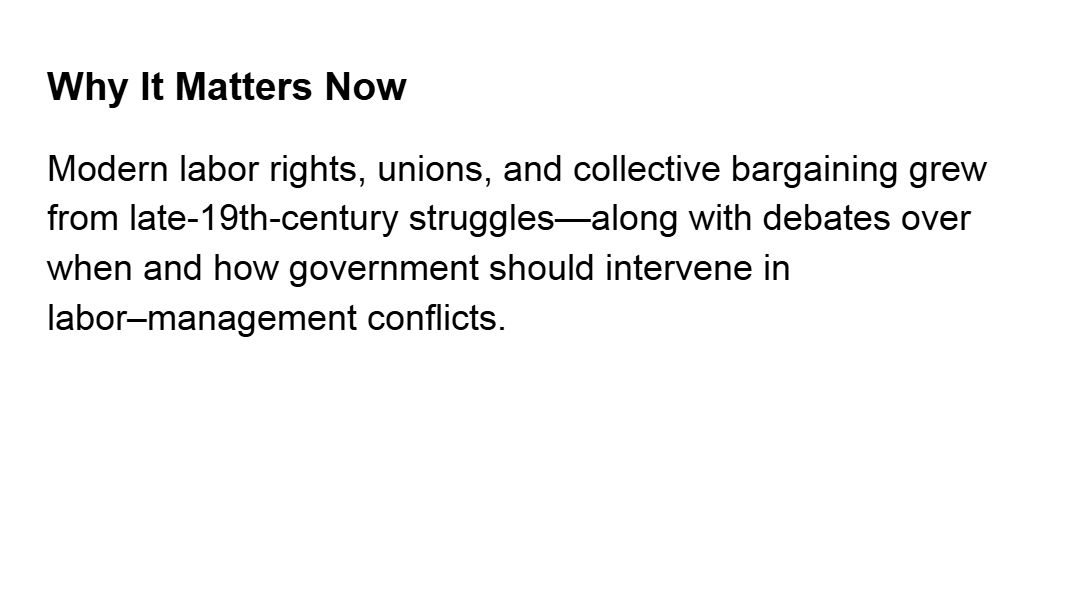
In what ways did late-19th-century labor struggles influence modern labor rights and government intervention in labor-management conflicts?
25
26
Multiple Choice
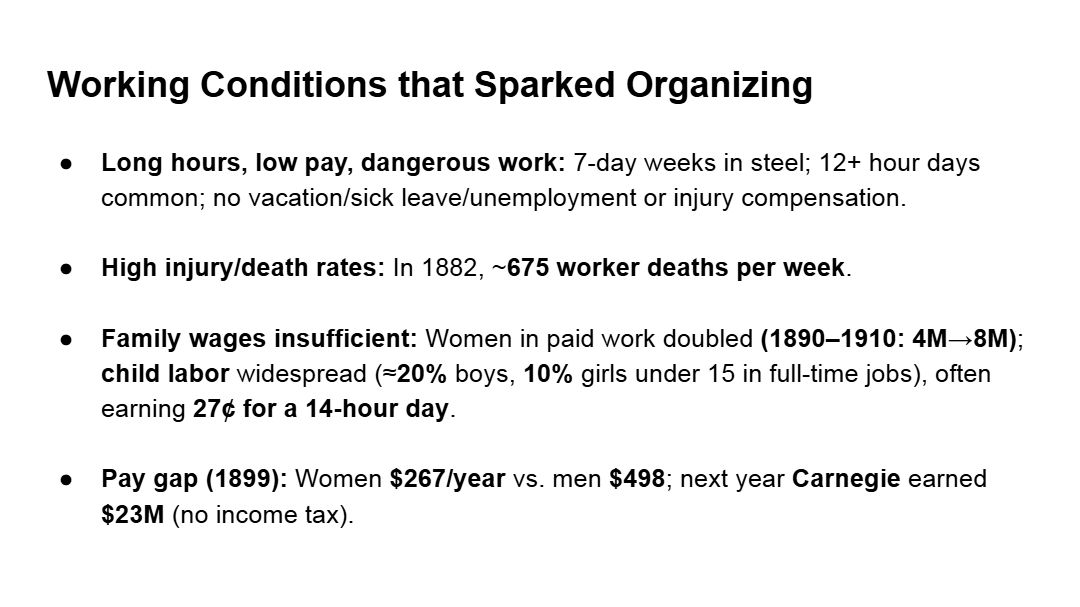
Which of the following working conditions contributed to the rise of labor organizing in the late 19th century?
Short workdays and high pay
High injury/death rates and child labor
Generous vacation and sick leave
Equal pay for men and women
27
28
Multiple Select
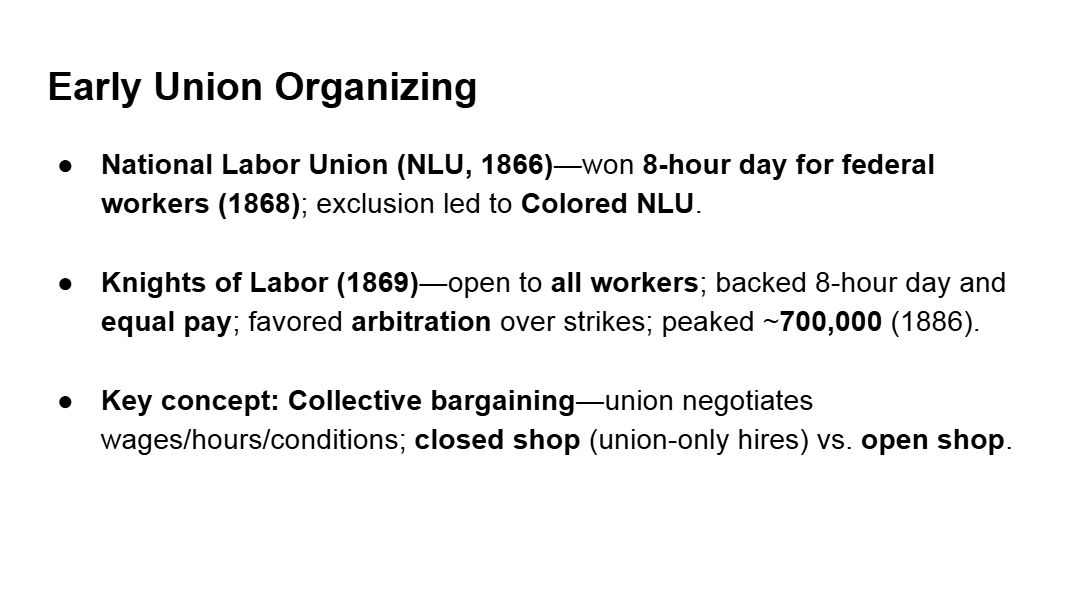
Which of the following were goals or tactics of early labor unions such as the National Labor Union and Knights of Labor?
Winning the 8-hour workday
Supporting child labor
Equal pay for all workers
Favoring arbitration over strikes
29
30
Multiple Choice
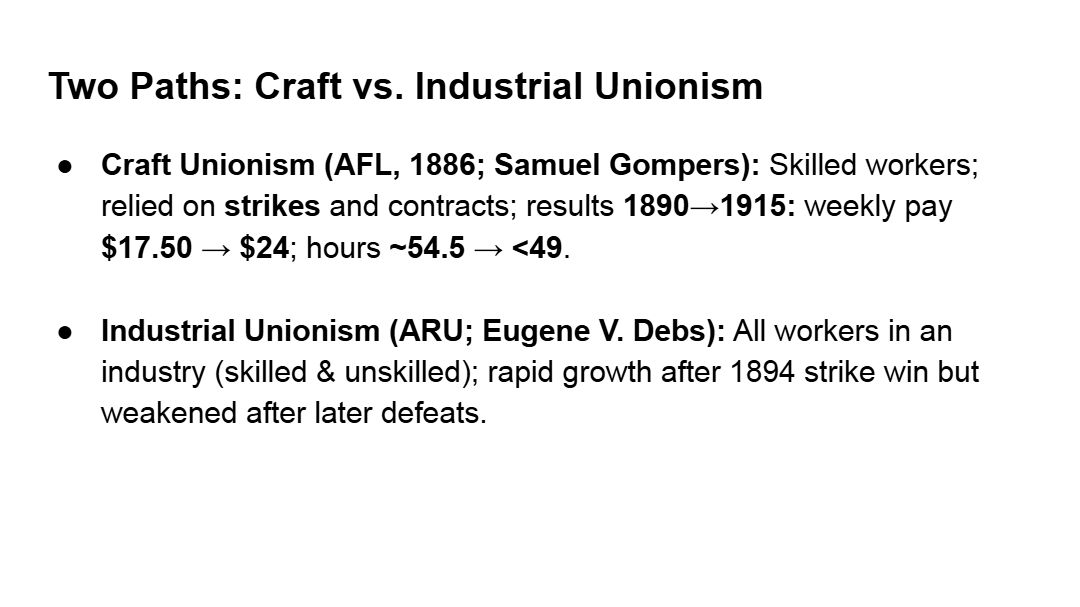
Which of the following best describes the main difference between craft unionism and industrial unionism?
Craft unionism focused on skilled workers, while industrial unionism included all workers in an industry.
Craft unionism included both skilled and unskilled workers, while industrial unionism only included skilled workers.
Craft unionism was led by Eugene V. Debs, while industrial unionism was led by Samuel Gompers.
Industrial unionism relied on contracts, while craft unionism relied on strikes.
31
32
Multiple Select
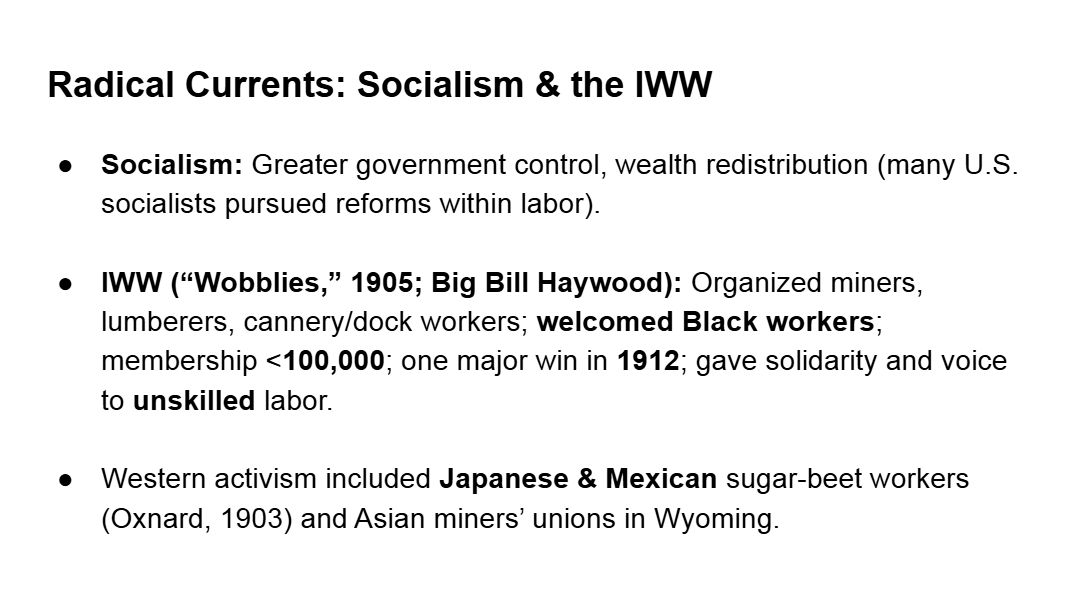
Which of the following were characteristics of the IWW ('Wobblies') as described in the slides?
Organized unskilled laborers
Welcomed Black workers
Had a major win in 1912
Membership exceeded 1 million
33
34
35
Multiple Choice
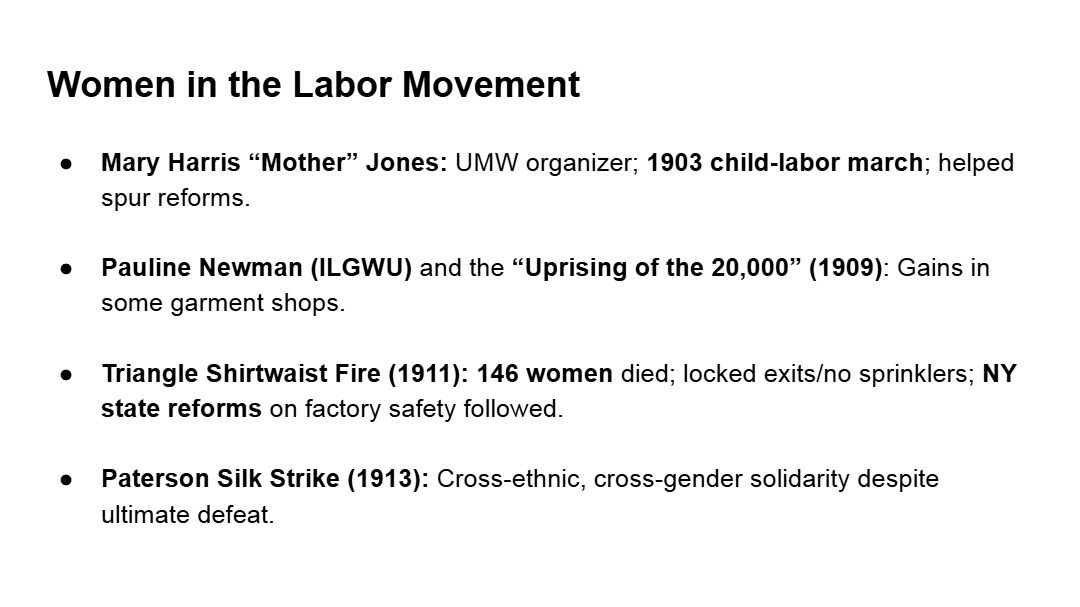
Which of the following reforms was a direct result of the Triangle Shirtwaist Fire of 1911?
Federal minimum wage laws
NY state reforms on factory safety
The end of convict leasing in Tennessee
The formation of the AFL
36
Open Ended
Explain how women contributed to the labor movement in the early 20th century, citing at least two examples from the slides.
37
38
Multiple Choice
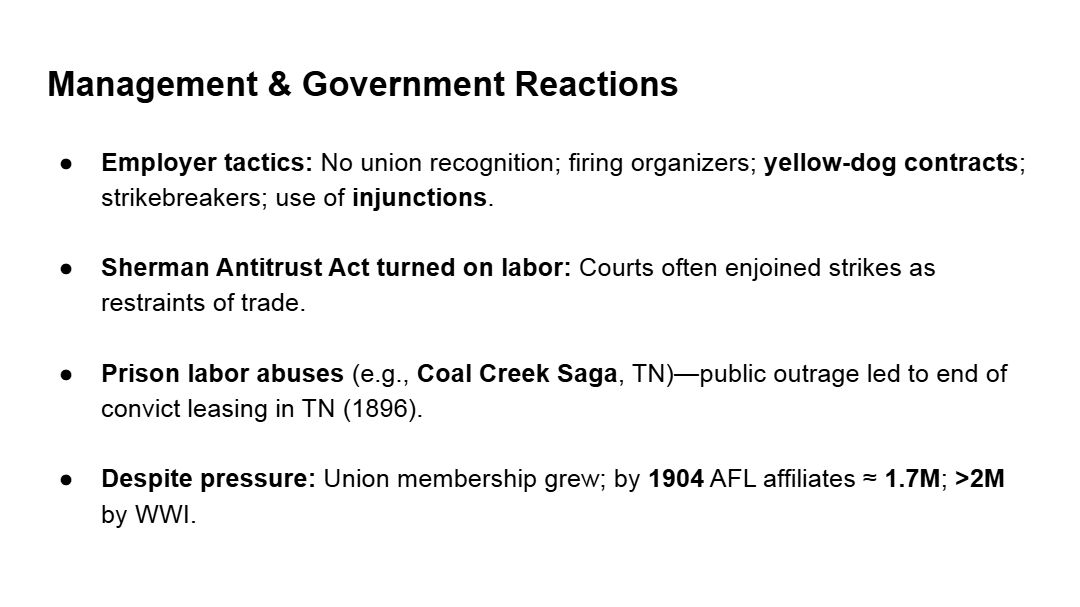
What was a common government or management response to major strikes in the late 19th century?
Offering higher wages to workers
Using federal troops or injunctions to end strikes
Granting immediate union recognition
Passing laws to support labor unions
39
40
Fill in the Blanks
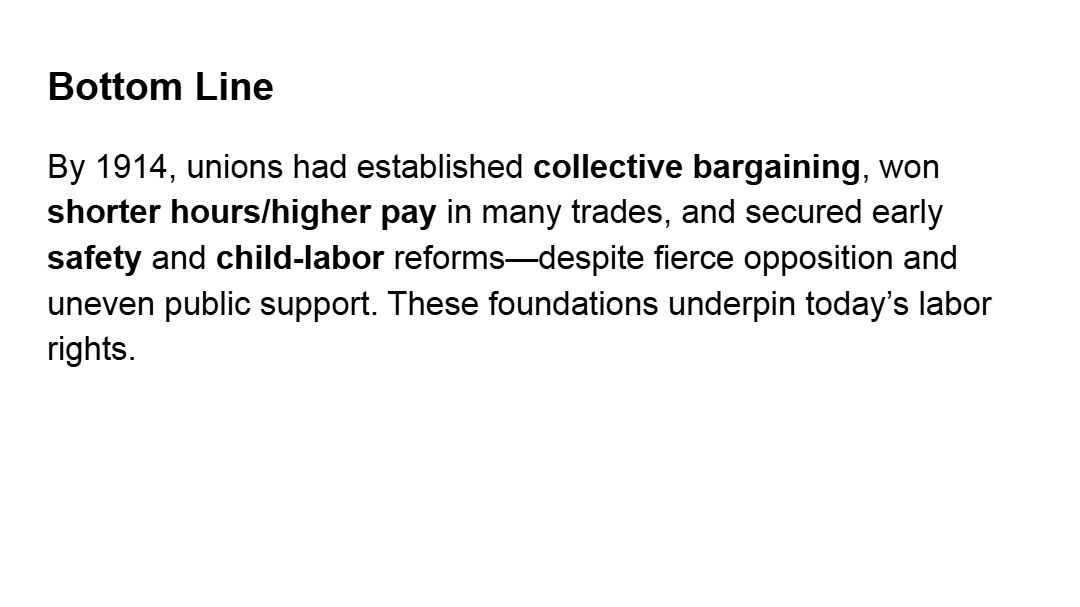
By 1914, unions had established
Type answer...
41
Open Ended
Reflecting on today's lesson about big business and industrial growth, what is one question you still have or something you would like to learn more about regarding the rise of big business in the late 19th century?
42
Multiple Choice
Which of the following factors contributed to a favorable climate for industrial growth in the late 19th century United States?
Strict government regulation of businesses
Free enterprise and laissez-faire policies
Lack of government support for railroads
Discouragement of entrepreneurship
Show answer
Auto Play
Slide 1 / 42
SLIDE
Similar Resources on Wayground

38 questions
Thermodynamics
Presentation
•
9th - 12th Grade
37 questions
Civics Follow Along Unit
Presentation
•
9th - 12th Grade
39 questions
French Revolution Begins
Presentation
•
9th - 12th Grade
42 questions
Credit Score
Presentation
•
9th - 12th Grade
37 questions
Ancient Egypt
Presentation
•
9th - 12th Grade
39 questions
Commas
Presentation
•
9th - 12th Grade
37 questions
Intro to Chemical Bonding
Presentation
•
9th - 12th Grade
36 questions
Les verbes pronominaux
Presentation
•
9th - 12th Grade
Popular Resources on Wayground
10 questions
Safety Day 2026 – Student Review

Quiz
•
9th Grade
21 questions
Continents and Oceans
Quiz
•
6th Grade
20 questions
Parts of Speech
Quiz
•
5th Grade
16 questions
Subject & Predicate
Quiz
•
5th Grade
25 questions
Multiplication Facts
Quiz
•
5th Grade
12 questions
Map Skills
Quiz
•
3rd Grade
22 questions
Continents and Oceans
Quiz
•
5th Grade
15 questions
Rounding Decimals
Quiz
•
5th Grade
Discover more resources for Social Studies
10 questions
Exploring the Age of Exploration: Key Events and Figures

Interactive video
•
6th - 10th Grade
9 questions
Exploring Ancient Mesopotamia and Its Civilizations
Interactive video
•
10th Grade
20 questions
Chapter 8 Test "Types of Business Organizations"
Quiz
•
12th Grade
39 questions
Unit 7 Key Terms
Quiz
•
11th Grade - University
10 questions
Debating the Legacy of Christopher Columbus
Interactive video
•
6th - 10th Grade
38 questions
Unit 6 Key Terms
Quiz
•
11th Grade - University
27 questions
World Geography - Q1 9week Test
Quiz
•
9th Grade
22 questions
U3T2 Vocab FAC: Domestic Policy
Quiz
•
10th Grade