

Untitled Presentation

Presentation
•
Chemistry
•
9th - 10th Grade
•
Practice Problem
•
Hard

Lucy Pasifull
FREE Resource
35 Slides • 25 Questions
1
2
Multiple Choice
Which group of the periodic table do halogens belong to?
Group 1
Group 7
Group 2
Group 0
3
Open Ended
Why are the reactions of halogens, including displacement reactions, significant in the study of chemistry?
4

5
6
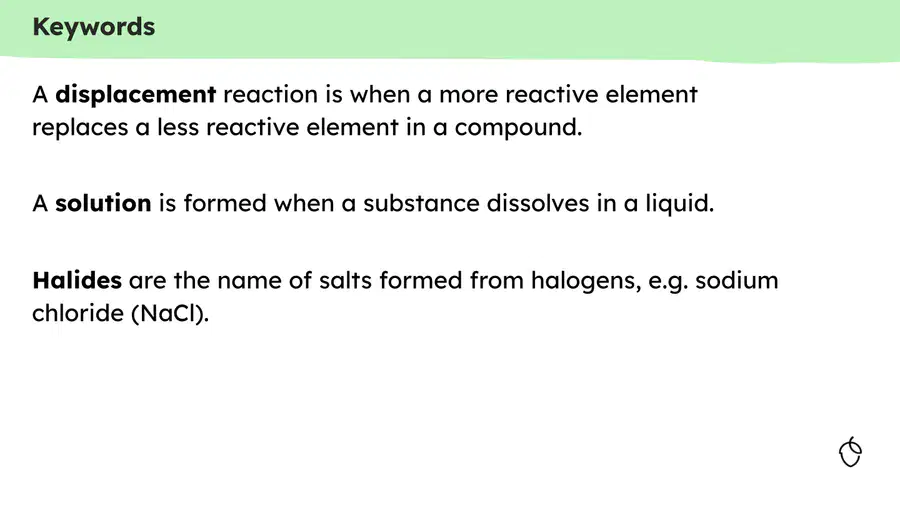
7
Fill in the Blanks
Type answer...
8
Open Ended
Explain the difference between a solution and a halide, using examples from Group 7 elements.
9
Multiple Choice
Which of the following best describes a displacement reaction?
A reaction where a less reactive element replaces a more reactive element in a compound.
A reaction where a more reactive element replaces a less reactive element in a compound.
A reaction where two elements combine to form a compound.
A reaction where an element dissolves in a liquid.
10
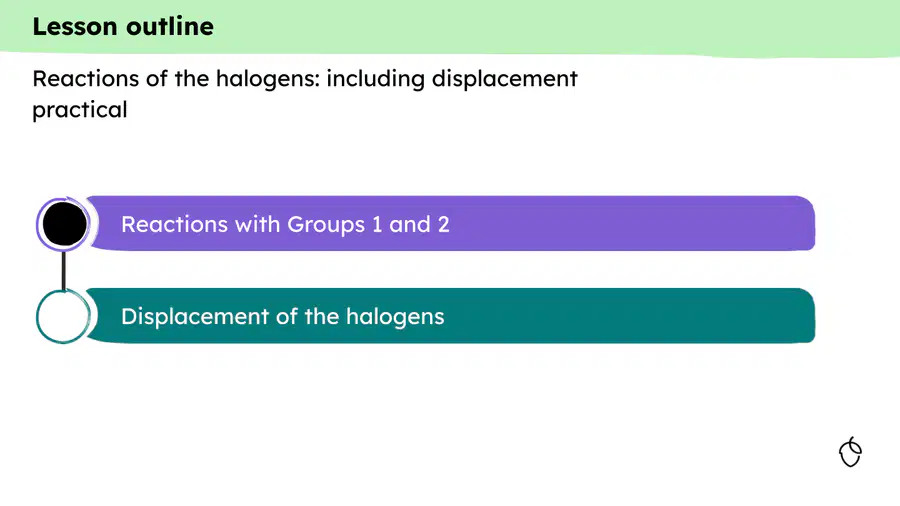
11
12
Multiple Choice
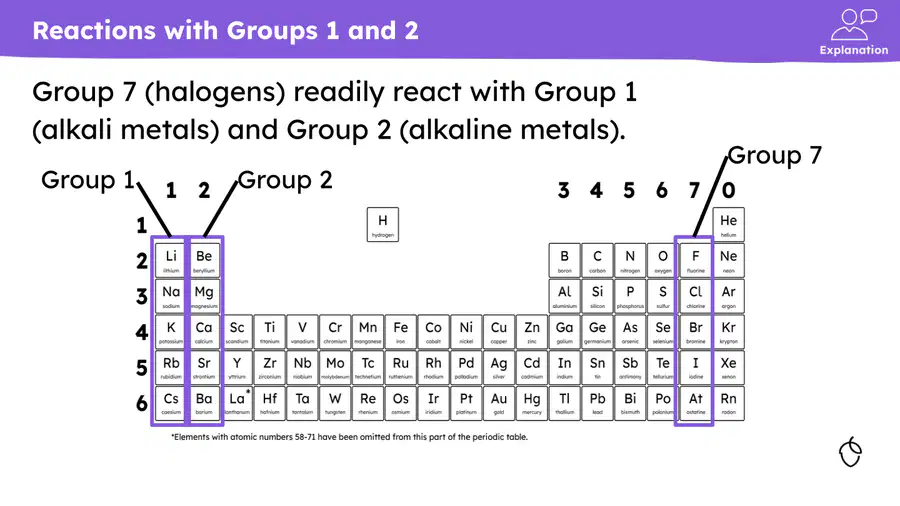
Which elements belong to Group 1, Group 2, and Group 7 according to the periodic table shown?
Group 1: Lithium, Sodium, Potassium; Group 2: Beryllium, Magnesium, Calcium; Group 7: Fluorine, Chlorine, Bromine, Iodine, Astatine
Group 1: Magnesium, Calcium, Potassium; Group 2: Lithium, Sodium, Beryllium; Group 7: Chlorine, Bromine, Iodine
Group 1: Sodium, Potassium, Calcium; Group 2: Magnesium, Beryllium, Lithium; Group 7: Fluorine, Chlorine, Bromine
Group 1: Lithium, Magnesium, Bromine; Group 2: Sodium, Calcium, Iodine; Group 7: Chlorine, Potassium, Astatine
13
14
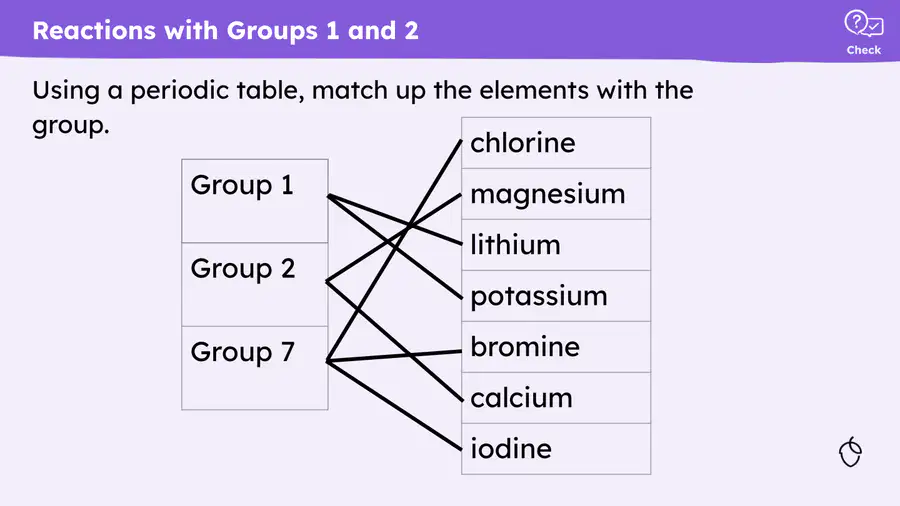
Multiple Select
Select all elements that are halogens from the following list: chlorine, magnesium, lithium, potassium, bromine, calcium, iodine.
chlorine
bromine
iodine
magnesium
15
16
Multiple Choice
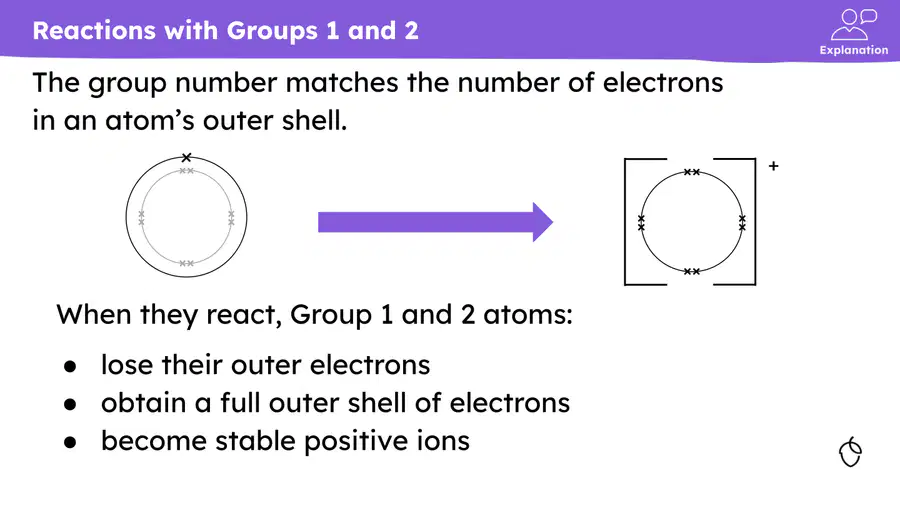
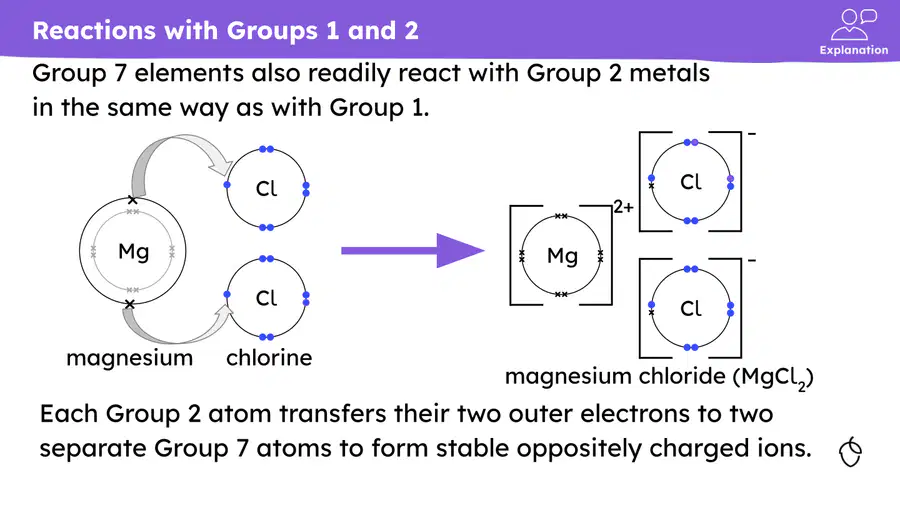
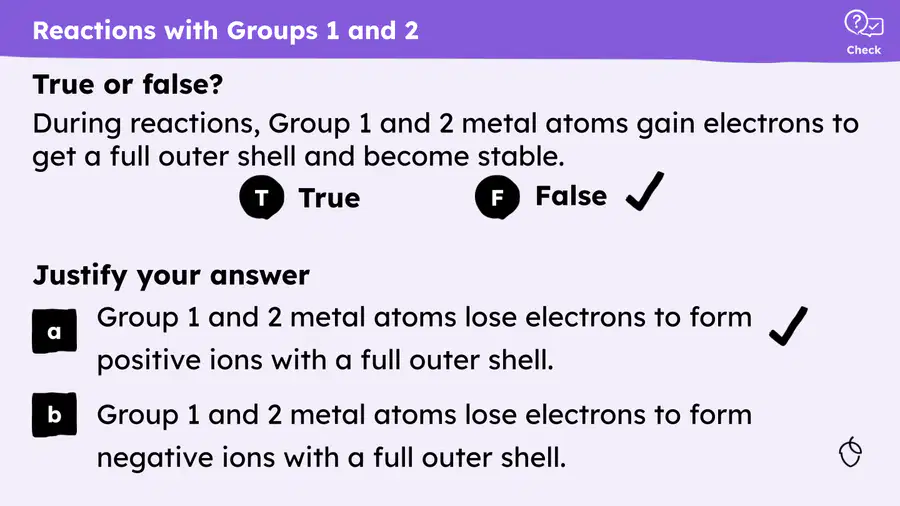
What happens to Group 1 and 2 atoms when they react?
They gain outer electrons and become negative ions
They lose their outer electrons and become stable positive ions
They share electrons and form covalent bonds
They remain unchanged
17
18
19
Multiple Choice
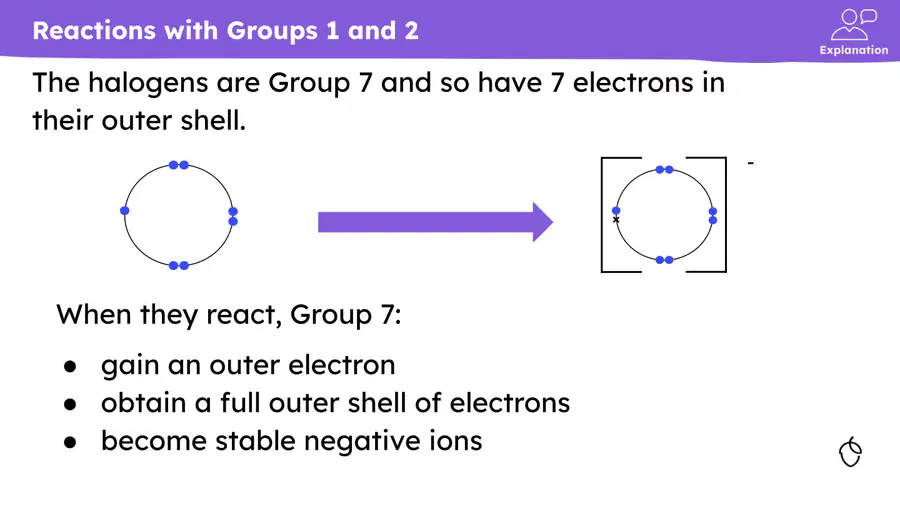
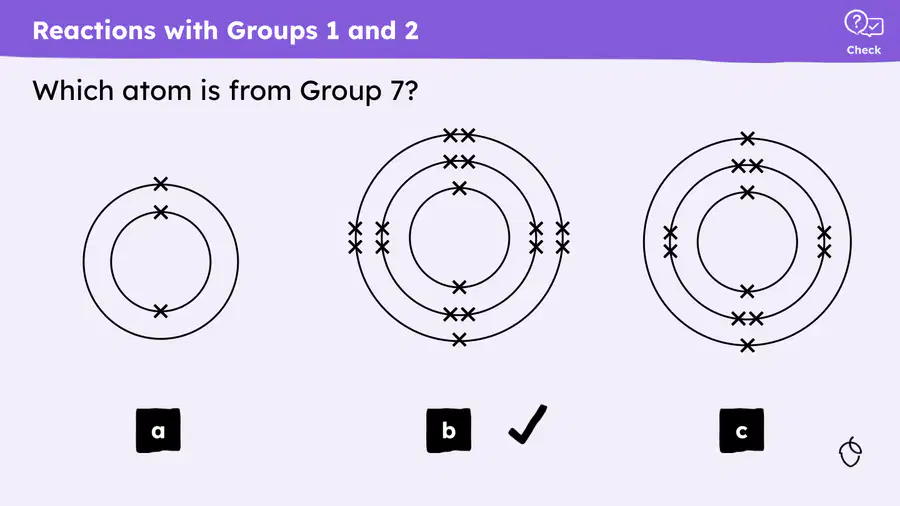
Which atom is from Group 7?
a
b
c
20
21
Multiple Select
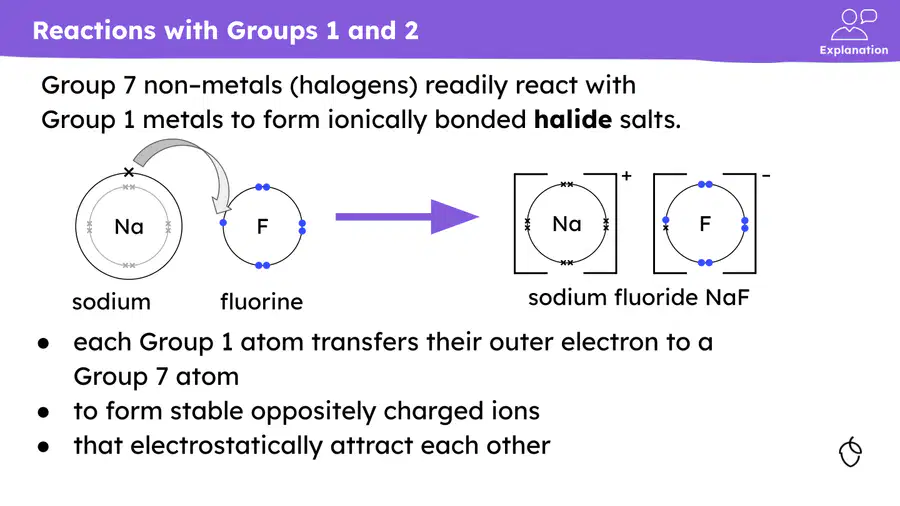
Select all statements that correctly describe the formation of sodium fluoride (NaF) from sodium and fluorine.
Sodium transfers its outer electron to fluorine
Both sodium and fluorine gain electrons
Stable oppositely charged ions are formed
Electrostatic attraction holds the ions together
22
23
Fill in the Blanks
Type answer...
24
25
Open Ended
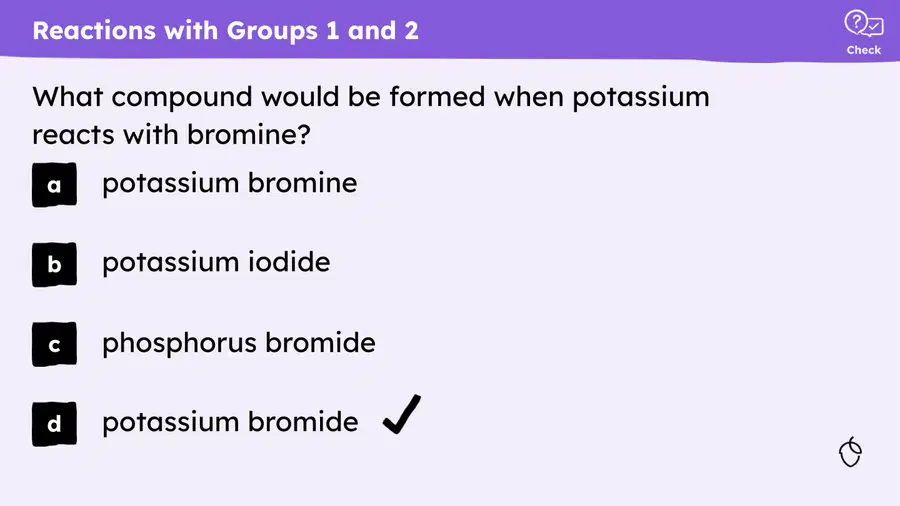
Explain why potassium reacts with bromine to form potassium bromide and not potassium iodide.
26
27
28
Open Ended
Describe the difference between how Group 1 and Group 2 metals react with Group 7 elements to form halide salts.
29
Multiple Select
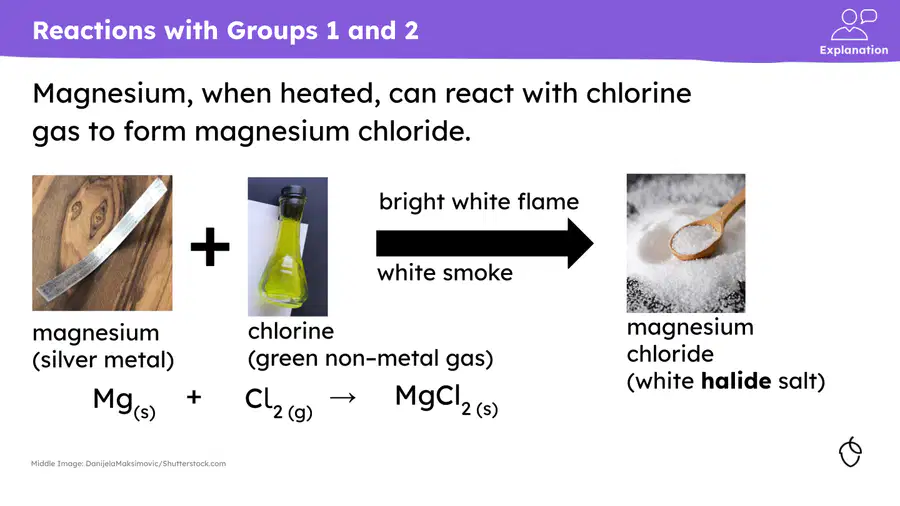
Which of the following are correct observations when magnesium reacts with chlorine gas?
A bright white flame is produced
White smoke is observed
A green solution is formed
A pungent smell is released
30
Open Ended
Explain how magnesium and chlorine react to form magnesium chloride, referring to the transfer of electrons.
31
32
Fill in the Blanks
Type answer...
33
Multiple Choice
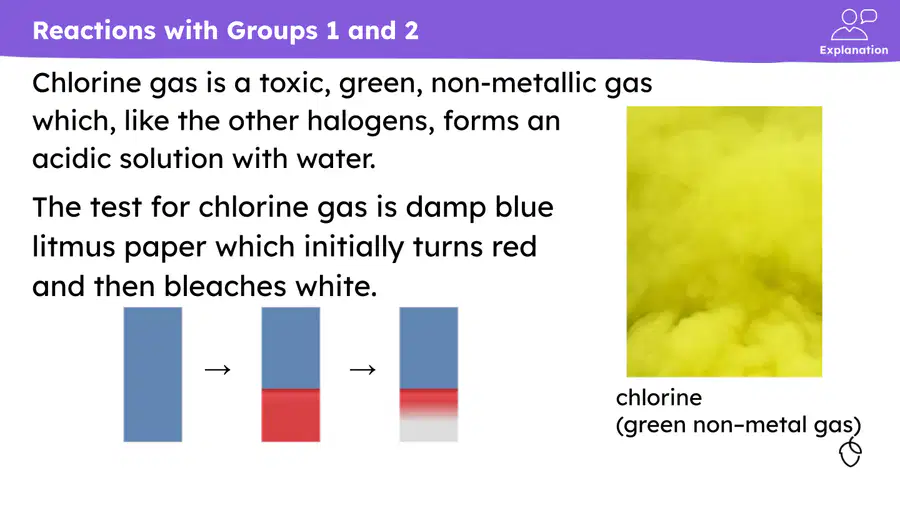
Which of the following best describes the appearance and properties of chlorine gas?
Colorless, odorless, metallic
Green, toxic, non-metallic
Yellow, sweet-smelling, non-metallic
Blue, toxic, metallic
34
35
36
37
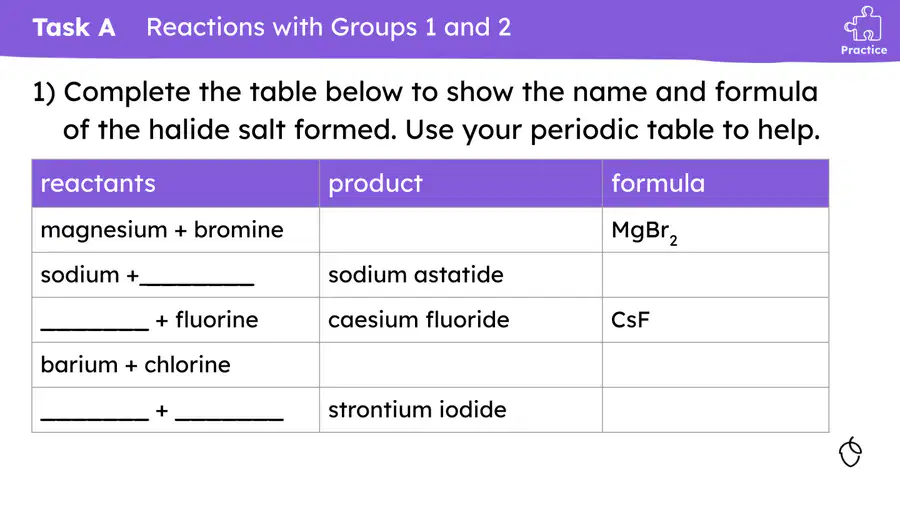
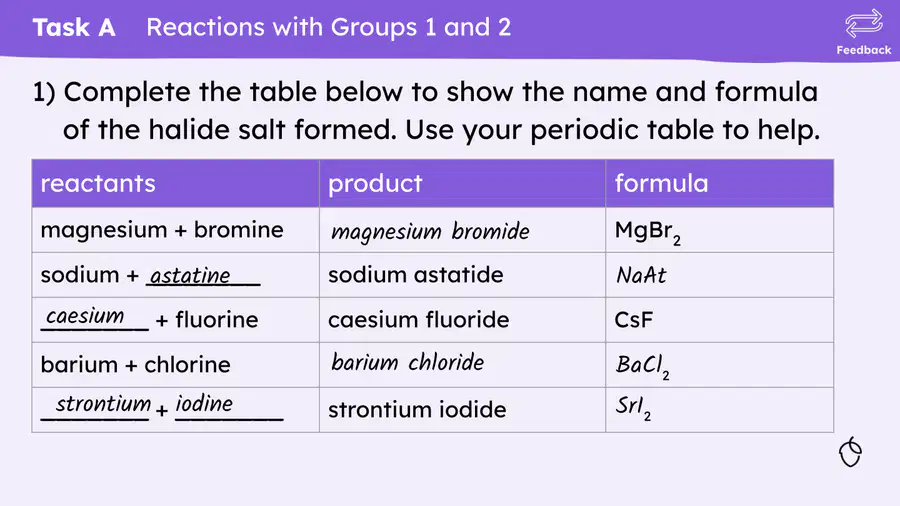
Fill in the Blanks
Type answer...
38
39
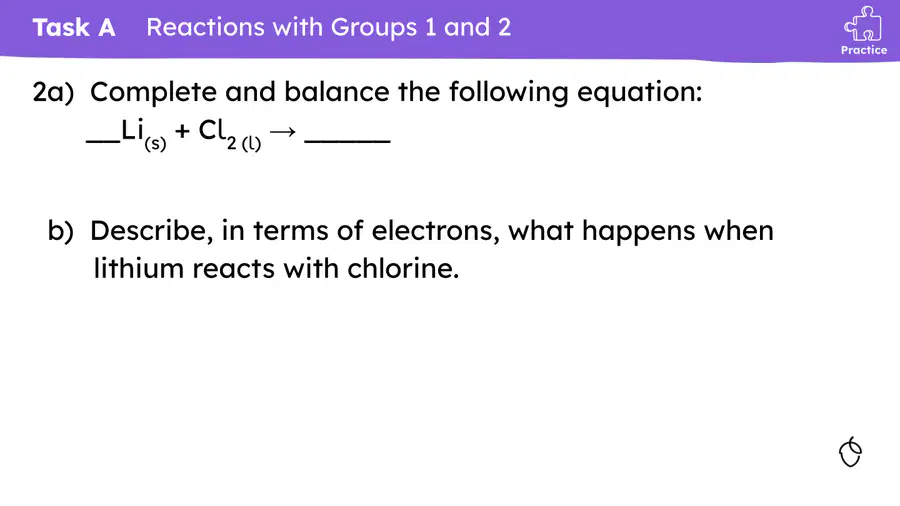
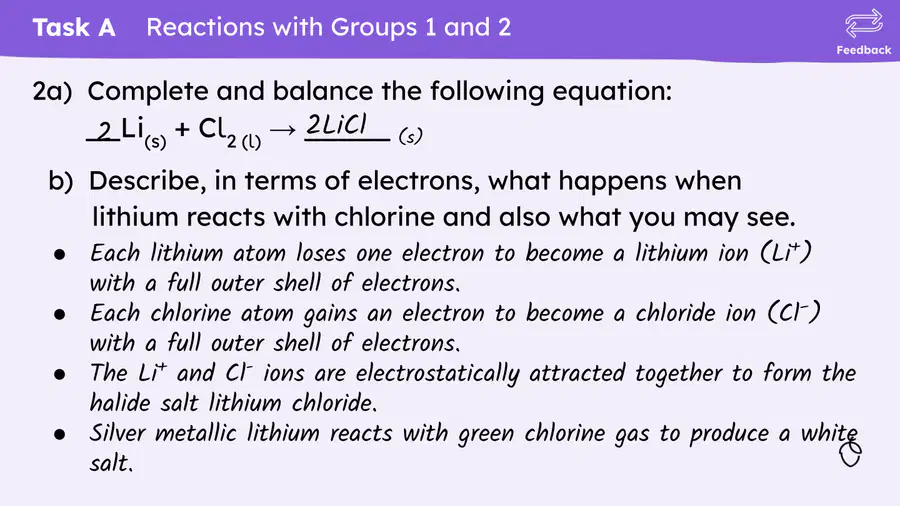
Open Ended
Describe, in terms of electrons, what happens when lithium reacts with chlorine.
40
Fill in the Blanks
Type answer...
41
42
43
44
45
Fill in the Blanks
Type answer...
46
47
Open Ended
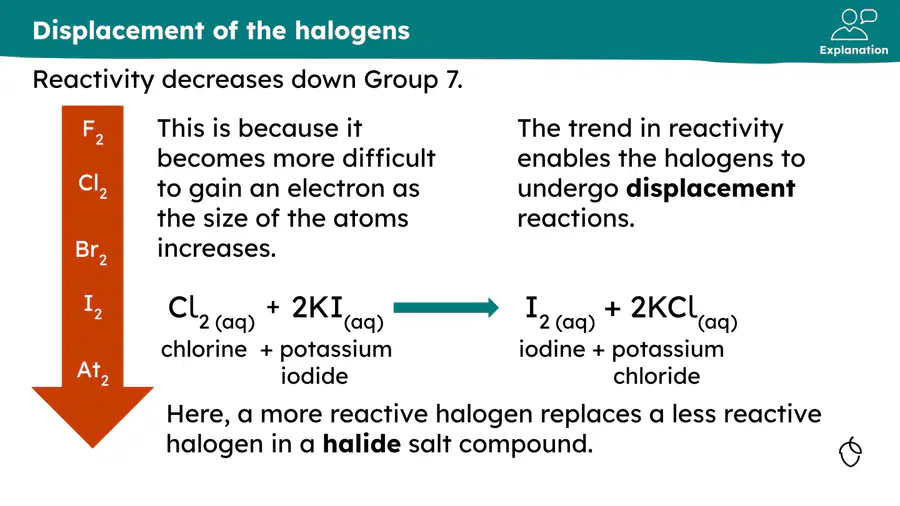
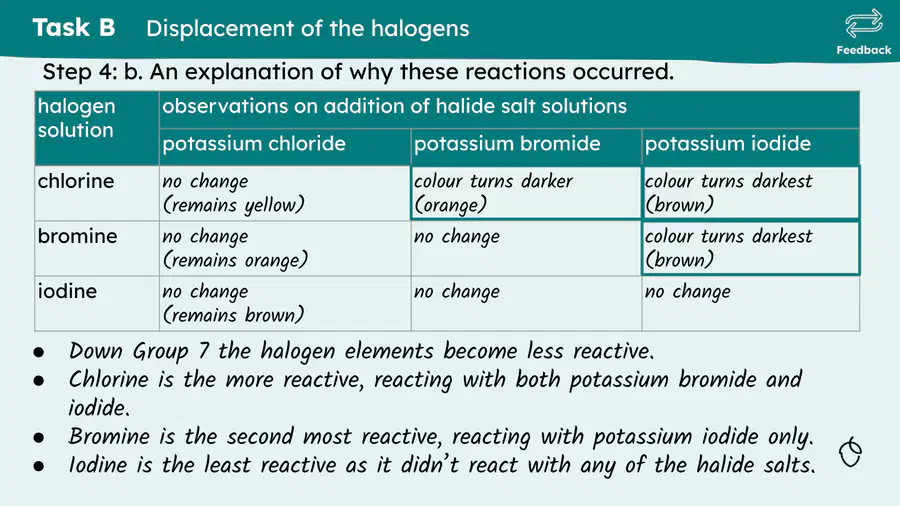
Explain why fluorine cannot be displaced by chlorine in a halide salt.
48
Multiple Select
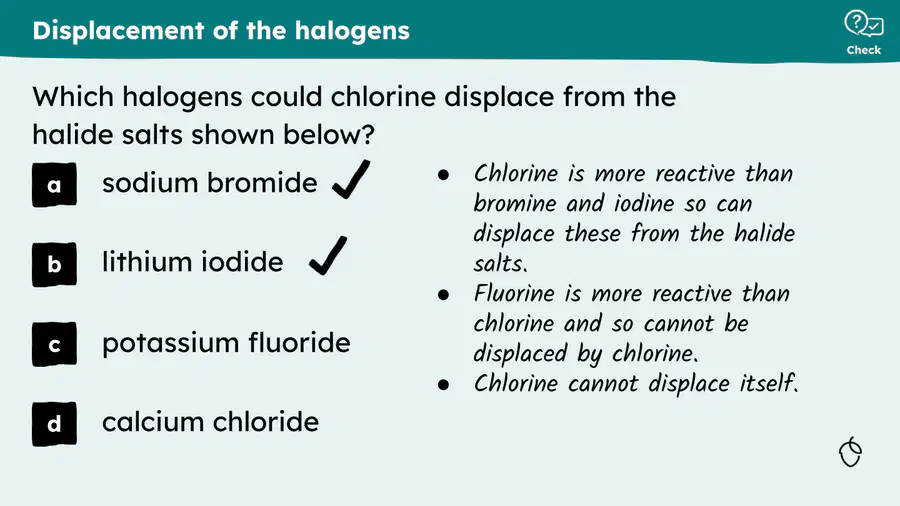
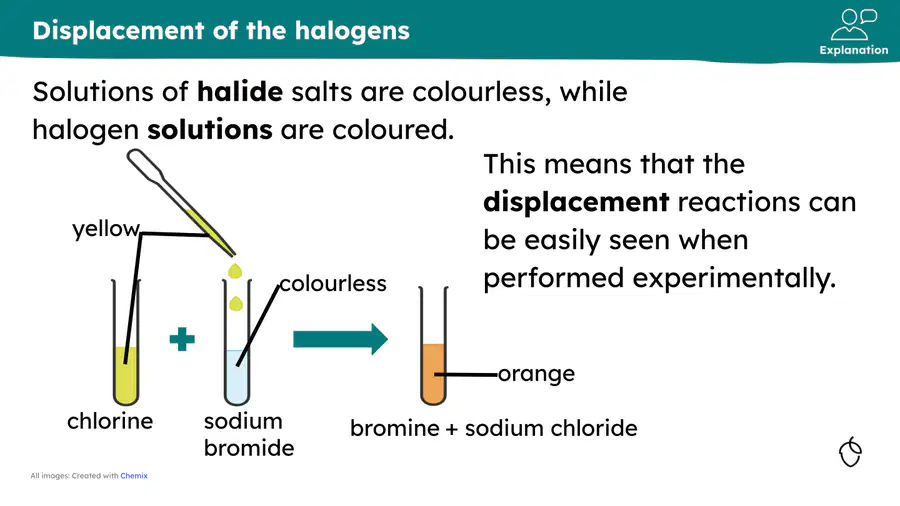
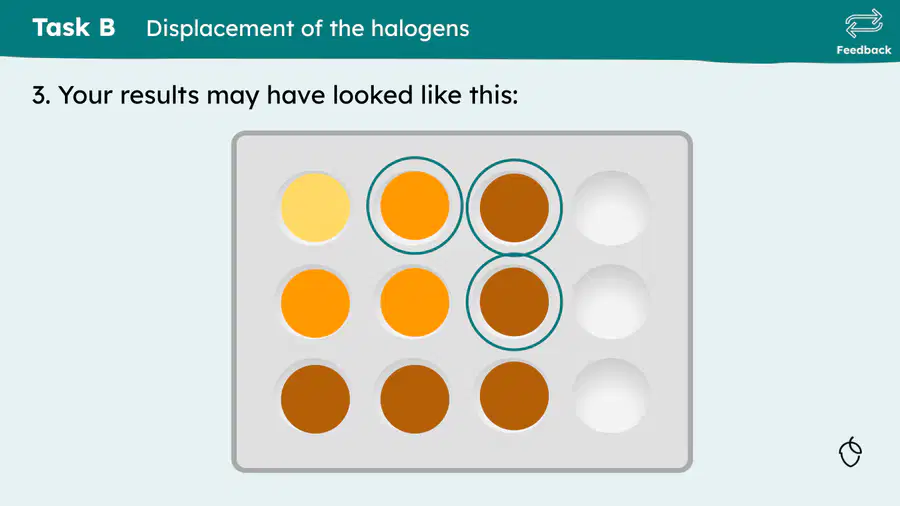
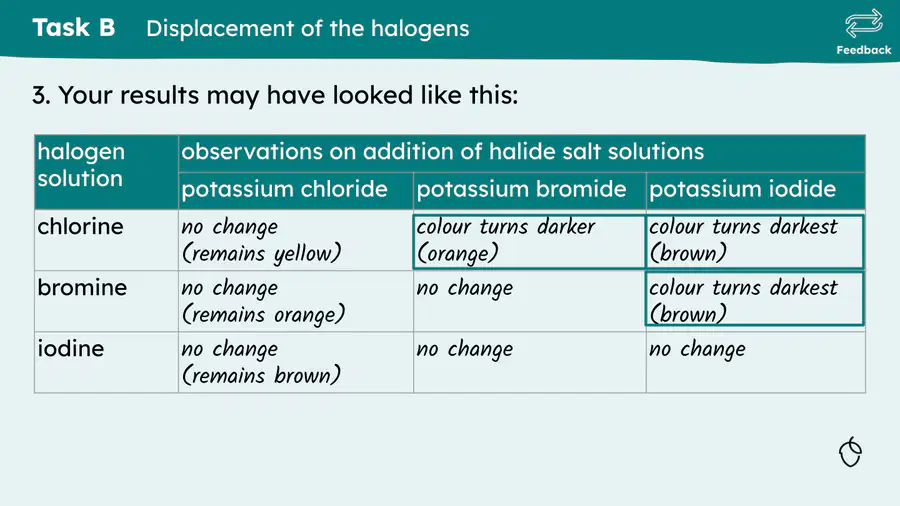
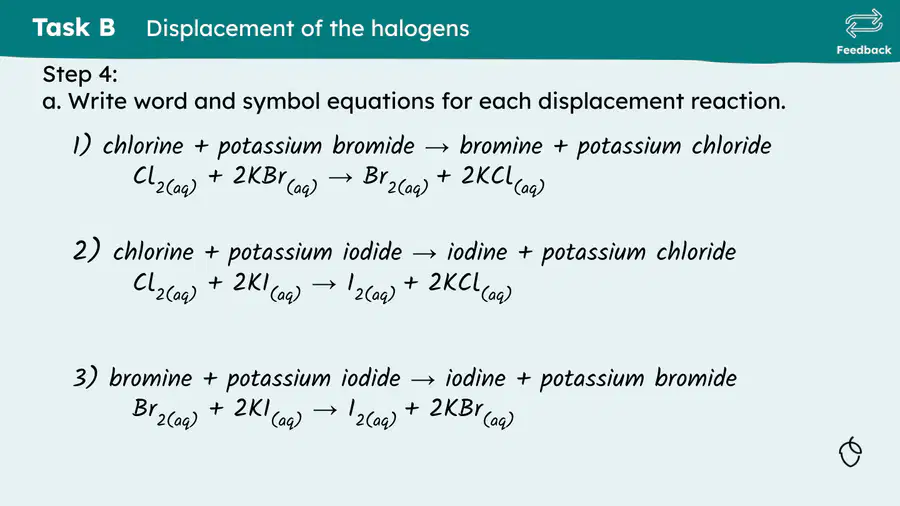
Which halogens could chlorine displace from the halide salts shown below?
sodium bromide
lithium iodide
potassium fluoride
calcium chloride
49
50
51
52
53
54
55
56
57
58

59
Open Ended
How does Oak's lesson structure support effective learning in the classroom?
60
Open Ended
What questions do you still have about the reactions of halogens and displacement practicals?
Show answer
Auto Play
Slide 1 / 60
SLIDE
Similar Resources on Wayground

55 questions
Boyle's Law Practice
Presentation
•
9th - 10th Grade
56 questions
Unit 1 Chemistry Review
Presentation
•
9th - 10th Grade
56 questions
Coulombic Attraction
Presentation
•
9th - 10th Grade
55 questions
Science 9 - Unit A Review Slides
Presentation
•
9th Grade
53 questions
Electron Configuration - CP
Presentation
•
10th Grade
53 questions
Preparation of Salts 2025
Presentation
•
9th Grade
58 questions
Acid-Base Theory
Presentation
•
10th Grade
58 questions
Invertebrates and Vertebrates
Presentation
•
9th Grade
Popular Resources on Wayground
10 questions
Factors 4th grade

Quiz
•
4th Grade
10 questions
Cinco de Mayo Trivia Questions

Interactive video
•
3rd - 5th Grade
13 questions
Cinco de mayo
Interactive video
•
6th - 8th Grade
20 questions
Math Review
Quiz
•
3rd Grade
20 questions
Main Idea and Details
Quiz
•
5th Grade
20 questions
Context Clues
Quiz
•
6th Grade
20 questions
Inferences
Quiz
•
4th Grade
19 questions
Classifying Quadrilaterals
Quiz
•
3rd Grade
Discover more resources for Chemistry
20 questions
Unit 7 Chemical Reactions
Quiz
•
10th Grade
25 questions
Unit 8 Stoichiometry Review
Quiz
•
10th Grade
22 questions
Unit 9 Gas Law Quiz
Quiz
•
10th Grade
20 questions
Types of Chemical Reactions
Quiz
•
9th - 12th Grade
25 questions
Solutions Test Review
Quiz
•
10th Grade
15 questions
Nuclear Chemistry: Balancing
Quiz
•
10th Grade
20 questions
Naming Acids and Bases
Quiz
•
10th Grade
10 questions
Exploring Stoichiometry in Chemistry
Interactive video
•
6th - 10th Grade