

Elements & Compounds

Presentation
•
Biology
•
9th Grade
•
Practice Problem
•
Hard
+2
Standards-aligned

M Moore
FREE Resource
20 Slides • 18 Questions
1

2
Open Ended
What happens to electrons when a covalent bond is formed?
3

4
Multiple Choice
Which of the following best describes a compound?
A substance made of only one type of atom
A mixture of different substances
A substance formed by chemically combining two or more elements
A physical blend of elements
5
Open Ended
Why is it important to understand the difference between elements and compounds in science?
6

7
Multiple Choice
Which of the following best describes an element as shown in the periodic table?
A substance made of two or more types of atoms
A pure substance that consists entirely of one type of atom
A mixture of different compounds
A substance that cannot be found on the periodic table
8

9
Open Ended
Explain how the atomic number and atomic mass of an atom are determined, and why these are important for understanding elements.
10

11
12
Multiple Choice
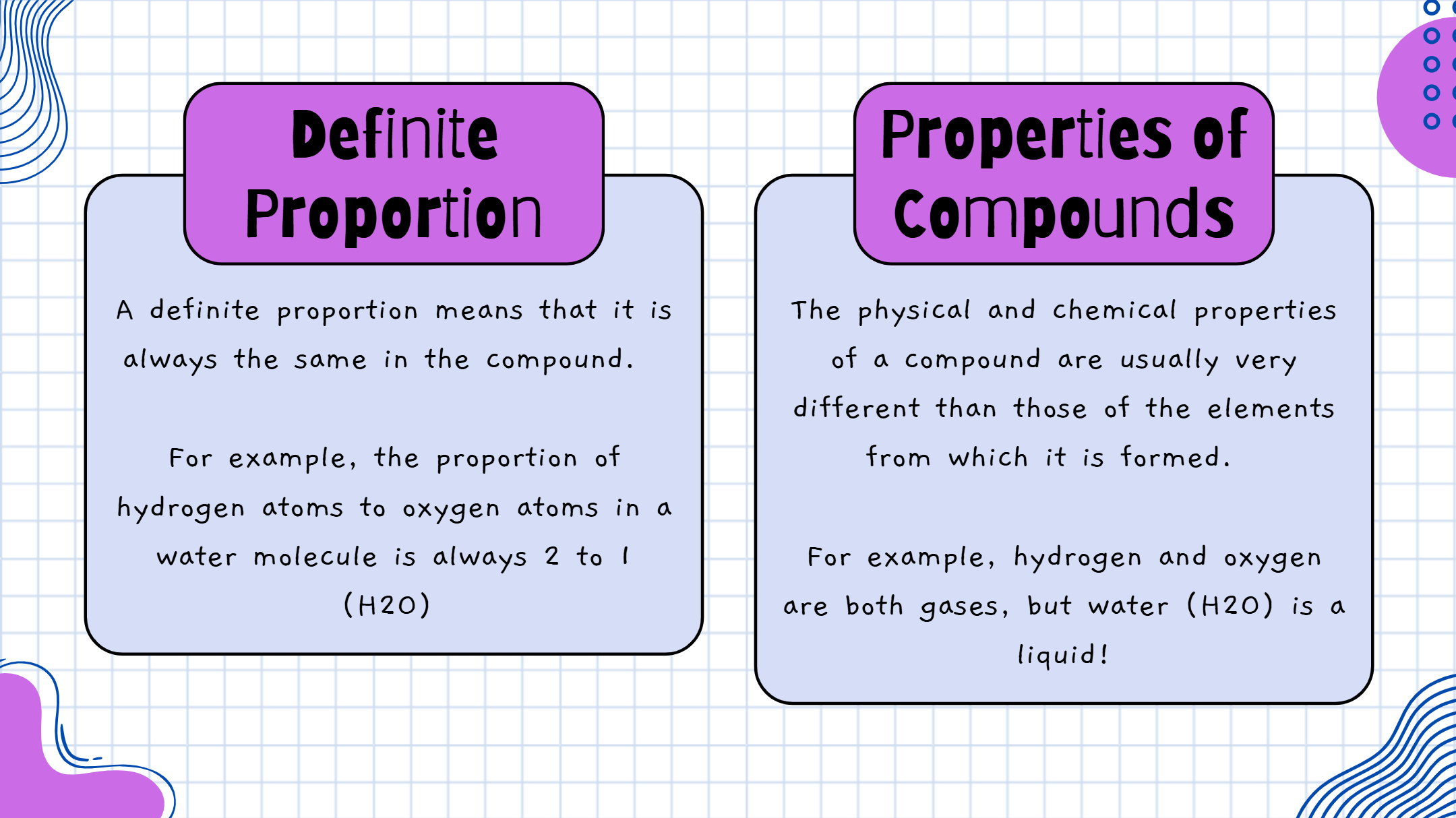
Which of the following best explains why water (H2O) is a liquid even though hydrogen and oxygen are gases?
Water is a mixture, not a compound.
The properties of a compound are different from those of the elements that form it.
Hydrogen and oxygen lose their properties when combined physically.
Water contains more oxygen than hydrogen.
13
Fill in the Blanks
A definite proportion in a compound means the ratio of atoms is always the
Type answer...
14
Multiple Choice
Which of the following statements about compounds is correct?
Compounds are made of only one type of atom.
Compounds are formed by the chemical combination of two or more elements in a definite proportion.
Compounds have the same properties as the elements that form them.
Compounds can be separated by physical means.
15

16

17
Open Ended
Describe what happens to electrons when an ionic bond is formed between two atoms.
18

19
Multiple Choice
Which part of the periodic table contains non-metals?
Left hand side
Middle
Right hand side
Bottom
20

21
22
Multiple Choice
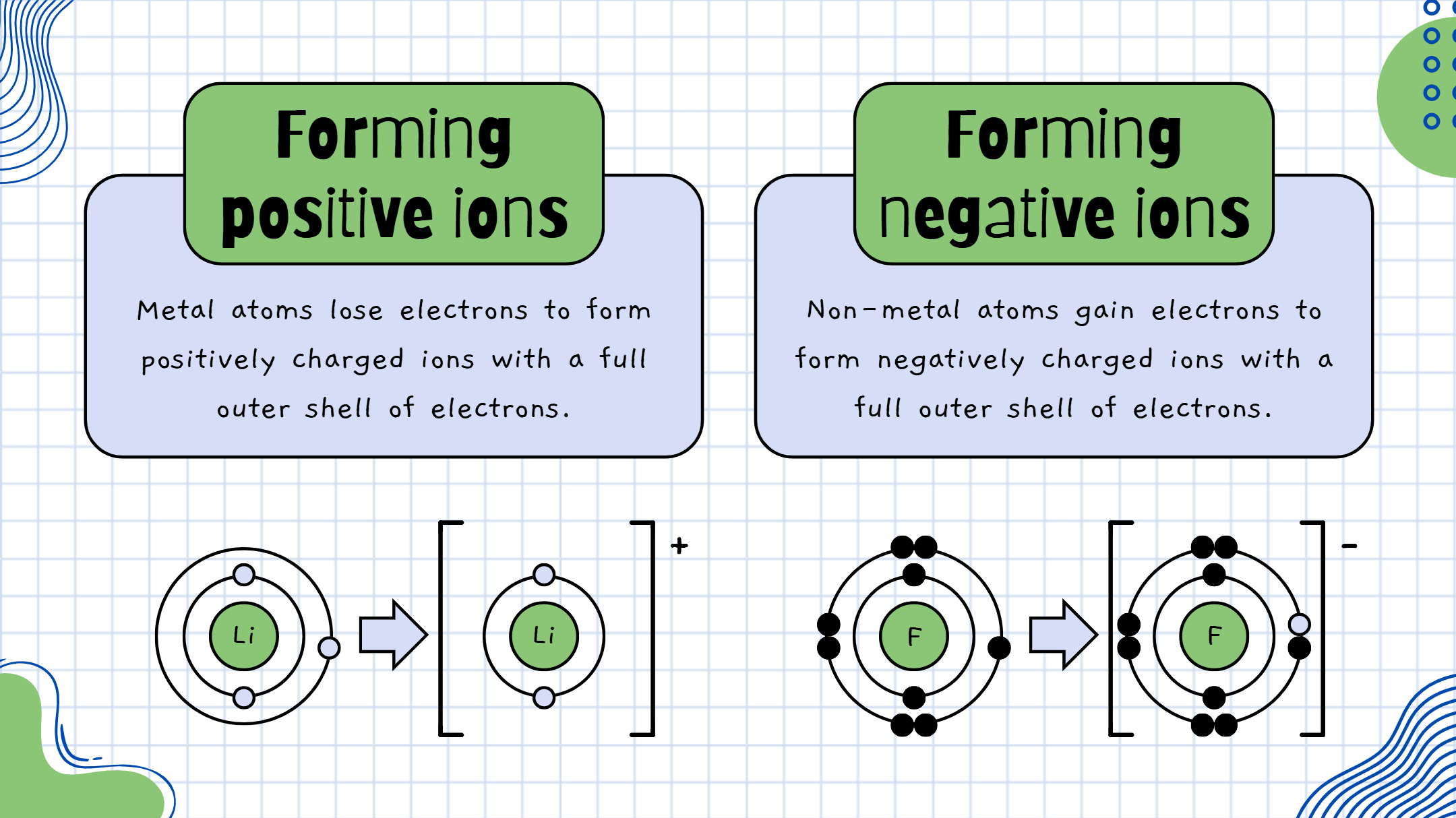
Which of the following statements about the formation of ions is correct?
Metals gain electrons to form positive ions.
Non-metals lose electrons to form negative ions.
Metals lose electrons to form positive ions.
Non-metals gain electrons to form positive ions.
23

24
Fill in the Blanks
Sodium loses an electron to become a
Type answer...
25

26

27

28

29

30
Multiple Choice
How many electrons can occupy the first shell and the other shells of an atom?
First shell: 2, Other shells: 8
First shell: 8, Other shells: 2
First shell: 4, Other shells: 6
First shell: 6, Other shells: 4
31

32
Multiple Select
Which of the following statements about covalent bonds is/are correct?
Covalent bonds involve sharing of electrons.
Covalent bonds are formed only between metals.
Electrons involved in covalent bonds are found in the outer shells.
Each atom contributes one electron to a covalent bond.
33
Open Ended
Explain how covalent bonds are formed between atoms, using examples from the molecules shown.
34

35
Fill in the Blanks
Each fluorine atom has
Type answer...
36

37
Multiple Choice
Would you like to know more about how substances are classified as elements or compounds?
Yes, I want to learn more about classification.
No, I feel confident about the topic.
I have some questions about elements.
I have some questions about compounds.
38
Open Ended
Reflecting on today's lesson, what is one key difference between an element and a compound that you learned?
Show answer
Auto Play
Slide 1 / 38
SLIDE
Similar Resources on Wayground

37 questions
Intro to photosynthesis and cellular respiration
Presentation
•
9th Grade
32 questions
11.4 Cell Differentiation
Presentation
•
9th Grade
33 questions
Slides on Cell Parts and Function
Presentation
•
9th Grade
33 questions
Cell Organ
Presentation
•
9th Grade
34 questions
Intro to the Cell Membrane
Presentation
•
9th Grade
30 questions
photosynthesis
Presentation
•
9th - 10th Grade
34 questions
Osmosis Lesson
Presentation
•
9th Grade
33 questions
DNA and Protein Synthesis Day 3
Presentation
•
9th Grade
Popular Resources on Wayground
21 questions
Continents and Oceans

Quiz
•
6th Grade
20 questions
Parts of Speech
Quiz
•
5th Grade
16 questions
Subject & Predicate
Quiz
•
5th Grade
25 questions
Multiplication Facts
Quiz
•
5th Grade
12 questions
Map Skills
Quiz
•
3rd Grade
22 questions
Continents and Oceans
Quiz
•
5th Grade
15 questions
Rounding Decimals
Quiz
•
5th Grade
20 questions
Brand Labels
Quiz
•
5th - 12th Grade
Discover more resources for Biology
10 questions
Exploring the 4 Major Macromolecules and Their Functions

Interactive video
•
9th - 12th Grade
20 questions
Cell Transport
Quiz
•
9th - 12th Grade
25 questions
photosynthesis and cellular respiration
Quiz
•
9th Grade
20 questions
Cell Cycle
Quiz
•
9th Grade
20 questions
BIOLOGY-CELL MEMBRANE AND CELL TRANSPORT
Quiz
•
9th - 10th Grade
19 questions
Macromolecules
Quiz
•
9th Grade
20 questions
Cell Organelles
Quiz
•
9th Grade
18 questions
The Carbon Cycle
Quiz
•
9th Grade