

Monroe HS1 Digestive System

Presentation
•
Science
•
9th - 12th Grade
•
Practice Problem
•
Easy
Standards-aligned

Scott Monroe
Used 2+ times
FREE Resource
28 Slides • 22 Questions
1

2
Learning Objectives
Upon completion of this unit students will be able to do the following:
Describe the general function of the digestive system.
List the structures and the functions of the digestive system.
Describe the action of the enzymes on carbohydrates, fats, and proteins.
Trace food from the beginning of the digestive process to the end.
Describe common disorders of the digestive system.
Define the key words that relate to this chapter.
3

4
Multiple Choice
Which of the following is NOT a primary function of the digestive system?
Physical breakdown of food
Chemical digestion of food
Absorption of nutrients
Production of hormones
5
Open Ended
Why is understanding the functions of the digestive system important for maintaining overall health?
6

7

8

9

10

11

12

13
Multiple Choice
Which organ is responsible for moving food from the pharynx to the stomach by rhythmic waves called peristalsis?
Esophagus
Stomach
Small intestine
Pancreas
14

15
Open Ended
Explain the role of the cardiac and pyloric sphincters in the digestive process.
16

17
Multiple Select
Which of the following statements about the small intestine are correct?
It is divided into three segments: duodenum, jejunum, and ileum.
Most absorption of nutrients occurs in the small intestine.
Digested food passes into the bloodstream from the small intestine.
Anything not digested passes on to the stomach.
18

19
Fill in the Blanks
The pancreas secretes digestive enzymes as part of its
Type answer...
20

21
Multiple Choice
Describe two major functions of the liver in the human body.
Detoxifies alcohol, drugs and other harmful substance
Absorbs nutrients
Produces & stores glucose in the form of Glycogen.
Creates Chyme
22

23
Multiple Choice
What happens to bile stored in the gallbladder when fatty foods are digested?
It is released by the gallbladder.
It is absorbed by the liver.
It is broken down in the pancreas.
It remains stored in the gallbladder.
24

25
Multiple Choice
What is another name for the Large Intestine?
Cecum
Rectum
Colon
GI Tract
26

27
Open Ended
Explain the difference between physical digestion and chemical digestion, and provide an example of each.
28

29
Multiple Choice
Which of the following vitamins are produced by bacteria in the large intestine?
Vitamin A and D
Vitamin K and B vitamins
Vitamin C and E
Vitamin B12 and C
30

31
Multiple Choice
Constipation is most effectively treated by increasing ___ in the diet.
Proteins
Fats
Carbohydrates
Fiber
32

33
Multiple Choice
What are two major causes of cirrhosis, and how does this disease affect the liver?
Excessive alcohol use
Smoking
Tylenol abuse
Going to school
34
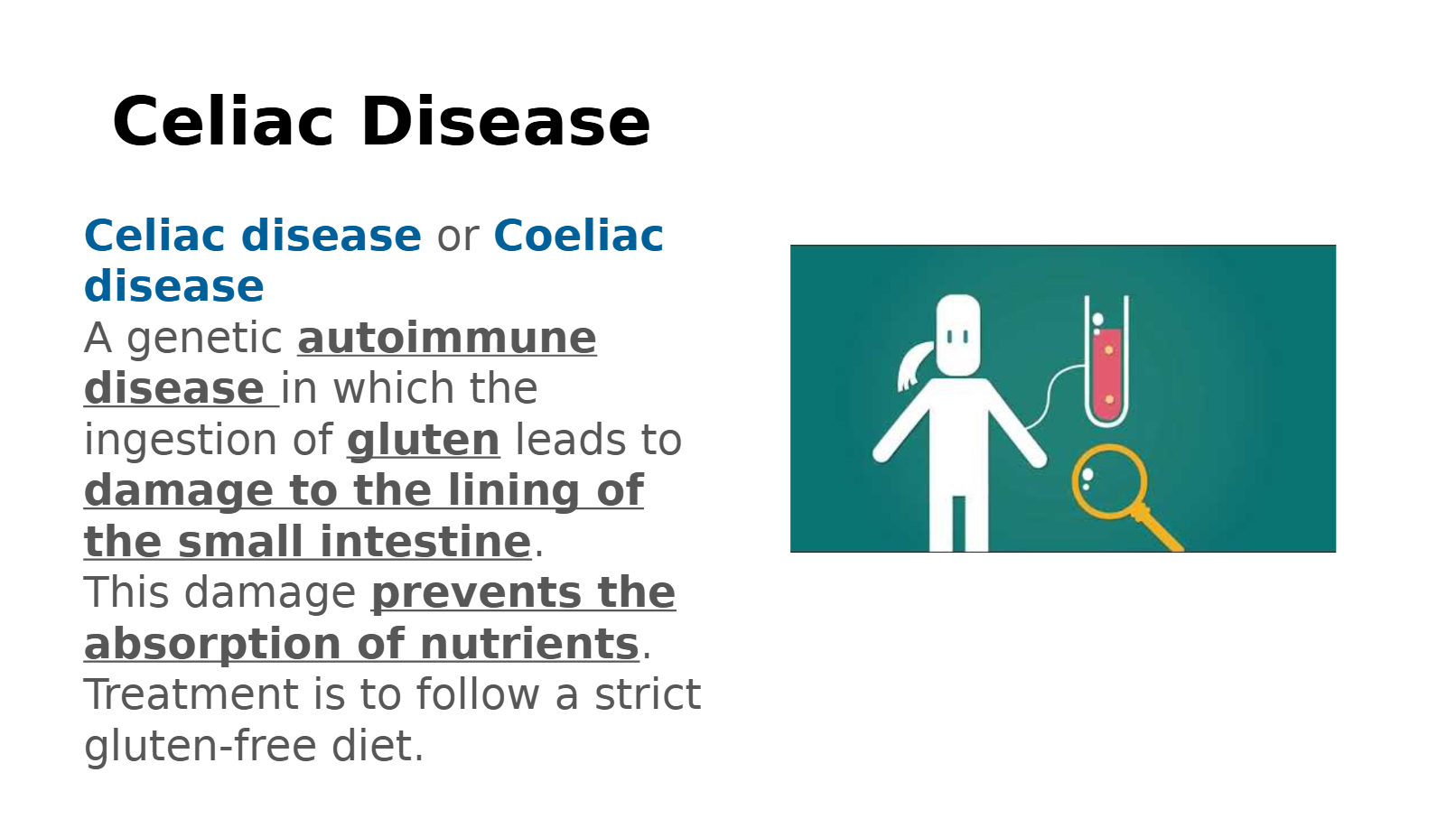
35
Multiple Choice
Celiac disease is an autoimmune disorder that damages the lining of the ___, preventing absorption of nutrients.
Large intestine
Small intestine
Colon
Pancreas
36

37
Multiple Choice
Which of the following is a common symptom of Irritable Bowel Syndrome (IBS)?
Abdominal pain
Skin rash
Headache
Joint pain
38

39
Multiple Choice
Which of the following statements about Crohn’s disease and IBS is correct?
Crohn’s disease is a type of IBS.
IBS is caused by chronic inflammation of the digestive tract.
Crohn’s disease is characterized by chronic inflammation, while IBS is not.
Both Crohn’s disease and IBS are inflammatory diseases.
40

41
Multiple Choice
Gastroenteritis is most commonly caused by a ___ infection.
Bacteria
Virus
Tetanus
MRSA
42

43
Multiple Select
Select all symptoms that may be caused by Gastroesophageal Reflux Disease (GERD).
Heartburn
Difficulty swallowing
Abdominal bloating
Sour or bitter taste in mouth
44

45

46
Open Ended
Explain how Hepatitis A and Hepatitis B/C are transmitted and how their transmission routes differ.
47

48
Multiple Choice
How do you treat a peptic ulcer?
Antibiotics
Fiber
Vaccinations
H2 blockers
49
Multiple Choice
Which of the following is NOT a function of the digestive system?
Physical breakdown of food
Chemical digestion of food
Absorption of nutrients
Production of hormones
50
Open Ended
Reflecting on what you learned about the digestive system, what is one function of the digestive system that you found most interesting or important?
Show answer
Auto Play
Slide 1 / 50
SLIDE
Similar Resources on Wayground

45 questions
Evolution PreTest
Presentation
•
9th - 12th Grade
40 questions
Introduction to Environmental Science Lesson
Presentation
•
9th - 12th Grade
45 questions
Intro to Nuclear Chemistry
Presentation
•
9th - 12th Grade
45 questions
Effect of Exercises
Presentation
•
9th - 12th Grade
44 questions
Introduction to Materials
Presentation
•
9th - 12th Grade
46 questions
Unit 3 Notes: Physical vs Chemical
Presentation
•
9th - 12th Grade
45 questions
Newton's Law of Motion Presentation
Presentation
•
9th - 12th Grade
Popular Resources on Wayground
10 questions
Safety Day 2026 – Student Review

Quiz
•
9th Grade
21 questions
Continents and Oceans
Quiz
•
6th Grade
20 questions
Parts of Speech
Quiz
•
5th Grade
16 questions
Subject & Predicate
Quiz
•
5th Grade
25 questions
Multiplication Facts
Quiz
•
5th Grade
12 questions
Map Skills
Quiz
•
3rd Grade
22 questions
Continents and Oceans
Quiz
•
5th Grade
15 questions
Rounding Decimals
Quiz
•
5th Grade
Discover more resources for Science
10 questions
Exploring Chemical and Physical Changes

Interactive video
•
6th - 10th Grade
20 questions
Atomic Structure
Quiz
•
9th Grade
10 questions
Exploring the Electromagnetic Spectrum for Middle School Science
Interactive video
•
6th - 10th Grade
10 questions
Exploring Force and Motion Concepts
Interactive video
•
6th - 10th Grade
10 questions
Exploring Air Masses and Weather Fronts
Interactive video
•
6th - 10th Grade
14 questions
Periodic Trends
Interactive video
•
11th Grade
10 questions
Exploring the States of Matter
Interactive video
•
6th - 10th Grade
10 questions
Exploring Forces: Net Force, Normal Force, Gravity, and Friction
Interactive video
•
6th - 10th Grade