

Chem 8-3 Solubility Basics

Presentation
•
Chemistry
•
10th Grade
•
Practice Problem
•
Easy
+1
Standards-aligned

KARLY CUMMINS
Used 2+ times
FREE Resource
22 Slides • 23 Questions
1

2

3
Open Ended
Describe what happens at the molecular level when a solute dissolves in a solvent, using water as an example.
4
Multiple Choice
Why is solubility an important concept in chemistry?
It helps us understand how substances interact in solutions.
It determines the color of a compound.
It is only relevant for gases.
It is unrelated to chemical reactions.
5

6
Multiple Choice
Which of the following statements best describes an insoluble substance?
A substance that does not dissolve in water and forms a precipitate.
A substance that dissolves completely in water.
A substance that evaporates quickly.
A substance that reacts with water to form a gas.
7

8
Multiple Choice
What is an example of a soluble ionic compound?
NaCl
AgCl
CO2
C6H12O6
9

10
Multiple Select
Which of the following statements are true about polar substances and ionic compounds dissolving in water?
They attract water molecules directly.
They always dissolve in water.
Water forms hydration shells around them.
They never dissolve in water.
11

12
Multiple Choice
Why do many nonpolar substances not dissolve in water?
They stick better to each other than to water.
They react with water to form a precipitate.
They form hydration shells easily.
They are always gases.
13

14
Open Ended
Explain how scientists use solubility rules to determine whether an ionic salt will dissolve in water.
15

16
Fill in the Blanks
As temperature increases, the solubility of most solid solutes in a liquid
17

18
Multiple Select
Based on the solubility curves, which substances show an increase in solubility as temperature rises?
NaCl
NaNO3
NH3
KBr
19
Multiple Choice
Which of the following statements best explains the effect of temperature on the solubility of ammonia in water?
As temperature increases, ammonia's solubility in water increases.
As temperature increases, ammonia's solubility in water decreases.
Ammonia's solubility in water is unaffected by temperature.
Ammonia becomes a solid at higher temperatures.
20

21
Open Ended
Explain how pressure affects the solubility of gases compared to liquids and solids.
22

23
Fill in the Blanks
Solutions of nonelectrolytes do not conduct
24

25
Multiple Choice
Which of the following is an example of a weak electrolyte?
Glucose
Acetic acid
KBr
NaCl
26

27

28
29
Multiple Choice
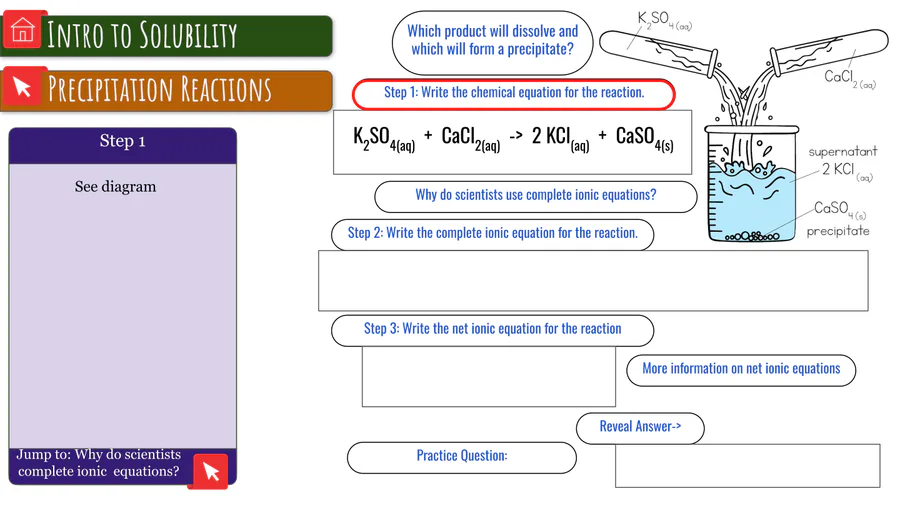
Which product will dissolve and which will form a precipitate when potassium sulfate reacts with calcium chloride?
Potassium chloride will dissolve, calcium sulfate will precipitate
Calcium chloride will dissolve, potassium sulfate will precipitate
Both products will dissolve
Both products will precipitate
30

31
Fill in the Blanks
Why do scientists write complete ionic equations when describing precipitation reactions?
Type answer...
32

33
Multiple Select
Which of the following ions are present in the complete ionic equation for the reaction between K2SO4 and CaCl2?
K+
SO4^2-
Ca^2+
Cl-
34

35
Fill in the Blanks
In the net ionic equation for the reaction between potassium sulfate and calcium chloride, fill in the blank: SO4^2- (aq) + Ca^2+ (aq) ->
36

37
Open Ended
Explain the difference between a complete ionic equation and a net ionic equation in precipitation reactions.
38

39
Open Ended
Write the net ionic reaction for the precipitation reaction that occurs when sodium chloride is mixed with silver nitrate. What precipitate forms?
40

41
Open Ended
Explain why scientists use complete ionic equations when describing precipitation reactions.
42
Multiple Choice
Which of the following is the correct net ionic equation for the reaction between potassium sulfate (K2SO4) and calcium chloride (CaCl2)?
SO4^2- (aq) + Ca^2+ (aq) -> CaSO4 (s)
K2SO4 (aq) + CaCl2 (aq) -> 2 KCl (aq) + CaSO4 (s)
2 K^+ (aq) + SO4^2- (aq) + Ca^2+ (aq) + 2 Cl^- (aq) -> 2 K^+ (aq) + 2 Cl^- (aq) + CaSO4 (s)
Ag^+ (aq) + Cl^- (aq) -> AgCl (s)
43

44
Multiple Choice
When a solute dissolves in water, what happens to the solute particles?
They remain unchanged and settle at the bottom.
They are surrounded by solvent molecules forming hydration shells.
They evaporate into the air.
They combine to form larger particles.
45
Open Ended
Reflecting on today's lesson about solubility, what is one concept you found most interesting or would like to learn more about?
Show answer
Auto Play
Slide 1 / 45
SLIDE
Similar Resources on Wayground

40 questions
Balancing and 5 Types of Chemical Reactions
Presentation
•
9th - 12th Grade
40 questions
Patterns in the Periodic Table
Presentation
•
10th Grade
40 questions
Acids, Bases and pH
Presentation
•
9th - 10th Grade
40 questions
Chemistry Unit 3 Lesson 4: Basics of Calorimetry
Presentation
•
11th Grade
41 questions
Physical Geography of Europe
Presentation
•
9th Grade
39 questions
Biology STAAR Review - 4B Cell Transport
Presentation
•
9th Grade
41 questions
G9 Chap 14.1 Fossil Evidence of Change
Presentation
•
9th Grade
41 questions
Module 1 Reviewer
Presentation
•
11th Grade
Popular Resources on Wayground
10 questions
Safety Day 2026 – Student Review

Quiz
•
9th Grade
21 questions
Continents and Oceans
Quiz
•
6th Grade
20 questions
Parts of Speech
Quiz
•
5th Grade
16 questions
Subject & Predicate
Quiz
•
5th Grade
25 questions
Multiplication Facts
Quiz
•
5th Grade
12 questions
Map Skills
Quiz
•
3rd Grade
22 questions
Continents and Oceans
Quiz
•
5th Grade
15 questions
Rounding Decimals
Quiz
•
5th Grade
Discover more resources for Chemistry
20 questions
electron configurations and orbital notation
Quiz
•
9th - 12th Grade
25 questions
Writing and Naming Binary Ionic compounds
Quiz
•
10th Grade
20 questions
COUNTING ATOMS
Quiz
•
10th Grade
20 questions
Physical or Chemical Change/Phases
Quiz
•
8th Grade - University
15 questions
Periodicity Module Exam Practice Quiz
Quiz
•
9th - 12th Grade
20 questions
Naming Ionic Compounds
Quiz
•
10th Grade
45 questions
Chem Unit 3 Review
Quiz
•
10th Grade
16 questions
History of the Atomic Theory
Quiz
•
10th Grade