Search Header Logo
Forces & Motion Lesson_Unit Vocabulary

Forces & Motion Lesson_Unit Vocabulary

Assessment

Presentation

Science

9th - 12th Grade

Hard

NGSS
MS-PS2-2, MS-PS2-1, HS-PS2-1

+1

Standards-aligned

Created by

Renay Treat

FREE Resource

17 Slides • 32 Questions

1

media

2

media

3

media

4

media

5

Multiple Choice

Which of the following best describes the difference between speed and velocity?

1

Speed is the distance traveled per unit time, while velocity is speed in a given direction.

2

Speed is always constant, while velocity always changes.

3

Speed is measured in Newtons, while velocity is measured in meters per second.

4

Speed includes direction, while velocity does not.

6

Multiple Select

Choose all that are examples of velocity.

1

10 m/h

2

10 m/h South

3

2 m/s

4

2 m/s, north

5

2m/s, upward

7

media

8

Acceleration is defined as the rate of change of velocity, and velocity includes both speed and direction. When an object changes its direction, its velocity changes, which means it is accelerating, even if its speed remains constant. 

9

Multiple Choice

Question image
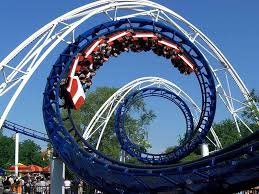
A roller coasters accelerates from an initial velocity of of 6.0 m/s to a final velocity of 70 m/s over 4 seconds.  What's the acceleration?
1
24 m/s2
2
18 m/s2
3
16 m/s2
4
16 m/s

10

Multiple Select

Acceleration can be (choose all that apply)

1

In one direction only

2

Speeding up or slowing down

3

Down only

4

None of these

5

Changing Directions

11

media

12

Fill in the Blanks

13

Multiple Choice

Which of the following statements about force is correct?

1

Force is always balanced.

2

Force can cause an object to change direction or speed.

3

Force is measured in meters per second.

4

Force cannot be described by its direction.

14

media

15

Multiple Choice

Question image
What is the net force?
1
30 N 
2

25 N right

3

5 N, left

4

5 N, right 

16

Multiple Choice

Question image
What is the net force?
1

20 N, right 

2
0 N 
3

40 N, left

4

40 N, right 

17

Multiple Choice

What is the net force acting on an object if two forces of 10 N each act in opposite directions?

1

0 N

2

10 N

3

20 N

4

5 N

18

media

19

media

20

Multiple Choice

Which of the following statements best describes how friction affects motion?

1

It speeds up motion between surfaces.

2

It opposes or slows down motion between surfaces.

3

It has no effect on motion.

4

It only affects motion on rough surfaces.

21

media

22

media

23

Multiple Choice

Question image
The tendency of an object to resist changes in its motion is...
1
inertia
2
force
3
acceleration
4
velocity

24

Multiple Choice

Question image

What will be the effect on the boy in the picture if the driver stops quickly?

1

Because of inertia he will remain in the same position.

2

He will be pushed back into the car seat.

3

He will move from one side of the car seat to the other.

4

He will move forward pressing against the seatbelt.

25

Multiple Select

Which of the following are true about Newton's 1st Law of Motion?

1

An object at rest will stay at rest unless acted upon by a force.

2

An object in motion will stay in motion unless acted upon by a force.

3

Inertia depends on mass.

4

All objects eventually stop moving without a force.

26

media

27

Constant speed motion results from balanced forces, as an unbalanced force would cause acceleration (a change in speed or direction). This is because balanced forces are equal in magnitude and opposite in direction, resulting in a net force of zero and no acceleration, according to Newton's laws. 

  • Balanced forces: If an object moves at a constant speed in a straight line, the forces acting on it are balanced, meaning they cancel each other out. For example, a car on cruise control has its forward engine force perfectly balanced by opposing forces like air resistance and friction.

  • Unbalanced forces: If there is a change in speed (speeding up or slowing down) or a change in direction, an unbalanced force is acting on the object. This unbalanced force results in acceleration. 

28

Multiple Choice

According to Newton's 1st Law, once a force is applied, an object will move at a constant speed in a straight line until ______________ causes it to slow down, stop, or turn.

1
an internal reaction
2
an external force
3

a person

4

a shoe

29

Multiple Choice

True or False

A car speeding up has balanced forces

1
False
2
True

30

Multiple Choice

True or False

A car going around a curve at a constant speed has balanced forces

1
False
2
True

31

Multiple Choice

True or False

A car going moving at a constant speed has balanced forces

1
False
2
True

32

media

33

Multiple Choice

Question image

The mass of a car is 1000 kg.  How much force would be required to accelerate the car at a rate of 3 m/s2?  How would you solve this?

1
1000 ÷ 3
2
3 ÷ 1000
3
1000 x 3

34

Multiple Choice

Question image
A force of 250 N is applied to an object that accelerates at a rate of 5 m/s2.  What is the mass of the object? To solve this problem you must do - 
1
250 ÷ 5
2
5 ÷ 250
3
250 x 5

35

Multiple Choice

Question image
A force of 250 N is applied to an object that accelerates at a rate of 5 m/s2.  What is the mass of the object? The answer to this question is most likely (HINT: Look at the units!!!) - 
1
50 N
2
50 m/s2
3
50 kg

36

Multiple Choice

Question image
A 5 kg block is pulled across a table by a net force of 32 N. Calculate the acceleration of the object. To solve this problem you must do - 
1
32 ÷ 5
2
5 ÷ 32
3
32 x 5

37

media

38

Fill in the Blanks

39

media

40

Multiple Choice

Question image

A squid moves through the water by ejecting water out of its body into the surrounding water. When the water is pushed out, the ejected water pushes back and thrusts the squid forward.

1

First Law of Motion (law of inertia)

2

Second Law of Motion (law of force and acceleration)

3

Third Law of Motion (law of motion and reaction)

4

Fourth Law of Motion (law of balanced forces)

41

Multiple Choice

Question image

Pushing a child on a swing is easier than pushing an adult on the same swing, because the adult has more mass. What which law explains this?

1

Newton's 1st Law (Law of Inertia)

2

Newton's 2nd Law (Law of Acceleration)

3

Newton's 3rd Law (Law of Action-Reaction)

4

Newton's 4th Law (Law of Science)

42

Multiple Choice

Question image

Alexis was conducting an experiment for her science class. She wants to know why does a soccer ball accelerate more than a bowling ball when thrown with the same force of 20 Newtons. Using her knowledge about Newton's Laws of Motion, which law should help her find the answer?

1

Newton's 1st Law (Law of Inertia)

2

Newton's 2nd Law (Law of Acceleration)

3

Newton's 3rd Law (Law of Action-Reaction)

4

Newton's 4th Law (Law of Science)

43

Multiple Choice

Question image

Damian L. just bought coffee and put it on the seat next to him. As he was driving, a rabbit crossed the road and he immediately pressed on the breaks to avoid hitting the rabbit. The rabbit was not harmed but his coffee spilled on the seat. What law explains why Dame's coffee spilled when he stopped?

1

Newton's 1st Law (Law of Inertia)

2

Newton's 2nd Law (Law of Acceleration)

3

Newton's 3rd Law (Law of Action-Reaction)

4

Newton's 4th Law (Law of Science)

44

Multiple Choice

Question image

A crash test dummy is used to test the durability of a new car seatbelt technology developed by Besla electronics. During the first test, the seat belt failed and resulted to the dummy being ejected as seen on the pictures. Which of law of motion explains why the dummy ejected in that fashion?

1

Newton's 1st Law (Law of Inertia)

2

Newton's 2nd Law (Law of Acceleration)

3

Newton's 3rd Law (Law of Action-Reaction)

4

Newton's 4th Law (Law of Science)

45

Multiple Choice

Question image

The picture shows an aerialist walking on a tightrope and holding a balancing bar. An action-reaction pair forces exists between which ?

1

The aerialist's feet and the rope

2

The rope and the balancing bar

3

The two ends of the rope

4

The aerialist's arms and legs

46

Multiple Choice

Question image
A person not paying attention while skateboarding hits a rock. The skateboard stops...they don't.
1
The Law of Inertia (1st law)
2
The Law of Acceleration (2nd law)
3
The Law of Conservation of Momentum
4
Action Reaction Law (3rd law)

47

Multiple Choice

Question image

Which law does this picture represent?

1

Newton's 1st law

2

Newton's 3rd law

3

Newton's 2nd law

48

Multiple Choice

When a force pushes a car and the car accelerates which law is that?

1

Newton's 3rd law

2

Newton's 2nd law

3

Newton's 1st law

49

Multiple Choice

You push against a wall and the wall is pushing back on you.

1

Newton's

1st

Law of Motion

2

Newton's

2nd

Law of Motion

3

Newton's

3rd

Law of Motion

4

Law of Conservation of Mass

media

Show answer

Auto Play

Slide 1 / 49

SLIDE