

Chapter 15 presentation

Presentation
•
Other
•
Professional Development
•
Hard

Mary Guerra
FREE Resource
33 Slides • 24 Questions
1

2

3
Multiple Choice
Which of the following behaviors is most likely associated with disordered eating rather than an eating disorder?
Frequent dieting
Sustained severe food restriction
Need for medical treatment
Persistent avoidance of all meals
4
Open Ended
Why is it important to understand the difference between disordered eating and eating disorders?
5

6
Multiple Choice
Which age group and gender is most affected by eating disorders according to the statistics?
15 to 24 years, female
15 to 24 years, male
25 to 34 years, female
25 to 34 years, male
7

8
Multiple Choice
What are the three main categories of factors contributing to the etiology of eating disorders?
Biological, Psychological, Social
Physical, Emotional, Environmental
Genetic, Behavioral, Cultural
Medical, Social, Economic
9

10
Open Ended
Explain how biological factors can contribute to the development of eating disorders.
11

12
Multiple Select
Which of the following psychological factors are commonly associated with eating disorders? Select all that apply.
Low self esteem & shame
Dislike & misperceive body shape
Childhood sexual abuse
High self confidence
13

14
Fill in the Blanks
Social media has a powerful influence in regards to diet &
Type answer...
15

16
Open Ended
Describe two approaches used in the treatment of eating disorders.
17

18
Multiple Choice
Which of the following is NOT considered a major eating disorder?
Anorexia nervosa
Bulimia nervosa
Diabetes mellitus
Binge eating disorder
19

20
Open Ended
Explain how distorted self-image contributes to the development of anorexia nervosa.
21
22
Multiple Select
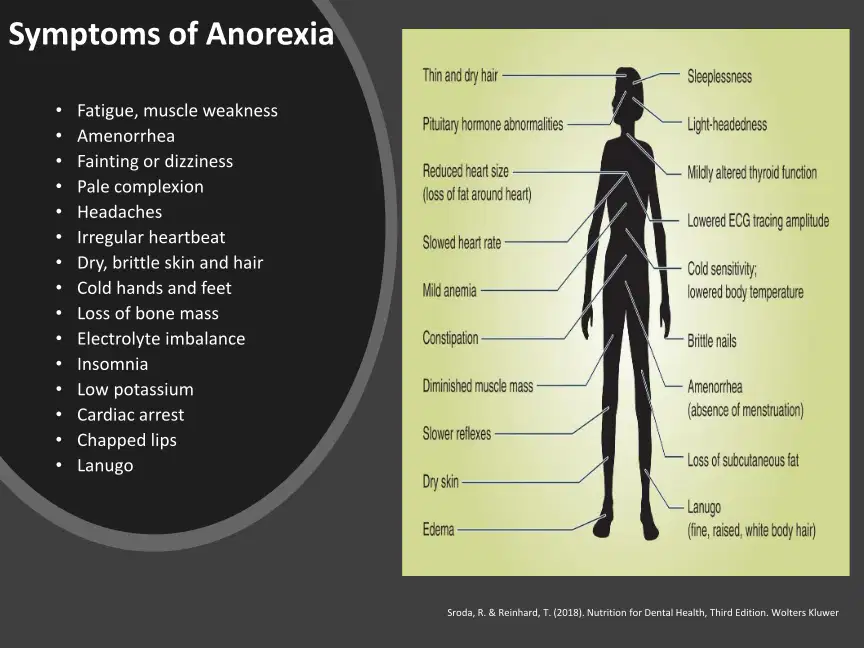
Which of the following are common symptoms of anorexia nervosa?
Fatigue
Irregular heartbeat
Weight gain
Electrolyte imbalance
23

24
Fill in the Blanks
Bulimia nervosa is characterized by cyclic overeating, feelings of guilt, and
Type answer...
25

26
Open Ended
Describe the difference between binging and purging behaviors in bulimia nervosa.
27

28
Multiple Choice
Arrange the following steps in the bulimia nervosa cycle in the correct order: Anxiety, Binging, Guilt, Fear of fat, Purging, Loss of fear.
Fear of fat → Binging → Anxiety → Guilt → Purging → Loss of fear
Fear of fat → Anxiety → Binging → Guilt → Purging → Loss of fear
Fear of fat → Binging → Purging → Loss of fear → Anxiety → Guilt
Fear of fat → Binging → Purging → Loss of fear → Guilt → Anxiety
29

30
Multiple Choice
Which of the following is NOT a symptom of bulimia?
Muscle weakness
Electrolyte imbalance
Obesity
Irregular heartbeat
31

32
Multiple Select
Which of the following are oral symptoms of bulimia?
Enamel erosion
Swollen parotid glands
High cholesterol
Erythematous oral tissues
33

34
Open Ended
Explain how gastric acids passing through the oral cavity can lead to multiple oral symptoms in bulimia.
35

36
Fill in the Blanks
Enamel erosion in bulimia is primarily caused by exposure to
Type answer...
37

38

39
Multiple Select
Which of the following physical symptoms are commonly associated with binge eating?
Diabetes
Decreased mobility
Electrolyte imbalance
High blood pressure
40

41
Multiple Choice
Which of the following is NOT a physical symptom of binge eating?
Shortness of breath
Heart disease
Liver and kidney problems
Dental caries
42

43
Multiple Choice
Which of the following are recommended treatments for eating disorders?
Psychological counseling/hospitalization
Antidepressants after weight stabilization
Dental care
All of the above
44

45
Fill in the Blanks
Pain from enamel erosion is a dental concern associated with eating disorders such as
Type answer...
46

47

48
Multiple Choice
Which of the following is a lesser-known eating disorder characterized by excessive concern for appearance?
Compulsive overeating
Anorexia athletica
Body dysmorphic disorder
Orthorexia nervosa
49

50

51

52

53
54

55

56

57
Multiple Choice
What is the key difference between disordered eating and an eating disorder?
Disordered eating is a temporary pattern, while eating disorder is a sustained mental illness requiring treatment.
Disordered eating always leads to eating disorders.
Eating disorders are less severe than disordered eating.
Disordered eating involves no food restriction.
Show answer
Auto Play
Slide 1 / 57
SLIDE
Similar Resources on Wayground

59 questions
New Anxiety Presentation
Presentation
•
University
52 questions
DCCA #3
Presentation
•
KG - University
49 questions
Chapter 13: Musculoskeletal review
Presentation
•
Professional Development
51 questions
F&F 6 Units 4-6 Review
Presentation
•
KG
56 questions
Visual Aid Prep
Presentation
•
University
49 questions
Lower Respiratory Obstructive Problems: Asthma vs CF
Presentation
•
KG - University
48 questions
Data Analysis Methods: Qualitative
Presentation
•
University
46 questions
Peri-Ometer
Presentation
•
KG - Professional Dev...
Popular Resources on Wayground
10 questions
Safety Day 2026 – Student Review

Quiz
•
9th Grade
21 questions
Continents and Oceans
Quiz
•
6th Grade
20 questions
Parts of Speech
Quiz
•
5th Grade
16 questions
Subject & Predicate
Quiz
•
5th Grade
25 questions
Multiplication Facts
Quiz
•
5th Grade
12 questions
Map Skills
Quiz
•
3rd Grade
22 questions
Continents and Oceans
Quiz
•
5th Grade
15 questions
Rounding Decimals
Quiz
•
5th Grade