

Species Interactions

Presentation
•
Science
•
9th - 12th Grade
•
Practice Problem
•
Medium
+8
Standards-aligned

Erynn Hayes
Used 3+ times
FREE Resource
17 Slides • 26 Questions
1

2
3
Open Ended
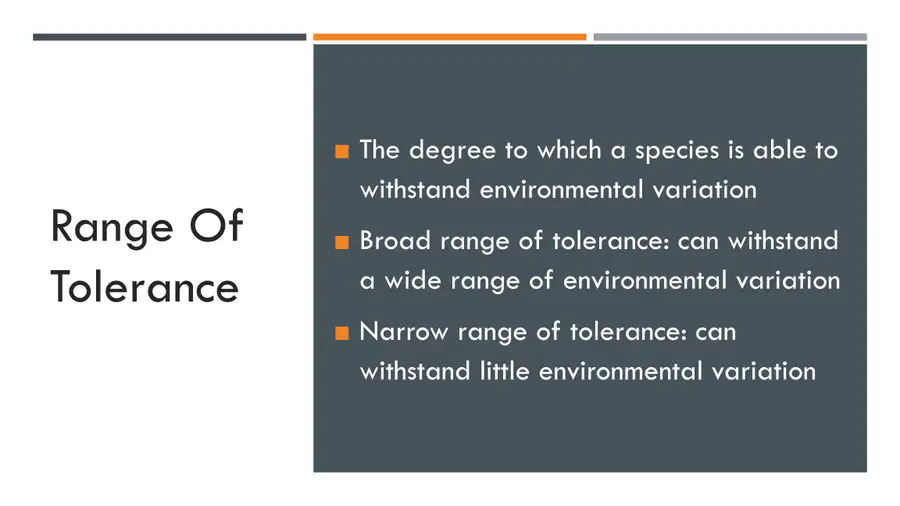
How might a species benefit from having a broad range of tolerance to environmental variation?
4
Multiple Choice
Why is it important for organisms to interact with their environments?
Because it helps them survive and adapt to changes
Because it makes them more visible to predators
Because it reduces their chances of reproduction
Because it increases competition among species
5
6
Multiple Choice
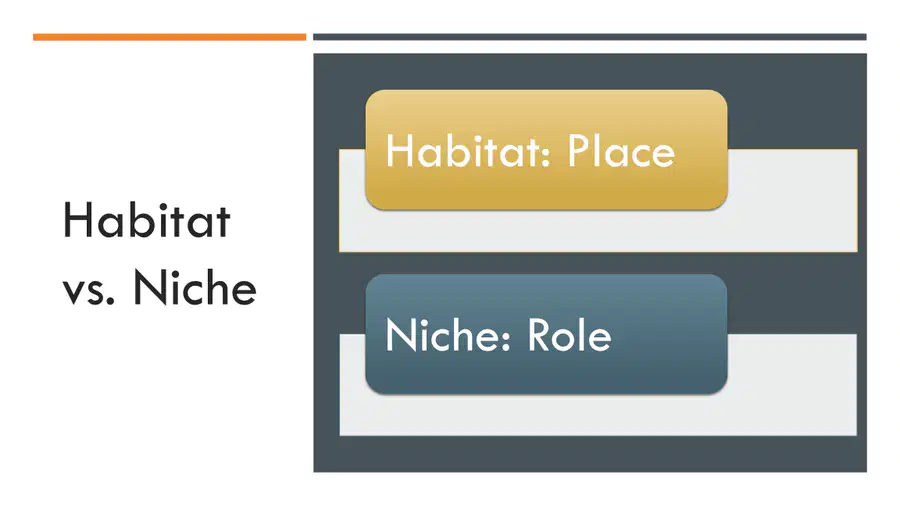
Which of the following best describes the difference between a habitat and a niche?
Habitat is the place an organism lives; niche is the role it plays in its environment.
Habitat is the role an organism plays; niche is the place it lives.
Habitat and niche mean the same thing.
Habitat is only for animals; niche is only for plants.
7
8
Open Ended
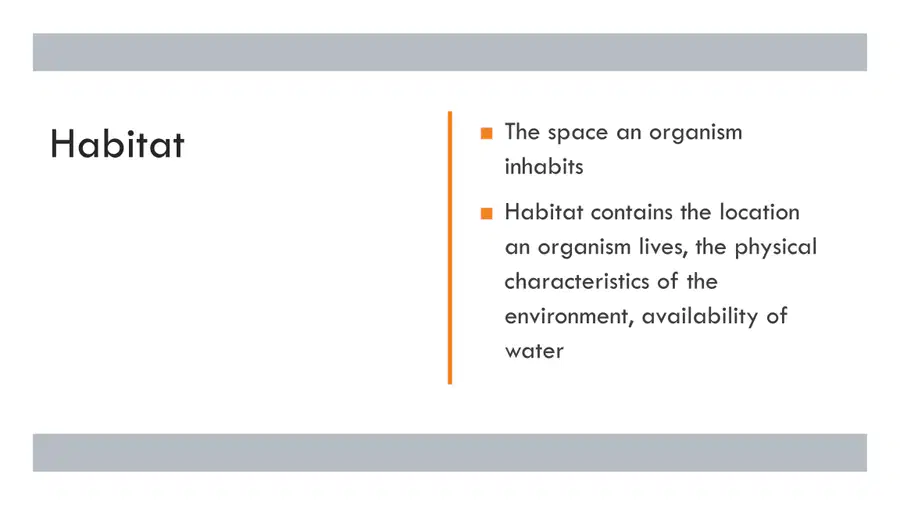
Explain how the physical characteristics of a habitat can influence the organisms that live there.
9
10
Multiple Select
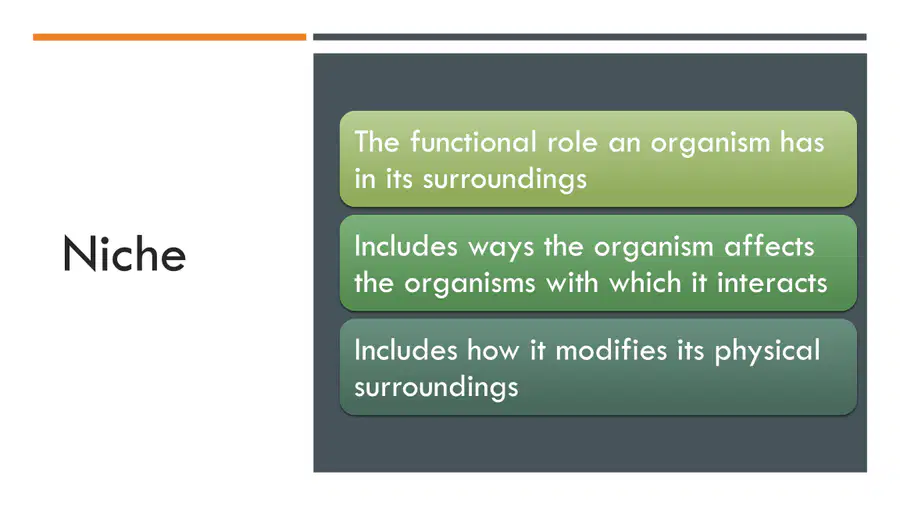
Which of the following are aspects of an organism's niche?
The functional role it has in its surroundings
The location where it lives
Ways it affects other organisms
How it modifies its physical surroundings
11
Multiple Choice
Which of the following is a habitat?
Meadow/Forest
Bee pollinating flowers
Beaver building dam
All of the above
None of the above
12
13
Fill in the Blanks
14
Open Ended
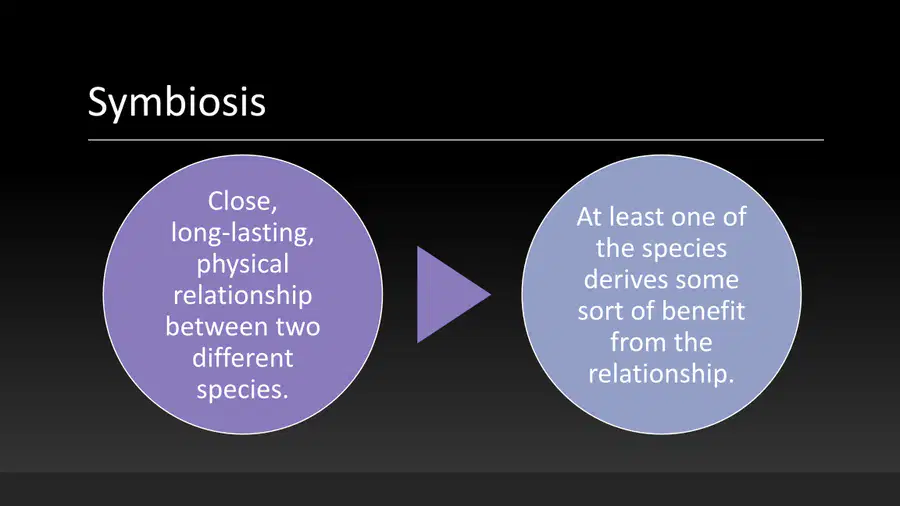
What is symbiosis?
15
16
17
Multiple Choice
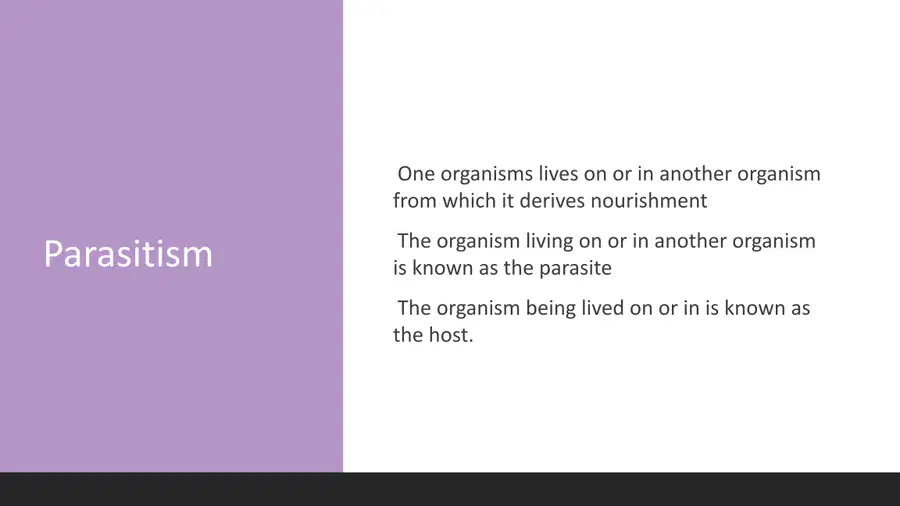
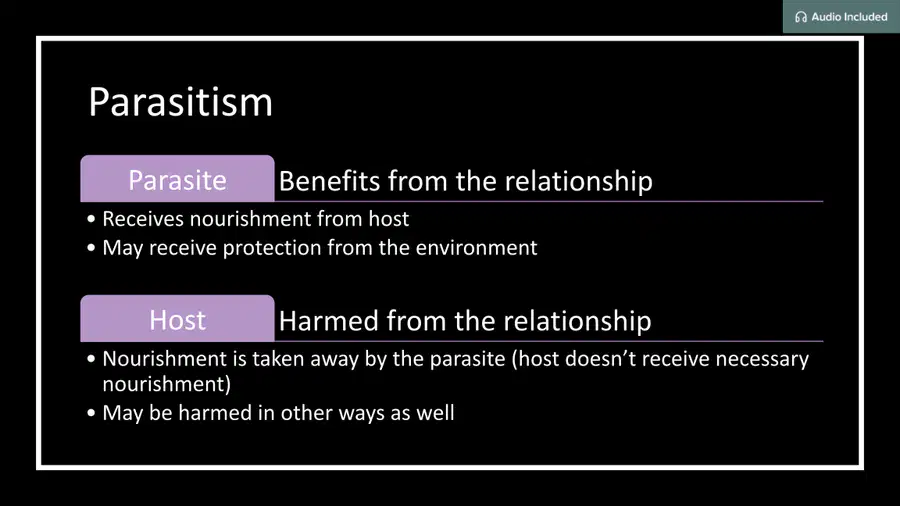
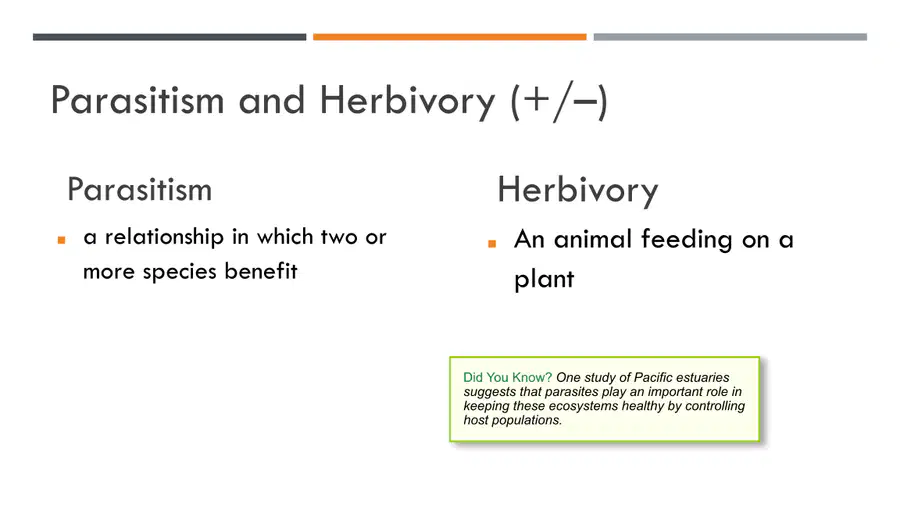
Which of the following best describes the difference between a parasite and a host in a parasitic relationship?
The parasite benefits while the host is harmed.
Both the parasite and host benefit equally.
The host benefits while the parasite is harmed.
Neither the parasite nor the host is affected.
18
19
Multiple Select
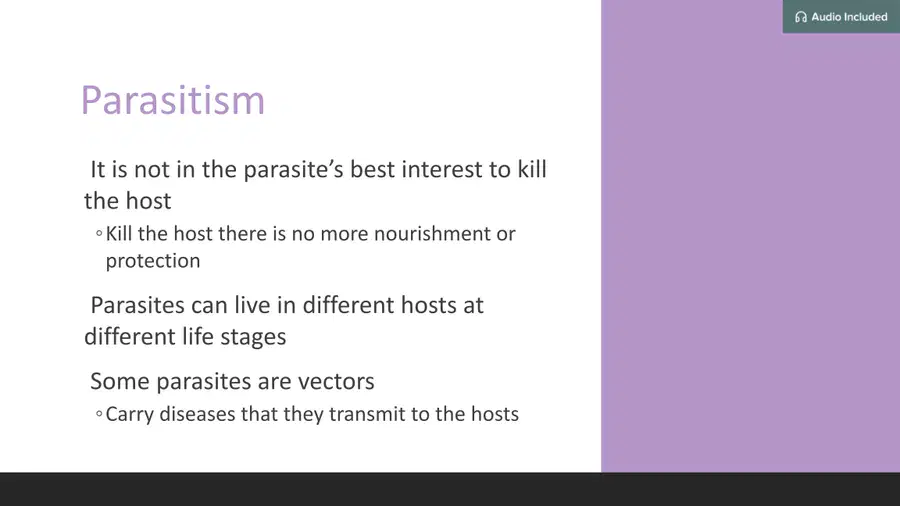
Which of the following statements about parasites is/are correct? There may be more than one answer.
Parasites can live in different hosts at different life stages.
All parasites kill their hosts.
Some parasites act as vectors for diseases.
Parasites always benefit the host.
20
Open Ended
Explain why it is not in the parasite’s best interest to kill its host.
21
22
Fill in the Blanks
23
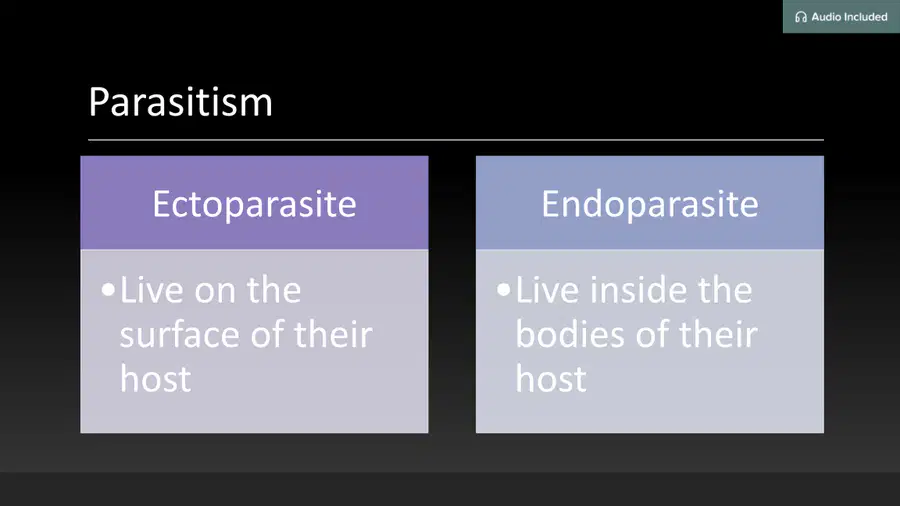
Hotspot
Tapeworm and Dogfish Shark: A tapeworm lives in the intestines of a dogfish shark and takes nutrients from the shark. As a result, the shark is weakened and more vulnerable to disease and predators.
24
25
Hotspot
Anemone Hermit Crab and Anemones: The crab attaches several anemones to its shell using them as camouflage and as a deterrent to potential predators. The anemones have a "mobile home" and get more exposure to food than if they remained stationary.
26

27
Match
Ticks will feed on deer's blood and harm the deer.
Wrasse fish feed on the parasites found on the black sea bass's body. The wrasse fish gets a meal and the black sea bass is helped by the removal of the parasites.
Hermit crabs live in shells made and then abandoned by snails.
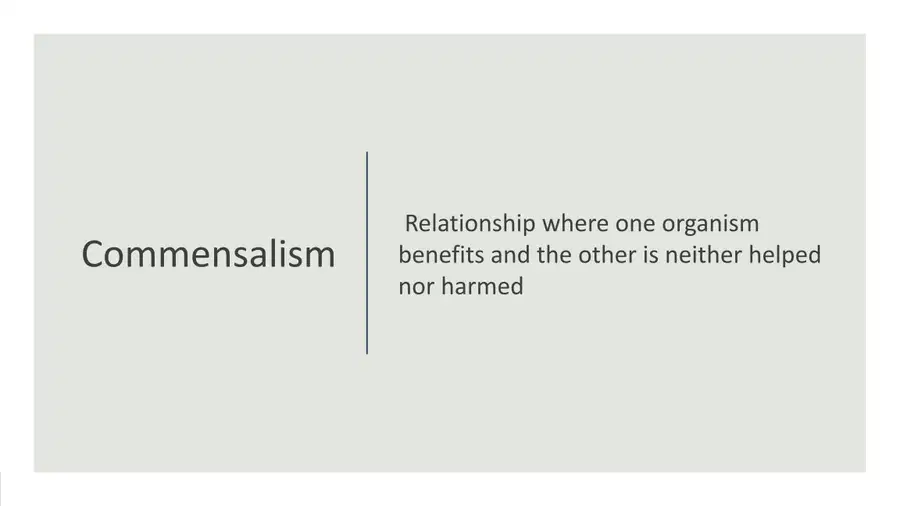
parasitism
mutualism
commensalism
parasitism
mutualism
commensalism
28
Labelling
Label the correct relationship.
Mutualism
Commensalism
Parasitism
29
Match

Match the following
mutualism
commensalism
parasitism
competition
+/+
+/0
+/-
-/-
+/+
+/0
+/-
-/-
30
Hotspot
Mosquitos and Humans: Mosquitoes find a human and feast upon their blood. This causes a small reaction on the human's skin, resulting in a red, itchy bump. In addition, mosquitoes can pass along diseases to their human host.
31
Hotspot
Maribou Stork and Bees: The stork uses its saw-like bill to cut up the dead animals it eats. As a result, the dead animal carcass is accessible to bees for food and egg-laying.
32
33
Multiple Choice
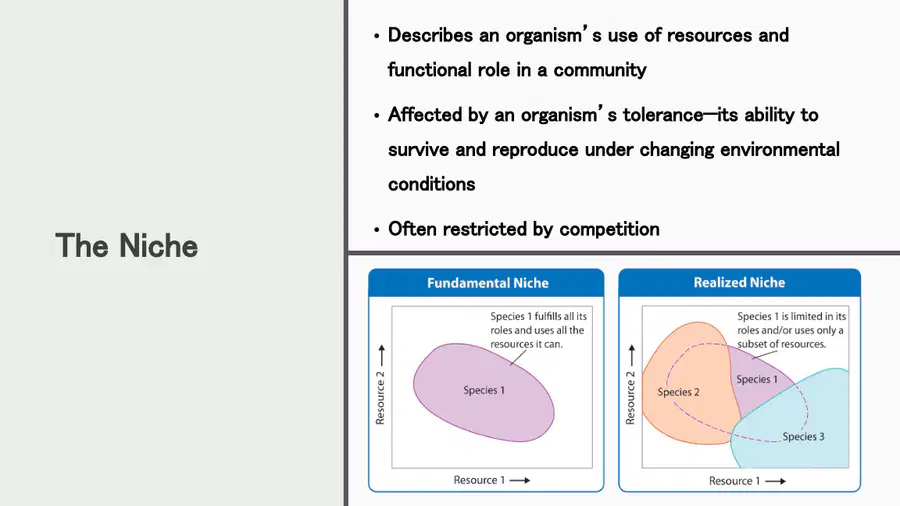
Which of the following best describes the difference between a fundamental niche and a realized niche?
A fundamental niche is the set of resources a species could potentially use, while a realized niche is the set of resources it actually uses due to competition.
A realized niche is the set of resources a species could potentially use, while a fundamental niche is the set of resources it actually uses.
A fundamental niche is always smaller than a realized niche.
A realized niche is unaffected by competition.
34
Multiple Choice
What type of niche are organisms more likely to live in?
Functional Niche
Realized Niche
35
36
Open Ended
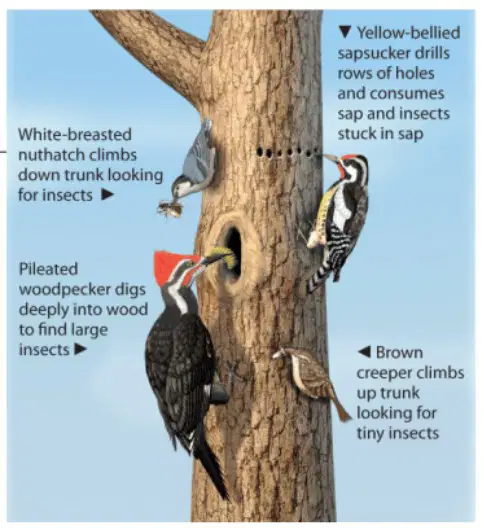
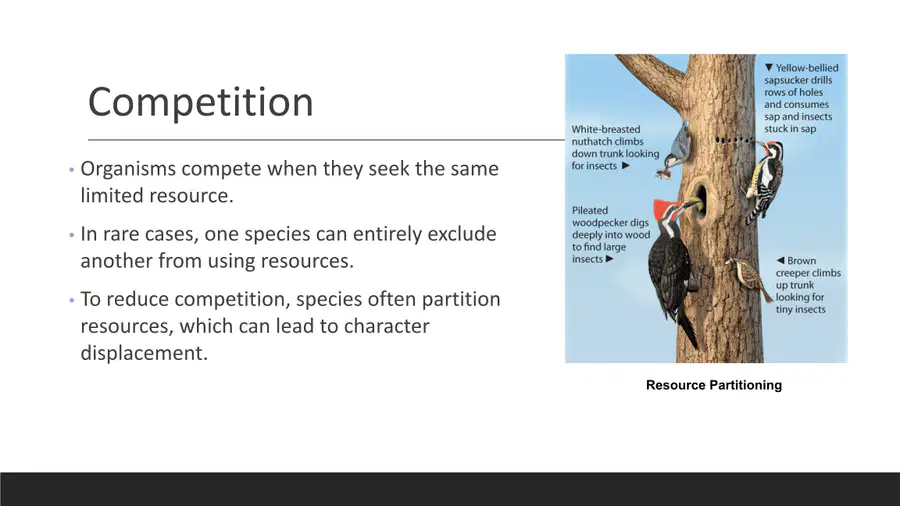
Explain how resource partitioning can reduce competition among species, using the example of the woodpeckers shown in the image.
37
38
Fill in the Blanks
39
Multiple Select
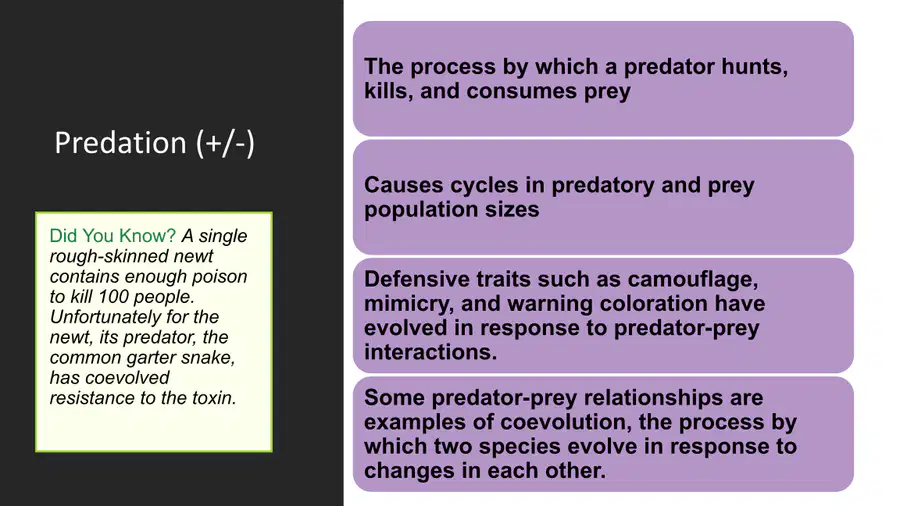
Which of the following are defensive traits that have evolved in response to predator-prey interactions?
Camouflage
Mimicry
Warning coloration
Resource partitioning
40
41

42
Fill in the Blanks
43
Match

Match the following:
Symbiosis
Mutualism
Parasitism
Commensalism
Predation
Interaction between 2 different organisms living in close physical association
Relationship between 2 organisms where both species benefit
Relationship between 2 organisms where one species benefits and the other is harmed (not killed)
Relationship between 2 organisms where one species benefits and the other is not affected
A relationship in which one organism consumes another for food
Interaction between 2 different organisms living in close physical association
Relationship between 2 organisms where both species benefit
Relationship between 2 organisms where one species benefits and the other is harmed (not killed)
Relationship between 2 organisms where one species benefits and the other is not affected
A relationship in which one organism consumes another for food
Show answer
Auto Play
Slide 1 / 43
SLIDE
Similar Resources on Wayground

42 questions
Biomolecule terms 2 - Enzymes
Presentation
•
9th - 12th Grade
38 questions
Cellular Transport
Presentation
•
8th - 12th Grade
35 questions
Ch 11 Forests and Forest Management
Presentation
•
9th - 11th Grade
35 questions
Biomolecule terms Part 1
Presentation
•
9th - 12th Grade
35 questions
The Scientific Method Notes Check
Presentation
•
9th - 12th Grade
40 questions
Gravity, Mass and Weight
Presentation
•
9th Grade - University
41 questions
EOC Practice 2
Presentation
•
9th - 12th Grade
37 questions
Newton's 3 Laws of Motion and Momentum
Presentation
•
9th - 12th Grade
Popular Resources on Wayground
10 questions
HCS SCI 03 Summer School Assessment 1

Quiz
•
3rd Grade
15 questions
HCS SCI 05 Summer School Assessment 1 Review
Quiz
•
5th Grade
22 questions
Day 9 Equations and Inequalities Review
Quiz
•
9th Grade
10 questions
Writing and Identifying Ratios Practice
Quiz
•
5th - 6th Grade
7 questions
PYRAMID PERSPECTIVES part 1
Presentation
•
9th - 12th Grade
12 questions
Understanding the Fourth of July
Quiz
•
9th Grade
15 questions
Soccer World Cup Quiz Questions
Quiz
•
7th Grade