

Poisson Process 1

Presentation
•
Mathematics
•
University
•
Practice Problem
•
Medium

Noha Youssef
Used 2+ times
FREE Resource
22 Slides • 24 Questions
1
2
3
Multiple Choice
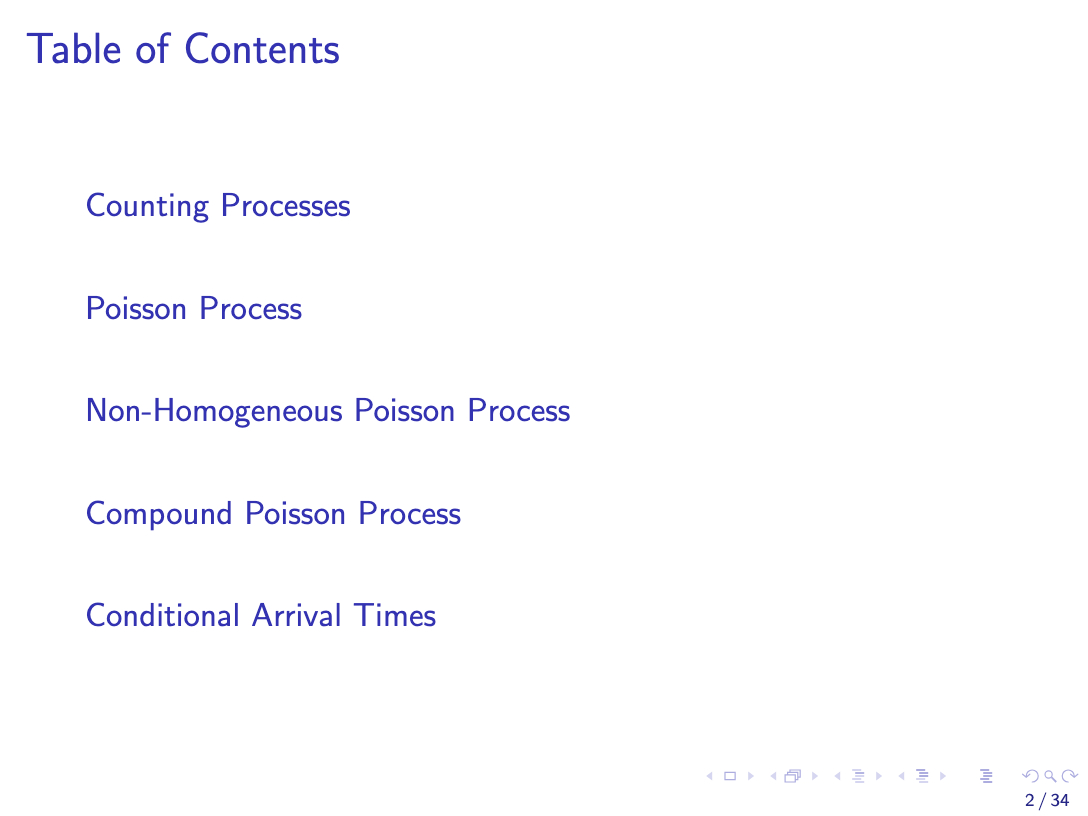
Which of the following topics is most closely related to predicting the number of events occurring in a fixed period of time?
Counting Processes
Compound Poisson Process
Conditional Arrival Times
Non-Homogeneous Poisson Process
4
Open Ended
Why do you think understanding Poisson processes is important in real-world applications?
5
6
Multiple Choice
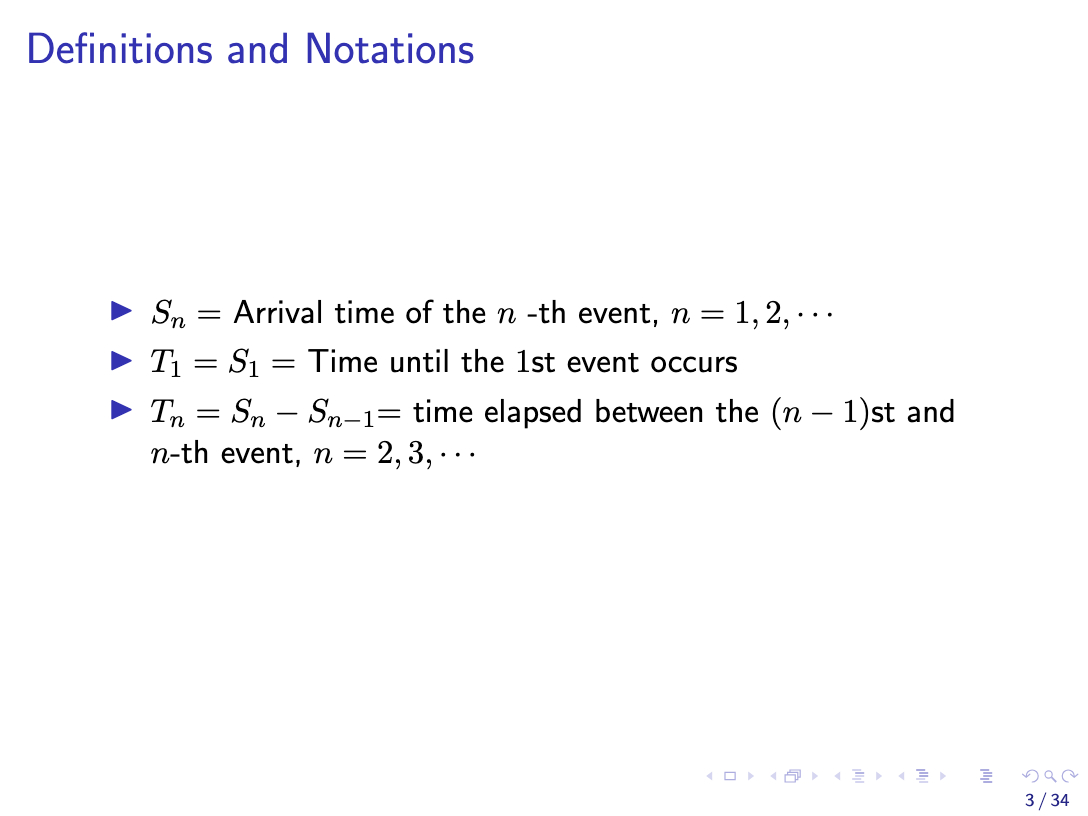
Which of the following best describes the meaning of T_n in the context of event arrivals?
The total number of events that have occurred by time n.
The time elapsed between the (n-1)st and n-th event.
The arrival time of the n-th event.
The rate of event arrivals.
7
8
Open Ended
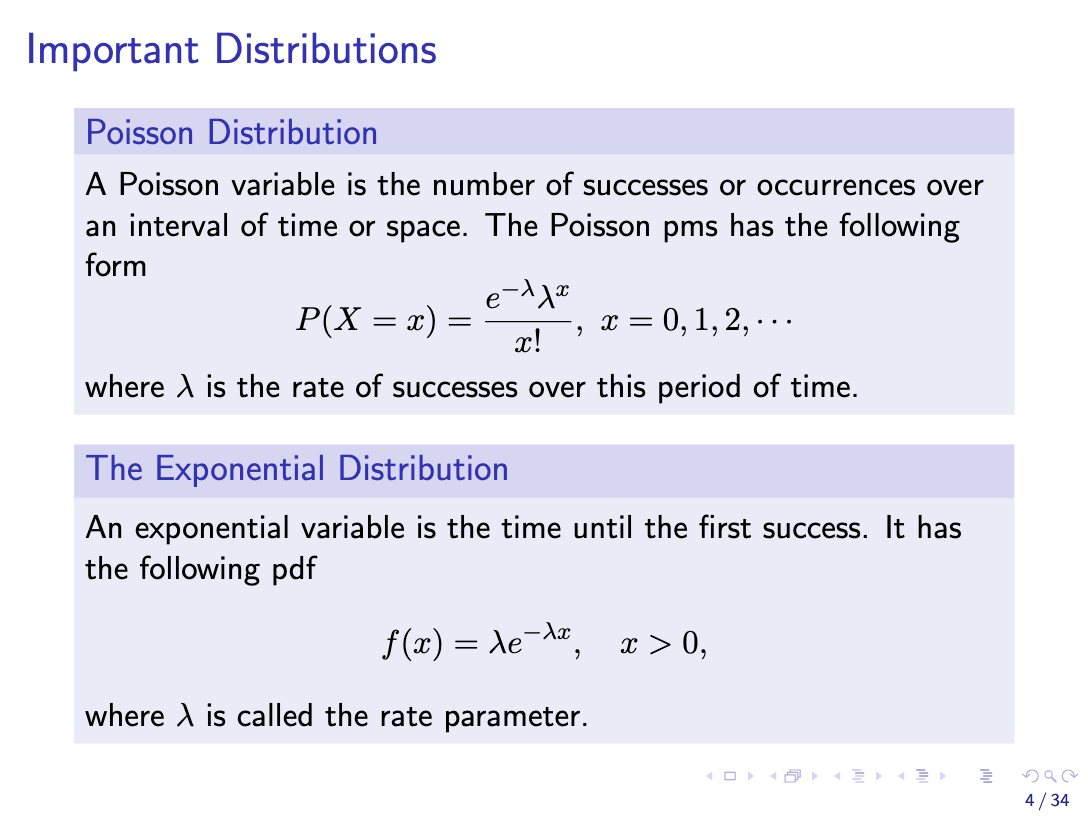
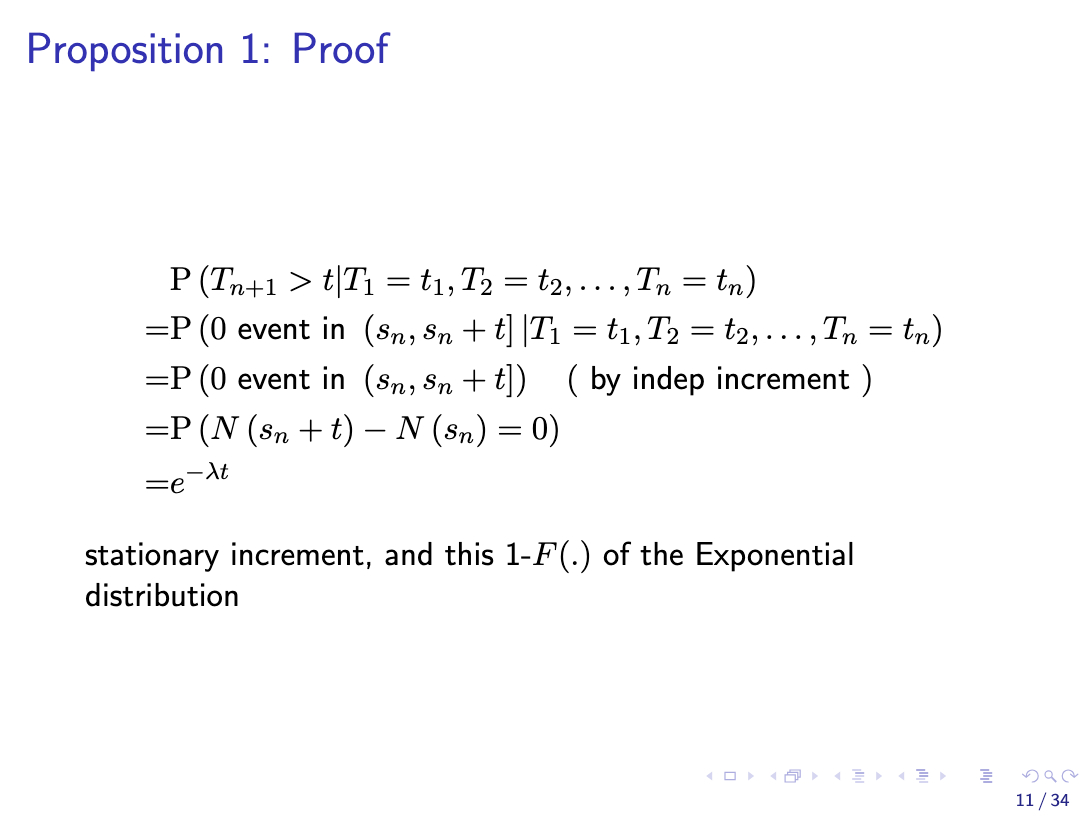
Explain how the Poisson and Exponential distributions are related in the context of event arrivals.
9
10
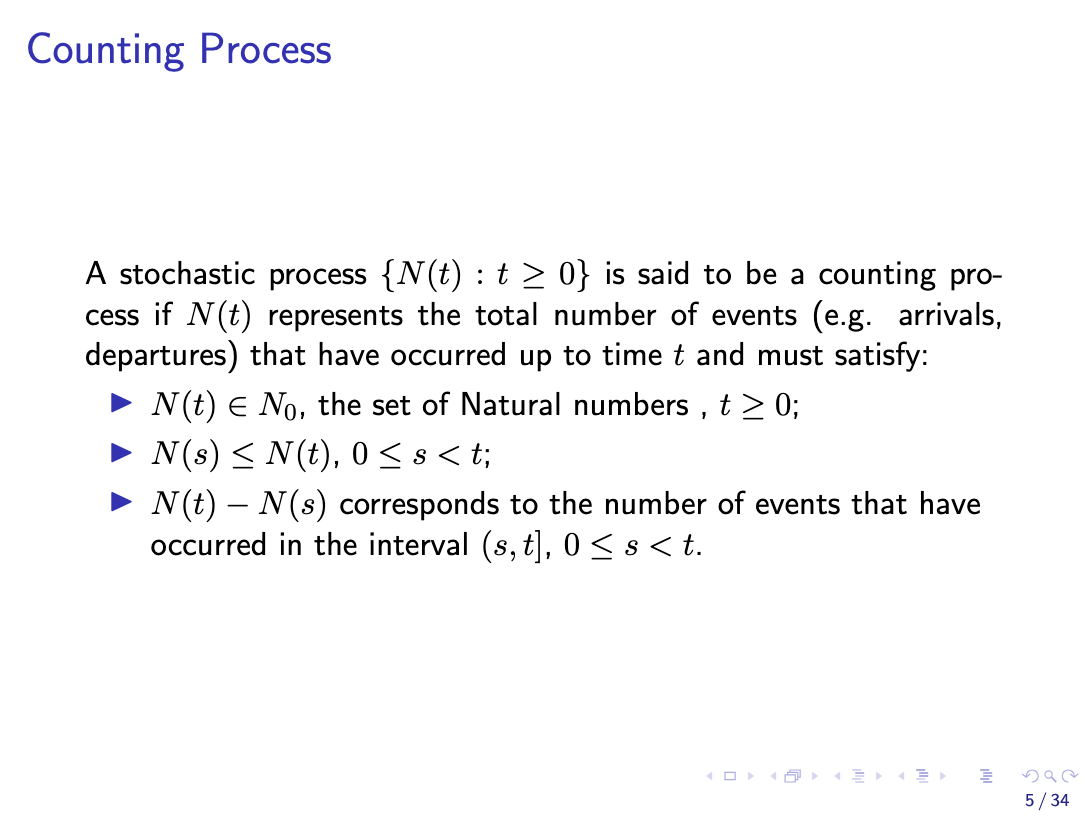
Multiple Choice
Which of the following conditions must be satisfied for a process {N(t): t ≥ 0} to be considered a counting process?
N(t) is always negative.
N(s) ≥ N(t) for all 0 ≤ s < t.
N(t) ∈ N_0, N(s) ≤ N(t) for 0 ≤ s < t, and N(t) - N(s) counts events in (s, t].
N(t) is a continuous variable.
11
12
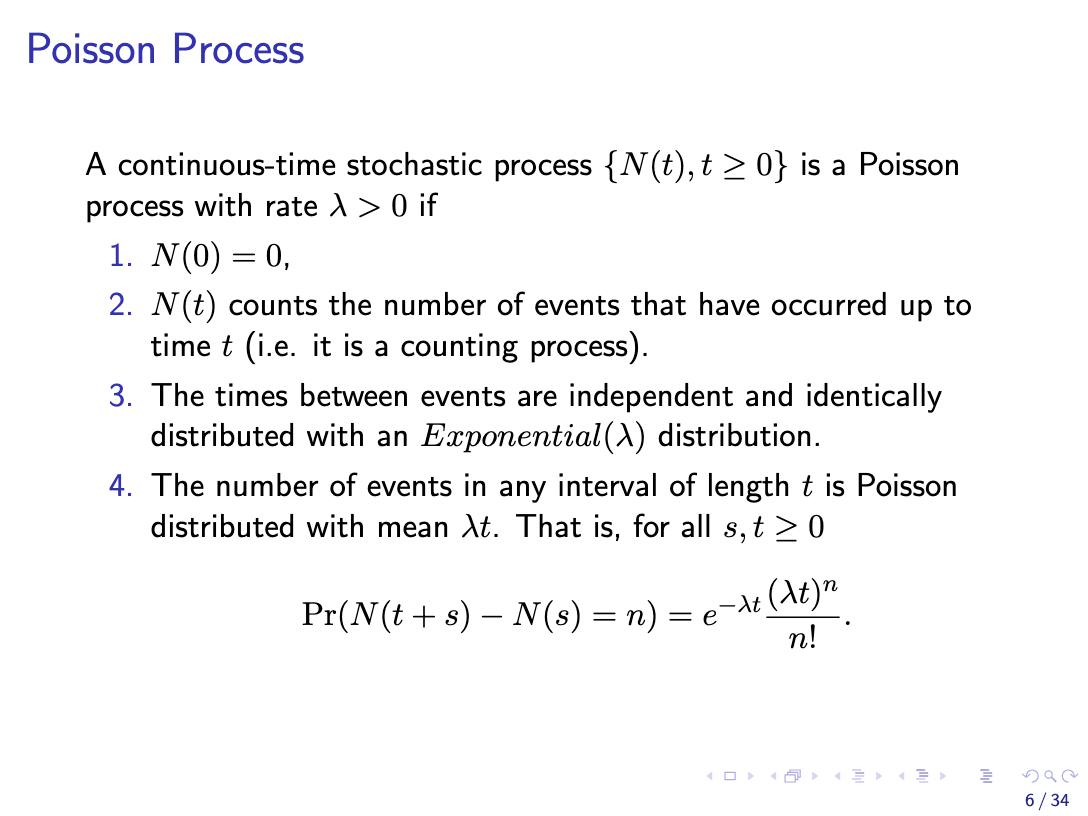
Fill in the Blanks
Type answer...
13
14
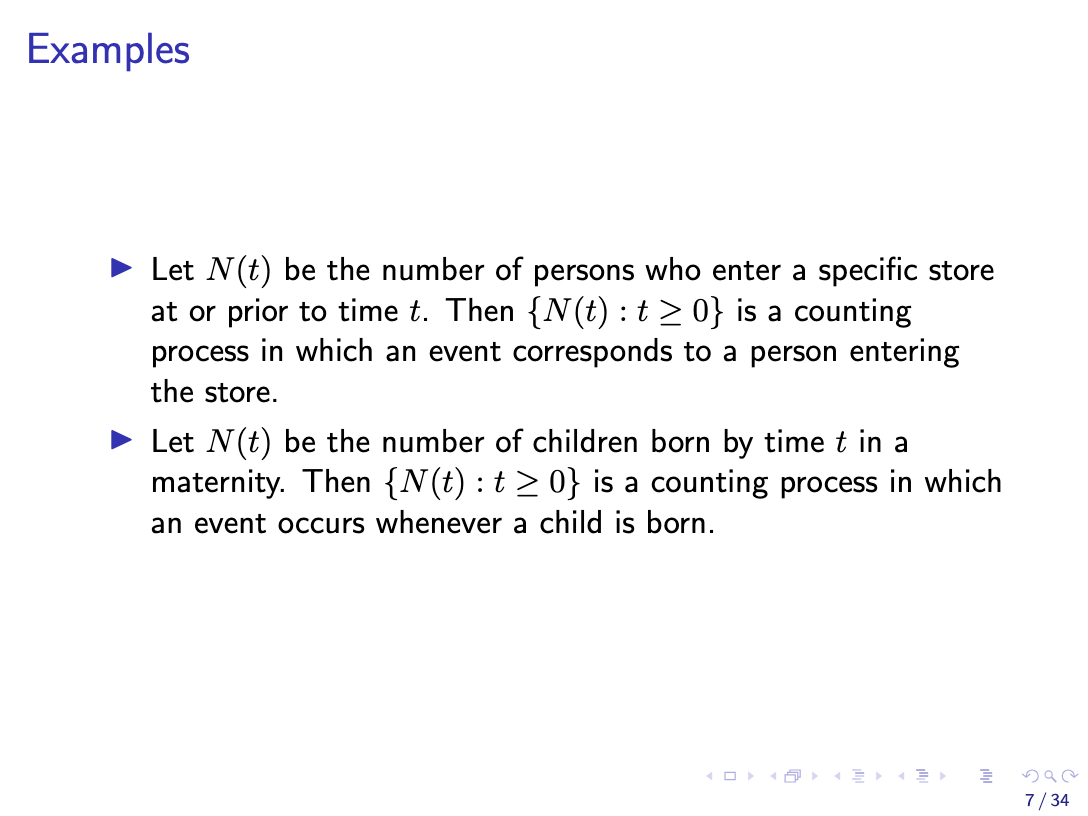
Open Ended
Describe a real-world scenario that can be modeled as a Poisson process. Justify your choice based on the properties of the process.
15
16
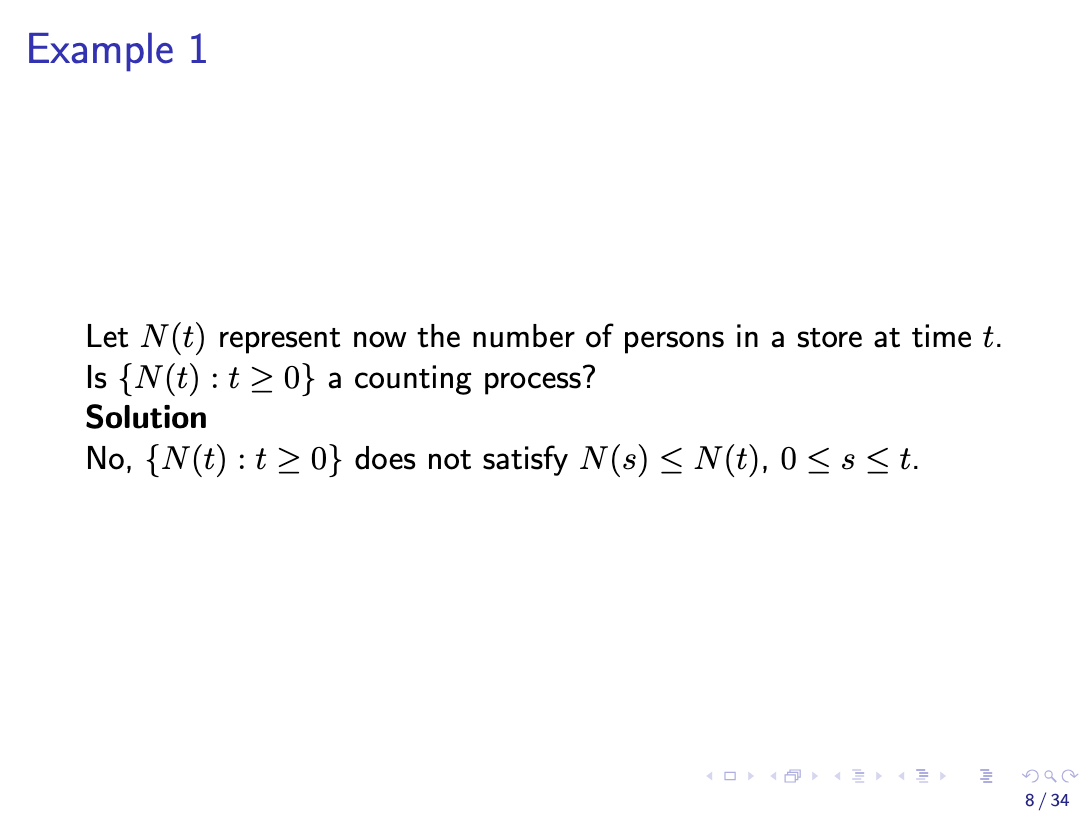
Multiple Choice
Is {N(t): t ≥ 0} a counting process if N(t) represents the number of persons in a store at time t? Why or why not?
Yes, because it counts the total number of persons who have ever entered.
No, because it does not satisfy N(s) ≤ N(t) for 0 ≤ s ≤ t.
Yes, because it is always a non-negative integer.
No, because it is not a stochastic process.
17
18
Open Ended
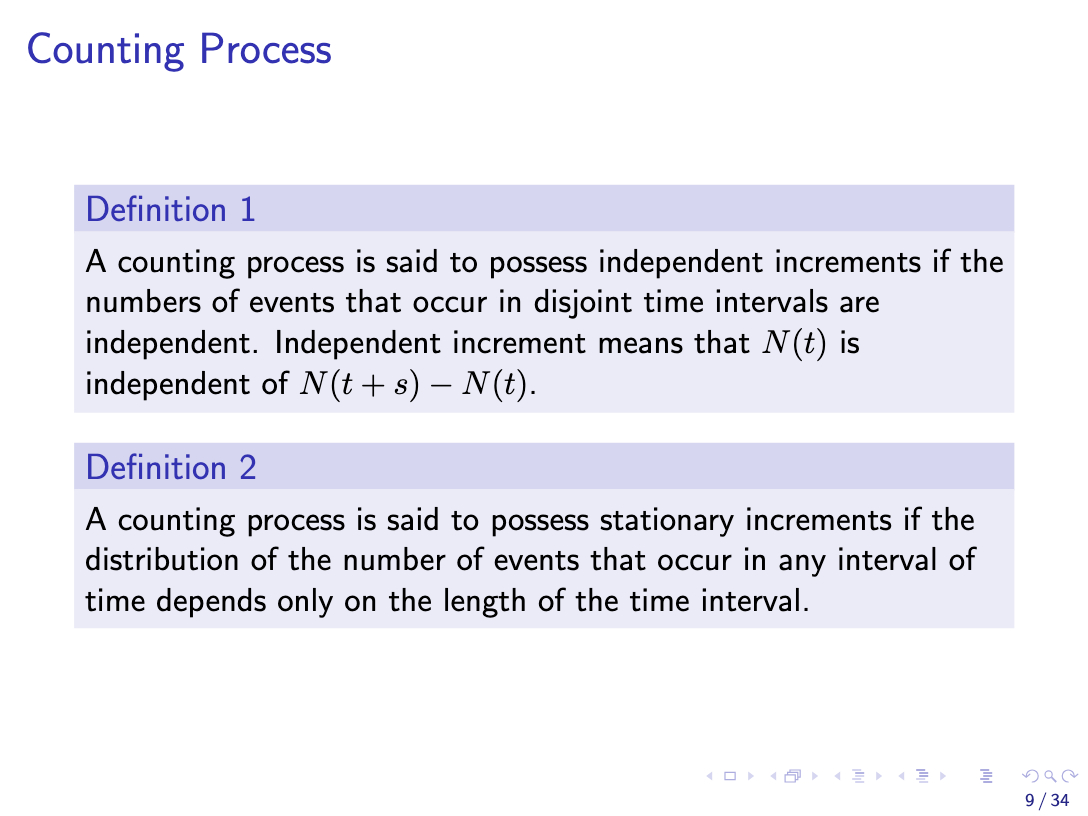
Explain the difference between independent increments and stationary increments in the context of counting processes.
19
Multiple Choice
Which property of a counting process states that the number of events occurring in disjoint time intervals are independent?
Stationary increments
Independent increments
Renewal property
Memoryless property
20
21
Multiple Choice
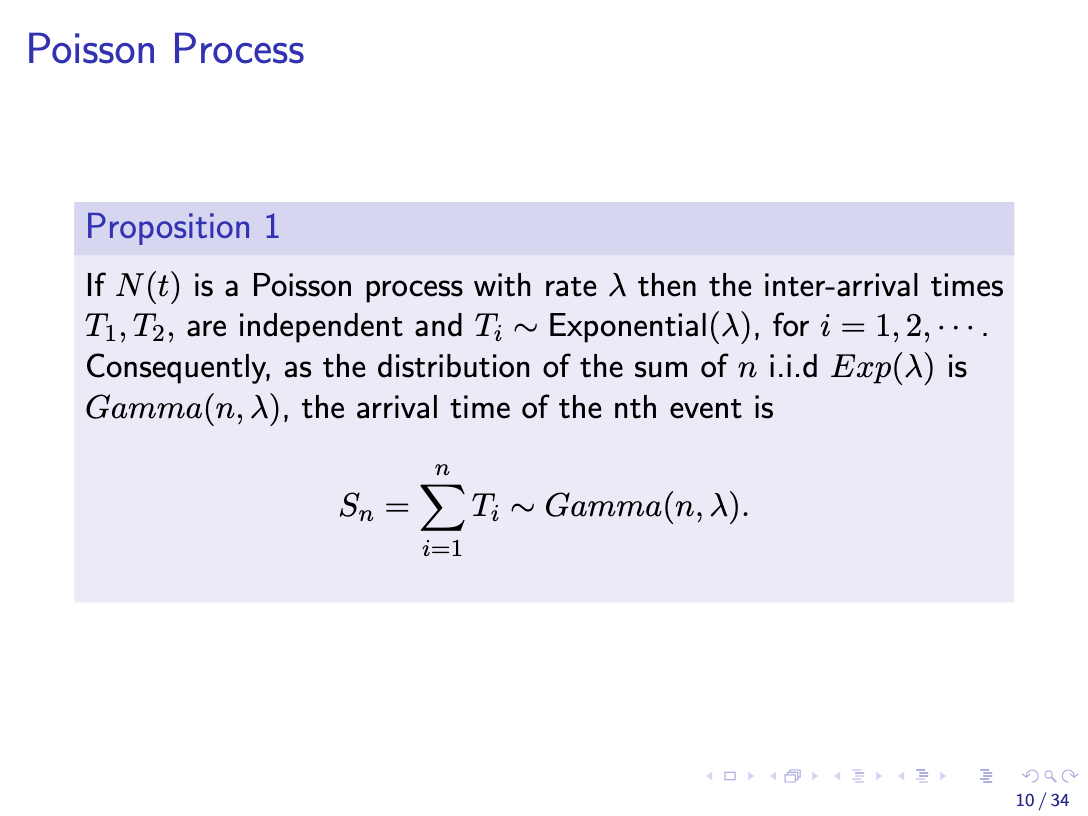
If N(t) is a Poisson process with rate λ, what is the distribution of the sum of n i.i.d Exp(λ) random variables?
Poisson(n, λ)
Gamma(n, λ)
Exponential(nλ)
Binomial(n, λ)
22
23
Fill in the Blanks
Type answer...
24
25
26
Open Ended
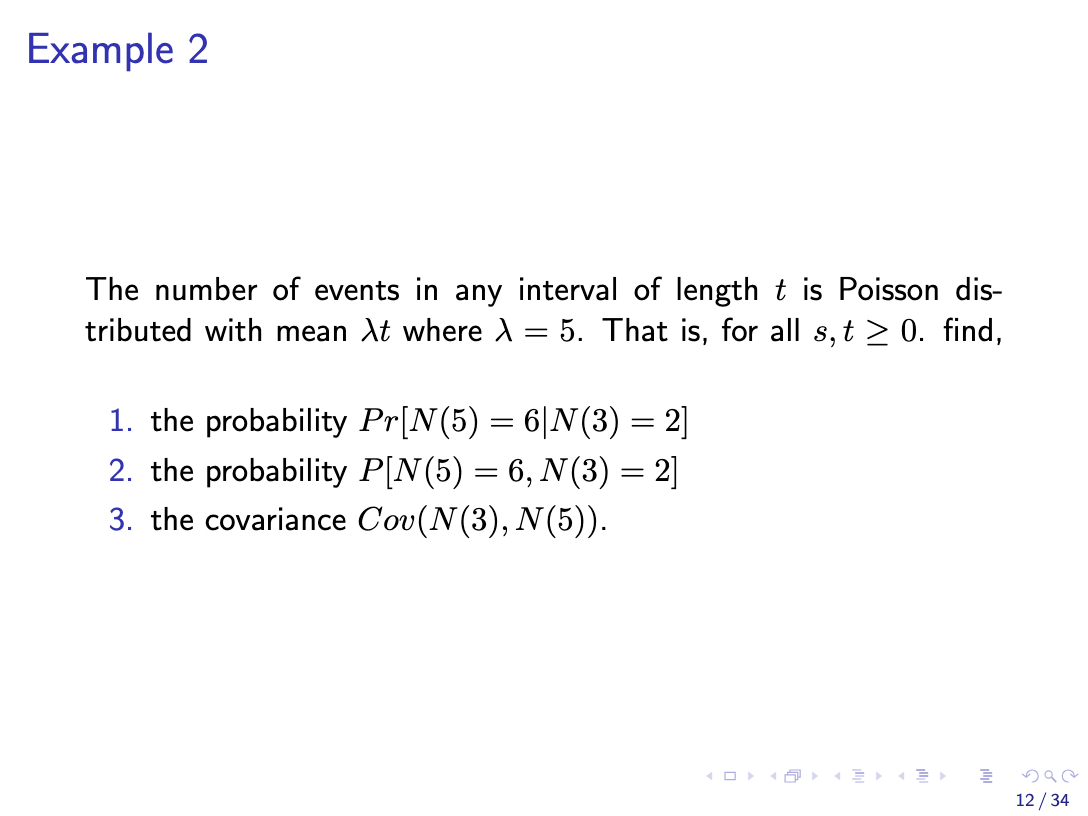
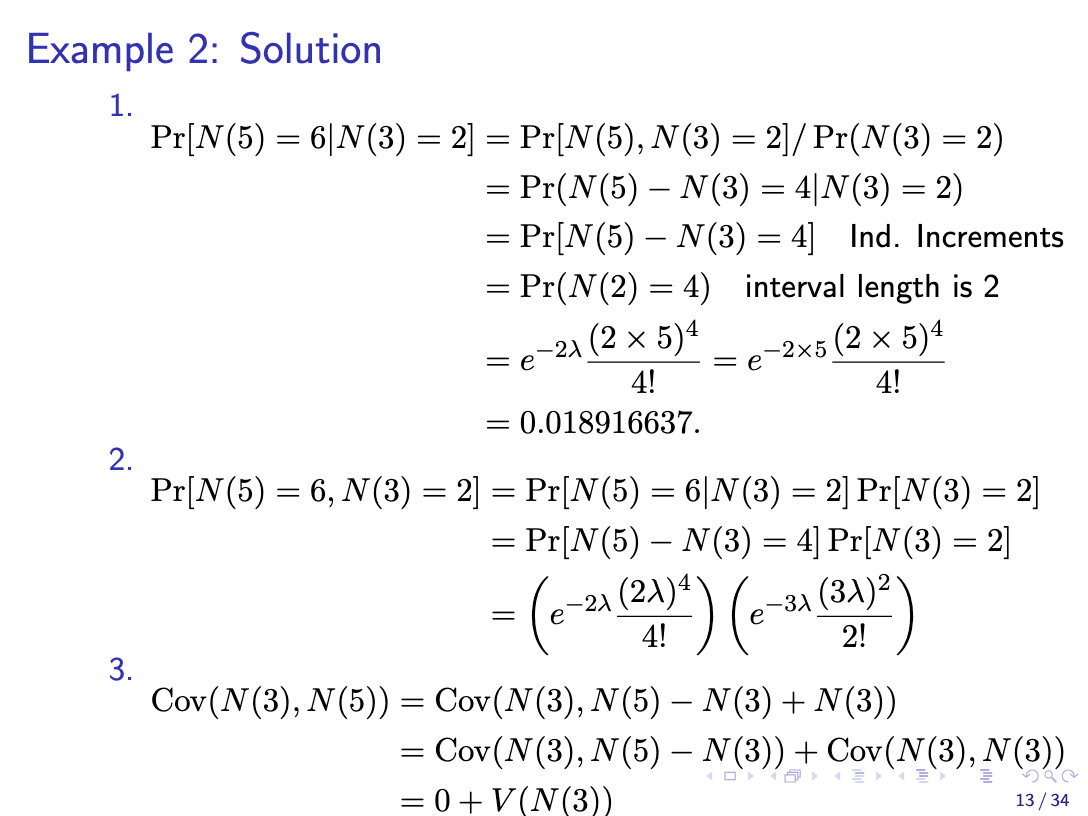
What is the covariance Cov(N(3), N(5)) for a Poisson process with rate λ?
27
28
Multiple Choice
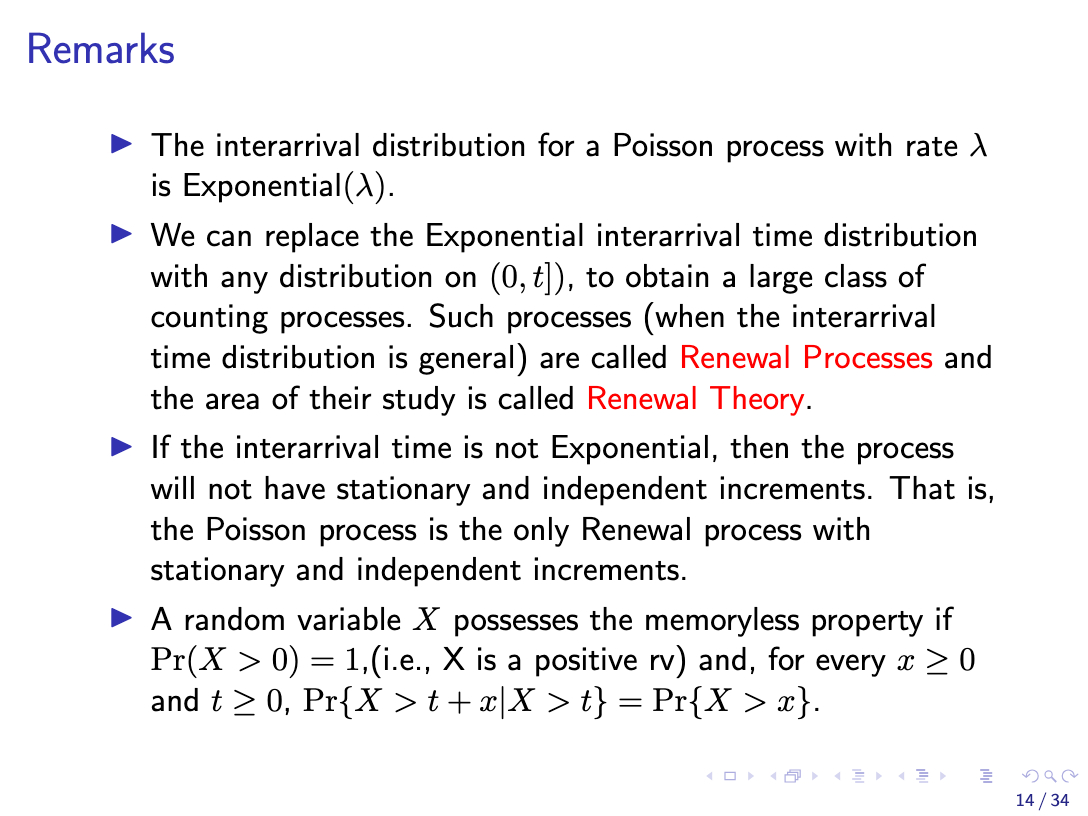
Which of the following statements about Renewal Processes is correct?
Renewal processes always have exponential interarrival times.
Poisson process is the only renewal process with stationary and independent increments.
Renewal theory only studies Poisson processes.
All renewal processes have the memoryless property.
29
30
Multiple Choice
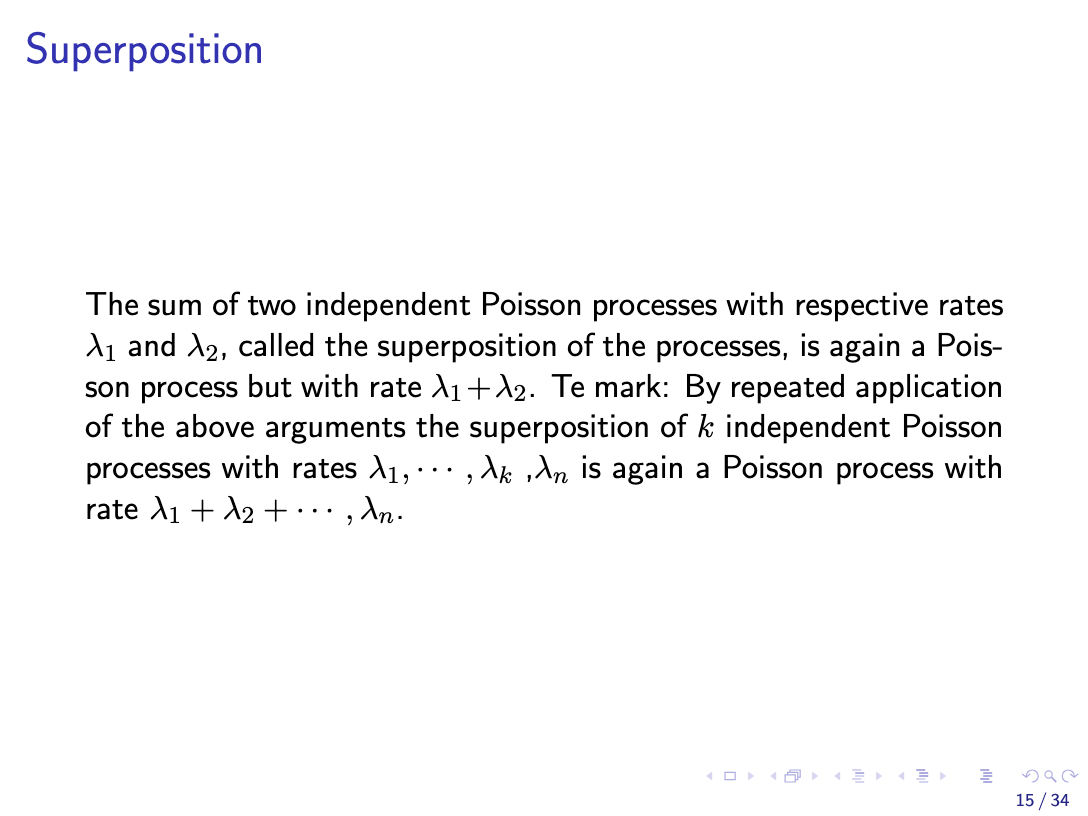
Which property allows the superposition of independent Poisson processes to result in another Poisson process?
Stationarity
Independent increments
Memorylessness
All of the above
31
32
33
Multiple Select
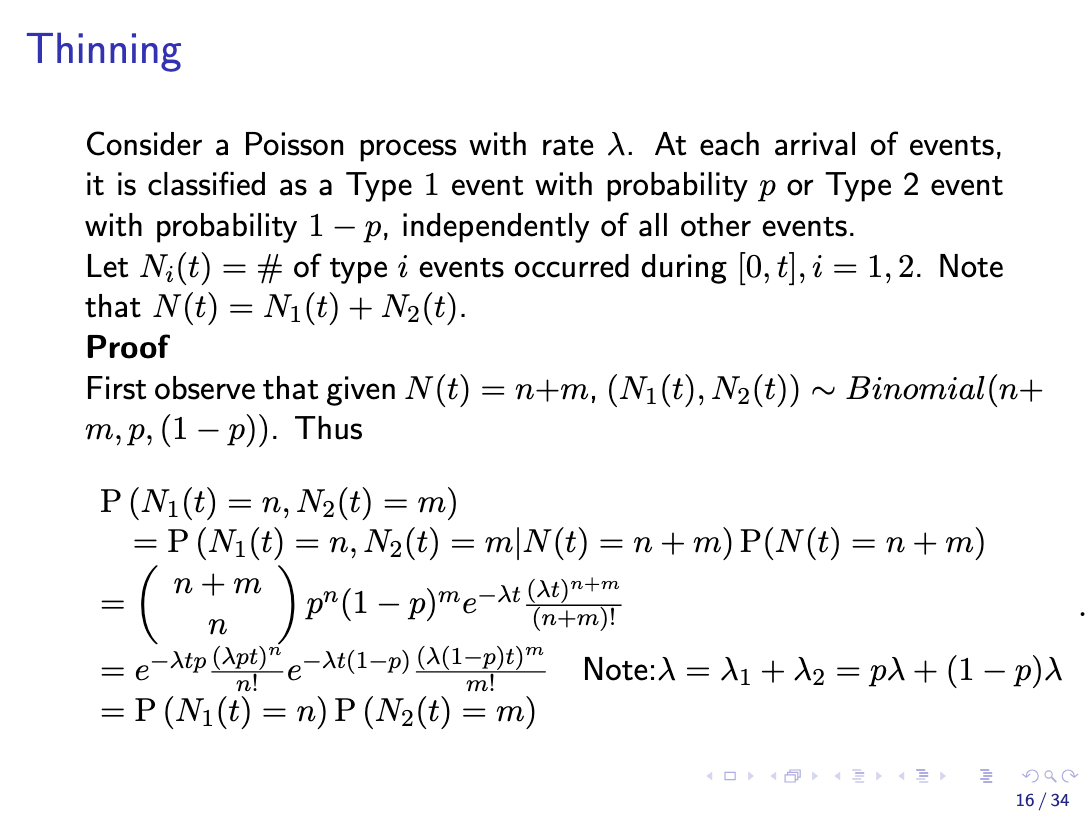
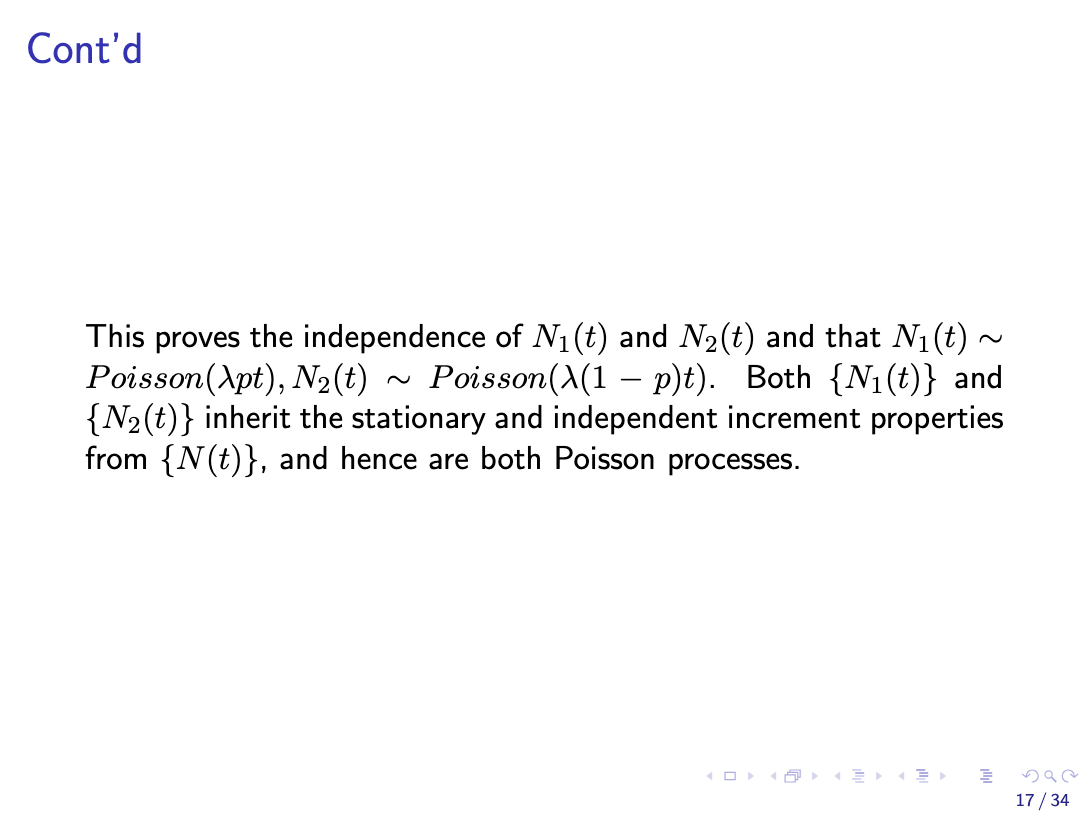
Which of the following statements about the thinning of a Poisson process are correct?
The thinned processes are dependent.
The thinned processes have rates λp and λ(1-p).
The thinned processes inherit stationary and independent increment properties.
Both b and c
34
Open Ended
Explain how the thinning of a Poisson process leads to two independent Poisson processes. What are the rates of these processes?
35
36
Multiple Choice
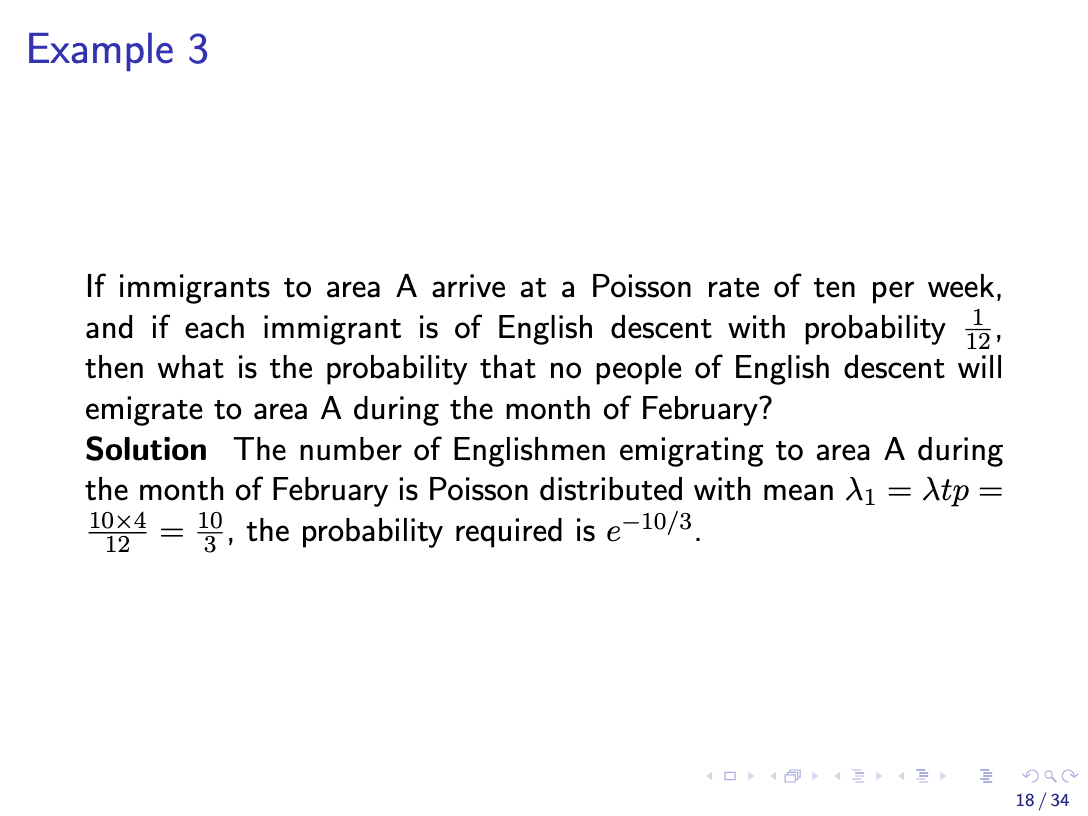
If immigrants arrive at a Poisson rate of ten per week and the probability that each is of English descent is 1/12, what is the probability that no people of English descent will emigrate to area A during the month of February?
e^{-10/3}
e^{-40}
e^{-10}
e^{-1/3}
37
38
Multiple Choice
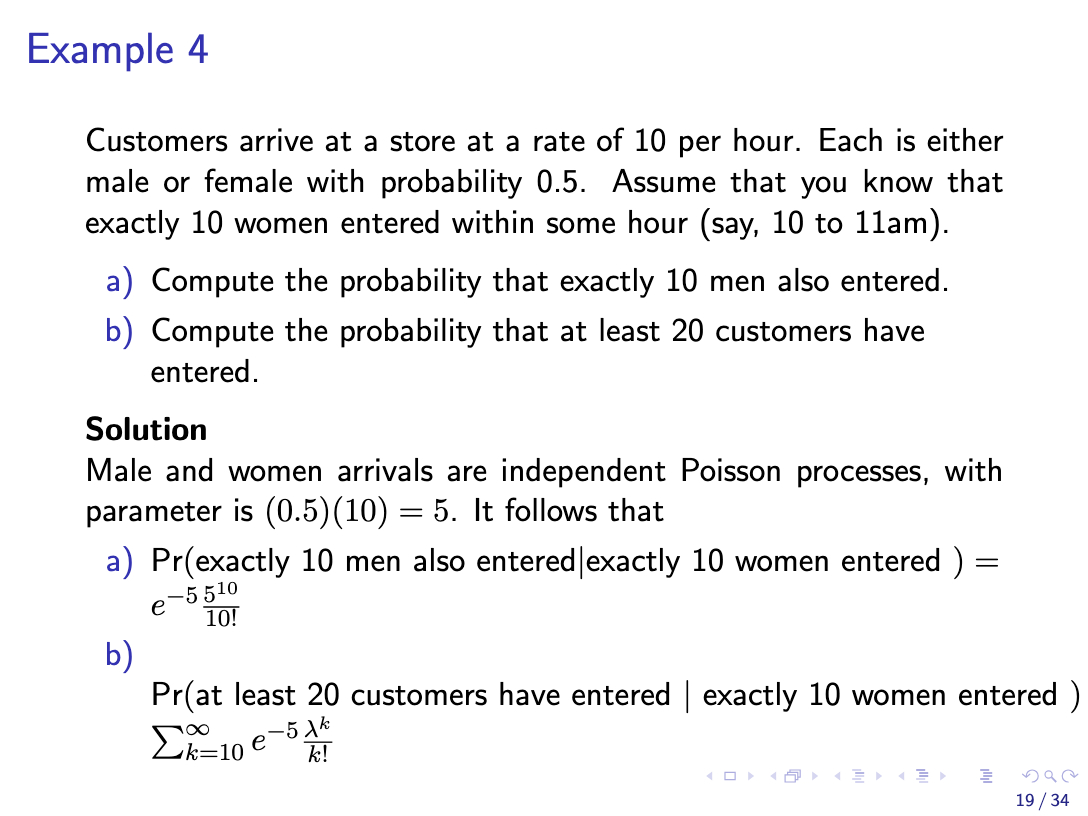
Customers arrive at a store at a rate of 10 per hour. Each is either male or female with probability 0.5. If exactly 10 women entered within some hour, what is the probability that exactly 10 men also entered?
e^{-5} 5^{10}/10!
e^{-10} 10^{5}/5!
e^{-5} 10^{5}/5!
e^{-10} 5^{10}/10!
39
40
Fill in the Blanks
Type answer...
41
42
Multiple Choice
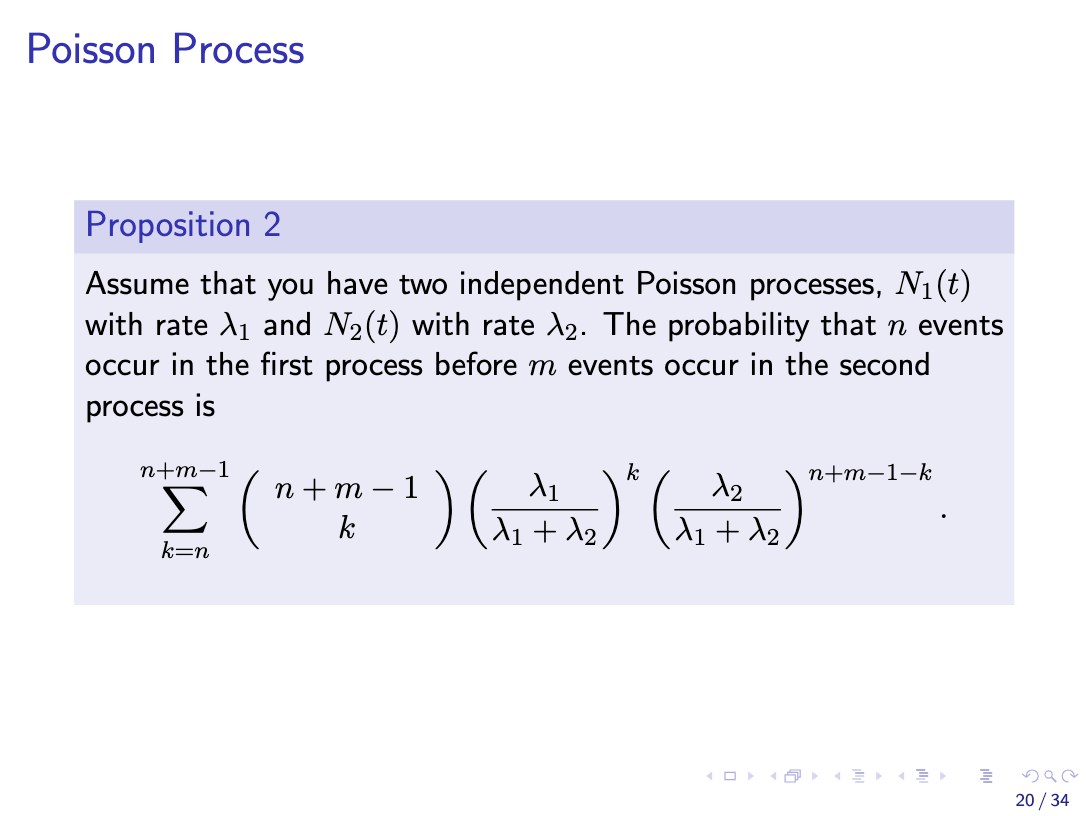
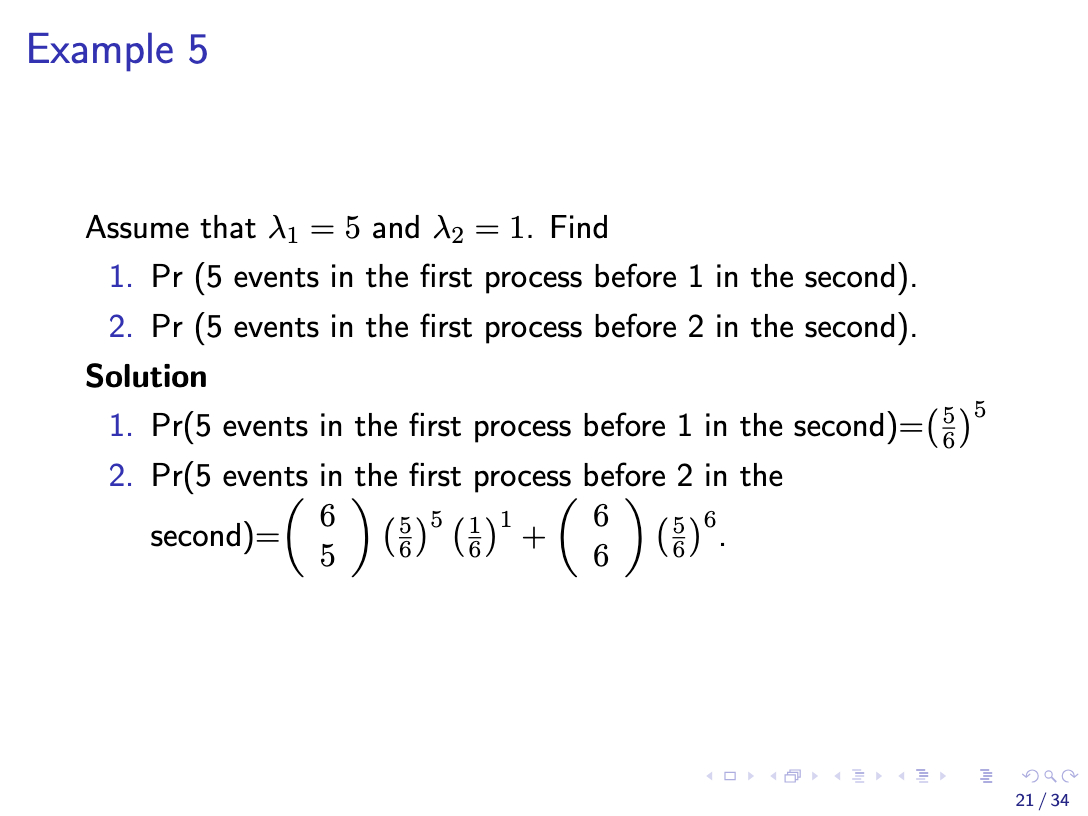
Given two Poisson processes with rates λ₁ = 5 and λ₂ = 1, what is the probability that 5 events in the first process occur before 2 events in the second process?
(6 choose 5) * (5/6)^5 * (1/6)^1 + (6 choose 6) * (5/6)^6
(5/6)^5
(1/6)^5
(5/6)^2
43
44
Open Ended
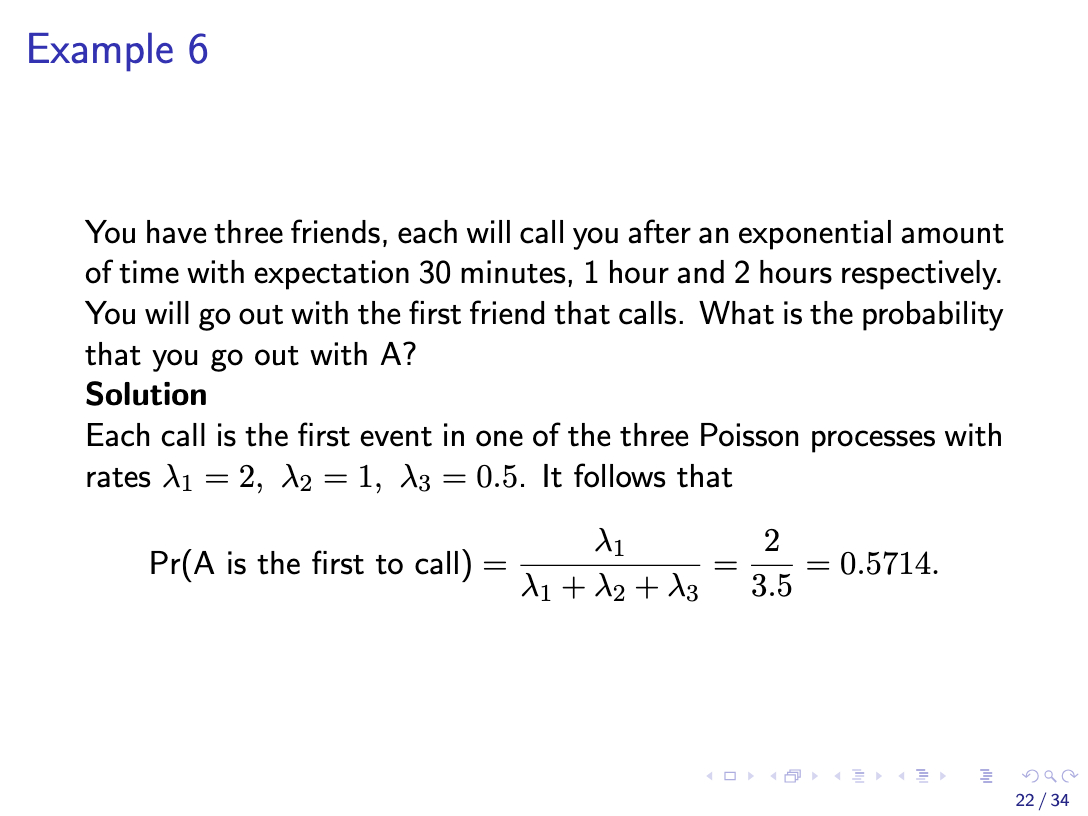
Explain how the probability that a specific friend is the first to call can be determined using Poisson processes. What factors influence this probability?
45
Open Ended
Reflecting on the session about Poisson Processes, what is one question you still have or one concept you would like to understand better?
46
Multiple Choice
Which topic from today's lesson on Poisson Processes would you like to explore further or found most challenging?
Counting Processes
Poisson Process
Non-Homogeneous Poisson Process
Compound Poisson Process
Conditional Arrival Times
Show answer
Auto Play
Slide 1 / 46
SLIDE
Similar Resources on Wayground

42 questions
ECE 6 - MIDTERM
Presentation
•
University
40 questions
Chapter 6: SDLC
Presentation
•
University
38 questions
Práctica Jamovi 2022-03-04
Presentation
•
University
41 questions
L04 Equilibrium and Elasticity
Presentation
•
University
42 questions
Consumer Mathematics - Taxation
Presentation
•
12th Grade
41 questions
Lesson 7: Roots, Radicals, and Rational Exponents
Presentation
•
12th Grade
42 questions
Radical & Its Properties
Presentation
•
University
42 questions
Inequalities
Presentation
•
University
Popular Resources on Wayground
10 questions
HCS SCI 03 Summer School Assessment 1

Quiz
•
3rd Grade
15 questions
HCS SCI 05 Summer School Assessment 1 Review
Quiz
•
5th Grade
22 questions
Day 9 Equations and Inequalities Review
Quiz
•
9th Grade
10 questions
Writing and Identifying Ratios Practice
Quiz
•
5th - 6th Grade
7 questions
PYRAMID PERSPECTIVES part 1
Presentation
•
9th - 12th Grade
12 questions
Understanding the Fourth of July
Quiz
•
9th Grade
15 questions
Soccer World Cup Quiz Questions
Quiz
•
7th Grade